
Yes, there are sharks in Montenegro, around 19 species with solid records, and the ones near the beaches are small and harmless. On the rocky and sandy bottoms you might come across a small-spotted catshark, a nursehound, a common smooth-hound or a spurdog; the blue shark, shortfin mako, thresher and basking shark live over the deep water offshore, and the sandbar shark uses the Bay of Kotor as a nursery.
The SharkSider database holds three records for Montenegro, all near Budva: a shark that bit a fishing boat in 1914, a swimmer killed by a 6.5-metre white shark in 1955, and a doubtful 1987 death of a cliff-jumper at Mogren that has never been verified in local records. There has been no confirmed shark injury in the country for seventy years.
- Shark species recorded19 with solid records
- ProtectionBarcelona Convention species protected; first marine parks (Platamuni, Katič, Stari Ulcinj) 2021
- Most seen from the beachSmall-spotted catshark and smooth-hounds
- Signature encounterBlue sharks over the South Adriatic Pit; sandbar sharks in the Bay of Kotor
- Incidents in the database3 (1914–1987), 2 listed fatal, one doubtful
- Water temperature13–14 °C in February, 25–27 °C in August

On this page
- Where sharks live in Montenegrin waters
- List of the different types of sharks in Montenegro
- Where to see sharks in Montenegro
- Best time of year to see sharks in Montenegro
- Shark attacks in Montenegro: what the record actually shows
- Is it safe to swim and snorkel in Montenegro?
- Shark conservation in Montenegro
- Sharks in neighbouring waters
- Frequently asked questions
- References
Where sharks live in Montenegrin waters
The Adriatic is a long, narrow, mostly shallow sea, and its sharks are concentrated where the water gets deep. That happens in the south, and Montenegro sits right on top of it. The South Adriatic Pit, a basin more than 1,200 m deep between Bar and the heel of Italy, is the only true deep water in the whole Adriatic, and it is where the sea's pelagic and deep-water sharks live: blue sharks, shortfin makos and threshers at the surface and mid-water, bluntnose sixgills, kitefin sharks and velvet belly lanternsharks on the slope. Fishermen from Bar and Ulcinj working swordfish and tuna longlines over the pit have always known these animals; the country's shark list is largely their catch record.
Inshore, the coast has three different habitats. The Bay of Kotor (Boka Kotorska) is a drowned river valley, deep, sheltered and rich, that functions as a nursery: juvenile sandbar sharks are recorded in its inner basins, and smooth-hounds and catsharks live along its steep rocky sides. The rocky Budva riviera, from Herceg Novi to Petrovac, has clear water over reefs and seagrass where catsharks and nursehounds rest by day and where the country's few historical incidents happened. The Ulcinj coast in the south is completely different: 13 km of sand at Velika Plaža and the muddy delta of the Bojana river, a low-salinity, plankton-rich shallow that suits smooth-hounds, spurdogs and young sandbar sharks and that occasionally brings a basking shark close to the beach in spring.
The water itself is Mediterranean in every sense. It falls to 13–14 °C in February and climbs to 25–27 °C in August, salinity is high, and the eastern Adriatic current carries warm Ionian water north along this coast. That explains both the presence of warm-temperate species such as the sandbar shark and the smooth hammerhead and the absence of the tropical requiem sharks, which never enter the Adriatic. It also explains the great white: the Adriatic has a genuine, if thin, history of white shark records, most of them from the deep southern and central basins, and Montenegro's 1955 case is one of them.
List of the different types of sharks in Montenegro
The table lists every shark with a solid record from Montenegrin waters. Roughly 30 shark species are known from the Adriatic as a whole; the ones below are those with landings, survey records or verified sightings on the Montenegrin side of the sea, and a few, such as the angelshark, are omitted because they have effectively vanished from the Adriatic. Sizes are realistic adult lengths. The risk column is about a swimmer at a Montenegrin beach; for most of these species, which live at depth or far offshore, it is theoretical. Montenegrins call sharks ajkule, the small bottom species mačke (cats), and the smooth-hounds sold in markets pas, dog.
| Species | Adult size | Risk to swimmers | Where in Montenegro & notes |
|---|---|---|---|
Blue SharkPrionace glauca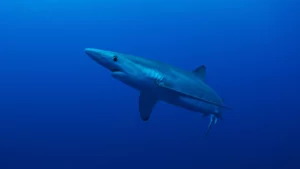 | 2–3 m (7–10 ft) | Low | Open water over the South Adriatic Pit; swordfish longline bycatchThe most frequently caught large shark off Bar and Ulcinj. Slender and deep blue; almost never seen from the shore. |
Shortfin Mako SharkIsurus oxyrinchus | 2–3 m (7–10 ft) | Moderate | Offshore with tuna and swordfish in summerFast and powerful, dangerous mostly to anglers handling one at the boat. Endangered in the Mediterranean and CITES-listed. |
Great White SharkCarcharodon carcharias | 4–6 m (13–20 ft) | High | Rare visitor to the deep southern AdriaticRecorded in the 1955 Budva fatality as a 6.5 m animal. Genuinely present in the Adriatic but now seen perhaps once a decade; critically endangered in the Mediterranean. |
Common Thresher SharkAlopias vulpinus | 3–5 m (10–16 ft) incl. tail | Low | Offshore; occasionally landed at BarHalf of its length is tail, used to whip sardines. Timid with people. |
Basking SharkCetorhinus maximus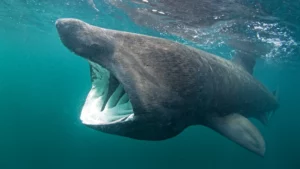 | 6–9 m (20–30 ft) | Low | Surface waters off Ulcinj and Bar in springA plankton feeder with no teeth worth the name. A few Montenegrin sightings, all in April and May; protected. |
Porbeagle SharkLamna nasus | 1.5–2.5 m (5–8 ft) | Low | Cool offshore water in winter; rareA stocky cold-water shark that is critically endangered in the Mediterranean and fully protected. Very few Adriatic records in recent decades. |
Sandbar SharkCarcharhinus plumbeus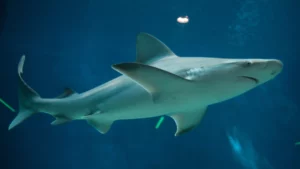 | 1.5–2 m (5–7 ft) | Low | Bay of Kotor and the Bojana delta shallows, where juveniles nurseThe only requiem shark with a real Montenegrin population. Placid, bottom-oriented; no Adriatic bite on record. |
Smooth Hammerhead SharkSphyrna zygaena | 2.5–3.5 m (8–12 ft) | Moderate | Warm offshore water in late summer; rareThe only hammerhead in the Adriatic. Once regular, now a rare summer visitor; critically endangered in the Mediterranean. |
Bluntnose Sixgill SharkHexanchus griseus | 3–4.5 m (10–15 ft) | Low | Deep slope of the South Adriatic Pit, below 300 mA big, slow deep-water shark occasionally hooked on deep longlines. Harmless; never near beaches. |
| Spiny Dogfish (Spurdog)Squalus acanthias | 0.8–1.2 m (2.5–4 ft) | Low | Shelf bottoms in winter and spring; trawl catchA small schooling shark whose two dorsal spines carry a weak venom. Sold in markets. |
| Longnose SpurdogSqualus blainville | 0.7–1 m (2.3–3.3 ft) | Low | Deeper shelf and slope, 100–500 mThe spurdog's Mediterranean cousin, more common than the spiny dogfish in the southern Adriatic trawl catch. |
Common Smooth-houndMustelus mustelus | 1–1.5 m (3–5 ft) | Low | Sandy bottoms off Ulcinj and in the Bay of KotorA flat-toothed crab and shellfish eater, sold as pas. Timid and fast; the shark most often netted inshore. |
| Blackspotted Smooth-houndMustelus punctulatus | 1–1.3 m (3–4 ft) | Low | Same sandy and muddy grounds as the common smooth-houndDistinguished by small black spots along the back. Both smooth-hounds are landed together and rarely told apart. |
Tope (School Shark)Galeorhinus galeus | 1.2–1.8 m (4–6 ft) | Low | Shelf edge; occasional in netsA slim hound shark, critically endangered globally and protected under the Barcelona Convention. Harmless. |
Small-spotted CatsharkScyliorhinus canicula | 0.6–0.9 m (2–3 ft) | Low | Rocky reefs and sand from the Bay of Kotor to UlcinjThe shark divers and snorkellers actually see, resting on the bottom by day. Locally mačka. |
| NursehoundScyliorhinus stellaris | 1–1.4 m (3–4.5 ft) | Low | Caves and ledges on rocky coasts: Katič, Platamuni, BokaA larger, boldly spotted catshark that lays egg cases in seagrass. Harmless. |
Blackmouth CatsharkGaleus melastomus | 0.5–0.7 m (1.6–2.3 ft) | Low | Slope of the South Adriatic Pit, 200–800 mOne of the commonest fish in deep Adriatic trawls. Never near the surface. |
Angular RoughsharkOxynotus centrina | 0.6–1 m (2–3.3 ft) | Low | Muddy slope bottoms, 100–600 mA strange, high-backed, sail-finned deep shark. Critically endangered in the Mediterranean; protected. |
Velvet Belly LanternsharkEtmopterus spinax | 0.35–0.45 m (1.1–1.5 ft) | Low | Deep water of the pit, 300–1,000 mA bioluminescent dwarf shark, abundant in deep trawls. Entirely harmless. |
Tiger SharkGaleocerdo cuvier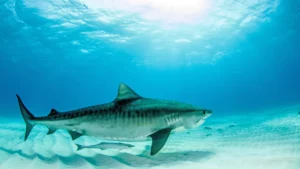 | 3–4.5 m (10–15 ft) | n/a | Not recorded in the AdriaticListed only because it is often asked about. A tropical species; no Adriatic record exists. |
Two sharks in the previous version of this page deserve a correction. The old text said there had been “no great white sightings near Montenegro”; that is contradicted by the site's own database, which records a 6.5 m white shark in the 1955 Budva fatality, and by the wider Adriatic record, which includes dozens of verified white shark captures and sightings from Croatia and Italy over the past century. The great white is rare here, perhaps one report a decade in the southern Adriatic, but it is real. On the other hand, the tiger shark and the bull shark do not occur anywhere in the Adriatic, and neither do reef sharks, hammerheads other than the smooth hammerhead, or the oceanic whitetip. The old table's sizes were also record maxima rather than typical adults; the sixgill, for example, was listed at 15–18 feet when the adults caught in the Adriatic are mostly 3–4 m.
Where to see sharks in Montenegro
Montenegro has no shark-diving industry and no reliable place to see a large shark. What it has are a few marine reserves, a deep offshore pit and a bay that sharks use as a nursery. These are the places with the best records.
- Bay of Kotor (Boka Kotorska)A UNESCO-listed fjord-like bay where juvenile sandbar sharks have been recorded in the inner basins around Kotor and Risan, and where divers on the rocky walls near Perast and the Verige strait find small-spotted catsharks and nursehounds resting under ledges.
- Platamuni Marine Protected AreaMontenegro's first marine park, declared in 2021 on the rocky coast between Kotor and Budva. Seagrass meadows and reefs where catsharks and smooth-hounds live; dive centres from Budva and Tivat visit it.
- Budva and Mogren BeachThe country's busiest resort and the site of all three database records, including the 1955 white shark fatality. Today the water off Mogren and Sveti Nikola island holds nothing bigger than a nursehound.
- Katič Marine Protected Area, PetrovacA second 2021 marine park around the islets of Katič and Sveta Neđelja. Clear water, sea caves and seagrass beds; the most likely place on the riviera to see a catshark while snorkelling.
- Stari Ulcinj Marine Protected AreaThe southernmost of the three parks, off the old town of Ulcinj. Rocky reefs that give way to sand, with smooth-hounds and spurdogs over the sand and the occasional spring basking shark passing offshore.
- Velika Plaža and the Bojana delta, UlcinjThirteen kilometres of sand where the Bojana river meets the sea. Fishermen using the traditional net platforms (kalimera) land smooth-hounds and young sandbar sharks, and the shallow, nutrient-rich water is a nursery for both.
- The South Adriatic Pit, offshore from BarThe deep basin where longliners from Bar catch blue sharks, makos and threshers with swordfish. The only realistic way to see a big Montenegrin shark is a fishing charter out here in summer.
- Bar and Ulcinj fish marketsWhere the sharks that are caught end up. Smooth-hounds, spurdogs and catsharks are sold as pas and mačka; a blue shark or thresher on the slab is the surest sign of what lives offshore.
If you want a shark on a Montenegrin holiday, the honest answer is a snorkel or dive in Katič or Platamuni in the autumn, looking under ledges and on the sand for catsharks and nursehounds, or a day on a longliner or sport-fishing boat out of Bar in July or August, where a blue shark is likely and a mako possible. Nobody should book a trip here expecting a large shark from the beach.
Best time of year to see sharks in Montenegro
The southern Adriatic has a strong seasonal cycle and the sharks move with it.
- June to September: the sea climbs from 22 °C to 25–27 °C. Blue sharks, makos and threshers are on the swordfish grounds over the South Adriatic Pit, and the few white shark reports in the Adriatic cluster in the warm months. Sandbar sharks give birth in the bay and the Bojana shallows in early summer. Inshore, the water is crowded and the bottom sharks stay deeper and quieter by day.
- October and November: still 18–22 °C, the tourists gone and the visibility at its best. The best diving months for catsharks and nursehounds in Katič, Platamuni and the Bay of Kotor.
- December to March: the surface drops to 13–14 °C. Spurdogs move onto the shelf and porbeagle records, rare as they are, fall in this season. Winter storms from the south-west (the jugo) keep small boats in port.
- April and May: the spring bloom. This is basking shark season in the Adriatic, and the handful of Montenegrin sightings, off Ulcinj and Bar, come from spring. Smooth-hound pups appear in the shallows of the Bojana delta.
Summer temperatures in the enclosed Bay of Kotor can exceed 28 °C at the surface, warm enough for the sandbar shark nursery, while the deep pit outside stays at 12–13 °C below 500 m all year, which is what keeps the sixgills and lanternsharks there.
Shark attacks in Montenegro: what the record actually shows
Montenegro's record is short enough to know by heart, and SharkSider keeps it in full on the shark attacks in Montenegro page. The database lists three records, all within a few kilometres of Budva, two of them classed as fatal. These are all three (the list, updated weekly, is on the attacks page):
- 1987 · Mogren Beach, Budva, Adriatic SeaJumped into the water from a cliff — FatalSpecies: Doubtful / Unconfirmed attack / Unable to verify in local records · fatal
- 1955 · Budva, Adriatic SeaSwimming — FatalSpecies: White shark, 6.5 m · fatal
- 1914 · Between St. Stjepan and Budva, Adriatic SeaFishing boat — No injury, shark bit paddle and stern of boatSpecies not identified · not fatal
Each case tells a different story. The 1914 entry is not an attack on a person at all: a shark bit the paddle and stern of a fishing boat between Sveti Stefan and Budva, the kind of behaviour a large shark shows toward a boat handling fish. The 1955 case is the one that matters. On 15 July 1955 a swimmer off Budva was killed by a shark reported as a 6.5 m great white, which would make it one of the largest ever recorded in the Adriatic and places it alongside the cluster of white shark fatalities in the northern and central Adriatic in the same decades, when the sea still held a real population of large sharks and mass beach tourism was just beginning. The 1987 entry is listed as fatal but flagged as doubtful: a young man jumped from the cliffs at Mogren Beach and died, and a shark was blamed at the time, but nothing in local records confirms one was involved, and a cliff jump into shallow rocky water has an obvious alternative explanation.
Read carefully, then, Montenegro has one confirmed fatal shark attack in its history, seventy years ago, and no confirmed injury to a swimmer since. That fits the wider Adriatic pattern: a handful of white shark fatalities between the 1930s and the 1970s, mostly in Croatia and Italy, followed by decades of near-silence as large sharks became rare. The standard advice applies but is rarely needed: avoid swimming near fishing boats cleaning their catch, do not spearfish with bleeding fish on your belt, and if a large shark is reported, the coastguard closes the beach.
Is it safe to swim and snorkel in Montenegro?
Yes. Montenegro's beaches, from the pebble coves of Budva to the long sand at Ulcinj, carry about as little shark risk as any shore in the Mediterranean. The animals a snorkeller could meet are a small-spotted catshark or nursehound lying on the bottom in a few metres of water, which will slide under a rock if approached, or the flash of a smooth-hound over sand at dusk. A juvenile sandbar shark in the Bay of Kotor is a rare sight and a harmless one. None of these species has bitten anyone in the Adriatic.
The genuine hazards are the usual Adriatic ones: sea urchins on every rock, weever fish buried in the sand at Velika Plaža, jellyfish in some summers, the bura wind that turns the Bay of Kotor into a washing machine in a few minutes, and boat traffic in the crowded Budva bay in August. Spearfishers, who are the only people who regularly meet larger sharks in the Adriatic, should keep their catch on a float rather than a belt and swim back to the boat in daylight. Divers in the marine parks should leave catsharks alone; they are protected within the park boundaries and easily stressed.
If you want to see a large shark safely, join a licensed fishing boat rather than hoping for one from the shore. Blue sharks brought alongside are curious and calm and are increasingly released, and the good skippers out of Bar will tag and let them go.
Shark conservation in Montenegro
Montenegro is not yet in the European Union, so the EU's shark rules do not apply directly, but the country has signed the treaties that matter. It is a party to the Barcelona Convention, whose protected-species annex covers the great white, basking shark, shortfin mako, porbeagle, smooth hammerhead, angelsharks and several other Adriatic sharks, and a member of the GFCM, the Mediterranean fisheries body that bans their retention. The national marine fisheries law lists the same species as strictly protected, and the shortfin mako's CITES listing in 2019 restricts its trade. In 2021 the country created its first three marine protected areas, Platamuni, Katič and Stari Ulcinj, covering the most important seagrass and reef habitat on the coast, the first real refuges the small bottom sharks have had.
The practical problems are the same as everywhere in the Adriatic. The small-scale fleet sets nets and longlines over the shelf where smooth-hounds, spurdogs and catsharks live, none of which is protected, and bottom trawling from Bar and Ulcinj takes them as bycatch. Blue sharks caught on swordfish longlines can be landed legally. Enforcement in a country with a small coastguard is thin, and protected species still turn up in markets, sometimes skinned and sold under another name. The Adriatic as a whole has lost most of its large sharks over the past century; the IUCN's Mediterranean assessment lists more than half the basin's sharks and rays as threatened, and the angelsharks and smooth hammerhead that northern Adriatic fishermen once caught routinely are now critically endangered. Montenegro's contribution is modest but real: the 2021 parks, participation in regional shark-sighting networks, and a growing sport-fishing culture of tagging and releasing blue sharks. The global forces behind these declines are set out in why sharks are endangered.
Sharks in neighbouring waters
Montenegro shares the southern Adriatic with three neighbours and the wider Mediterranean with the rest. Croatia, to the north, has the Adriatic's longest shark list and the region's real white shark history, with fatalities and captures around the Dalmatian islands throughout the twentieth century. Albania, to the south, shares the Bojana delta and the same shelf. Italy lies across the southern Adriatic, roughly 200 km west of Bar, and Greece begins where the Adriatic meets the Ionian. Further away, Malta and Turkey bracket the central and eastern Mediterranean. The full list of coasts we have profiled is on the sharks around the world index.
Frequently asked questions
Are there sharks in Montenegro?
Yes. Nineteen shark species have solid records in Montenegrin waters. Inshore the residents are small bottom-dwellers: small-spotted catshark, nursehound, the smooth-hounds and the spurdog; offshore, over the deep South Adriatic Pit, there are blue sharks, shortfin makos, threshers and, in spring, basking sharks. Sandbar sharks use the Bay of Kotor as a nursery.
Have there been shark attacks in Montenegro?
Three records, all near Budva. A shark bit a fishing boat in 1914 without injuring anyone; a swimmer was killed off Budva by a reported 6.5-metre white shark in July 1955; and a cliff-jumper died at Mogren Beach in 1987 in a case blamed on a shark but never verified. There has been no confirmed shark injury in Montenegro for seventy years.
Are there great white sharks in Montenegro?
Rarely, but yes. The Adriatic holds occasional great white records, and Montenegro's 1955 Budva fatality was attributed to a 6.5-metre white shark. The species is critically endangered in the Mediterranean and a sighting off Montenegro today would be a once-a-decade event. The old claim that no great white has ever been seen near Montenegro is wrong.
Is it safe to swim in the sea in Montenegro?
Yes. Sharks are not a practical concern at any Montenegrin beach. The species near shore are small, bottom-dwelling and harmless, and the last confirmed shark attack was in 1955. The real hazards are sea urchins, weever fish in the sand at Ulcinj, jellyfish in some summers and sudden winds in the Bay of Kotor.
Can you dive or snorkel with sharks in Montenegro?
Only with small ones. There are no shark dives, but divers and snorkellers in the Katič and Platamuni marine parks and the Bay of Kotor regularly find small-spotted catsharks and nursehounds resting under ledges. For a large shark, a sport-fishing charter out of Bar in summer is the only realistic option, and blue sharks are usually released.
Are there sharks in the Bay of Kotor?
Yes. The Bay of Kotor is deep and sheltered and works as a nursery for sandbar sharks, whose juveniles have been recorded in its inner basins. Small-spotted catsharks, nursehounds and smooth-hounds live along its rocky sides. None of them poses any danger to the swimmers and kayakers who use the bay every summer.
What is the most common shark in Montenegro?
Inshore, the small-spotted catshark, which rests on reefs and sand along the whole coast and is the shark divers most often see. In the fishing catch, the smooth-hounds and spurdogs landed at Bar and Ulcinj dominate. Offshore, the blue shark is by far the most frequently caught large species on the swordfish longlines.
When is the best time to see sharks in Montenegro?
July and August for blue sharks and makos on offshore fishing trips, April and May for the rare basking shark passing Ulcinj and Bar, and October and November for divers looking for catsharks and nursehounds in the clear autumn water of the marine parks. Sandbar shark pups appear in the Bay of Kotor in early summer.
Are sharks protected in Montenegro?
Partly. Montenegro is a party to the Barcelona Convention and a GFCM member, so the great white, basking shark, mako, porbeagle, smooth hammerhead, tope and angular roughshark are protected and must be released. Smooth-hounds, spurdogs and catsharks can be fished legally. Three marine protected areas, created in 2021, shelter the inshore species.
Are there tiger sharks or bull sharks in Montenegro?
No. Neither the tiger shark nor the bull shark has ever been recorded in the Adriatic Sea, and both are tropical species that do not occur in the Mediterranean. The only large sharks with a genuine Montenegrin record are the blue shark, shortfin mako, thresher, basking shark, sixgill and, very rarely, the great white.
References

A small team focused on researching sharks and making marine biology easy to understand. Every page is reviewed against current species records and the SharkSider attack database, and updated when new incidents or research appear.
Published January 25, 2023 · Last updated September 21, 2026 · Incident data from the SharkSider attack database (3 records for Montenegro, 2 fatal).


