
Yes, there are sharks in the Maldives, and plenty of them. At least 15 species are regularly recorded around the atolls. The ones you are most likely to meet are the blacktip reef shark, the grey reef shark, the whitetip reef shark, the tawny nurse shark and, in South Ari and Baa Atoll, the whale shark.
They are not a reason to stay out of the water. The Maldives has a short, well-documented incident list: 10 records in the SharkSider database, 9 of them since 2018, and only two deaths (a castaway child in 1959 and a military diver on an ocean training exercise in 2024). Most of the injuries involved fishermen falling from boats or shark-feeding sites rather than swimmers off a resort beach.
- Shark species recorded15 confirmed
- Protected since2010 (whole country)
- Most seen from the beachBlacktip reef shark
- Whale shark hotspotSouth Ari Atoll, all year
- Incidents since 20189 (1 fatal, 2024)
- Water temperature26–30 °C year-round

On this page
- Why the Maldives has so many sharks
- List of the different types of sharks in the Maldives
- Where to see sharks in the Maldives
- Best time of year to see sharks in the Maldives
- Shark attacks in the Maldives: what the record actually shows
- Is it safe to swim and snorkel with sharks in the Maldives?
- Shark conservation in the Maldives
- Sharks in neighbouring waters
- Frequently asked questions
- References
Why the Maldives has so many sharks
Geography does most of the work. The Maldives is a 900-kilometre chain of coral atolls sitting on top of a submerged mountain ridge in the middle of the Indian Ocean. Each atoll is a ring of reef around a shallow lagoon, cut by deep channels (the locals call them kandu) that flush plankton-rich water in and out with every tide. Those channels are where reef sharks hunt, and the outer walls drop straight into open ocean, which brings the big pelagic species close to shore. Very few countries put shallow lagoon sharks and deep-water sharks within a five-minute boat ride of each other.
The other half of the story is the law. Sharks were once caught here for their fins and for liver oil that fishermen used to seal wooden dhoni hulls. Tourism changed the maths: by the early 1990s a single grey reef shark living on a popular dive site was estimated to be worth more to the economy every year than a boatload of dead ones. The government closed shark fishing around the tourist atolls first, and in March 2010 it banned all shark fishing and the trade in shark products across the entire country. Fifteen years on, the reefs show the difference. Dive sites that were fished out in the 1990s now hold resident groups of grey reef sharks again, and juvenile blacktips are common in lagoons where they were once rare.
List of the different types of sharks in the Maldives
The table below covers every species with a solid record in Maldivian waters. Sizes are realistic adult lengths, not the largest individual ever measured. The risk column is about swimmers and snorkellers, not divers who deliberately seek a species out. A few names need a note: the “leopard shark” Maldivian dive guides talk about is the zebra shark (Stegostoma tigrinum), not the Californian species of the same name, the nurse shark of the Maldives is the tawny nurse shark, and the local lemon shark is the sicklefin lemon shark (Negaprion acutidens) rather than its Atlantic cousin.
| Species | Adult size | Risk to swimmers | Where in the Maldives & notes |
|---|---|---|---|
Blacktip Reef SharkCarcharhinus melanopterus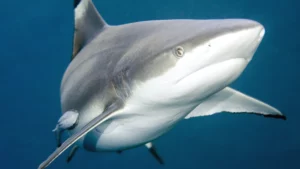 | 1.2–1.6 m (4–5 ft) | Low | Lagoons and reef flats, often in ankle-deep water at high tideThe shark most visitors see first. Shy; bites are rare and almost always to the feet of waders. |
Blacktip SharkCarcharhinus limbatus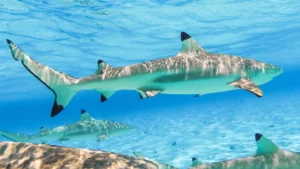 | 1.5–2.5 m (5–8 ft) | Moderate | Outer reef slopes and open lagoons, more offshore than its reef cousinFast, jumping hunter of schooling fish. Confused with the blacktip reef shark; no black tip on the anal fin. |
Grey Reef SharkCarcharhinus amblyrhynchos | 1.5–2.5 m (5–8 ft) | Moderate | Atoll channels and pinnacles in current: Maaya Thila, Fish Head, LhaviyaniThe signature shark of Maldivian dive sites. Territorial toward divers who crowd it; harmless to snorkellers above. |
Whitetip Reef SharkTriaenodon obesus | 1.2–1.6 m (4–5 ft) | Low | Resting under ledges and in caves by day on almost every reefSlender, sluggish by day, hunts in packs at night. One of the few sharks that can pump water over its gills while lying still. |
Tawny Nurse SharkNebrius ferrugineus | 2.5–3.2 m (8–10 ft) | Low | Reef caves by day; Alimatha jetty at nightThe Maldives' nurse shark (the Atlantic nurse shark is a different species). Docile unless food is in the water, which is exactly the situation at feeding sites. |
Whale SharkRhincodon typus | 4–8 m here (adults to 12 m+) | Low | South Ari Atoll all year; Hanifaru Bay May–NovemberFilter feeder; harmless. Maldivian animals are mostly young males that stay for years. |
Tiger SharkGaleocerdo cuvier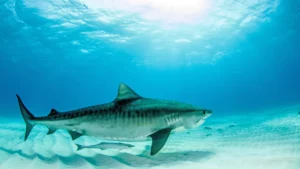 | 3–4.5 m (10–15 ft) | High | Fuvahmulah harbour wall; outer atoll drop-offs elsewhereThe one species here with a serious bite history worldwide. Dive it with a guide, never snorkel near fish waste. |
Scalloped Hammerhead SharkSphyrna lewini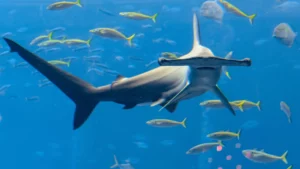 | 2.5–3.5 m (8–12 ft) | Low | Deep atoll edges at dawn: Rasdhoo, FuvahmulahSchools at depth, rarely near the surface. Critically endangered globally; the Maldives is a refuge. |
Smooth Hammerhead SharkSphyrna zygaena | 2.5–4 m (8–13 ft) | Low | Rare visitor to the outer atollsPrefers cooler water; only occasional records in the Maldives. |
Pelagic Thresher SharkAlopias pelagicus | 2.5–3.5 m (8–12 ft) incl. tail | Low | Deep cleaning stations off Fuvahmulah, early morningRecognised by a tail as long as its body, used to stun schooling fish. Harmless; a Fuvahmulah speciality. |
| Oceanic Whitetip SharkCarcharhinus longimanus | 2–3 m (7–10 ft) | High | Open ocean beyond the atolls; FuvahmulahBold, curious pelagic shark that follows boats. A genuine risk to people in open water, not on the reefs. |
Silky SharkCarcharhinus falciformis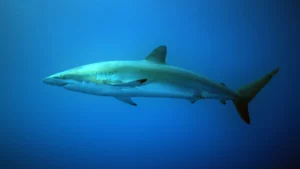 | 2–3 m (7–10 ft) | Moderate | Outer channels and blue water, often with tunaSleek pelagic shark; the main bycatch species of the tuna fishery. |
Silvertip SharkCarcharhinus albimarginatus | 2–2.5 m (7–8 ft) | Moderate | Deep channels and outer walls: Lhaviyani, Noonu, FuvahmulahBig, confident reef shark with white-edged fins. Will approach divers closely. |
Sicklefin Lemon SharkNegaprion acutidens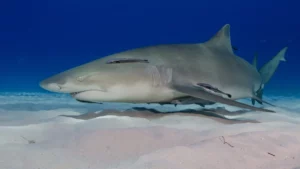 | 2.5–3 m (8–10 ft) | Low | Sandy lagoons and mangrove-fringed islandsThe Indo-Pacific lemon shark. Slow, yellowish, easily seen in shallow water near a few resorts. |
Zebra Shark ('Leopard Shark' locally)Stegostoma tigrinum | 2–2.5 m (7–8 ft) | Low | Sandy bottoms beside reefs, resting by dayAdults are spotted (hence 'leopard'), juveniles striped. Completely placid. |
Great White SharkCarcharodon carcharias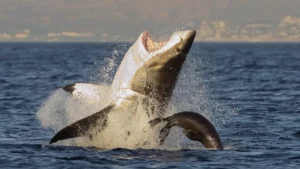 | 4–6 m (13–20 ft) | n/a | Not recorded in the MaldivesIncluded only because it is the most-asked question. Cold-water species; no confirmed Maldivian record. |
One species that gets asked about constantly is the great white shark. Great whites are cold-water animals that prefer 12–24 °C; Maldivian water never drops below about 26 °C. There is no confirmed record of a great white in the Maldives, and the occasional “sighting” reported by tourists has always turned out to be a tiger, bull or oceanic whitetip shark. Bull sharks are also rare here: they need river mouths and estuaries, and the Maldives has no rivers at all.
Where to see sharks in the Maldives
You will see a shark from almost any resort jetty if you are patient at dawn or dusk, but a few places are famous for a reason. These are the sites Maldivian dive centres run to week after week, and what you can expect at each one.
- South Ari Atoll (Dhigurah, Maamigili)The only place in the world with whale sharks all year. The South Ari Marine Protected Area holds a resident population of mostly juvenile males, 4–8 m long, that feed along the outer reef. Seen on snorkelling trips, no diving needed.
- Hanifaru Bay, Baa AtollA UNESCO biosphere reserve where plankton concentrates on the incoming tide between May and November. Manta rays arrive in the hundreds and whale sharks join them. Snorkelling only, limited numbers, ranger-controlled.
- FuvahmulahA lone island in the far south with a deep harbour wall where tiger sharks gather every day of the year. Divers also record thresher sharks, oceanic whitetips, scalloped hammerheads and the occasional silvertip on the same reef.
- Rasdhoo Atoll (Hammerhead Point)An early-morning deep dive at the edge of the atoll for scalloped hammerheads, which rise from the blue at first light. Grey reef sharks and eagle rays on the way back up.
- Maaya Thila and Fish Head, North Ari AtollClassic pinnacle dives ringed by grey reef sharks and whitetip reef sharks, especially on a running current. Night dives at Maaya Thila show the whitetips hunting.
- Alimatha, Vaavu AtollFamous night dive where dozens of tawny nurse sharks and stingrays circle the jetty. This is a feeding-influenced aggregation, which is why it is also the site of one of the country's few recorded shark injuries.
- Lhaviyani and Noonu atoll channelsStrong-current channel dives where silvertips, grey reef sharks and sometimes silky sharks hang in the flow. For experienced divers with a reef hook.
- Any resort house reefBlacktip reef sharks patrol the reef edge in knee-deep water at high tide, and juveniles nurse in sandy lagoons. Whitetips rest under ledges by day. Free, and the best first shark for children.
If you only have one trip, South Ari Atoll is the safest bet: a whale shark encounter is likely in any month, and the same excursion boats usually find blacktip and grey reef sharks on the way. Baa Atoll is the choice for the May to November plankton season; Fuvahmulah is for divers who want big animals.
Best time of year to see sharks in the Maldives
The Maldives has two monsoons and they decide which side of each atoll the plankton, and therefore the filter feeders, ends up on.
- Northeast monsoon (Iruvai), December to April: the dry season. Calm seas, visibility of 30 m and more, and currents that push nutrient-rich water to the western sides of the atolls. The best months for reef sharks in the channels and for hammerheads at Rasdhoo.
- Southwest monsoon (Hulhangu), May to November: wetter, windier, with more plankton and slightly lower visibility. Feeding action moves to the eastern sides. This is when Hanifaru Bay fills with mantas and whale sharks, with the peak from August to October.
- Whale sharks in South Ari: present every month. Sightings dip a little in the roughest weeks of the southwest monsoon and climb again from late October.
- Tiger sharks at Fuvahmulah: year-round, with the largest females seen from around December to April.
Water temperature barely moves, 26–30 °C at the surface all year, which is why the resident reef sharks never leave and why cold-water species never arrive.
Shark attacks in the Maldives: what the record actually shows
For a country where hundreds of thousands of people snorkel every year, the Maldives has an unusually short incident list. SharkSider tracks every reported case in its own database, which is updated weekly on the shark attacks in the Maldives page. These are the six most recent recorded incidents (the full list, updated weekly, is on the attacks page):
- 2026 · Kooddoo, Gaafu Alif AtollSwimming — Leg strpped off flesh later amputated in hospitalSpecies not identified · not fatal
- 2025 · Haa Dhaalu atoll, Kulhudhuffushi CitySnorkeling — Injuries to right shoulderSpecies not identified · not fatal
- 2024 · Maafushi, KaafuDiving — Not stated but reported as minor injuriesSpecies not identified · not fatal
- 2024 · Indian Ocean, Maahvah Laamu AtollMilitary ocean training — Wounds to lower extremities fatalSpecies not identified · fatal
- 2024 · Nunu AtollSwimming — Minor injury to left legSpecies not identified · not fatal
- 2023 · Vaavu AtollSnorkeling at Shark Feeding site — Minor injury to shoulder and backSpecies: Nurse shark · not fatal
Two patterns stand out. First, deaths are extremely rare: the only modern fatality is a Maldives National Defence Force diver killed during an ocean training exercise off Maavah in Laamu Atoll in June 2024, and the 1959 case was a child among castaways adrift in an open boat for 31 days, not a swimmer. Second, the injuries cluster around two situations: people falling from or fishing off boats at night, when sharks are already feeding on discarded catch, and sites where sharks are deliberately fed for tourists. The 2023 case at a nurse shark feeding site in Vaavu Atoll is the textbook example: a normally harmless species, excited by food in the water, mistaking a hand or shoulder for the bait. Swimmers and snorkellers do appear in the record, but rarely: a few minor bites, and one serious leg injury to a swimmer at Kooddoo in Gaafu Alif Atoll in 2026.
The tiger shark is the only species in Maldivian waters with a genuine history of serious bites on people elsewhere in the world, and Fuvahmulah runs its tiger shark dives under strict protocols for that reason. The standard advice applies: stay out of the water at dusk and after dark, never swim near fishing activity or fish-cleaning, do not touch or chase any shark, and give feeding sites a wide berth if you are snorkelling rather than diving with a guide.
Is it safe to swim and snorkel with sharks in the Maldives?
For the reef sharks, yes. Blacktip and whitetip reef sharks are shy, and a snorkeller who keeps still will usually watch them lose interest within a minute. Grey reef sharks are bolder and more territorial; if one arches its back, drops its pectoral fins and swims in exaggerated S-curves, it is asking you to leave, and you should back off slowly along the reef rather than into open water. That display is rare around snorkellers and mostly seen by divers who press too close in a channel.
Whale sharks are harmless, but they are also 20-tonne animals with a tail that sweeps several metres. Maldivian guidelines ask you to keep 3 m from the body and 4 m from the tail, never touch, never block the animal's path, and to enter the water quietly rather than jumping from the boat. Reputable operators cap the number of swimmers per shark. Choose one of those; the crowded free-for-alls in South Ari are the main reason whale sharks there carry boat-propeller scars.
Nurse sharks at Alimatha and tiger sharks at Fuvahmulah are a different category: you go with a dive centre, follow the briefing, and keep your hands to yourself. Do that and both are among the most reliable big-animal encounters in the Indian Ocean.
Shark conservation in the Maldives
The 2010 nationwide ban made the Maldives one of the first countries in the world to protect every shark species in all of its waters, and it has largely held. Shark fishing, shark fin exports and the sale of shark products are illegal, and marine protected areas now cover the key aggregation sites: South Ari for whale sharks, Hanifaru Bay for mantas and whale sharks, and a growing list of channel dive sites.
The pressures have not gone away. Tuna is the country's biggest fishery, and sharks still die as bycatch on longlines outside the protected zones. Reef sharks are slow to reproduce: a grey reef shark may not breed until it is seven years old and then produces only a handful of pups every other year, so a small amount of illegal fishing can undo a decade of recovery. Coral bleaching in 1998 and again in 2016 damaged the reefs that feed the whole food chain, and rising tourism pressure at whale shark sites is now managed with swimmer limits and boat-speed rules. If you want to help, the simplest things work: pick operators that follow the encounter codes, report shark sightings to the local monitoring programmes, and never buy anything made from sharks or rays anywhere in the region. Our guide on why sharks are endangered explains the wider picture.
Sharks in neighbouring waters
The Maldives shares its shark fauna with the rest of the tropical Indian Ocean. Sri Lanka, a short flight to the north-east, has the same reef species plus a seasonal blue whale and whale shark run off its south coast. India's Lakshadweep islands are the geological continuation of the same atoll ridge. Further afield, Thailand, Indonesia and Malaysia offer the Indo-Pacific reef sharks in bigger, busier reef systems, while Oman and Kenya cover the western side of the ocean. Our overview of sharks around the world lists every country we cover.
Frequently asked questions
Are there sharks in the Maldives?
Yes. At least 15 shark species are recorded around the atolls, and reef sharks are part of everyday life on the house reefs. Blacktip reef sharks, whitetip reef sharks and grey reef sharks are the most common, and South Ari Atoll has whale sharks in every month of the year.
Have there been shark attacks in the Maldives?
Only a handful. SharkSider's database lists ten incidents, nine of them since 2018, with two deaths: a castaway child in 1959 and a military diver on a training exercise in 2024. Most of the injuries involved fishermen falling from boats at night or tourists at shark-feeding sites. The country's shark attack page tracks new cases weekly.
Is it safe to swim with sharks in the Maldives?
For reef sharks and whale sharks, yes, provided you keep your distance, avoid dusk and night swimming, and stay clear of fishing boats and feeding sites. Tiger shark and nurse shark encounters should be done with a licensed dive centre that follows a briefing.
Can you swim with whale sharks in the Maldives?
Yes, and it is the country's best-known marine encounter. South Ari Atoll has whale sharks all year, seen on snorkelling trips from Dhigurah and Maamigili. Hanifaru Bay in Baa Atoll adds them to the manta season from May to November, with snorkelling only and strict swimmer limits.
Are there great white sharks in the Maldives?
No confirmed records exist. Great whites prefer water of 12–24 °C, and the Maldives never cools below about 26 °C. Reports of great whites have always turned out to be tiger, bull or oceanic whitetip sharks, which have the same grey-and-white colouring.
Are there tiger sharks in the Maldives?
Yes. Fuvahmulah, the isolated island in the far south, has tiger sharks along its harbour wall every day of the year and has become one of the world's most reliable places to dive with them. Elsewhere they patrol the deep outer edges of the atolls and rarely enter lagoons.
What is the most common shark in the Maldives?
The blacktip reef shark. It lives in the shallow lagoons and along the reef crest, so it is the species people see from jetties and beaches. Underwater, the grey reef shark is the most familiar sight on channel dives, and whitetip reef sharks rest under ledges on nearly every reef.
When is the best time to see sharks in the Maldives?
December to April brings calm seas, the clearest water and the best channel dives on the western atoll sides. May to November is plankton season, when Hanifaru Bay fills with mantas and whale sharks, peaking August to October. South Ari's whale sharks are present in every month.
Is shark fishing legal in the Maldives?
No. The Maldives banned all shark fishing and the trade in shark products throughout its waters in March 2010, after earlier closures around the tourist atolls. Sharks are still lost as bycatch in the tuna fishery, but targeted fishing and fin exports are illegal.
Which Maldives atoll is best for sharks?
South Ari Atoll for whale sharks and easy reef shark sightings, Baa Atoll for the Hanifaru Bay season, Rasdhoo for hammerheads, and Fuvahmulah for tiger, thresher and oceanic whitetip sharks. North Ari's pinnacles such as Maaya Thila are the classic grey reef shark dives.
References
- International Shark Attack File: Yearly Worldwide Shark Attack Summary (Florida Museum of Natural History, University of Florida)
- Baa Atoll Biosphere Reserve, UNESCO Man and the Biosphere Programme
- Rhincodon typus (whale shark), Convention on the Conservation of Migratory Species of Wild Animals
- Scalloped hammerhead shark, NOAA Fisheries species directory

A small team focused on researching sharks and making marine biology easy to understand. Every page is reviewed against current species records and the SharkSider attack database, and updated when new incidents or research appear.
Published December 14, 2022 · Last updated September 21, 2026 · Incident data from the SharkSider attack database (10 records for the Maldives, 2 fatal).


