
Yes, the Philippines has a great many sharks: 34 species with solid records in this list, from a fauna of well over 100. The ones divers and snorkellers actually meet are the whale shark, the pelagic thresher, the blacktip reef shark, the whitetip reef shark and the grey reef shark; hammerheads, tiger sharks and silvertips are for the Tubbataha liveaboards.
The SharkSider database holds 62 dated records for the Philippines from 1901 to 2025, 21 of them fatal, but the majority are shipwrecks and wartime sinkings rather than swimmers: the USS Indianapolis, the Battle off Samar, the ferries Doña Paz and Doña Marilyn. Since 2000 there have been 12 records and two deaths, one a fisherman and one a cargo-ship sinking. No tourist snorkeller or diver has been killed by a shark in the country.
- Shark species recorded34 with solid records (100+ nationally)
- Protected since1998 whale shark ban; Tubbataha no-take since 1988
- Most seen from the beachBlacktip reef shark
- Signature encounterPelagic threshers at Monad Shoal, Malapascua
- Incidents in the database62 (1901–2025), 21 fatal; 2 fatal since 2000
- Water temperature26–30 °C year-round

On this page
- Why the Philippines has so many sharks
- List of the different types of sharks in the Philippines
- Where to see sharks in the Philippines
- Best time of year to see sharks in the Philippines
- Shark attacks in the Philippines: what the record actually shows
- Is it safe to swim and snorkel with sharks in the Philippines?
- Shark conservation in the Philippines
- Sharks in neighbouring waters
- Frequently asked questions
- References
Why the Philippines has so many sharks
Marine biologists call the Verde Island Passage between Luzon and Mindoro “the centre of the centre” of marine biodiversity, and the reason applies to the whole archipelago. The Philippines sits where the Pacific meets the South China Sea, with the Sulu and Celebes seas tucked between its southern islands, and every one of those basins has its own currents, its own temperature profile and its own depth. The Philippine Trench off the east coast drops past 10,000 m; the Sulu Sea is a warm, enclosed bowl; the Bohol Sea and the Camotes Sea are shallow inland waters flushed by strong tidal passes. Put that much habitat variety inside one country's waters and you get everything from reef sharks in a metre of water to deep-sea gulper sharks and the megamouth, a species that was unknown to science until 1976 and has since been found stranded on Philippine beaches more often than anywhere else in the world.
Plankton does the rest. The seasonal upwelling off Sorsogon and the tidal mixing in Ticao Pass and the Bohol Sea concentrate the krill and copepods that whale sharks and manta rays feed on, which is why Donsol and Southern Leyte have wild whale shark seasons without anyone feeding them. The same productivity feeds the schooling fish that threshers, hammerheads and silky sharks hunt on the offshore seamounts of the Visayan Sea.
The other half of the story is less comfortable. The Philippines has been one of Asia's larger shark-fishing nations, with bamboo sharks sold dried in markets, whale sharks butchered for export until the 1990s and fins shipped to Hong Kong. Protection came piece by piece, starting with the whale shark ban of 1998, and the recovery is uneven: Tubbataha, with its ranger station and no-take rules, has some of the healthiest reef shark populations in Southeast Asia, while heavily fished reefs near the big cities have almost none.
List of the different types of sharks in the Philippines
The table covers the species with solid records in Philippine waters that a visitor, a fisherman or a research trawl is realistically likely to encounter; the national list runs well past 100 once the rarely seen deep-water dogfishes and catsharks are added. Sizes are realistic adult lengths. The risk column is about swimmers and snorkellers, not divers who go looking for a species. Two naming points: the “leopard shark” of Philippine dive shops is the zebra shark (Stegostoma tigrinum), not the Californian species, and the nurse shark here is the tawny nurse shark, a different animal from the Atlantic one. The Filipino word for shark is pating; whale sharks are butanding in Bicol and tuki in Cebuano.
| Species | Adult size | Risk to swimmers | Where in the Philippines & notes |
|---|---|---|---|
Whale SharkRhincodon typus | 5–10 m (16–33 ft) here | Low | Donsol, Oslob, Southern Leyte, Tubbataha, Honda BayButanding. Filter feeder, harmless. The Philippines has one of the largest known populations of young males in the world. |
Pelagic Thresher SharkAlopias pelagicus | 2.5–3.5 m (8–12 ft) incl. tail | Low | Monad Shoal, Malapascua, at dawn; offshore seamountsThe country's signature dive. Timid, deep-living, rises to be cleaned by wrasse. Endangered. |
Bigeye Thresher SharkAlopias superciliosus | 3–4 m (10–13 ft) incl. tail | Low | Deep offshore water; tuna longline bycatchHuge upward-looking eyes for hunting in the dark. Rarely seen by divers. |
Tiger SharkGaleocerdo cuvier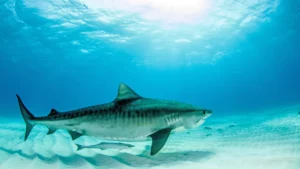 | 3–4.5 m (10–15 ft) | High | Tubbataha walls; offshore passes; rare elsewhereHeavily fished out around the main islands. Tubbataha is the one place divers see it regularly. |
Bull SharkCarcharhinus leucas | 2.2–3.4 m (7–11 ft) | High | River mouths, harbours and murky bays of Luzon and MindanaoThe likely culprit in the historical Manila Bay fatalities. Tolerates fresh water; avoid dawn and dusk swims near estuaries. |
Great Hammerhead SharkSphyrna mokarran | 3.5–4.5 m (11–15 ft) | Moderate | Tubbataha and Apo Reef drop-offsSolitary, hunts rays over sand. Critically endangered; a rare thrill on the Sulu Sea walls. |
Scalloped Hammerhead SharkSphyrna lewini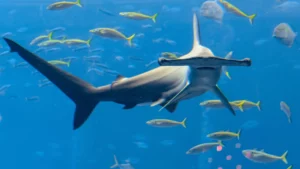 | 2.5–3.5 m (8–12 ft) | Low | Kimud Shoal off Malapascua, December to May; TubbatahaSchools at depth in the cool months. Shy of bubbles; free-divers see them best. |
Blacktip Reef SharkCarcharhinus melanopterus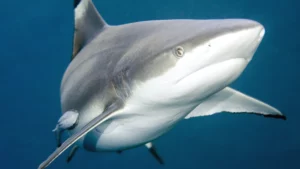 | 1.2–1.6 m (4–5 ft) | Low | Reef flats and lagoons nationwide; Anilao, Apo Reef, PalawanThe shark most people see from a beach or a bangka. Skittish; occasional nips to waders' ankles. |
Whitetip Reef SharkTriaenodon obesus | 1.2–1.6 m (4–5 ft) | Low | Resting under ledges on almost every healthy reefSlender, sluggish by day, hunts in packs at night. The commonest shark on Tubbataha dives. |
Grey Reef SharkCarcharhinus amblyrhynchos | 1.5–2.5 m (5–8 ft) | Moderate | Tubbataha, Apo Reef and other remote walls in currentBold and territorial toward divers who crowd it; harmless to snorkellers above the reef. |
Silvertip SharkCarcharhinus albimarginatus | 2–2.5 m (7–8 ft) | Moderate | Deep outer walls at TubbatahaBig, white-edged fins, approaches divers closely. Not seen on the main islands. |
Silky SharkCarcharhinus falciformis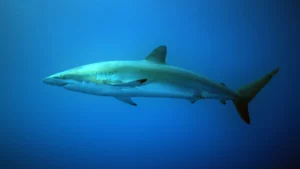 | 2–3 m (7–10 ft) | Moderate | Open water and passes, often with tuna schoolsThe main shark bycatch of the tuna fishery. Curious around boats and divers in blue water. |
| Oceanic Whitetip SharkCarcharhinus longimanus | 2–3 m (7–10 ft) | High | Open ocean of the Philippine Sea and Sulu SeaThe shark of the shipwreck cases. A danger to people adrift offshore, never seen on the reefs. |
Blacktip SharkCarcharhinus limbatus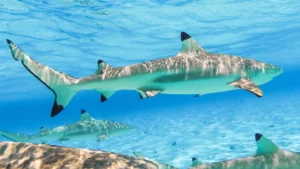 | 1.5–2.5 m (5–8 ft) | Moderate | Coastal water and bays around the larger islandsThe bigger, offshore cousin of the blacktip reef shark; no black tip on the anal fin. Common in fish landings. |
Spinner SharkCarcharhinus brevipinna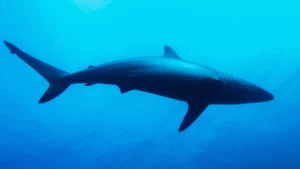 | 2–2.5 m (7–8 ft) | Moderate | Coastal schooling-fish grounds; caught in gillnetsLeaps and spins after sardines. The few bites on record come from fishermen untangling it from nets. |
| Spot-tail SharkCarcharhinus sorrah | 1–1.6 m (3–5 ft) | Low | Shallow shelves and reefs nationwide; a staple of marketsSmall requiem shark with a black-tipped tail lobe. Among the most-landed sharks in the country. |
Tawny Nurse SharkNebrius ferrugineus | 2.5–3.2 m (8–10 ft) | Low | Reef caves and ledges by day; Tubbataha, PalawanThe Philippine nurse shark (the Atlantic species is different). Placid unless grabbed. |
Sicklefin Lemon SharkNegaprion acutidens | 2.5–3 m (8–10 ft) | Low | Sandy lagoons and mangrove channels; Palawan, SuluSlow, yellowish, easily seen in shallow water. Rare now near populated islands. |
Zebra Shark ('Leopard Shark' locally)Stegostoma tigrinum | 2–2.5 m (7–8 ft) | Low | Sandy patches beside reefs, resting by daySpotted adults, striped juveniles. Completely placid. Endangered by fishing for its fins and skin. |
Brownbanded Bamboo SharkChiloscyllium punctatum | 0.7–1 m (2.5–3.5 ft) | Low | Under coral heads on every reef; Anilao at nightSold dried in markets as pating. Can survive hours out of water. Harmless. |
Whitespotted Bamboo SharkChiloscyllium plagiosum | 0.7–0.95 m (2.5–3 ft) | Low | Shallow reefs and seagrass; Luzon and VisayasBanded with white spots. Feeds on crabs and worms at night; the aquarium-trade bamboo shark. |
Coral CatsharkAtelomycterus marmoratus | 0.5–0.7 m (1.5–2.5 ft) | Low | Crevices in shallow coral, seen on night divesSlender, marbled, secretive. Lays egg cases among coral rubble. |
Blue SharkPrionace glauca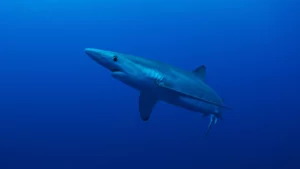 | 2–3 m (7–10 ft) | Low | Open ocean, mainly the cooler Philippine Sea and Luzon StraitTuna longline bycatch. Almost never seen near shore. |
Shortfin Mako SharkIsurus oxyrinchus | 2–3 m (7–10 ft) | Moderate | Offshore with tuna; Luzon Strait, Philippine SeaThe fastest shark; reacts to hooked fish and bleeding catch. Endangered. |
Longfin Mako SharkIsurus paucus | 2–2.5 m (7–8 ft), rarely 4 m | Low | Deep tropical water offshore; longline bycatchLong pectoral fins, slower than its shortfin cousin. Endangered; no record of unprovoked bites. |
Megamouth SharkMegachasma pelagios | 4–5.5 m (13–18 ft) | Low | Bohol Sea, Burias Pass, off Cagayan de Oro; strandings and net capturesFilter feeder discovered in 1976. The Philippines has more records than any other country. Harmless. |
Crocodile SharkPseudocarcharias kamoharai | 0.9–1.1 m (3–3.5 ft) | Low | Deep open water; tuna longline bycatchSmall, big-eyed relative of the makos. Only bites hooks and undersea cables. |
Milk SharkRhizoprionodon acutus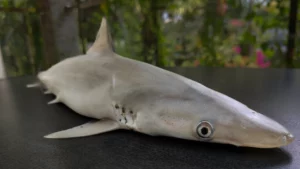 | 0.8–1 m (2.5–3.5 ft) | Low | Shallow sandy coasts and estuaries; common in marketsSmall, fast and harmless. One of the most-landed sharks in Philippine gillnets. |
Hooktooth SharkChaenogaleus macrostoma | 0.8–1 m (2.5–3.5 ft) | Low | Shallow shelves; landed in Visayan and Palawan portsSlim weasel shark with hooked lower teeth. Vulnerable to inshore net fisheries. |
Snaggletooth SharkHemipristis elongata | 1.5–2.3 m (5–7.5 ft) | Low | Coastal shelves 1–130 m; caught in trawls and gillnetsThe only surviving member of its family, with protruding, ragged teeth. Prized for its fins. |
Whitefin TopesharkHemitriakis leucoperiptera | 0.8–1 m (2.5–3.5 ft) | Low | Endemic to the Philippines; shallow coastal water of the VisayasFound nowhere else on Earth and known from very few specimens. Endangered. |
Speckled CatsharkHalaelurus boesemani | 0.4–0.5 m (1.3–1.6 ft) | Low | Shelf bottoms 40–100 m; trawl bycatchSmall spotted catshark of the Sulu and Visayan seas. Egg-laying, harmless. |
Leafscale Gulper SharkCentrophorus squamosus | 1–1.4 m (3–4.5 ft) | Low | Deep slopes below 500 m; deep longline bycatchA deep-sea dogfish with a liver full of squalene and one of the lowest reproductive rates of any shark. |
Winghead SharkEusphyra blochii | 1–1.5 m (3–5 ft) | Low | Shallow muddy coasts and estuariesThe hammerhead with the widest head of all, half its body length. Small mouth, harmless, endangered. |
Great White SharkCarcharodon carcharias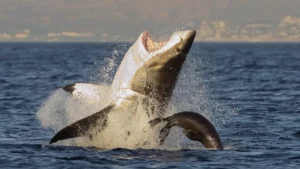 | 4–6 m (13–20 ft) | n/a | Rare stray in northern Luzon waters; not residentA handful of records, including the 2003 Limay incident in the database. A cool-water species that does not live here. |
Several species listed in older guides do not belong here. The sand tiger shark, the Californian leopard shark and the swell shark of the eastern Pacific have no Philippine records; their names crept in through confusion with the zebra shark, the local bamboo sharks and the Indo-Pacific swellsharks of the deep slopes. The great white shark is the harder case. It is a cool-water species, but it does reach the northern Philippines on occasion: the SharkSider database attributes a 2003 case at Limay in Bataan, in which a man lost an arm, to a white shark, and there are a handful of fishery records from Luzon. It is a rare stray, not a resident, and the “great white” in most Philippine stories is a bull shark, a tiger shark or an oceanic whitetip.
Where to see sharks in the Philippines
Few countries offer this range of shark encounters within a few domestic flights of each other. These are the sites that deliver, season after season, and what each one is really like.
- Donsol, SorsogonThe original Philippine whale shark town. Wild animals feed on plankton in the shallow, murky bay from November to June, peaking February to May. Snorkelling only, with trained spotters; no feeding, no touching, sightings not guaranteed but usually several per morning.
- Oslob, CebuWhale sharks are hand-fed shrimp from boats every morning, which makes sightings certain and the encounter controversial: the animals stay year-round instead of migrating and carry propeller scars. Go early, keep your distance, and understand what you are paying for.
- Monad Shoal and Kimud Shoal, MalapascuaThe most reliable thresher shark dive on the planet. Pelagic threshers rise from deep water to a cleaning station on the seamount at dawn, almost every day of the year. Kimud Shoal adds schooling scalloped hammerheads from roughly December to May.
- Tubbataha Reefs Natural Park, Sulu SeaA UNESCO World Heritage no-take reserve reachable only by liveaboard from Puerto Princesa between mid-March and mid-June. Grey reef and whitetip reef sharks on every dive, plus tiger sharks, hammerheads, silvertips and whale sharks on the walls.
- Sogod Bay, Southern LeyteWild whale sharks around Pintuyan and Padre Burgos from about November to May, in clear water and with far fewer boats than Oslob. Whitetip reef sharks on the walls at Napantao.
- Apo Reef, MindoroThe second-largest contiguous reef in the world, a national park with sheer walls and blacktip, whitetip and grey reef sharks, plus hammerheads in the deep blue on the right day. Liveaboard or day trips from Sablayan.
- Ticao Pass and the Manta Bowl, MasbateStrong currents funnel plankton through the pass. Manta rays are the headline, but whale sharks pass through in season and threshers and hammerheads are seen on the deeper ledges.
- Anilao and the Verde Island Passage, BatangasThe country's macro-diving capital, where blacktip reef sharks patrol the shallows and brownbanded bamboo sharks hide under coral heads at night. Also the site of the most recent entry in the incident record, a diver who drowned in 2025.
If whale sharks are the goal, Donsol or Southern Leyte give you the wild experience and Oslob the guaranteed one. Divers who want a single trip with everything should time a Tubbataha liveaboard for April or May, and anyone with two days in Cebu should get to Malapascua for the threshers. Bring a torch to any reef at night for bamboo sharks and coral catsharks.
Best time of year to see sharks in the Philippines
The country has two monsoons, and they decide the sea state far more than they decide the sharks, which are present all year.
- Amihan, the northeast monsoon (November to April): the dry season. Calm seas on the western coasts, the best visibility, and the season for every major shark site: Donsol and Southern Leyte whale sharks, Kimud Shoal hammerheads, and the Tubbataha liveaboard window from mid-March to mid-June. Water is at its coolest, still 26–27 °C.
- Habagat, the southwest monsoon (June to October): wet, with typhoons possible from July to November. Many liveaboards stop, Donsol closes for whale sharks, and diving moves to sheltered east-facing sites. Malapascua's threshers keep coming regardless, and Oslob's fed whale sharks are there every morning.
- Megamouth season: there is none you can plan for, but most Philippine strandings and captures have come between January and April in the Bohol Sea, Burias Pass and off Cagayan de Oro.
Surface temperature sits between 26 and 30 °C in every month, which is why the reef sharks never leave and why the cold-water species of Japan and Australia, the great white above all, appear only as rare strays in the far north.
Shark attacks in the Philippines: what the record actually shows
The Philippine list is one of the longest in Asia, and it needs reading carefully, because most of it has nothing to do with beaches. SharkSider tracks every reported case on the shark attacks in the Philippines page. The database holds 62 dated records from 1901 to 2025, 21 of them fatal, plus three older entries from the 1890s. These are the six most recent (the full list, updated weekly, is on the attacks page):
- 2025 · Verde Island, Batangas ResortSCUBA Diving — Both arms severed by sharks after drowningSpecies not identified · not fatal
- 2023 · Pangasinan, Ilocos Norte, Luzon Island, BolinaoFishing — Laceration to left thighSpecies not identified · not fatal
- 2017 · Villamar, Caoayan, Luzon IslandSpearfishing — Right thigh injured Species: 10' shark · not fatal
- 2013 · Off Likas Island, PalawanSwimming to shore with floatioon devices after boat engine conked out — Minor leg injuriesSpecies: "small sharks" · not fatal
- 2011Sea disaster — The two malabagos were bitten by sharks but survived. the other occupants of the boat were rescued.Species not identified · not fatal
- 2009 · Mabini, Batangas provinceSwimming — Legs bittenSpecies not identified · not fatal
Sort the whole record by circumstance and three groups appear. The biggest is sea disasters: the USS Indianapolis in July 1945, when hundreds of sailors in the water between Tinian and Leyte were taken over four days; the destroyers Hoel and Johnston and the escort carrier Gambier Bay, sunk in the Battle off Samar in October 1944; the ferries Doña Paz in 1987 and Doña Marilyn in 1988, the Pioneer Cebu in 1966, the Don Juan in 1980 and half a dozen smaller capsizings. In most of these the victims were already drowning or dead when sharks arrived, and the database records them honestly as unconfirmed where the evidence is thin. The second group is a cluster of early 20th-century fatalities around Manila Bay: American servicemen swimming at Canacao Bay, Fort Mills on Corregidor, Fort Drum and Fort Frank between 1917 and 1932, six deaths in fifteen years in a bay that then held bull sharks and large requiem sharks around the fish traps. The third, and the only one that matters to a modern visitor, is fishermen and spearfishers: the 2008 fatality at Paoay in Ilocos Norte, the 2017 thigh injury at Caoayan, the 2023 laceration at Bolinao, all men handling fish or bleeding catch in the water.
Tourist swimmers barely feature. The 2009 Mabini case, a swimmer whose legs were bitten at a Batangas beach, and the 2013 Likas Island case, swimmers nipped by small sharks while heading to shore from a broken-down boat, are the closest the modern record comes, and both survived. The 2025 Verde Island entry was a diver who drowned; the injuries were inflicted afterwards. In a country where several million people snorkel with whale sharks and dive the reefs every year, there is no fatal attack on a tourist in the database at all. The usual rules still apply, and in the Philippines the two that matter are: do not swim near fish traps, fishing boats or fish-cleaning at dusk, and do not spearfish with a catch on your belt in the passes where bull, tiger and silky sharks hunt.
Is it safe to swim and snorkel with sharks in the Philippines?
For the sharks people travel to see, yes. Whale sharks are harmless filter feeders, and the Philippine encounter rules, drawn up at Donsol and copied since, are about protecting the shark from you: keep 3 m from the body and 4 m from the tail, no touching, no flash, no more than a set number of swimmers per animal, and enter the water slowly rather than jumping. Oslob's fed sharks come closer than any wild animal would and a swinging tail or a bump from a 6 m fish is the real risk there; the injuries at Oslob over the years have been to whale sharks, from propellers, not to people.
The pelagic threshers of Malapascua are timid and rise to the cleaning station only if divers stay behind the rope line and keep still. Blacktip and whitetip reef sharks are shy and leave when approached; grey reef sharks are more assertive on the Tubbataha walls and will warn a diver who crowds them with the hunched, pectorals-down display that means back off slowly along the reef. Bamboo sharks and coral catsharks can be looked at from centimetres away and will not react.
The species that deserve respect are the ones you rarely see. Bull sharks live in the murky river mouths and harbours of Luzon and Mindanao, which is exactly where the historical Manila Bay fatalities happened, and where you should not swim at dawn or dusk. Tiger sharks and silky sharks appear in the offshore passes where fishermen work. Oceanic whitetips are an open-ocean animal and a genuine danger to anyone adrift, which is the whole history of the shipwreck cases in one sentence. None of these is a factor on a resort beach at Boracay, Panglao or El Nido.
Shark conservation in the Philippines
The Philippines was the first country in Asia to protect the whale shark. In 1998, after the Donsol aggregation came to light and footage of whale sharks being butchered in Bohol and Sorsogon reached the national press, the Fisheries Administrative Order banning the catch, sale and export of whale sharks and manta rays was signed within months. The Wildlife Act of 2001 added a legal backbone, and later orders extended protection to the species listed under CITES, which by 2019 included the thresher sharks, hammerheads, silky and oceanic whitetip sharks and the shortfin mako. Cebu province and Palawan have their own ordinances protecting all sharks and rays in provincial waters, and Malapascua's Monad Shoal is a declared shark and ray sanctuary.
Enforcement is the gap. The Philippines is still a substantial shark-fishing nation, mostly through bycatch in tuna longlines and gillnets, and protected species turn up in markets where inspectors are thin on the ground. Dynamite and cyanide fishing, though much reduced, have destroyed the reef habitat that juvenile blacktips and bamboo sharks depend on around the populous islands. Tubbataha shows what protection can do: after the park was declared in 1988 and rangers stationed on the reef, grey reef and whitetip shark numbers recovered to densities that survey teams now use as a regional baseline. The whale shark tourism at Donsol, Oslob and Southern Leyte has turned an animal once worth a few thousand pesos dead into a living asset worth millions each year, and even the critics of Oslob's feeding accept that its sharks are no longer being hunted.
If you visit, choose operators that follow the encounter codes, report tagged whale sharks and any megamouth stranding to the Bureau of Fisheries or the LAMAVE research group, and never buy dried shark, fins or shark-liver products in markets. Our guide on why sharks are endangered explains the wider picture.
Sharks in neighbouring waters
The Philippines shares its sharks with the rest of the Coral Triangle. Indonesia to the south has the same reef sharks in even greater numbers at Raja Ampat and Komodo, and Malaysia's Sabah coast, across the Sulu Sea from Palawan, offers Sipadan's schooling hammerheads and reef sharks. Vietnam and Thailand cover the western side of the South China Sea, where whale sharks and blacktip reef sharks are the main draw. To the north, China and Japan mark the transition to cooler water, where great whites and the sand tiger sharks that do not reach the Philippines become regular. The full set of country guides is on our sharks around the world page.
Frequently asked questions
Are there sharks in the Philippines?
Yes, a great many. Well over 100 shark species have been recorded in Philippine waters, and 34 with solid records appear in this list. Divers and snorkellers most often meet whale sharks, pelagic threshers, blacktip reef sharks, whitetip reef sharks and grey reef sharks; tiger sharks, hammerheads and silvertips are mainly seen at Tubbataha.
Have there been shark attacks in the Philippines?
Yes. The SharkSider database holds 62 dated records from 1901 to 2025, 21 fatal, but most are shipwrecks and wartime sinkings such as the USS Indianapolis and the ferry Doña Paz, or fishermen handling catch. Since 2000 there have been 12 records and two deaths; no tourist swimmer or diver has been killed by a shark.
Are there great white sharks in the Philippines?
Only as rare strays. The great white is a cool-water species and does not live in the Philippines, but a few records exist from northern Luzon, including a 2003 case at Limay in Bataan, a severed arm attributed to a white shark. Most Philippine sightings reported as great whites are bull, tiger or oceanic whitetip sharks.
Can I swim with whale sharks in the Philippines?
Yes, at several sites. Donsol in Sorsogon and Sogod Bay in Southern Leyte offer wild whale sharks from about November to May or June, with snorkelling only and strict codes of conduct. Oslob in Cebu feeds its whale sharks daily, which guarantees sightings but is controversial. Tubbataha and Honda Bay also see them.
Is Oslob or Donsol better for whale sharks?
Donsol is the wild, ethical option: the sharks are feeding naturally, sightings are usual in season but never guaranteed, and the water is murky. Oslob is certain and close to Cebu City, but the animals are hand-fed from boats, stay all year and carry propeller scars. Southern Leyte is the quieter middle ground.
When is the best time to see thresher sharks in Malapascua?
Any month. Pelagic threshers rise to the cleaning station on Monad Shoal at dawn almost every day of the year, so the dive runs year-round. The calmest seas and best visibility are during the northeast monsoon from November to April, which is also when scalloped hammerheads school at nearby Kimud Shoal.
Are there tiger sharks in the Philippines?
Yes, but they have been fished out around the main islands and are now rare. Tubbataha Reefs Natural Park in the Sulu Sea is the one place divers see them with any regularity, along with hammerheads and silvertips. Elsewhere they turn up occasionally in the offshore passes and in fishery landings.
Is it safe to swim at Boracay, El Nido and Panglao?
Yes. The resort beaches have no shark incidents on record, and the only sharks nearby are small blacktip reef sharks and bamboo sharks. The real hazards are currents, boat traffic and jellyfish. The historical fatalities happened in murky harbours and river mouths, and the modern injuries involve fishermen with bleeding catch.
What is the most common shark in the Philippines?
On healthy reefs, the whitetip reef shark and the blacktip reef shark; the blacktip is the one seen from beaches and boats. In fish markets the milk shark and spot-tail shark are landed most, and on offshore longlines the silky shark dominates. Bamboo sharks are the commonest sight on night dives.
Is shark fishing legal in the Philippines?
Partly. Whale sharks and manta rays have been fully protected since 1998, and species listed under CITES, including threshers, hammerheads, silky, oceanic whitetip and mako sharks, are covered by later fisheries orders. Cebu and Palawan protect all sharks locally. Other species are still caught, mainly as bycatch, and enforcement is uneven.
References
- International Shark Attack File: Yearly Worldwide Shark Attack Summary (Florida Museum of Natural History, University of Florida)
- Tubbataha Reefs Natural Park, UNESCO World Heritage List
- Rhincodon typus (whale shark), Convention on the Conservation of Migratory Species of Wild Animals
- Scalloped hammerhead shark, NOAA Fisheries species directory

A small team focused on researching sharks and making marine biology easy to understand. Every page is reviewed against current species records and the SharkSider attack database, and updated when new incidents or research appear.
Published February 1, 2023 · Last updated September 21, 2026 · Incident data from the SharkSider attack database (62 records for the Philippines, 21 fatal).


