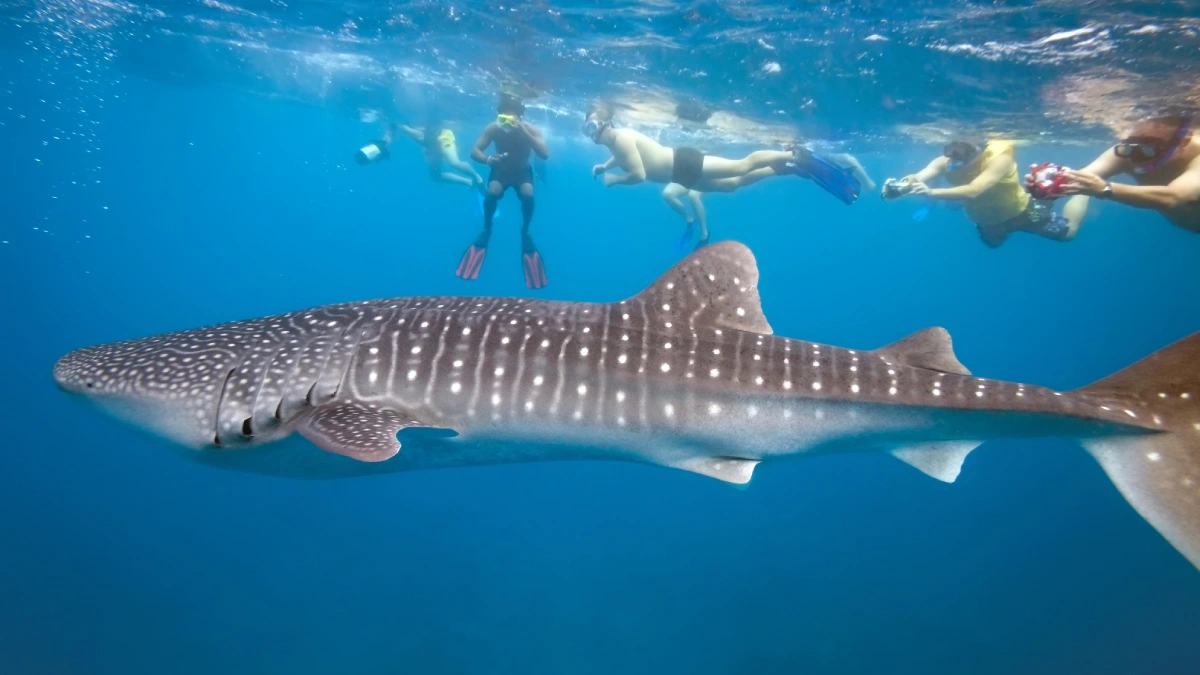
The whale shark (Rhincodon typus) is the largest living fish, a slow-swimming carpet shark of tropical and warm-temperate oceans that reliably reaches 12–13 m (40 ft) and has been credibly estimated at 18 m or more. It is grey-blue with a chequerboard of white spots and lines, a flattened head, a terminal mouth up to 1.5 m wide and three ridges along each flank.
It filters plankton, krill, fish eggs and small fish through pads in its gills. Females are aplacental viviparous; one carried 304 embryos. Males mature at about 8–9 m and 25–30 years, and the species probably lives more than a century. It is listed as Endangered and has never seriously hurt anyone.
- Maximum length12.65 m measured; 18.8 m credibly estimated (62 ft)
- WeightUp to about 21,500 kg (47,000 lb), estimated
- Lifespan50 years confirmed; probably 80–130
- Depth rangeSurface to 1,928 m (6,300 ft)
- DietZooplankton, krill, fish and coral spawn, small fish
- IUCN statusEndangered (assessed 2016)
- Kingdom
- Animalia
- Phylum
- Chordata
- Class
- Chondrichthyes
- Order
- Orectolobiformes
- Family
- Rhincodontidae
- Genus
- Rhincodon
- Species
- Rhincodon typus
- Family (common)
- Whale sharks
- Also known as
- Tofu shark (Taiwan), Butanding (Philippines), Tiburón ballena (Latin America), Domino
On this page
- How to recognise a whale shark
- How big do whale sharks really get?
- Where whale sharks live
- What whale sharks eat and how filter feeding works
- Behaviour, senses and social life
- Reproduction and lifespan
- Are whale sharks dangerous to people?
- Conservation status
- Similar species and close relatives
- Frequently asked questions
- References
How to recognise a whale shark
Size settles most identifications, but a young whale shark of 3 or 4 m can still be confused with a basking shark from a boat, so look at the head. A whale shark's mouth opens at the very front of a broad, flat head, almost level with the eyes, rather than under a pointed snout like every other big shark. The eyes are tiny for the size of the animal and sit at the corners of the mouth; in 2020 Japanese researchers found they are armoured with small tooth-like denticles, which no other fish is known to have.
The pattern is the second giveaway: a grey to blue-grey back covered with pale spots and short vertical bars laid out in a grid, fading to a white belly. Every animal's arrangement behind the gills is unique, and researchers match photographs of it with software written for star maps. Three prominent ridges run along each flank from the gills to the tail, the lowest ending in a strong keel on the tail stalk.
The five gill slits are enormous, the first dorsal fin is set far back, and the tail is tall and crescent-shaped in adults, though juveniles have a much longer upper lobe. Inside the mouth are around 300 rows of teeth on each jaw, each tooth barely 6 mm long; there may be 3,000 of them and they play no part in feeding.

How big do whale sharks really get?
Be careful with the numbers you have read, including the ones this page used to give. The largest whale shark ever measured with a tape was a female landed at Baba Island near Karachi in 1947, 12.65 m (41.5 ft) long, with an estimated weight of about 21.5 tonnes. Bigger animals certainly exist: a 2015 review of ocean giants accepted a length estimate of 18.8 m from the Arabian Sea, and fishers in Taiwan and India have reported fish of 17 to 20 m, but none of these was measured directly. Claims of 15 tonnes for an average adult are wrong in the other direction; a 10 m shark weighs roughly 9 tonnes.
Most whale sharks people swim with are far smaller. The famous aggregations at Ningaloo, Isla Mujeres and Donsol are dominated by juvenile males of 4 to 8 m, and a 12 m animal is a rare event anywhere. Newborns are 55 to 64 cm long, the smallest free-swimming individuals ever found were around 60 cm, and the 46 cm figure quoted in old sources comes from embryos. The bar below sets the largest credible estimate against a 1.8 m diver.
Where whale sharks live
Whale sharks live in every tropical and warm-temperate ocean between roughly 30°N and 35°S, and genetic work shows the Atlantic and Indo-Pacific animals mix only rarely. They are absent from the Mediterranean and from cold water; the surface temperatures they favour are 21 to 30 °C. Most of their time is spent in the upper 50 m, not the "800 m" the old text claimed, but satellite tags have recorded dives to 1,928 m (6,300 ft), among the deepest dives recorded for any tagged shark.
Where you see them depends on food. A dozen seasonal aggregations account for nearly all sightings: Ningaloo Reef on the Australian coast after the March coral spawn; Isla Mujeres and Holbox in Mexico, where hundreds gather in summer over tuna spawn; Donsol and Oslob in the Philippines; South Ari Atoll in the Maldives; Utila in Honduras; Cenderawasih Bay in Indonesia; the Al Shaheen oil field off Qatar, which holds the largest gathering ever counted; Mafia Island, Tofo and Djibouti in the western Indian Ocean; and Darwin Island in the Galápagos, where almost all visitors are large females.
In United States water they turn up along the northern Gulf of Mexico off Texas and Louisiana and off the Florida Keys, mostly in summer. Tags show individuals crossing whole basins: a female named Anne covered more than 20,000 km from Panama to the Mariana Trench.


- South Africa1 record
- Alabamalisted
- Anguillalisted
- Arubalisted
- Bahamaslisted
- Bahrainlisted
- Barbadoslisted
- Belizelisted
- Bermudalisted
- Brazillisted
- Cambodialisted
- Chilelisted
Show all 81 places
- Chinalisted
- Colombialisted
- Cook Islandslisted
- Costa Ricalisted
- Cubalisted
- Curaçaolisted
- Dominicalisted
- Dominican Republiclisted
- Ecuadorlisted
- Egyptlisted
- El Salvadorlisted
- Fijilisted
- Floridalisted
- French Polynesialisted
- Ghanalisted
- Grenadalisted
- Guamlisted
- Guatemalalisted
- Haitilisted
- Hawaiilisted
- Honduraslisted
- Hong Konglisted
- Indialisted
- Indonesialisted
- Iranlisted
- Jamaicalisted
- Japanlisted
- Kenyalisted
- Louisianalisted
- Malaysialisted
- Massachusettslisted
- Mexicolisted
- Mississippilisted
- Moroccolisted
- Namibialisted
- New Jerseylisted
- New Zealandlisted
- Nicaragualisted
- Nigerialisted
- Omanlisted
- Pakistanlisted
- Panamalisted
- Papua New Guinealisted
- Perulisted
- Portugallisted
- Puerto Ricolisted
- Qatarlisted
- Russialisted
- Saint Lucialisted
- Samoalisted
- Saudi Arabialisted
- Senegallisted
- Singaporelisted
- Somalialisted
- South Korealisted
- Spainlisted
- Sri Lankalisted
- Texaslisted
- Thailandlisted
- The British Virgin Islandslisted
- The Cayman Islandslisted
- The Gambialisted
- The Maldiveslisted
- The Philippineslisted
- The U.S. Virgin Islandslisted
- Tongalisted
- Vanuatulisted
- Venezuelalisted
- Vietnamlisted
73 countries and 8 US states list the whale shark in their species guide; the count is the number of incidents attributed to it there in the SharkSider database. Browse every guide on sharks around the world and sharks in the US.
What whale sharks eat and how filter feeding works
Whale sharks are one of three filter-feeding sharks, with the basking shark and the megamouth, and the only one that also uses suction. The diet is whatever is small and dense: copepods and other zooplankton, krill, crab and fish larvae, the eggs released in mass spawnings of corals and of tunny at Isla Mujeres, and small schooling fish such as sardines and anchovies, plus the occasional squid.
The machinery is in the gills. Twenty sieve-like filter pads, one on each side of each gill arch, are made of a mesh with openings of about a millimetre. Water enters the mouth, crosses the pads at an angle and leaves through the gill slits, while the particles are carried along the pad surface to the back of the throat. This cross-flow filtration is why the pads do not clog; when they do, the shark "coughs", flushing the mesh backwards. Nothing is chewed. Sharks feed either by ram, swimming forward with the mouth open, or by hanging vertically at the surface and gulping, which pulls in an estimated 6,000 litres of water an hour and is the pose that has made them famous in the Philippines.
Tagging suggests they feed at depth as well, tracking the plankton layer as it rises and sinks through the day; the deep dives recorded at Ningaloo and in the Gulf of Mexico fit a search for concentrated food rather than an escape from heat.

Behaviour, senses and social life
A whale shark cruises at about 5 km/h (3 mph), moving the whole rear half of its body rather than just the tail, and it can keep that up for months. It is not warm-bodied like a great white; it holds heat simply by being enormous, a mass of white muscle round the organs cooling so slowly that a dive into 4 °C water barely chills the core, which may be one reason the species grew so large.
The senses are tuned to finding food, not chasing it. The nostrils sit at the front corners of the mouth and smell is good; the eyes are small but can be retracted into the head and are protected by those denticles; and the snout carries ampullae of Lorenzini like any shark's. They seem to find spawning events by smell and by memory, returning to the same reefs in the same weeks each year.
Socially they are loners that tolerate company. The great gatherings are crowds drawn to the same buffet, mostly immature males, not structured schools. Where the sexes and the big adults go is the largest hole in the science: St Helena in the South Atlantic is one of the few places where mature males and females are seen together, and the mid-ocean tracks of the tagged Galápagos females hint at pupping grounds far from any coast. They tolerate remoras, cobia and jacks riding with them, and snorkellers too, though they dive if crowded.
Reproduction and lifespan
Nearly everything known about whale shark reproduction comes from a single fish. In July 1995 a 10.6 m female harpooned off Taiwan was found to be carrying 304 embryos in her two uteri, at every stage from egg cases to pups of 58 to 64 cm ready to be born. That one dissection settled a long argument: the species is aplacental viviparous (older texts say ovoviviparous), the eggs hatch inside the mother, and the litter is by far the largest recorded for any shark. Their staggered development implied that she had stored sperm from one mating and was giving birth a few pups at a time over many months.
Mating has essentially never been observed, no nursery has been found, and newborn whale sharks are among the rarest sightings in the sea, so the size and survival of litters in the wild are unknown. Males mature at about 8 to 9 m, which at Ningaloo corresponds to an age of roughly 25 to 30 years; females probably mature later and larger, at 9 m or more. A pregnant female is therefore a large, old animal, which is why the Darwin Island females matter so much.
Lifespan was guessed for decades. In 2020 scientists dated the vertebral growth bands of a 10 m shark using the radiocarbon left by 1950s bomb tests and confirmed an age of 50 years, the first validated age for the species. Growth models built on that calibration put the maximum lifespan between 80 and 130 years; the "150 years" quoted here before has no evidence behind it (see how long sharks live).

Are whale sharks dangerous to people?
They are not. The SharkSider database holds two records attributed to whale sharks, both involving boats and neither involving an injury: a fish that buckled a prop shaft off Robberg Point, South Africa, in 1976, and one that bumped a fishing boat off Inhambane, Mozambique, some time before 2004. No whale shark has ever bitten a person, and with a throat only a few centimetres wide it could not swallow one if it tried.
The real hazards are the ones that come with any animal of ten tonnes. The tail of a startled shark can knock a snorkeller senseless, people have been bruised by the pectoral fins in the crowded water at Oslob, and boats moving fast over a feeding aggregation injure sharks far more often than sharks injure boats. Keep 3 to 4 m from the body and further from the tail, never touch or ride one, and choose operators that limit swimmer numbers; our guides on whether whale sharks are dangerous and how to swim with them safely go into the detail.
Whale Shark incidents in the SharkSider database
- Records attributed2
- Fatal0 (0%)
- Years covered1976–2004
- Since 20001 incidents, 0 fatal
- Most common activityFishing & boats
- Most recordsMozambique (1)
The six most recent records attributed to the whale shark
- Before 2004 · Off Inhambane, Inhambane Province, MozambiqueFishing — No injury to occupants, shark bumped boatRecorded as: Whale shark · not fatal
- 12 March 1976 · Robberg Point, Western Cape Province, South AfricaFishing — No injury to occupants, shark buckled prop shaftRecorded as: Whale shark · not fatal
Records are matched on the shark named in each report (“whale”), so they include incidents where the species was reported rather than confirmed. Full records by country on the shark attacks pages.
Conservation status
The IUCN moved the whale shark from Vulnerable to Endangered in 2016, estimating that the global population has fallen by more than half over the last three generations, about 75 years, with the Indo-Pacific population down by roughly 63 percent. Trade has been controlled under CITES Appendix II since 2003, and in 2017 the species was placed on Appendix I of the Convention on Migratory Species, its strictest listing.
Directed fishing did most of the historical damage. Taiwan's "tofu shark" fishery took hundreds a year until a full ban in 2008, India's Gujarat coast harpooned them for liver oil until protection in 2001, and the Philippines closed its fishery in 1998. A processing plant in southern China was still handling whale sharks in the 2010s for fins, oil and skin. Today the biggest killers are indirect: bycatch in tuna purse seines, which set their nets round whale sharks because tuna school beneath them, and ship strikes, which studies of shipping lanes and tag data suggest kill far more animals than are ever reported because a dead whale shark sinks.
Protection is now widespread, from Australia, Mexico, the Maldives and Honduras to the whole of the Red Sea coast of Saudi Arabia, and tourism gives the species a cash value alive that it never had dead. That has its own problems, notably the hand-feeding at Oslob, but it has paid for most of the tagging and photo-identification we rely on. The larger picture of shark declines is on why sharks are endangered.
Similar species and close relatives
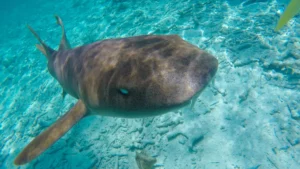
The whale shark is the only member of its family, and its nearest relatives are a surprise: the carpet sharks of the order Orectolobiformes, small bottom-dwellers of tropical reefs. The zebra shark, another spotted species whose juveniles are striped, is usually placed closest, followed by the nurse shark and tawny nurse shark and the bamboo sharks such as the brownbanded bamboo shark. All share a mouth set in front of the eyes and small barbel-like nasal flaps; the whale shark simply took the design into open water and grew.
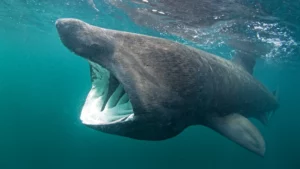
The animals it is confused with are the other two filter feeders, neither a relative. The basking shark is a cold-water mackerel shark with a pointed snout, a cavernous mouth under the head and no spots; it is the "whale shark" of British and New England reports. The megamouth is a rarely seen deep-water shark. The three evolved filter feeding separately, a story told on our filter feeders page. And the whale shark is not a whale: it is a fish with gills, no lungs and a vertical tail, as our sharks and whales comparison explains.
 Zebra Sharkspecies profile
 Nurse Sharkspecies profile
 Tawny Nurse Sharkspecies profile
 Brownbanded Bamboo Sharkspecies profile
 Basking Sharkspecies profile
- Megamouth Sharkspecies profile
Frequently asked questions
How big is a whale shark?
The largest one measured with a tape was 12.65 m (41.5 ft), landed near Karachi in 1947, and credible estimates reach 18 to 18.8 m. Most sharks seen at tourist sites are juveniles of 4 to 8 m. A 10 m animal weighs about 9 tonnes and the biggest may pass 20 tonnes. Newborns are 55 to 64 cm.
Is the whale shark a whale or a shark?
A shark. It breathes through five pairs of gills, has a skeleton of cartilage, a vertical tail and no blubber, and it is cold-blooded. The name refers only to its size and its whale-like habit of filter feeding. Its closest relatives are small reef carpet sharks such as the zebra shark and nurse shark.
What do whale sharks eat?
Plankton, krill, copepods, crab and fish larvae, the eggs of spawning corals and tunny, and small schooling fish such as sardines and anchovies. Water is strained through twenty filter pads in the gills, either by swimming with the mouth open or by gulping at the surface. The 3,000 tiny teeth are not used for feeding.
Where can you swim with whale sharks?
At seasonal feeding aggregations: Ningaloo Reef in Western Australia (March to July), Isla Mujeres and Holbox in Mexico (June to September), Donsol in the Philippines, South Ari Atoll in the Maldives, Utila in Honduras, Mafia Island in Tanzania, Tofo in Mozambique and Djibouti in winter. Keep 3 to 4 m away and never touch the shark.
Are whale sharks dangerous to humans?
No. They eat plankton, their throat is only a few centimetres wide, and no whale shark has ever bitten a person. The SharkSider database records only two boats bumped, in 1976 and before 2004, with nobody hurt. The only risk is being struck by the tail of a ten-tonne animal that is startled by a crowd.
How do whale sharks reproduce?
Eggs hatch inside the mother and the pups are born live, a mode called aplacental viviparity. A single female caught off Taiwan in 1995 carried 304 embryos at different stages, the largest litter of any shark, suggesting she stored sperm and gave birth over months. Mating and birth have never been observed in the wild.
How long do whale sharks live?
At least 50 years, confirmed in 2020 by radiocarbon dating of a 10 m shark's vertebrae. Growth models built on that calibration suggest a maximum lifespan of 80 to 130 years. Males mature at 8 to 9 m and about 25 to 30 years old, and females later still, so the species recovers slowly from losses.
How deep can a whale shark dive?
A satellite tag has recorded a whale shark at 1,928 m (6,300 ft), one of the deepest dives documented for any tagged shark. Most of its life is spent in the top 50 m of warm water at 21 to 30 °C, but it makes regular deep dives, probably to feed on plankton layers and possibly to cool down after time at the surface.
Why are whale sharks endangered?
The IUCN listed them as Endangered in 2016 after estimating a decline of more than half in 75 years. Historical harpoon fisheries in Taiwan, India and the Philippines, continuing demand for fins, oil and skin in China, bycatch in tuna purse seines and collisions with ships are the causes. Late maturity makes recovery slow.
How do scientists identify individual whale sharks?
By the spots. The pattern behind the gills and above the left pectoral fin is unique to each shark and does not change with age. Researchers and tourists upload photographs to a global database where software adapted from star-mapping matches the constellations of spots, allowing individuals to be tracked between countries for decades.
References

A small team focused on researching sharks and making marine biology easy to understand. Every page is reviewed against current species records and the SharkSider attack database, and updated when new incidents or research appear.
Published December 1, 2014 · Last updated September 22, 2026 · 2 incidents attributed to the whale shark in the SharkSider attack database (0 fatal), updated weekly.