
Yes, there are sharks in Croatia, about 29 species, and nearly all of them are small, deep-living or offshore. Small-spotted catsharks, nursehounds, common and starry smooth-hounds and spiny dogfish make up the everyday catch, with blue sharks and shortfin makos beyond the islands; basking sharks come through with the spring bloom, and the great white, rare as it is, is a genuine Adriatic animal.
The SharkSider database lists 29 records for Croatia dated 1900 or later, 17 of them flagged fatal, though that count includes a 1934 false report, a questionable 1910 case and one 1971 death entered twice; the accepted figure is around 14 deaths, the last at Omiš in August 1974. Seven older entries from 1872 to 1893 are mostly human remains found inside sharks near Rijeka. The only injury since 1974 is a spearfisher's calf bitten by a white shark off Vis in 2008, and the 2012 “attack” in Bakar Bay turned out to be a swordfish.
- Shark species recorded29 with solid records
- ProtectionWhite, basking and angel sharks strictly protected; EU rules since 2013
- Most seen from the beachSmall-spotted catshark and smooth-hounds
- Signature encounterBlue sharks over the Jabuka Pit; spring basking sharks
- Incidents in the database29 dated (1900–2012), 17 flagged fatal; last death 1974
- Water temperature10–13 °C in February (north), 24–27 °C in August

On this page
- Where sharks live in Croatian waters
- List of the different types of sharks in Croatia
- Where to see sharks in Croatia
- Best time of year to see sharks in Croatia
- Shark attacks in Croatia: what the record actually shows
- Is it safe to swim and snorkel in Croatia?
- Shark conservation in Croatia
- Sharks in neighbouring waters
- Frequently asked questions
- References
Where sharks live in Croatian waters
The Adriatic is a long, narrow arm of the Mediterranean, and Croatia's side of it changes character from north to south. The northern basin, from Istria down past the Kvarner Gulf, is shallow, rarely more than 50 m, and is fed by the Po and the rivers of the Italian plain. It is the most productive water in the whole Mediterranean, a green, plankton-rich sea that feeds sardines and anchovies by the million and, through them, the sharks that eat them. This is why the Kvarner Gulf around Rijeka, Opatija, Bakar and Krk has always been the part of Croatia where the big fish turned up: basking sharks in the spring bloom, blue sharks and makos following the sardine shoals, and, for a century, great whites. The Kvarner is also where Croatia's fatal incidents cluster, from Volosko in 1900 to Preluka in 1974.
South of Zadar the seabed deepens. The Jabuka Pit, a 270 m basin around the tiny volcanic islet of Jabuka west of Vis, is the Adriatic's nursery for hake and Norway lobster and a magnet for pelagic sharks; Croatian longliners have taken blue sharks, threshers and makos there for generations. Further south again, past Lastovo and Mljet, the South Adriatic Pit drops to 1,233 m, and this is where the deep-water sharks live: bluntnose sixgills, gulper sharks, kitefin sharks, velvet belly lanternsharks and the angular roughshark, all of them known from the deep longlines and trawl surveys but none from the beaches.
The third habitat is the one tourists actually swim in. Croatia's 1,244 islands sit on a rocky, weed-covered shelf between 5 and 100 m deep, riddled with ledges and seagrass meadows, and this is where the small bottom sharks make their living. A diver who looks under overhangs at Kornati, Vis or the Brijuni islands will find small-spotted catsharks and nursehounds resting by day; the trawlers of Istria and Dalmatia land smooth-hounds and spurdogs by the crate; and every fish market from Pula to Dubrovnik sells them as pas, kostelj or mačka. In Croatian a shark is a morski pas, a “sea dog”, and the great white is the velika bijela psina.
List of the different types of sharks in Croatia
The table lists every shark with a dependable Croatian record, drawn from fisheries landings, research trawls and verified sightings; sizes are realistic adults rather than record fish. The risk column concerns a swimmer at a Croatian beach, which for almost all of these species is a formality: they live on the bottom, below 100 m or far out over the pits. The one exception, the great white, is discussed honestly in the sections that follow. A note on names: the “school shark” of older lists is the tope, and the “angel shark” is three separate species in the Adriatic, of which the common angelshark is by far the most often recorded.
| Species | Adult size | Risk to swimmers | Where in Croatia & notes |
|---|---|---|---|
Great White SharkCarcharodon carcharias | 4–5.5 m (13–18 ft) | High | Rare visitor; historically the Kvarner Gulf, Vis, OmišThe species behind nearly every Croatian death from 1900 to 1974 and the 2008 Vis bite. Strictly protected; a few confirmed animals per decade. |
Shortfin Mako SharkIsurus oxyrinchus | 2.5–3.5 m (8–12 ft) | Moderate | Open water over the Jabuka and South Adriatic pitsFollows tuna and swordfish; occasionally landed by longliners. Never at the beaches. |
Blue SharkPrionace glauca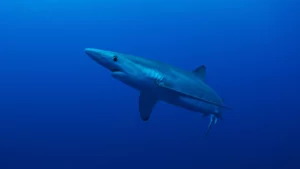 | 2–3 m (7–10 ft) | Low | Outer islands and pits, June to SeptemberThe most common large shark in the Adriatic and the one a boat crew is likeliest to see. Curious, not aggressive. |
Porbeagle SharkLamna nasus | 2–2.5 m (7–8 ft) | Low | Cool northern Adriatic in winter and springA cold-water mackerel shark now scarce in the Mediterranean; protected. Records come from Kvarner landings. |
Basking SharkCetorhinus maximus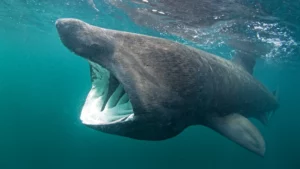 | 6–8 m (20–26 ft) | Low | Kvarner, Istria and Dugi Otok in April and MayThe psina golema. Plankton feeder, harmless, strictly protected; Croatia's most reliable big-shark sighting. |
Common Thresher SharkAlopias vulpinus | 3.5–4.5 m (11–15 ft) incl. tail | Low | Offshore, chasing sardine shoals in summerThe upper tail lobe is as long as the rest of the fish. Taken on longlines over the pits. |
Bigeye Thresher SharkAlopias superciliosus | 3.3–4 m (11–13 ft) incl. tail | Low | Deep water of the southern Adriatic; rareA handful of Croatian records from deep longlines. Harmless. |
Sandbar SharkCarcharhinus plumbeus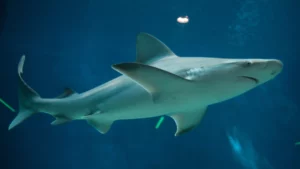 | 1.8–2.4 m (6–8 ft) | Low | Sandy bays and river mouths of the northern AdriaticThe Adriatic's one coastal requiem shark, seen in summer and once common. Timid. |
Copper SharkCarcharhinus brachyurus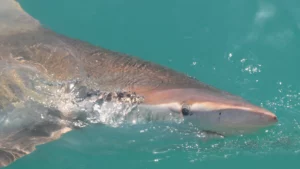 | 2.5–3 m (8–10 ft) | Moderate | Rare summer records in the central AdriaticAn occasional visitor from the wider Mediterranean; a few verified Croatian specimens. |
Smooth Hammerhead SharkSphyrna zygaena | 2.5–3.5 m (8–12 ft) | Low | Offshore; rare, mostly southern AdriaticThe only hammerhead with solid Adriatic records. Critically endangered in the Mediterranean and protected. |
Sand Tiger SharkCarcharias taurus | 2.5–3 m (8–10 ft) | Low | Historical records only; possibly gone from the AdriaticFierce-looking but placid. Once caught along the Dalmatian coast; now protected and almost never seen. |
Small-spotted CatsharkScyliorhinus canicula | 0.6–0.8 m (2–2.5 ft) | Low | Everywhere on the shelf, under ledges and on sandThe mačka bljedica, the shark a Croatian diver actually sees. Lays egg cases on seaweed and gorgonians. |
| NursehoundScyliorhinus stellaris | 1–1.4 m (3–4.5 ft) | Low | Rocky walls and caves: Kornati, Vis, TelašćicaThe larger, bigger-spotted catshark. Rests in caves by day; completely harmless. |
Blackmouth CatsharkGaleus melastomus | 0.5–0.7 m (1.5–2.5 ft) | Low | Muddy slopes below 150 m, southern and central AdriaticA deep-water catshark with a black-lined mouth. A trawl bycatch, never seen by divers. |
Common Smooth-houndMustelus mustelus | 1–1.5 m (3–5 ft) | Low | Sandy bottoms of the northern shelf and KvarnerThe pas mekuš of the fish markets. Eats crabs; toothless-looking flat teeth. |
| Blackspotted Smooth-houndMustelus punctulatus | 0.9–1.2 m (3–4 ft) | Low | Northern Adriatic shelf, mixed with the other smooth-houndsSeparated from its cousins only recently; probably the commonest smooth-hound in the north. |
Starry Smooth-houndMustelus asterias | 1–1.3 m (3–4 ft) | Low | Shelf sands, mainly north and centralWhite-flecked back. Gives birth to live young in the shallow bays in early summer. |
Tope SharkGaleorhinus galeus | 1.5–1.8 m (5–6 ft) | Low | Shelf and slope, mostly deeper waterOlder Croatian lists call it the school shark. Fast, timid, and off-limits under the GFCM rules. |
| Spiny DogfishSqualus acanthias | 0.8–1.2 m (2.5–4 ft) | Low | Northern Adriatic in winter and springThe kostelj. A cold-water shark with venomous dorsal spines; a staple of the trawl catch. |
| Longnose SpurdogSqualus blainville | 0.7–1 m (2.5–3 ft) | Low | Deeper shelf and slope, central and southThe warmer-water spurdog, more common in the south than the spiny dogfish. |
Bluntnose Sixgill SharkHexanchus griseus | 3.5–4.8 m (11–16 ft) | Low | South Adriatic Pit and the Jabuka Pit slopesThe biggest deep-water shark in the Adriatic, taken on deep longlines off Lastovo and Vis. |
Sharpnose Sevengill SharkHeptranchias perlo | 1–1.3 m (3–4 ft) | Low | Deep southern slopes; rareA slim, big-eyed primitive shark known from a few trawl records. |
| AngelsharkSquatina squatina | 1.2–1.8 m (4–6 ft) | Low | Sandy shelf of the northern Adriatic; now rareThe sklat. A flat, ray-like ambush hunter once fished commercially, now critically endangered and protected. |
Sawback AngelsharkSquatina aculeata | 1.2–1.5 m (4–5 ft) | Low | Deeper shelf, southern Adriatic; very rareDistinguished by a row of thorns down its back. A handful of Croatian records. |
| Smoothback AngelsharkSquatina oculata | 1–1.4 m (3–4.5 ft) | Low | Muddy slopes, southern Adriatic; very rareThe third Adriatic angelshark, with eyespots on its fins. Critically endangered. |
Gulper SharkCentrophorus granulosus | 0.9–1.2 m (3–4 ft) | Low | South Adriatic Pit, below 400 mA deep-water dogfish with huge green eyes; one of the slowest-breeding sharks known. |
Kitefin SharkDalatias licha | 1–1.5 m (3–5 ft) | Low | Deep slopes of the southern AdriaticA black, bioluminescent deep-sea shark taken on Lastovo longlines. |
Velvet Belly LanternsharkEtmopterus spinax | 0.35–0.45 m (1–1.5 ft) | Low | Muddy slopes below 200 m, central and southThe smallest shark on the list, glowing along its belly in the dark. Trawl bycatch only. |
Angular RoughsharkOxynotus centrina | 0.5–0.8 m (1.5–2.5 ft) | Low | Muddy shelf and slope, mainly southA strange, high-backed, sail-finned shark. Protected under the GFCM list. |
Several sharks that visitors ask about have no business on a Croatian list. Neither the bull shark nor the tiger shark lives anywhere in the Mediterranean; the great and scalloped hammerheads are known from a stray or two in the far south of the basin and have never been recorded in the Adriatic; and the oceanic whitetip belongs to the open Atlantic. The great white, by contrast, belongs here. The Mediterranean holds a small, genetically distinct and critically endangered population, and the Adriatic is one of its historical strongholds: Croatian and Italian records add up to several dozen documented white sharks since the 1860s, far more than the twelve sightings older versions of this page claimed. Modern encounters are rare, perhaps one confirmed animal every few years, but the 5 m fish that bit a spearfisher off Vis in 2008 shows the species has not gone.
Where to see sharks in Croatia
Nobody sells shark dives in Croatia, and a live shark sighting is something you earn with patience rather than book. These are the places where sharks are most reliably part of the scenery, in the water or on the quay.
- Kornati National ParkCroatia's densest archipelago, 89 islands of bare limestone west of Šibenik with sheer outer walls. Divers who check the overhangs at 15–30 m find small-spotted catsharks and nursehounds, and the park's fishermen see blue sharks over the outer drop-off in summer.
- Vis, Biševo and the Jabuka PitThe most oceanic island group in Croatia. The Jabuka Pit west of Vis is the Adriatic's pelagic hotspot for blue sharks, threshers and makos, and Smokvina Bay on Vis is where the 2008 white shark bite happened. Komiža's fishing fleet still lands smooth-hounds and spurdogs.
- The Kvarner Gulf: Rijeka, Opatija, Bakar and KrkThe most productive water on the coast and the setting for most of the historic white shark cases. Today the gulf is busy with ferries and swimmers; the shark connection survives in the fish markets of Rijeka and in spring basking shark reports off Krk and Cres.
- Brijuni National Park, IstriaFourteen islands off Pula with protected seagrass meadows and shallow reef. Catsharks and juvenile smooth-hounds live on the seagrass; the park runs guided snorkelling and boat tours.
- Lastovo Islands Nature ParkCroatia's most remote inhabited archipelago, protected since 2006, with clean water and steep walls into the South Adriatic Pit. Deep-water sharks are landed by the local longliners, and blue sharks are seen from boats between Lastovo and Sušac in late summer.
- Telašćica and Dugi OtokA nature park with 160 m cliffs facing the open sea and a lagoon behind them. Nursehounds in the caves along the outer wall, and one of the better places on the coast for a chance basking shark sighting in April and May.
- Pula Aquarium, Fort VerudelaThe largest aquarium in Croatia, inside a 19th-century Austro-Hungarian fort, keeps Adriatic catsharks and smooth-hounds among 200 local species. The only guaranteed shark in the country, and a good primer before you dive.
For a realistic sighting, dive Kornati or Vis in late spring or autumn and search under ledges for catsharks. For pelagic sharks, the only practical route is a fishing charter out of Komiža or Lastovo working the edge of the pits in July and August, and the better skippers now tag and release blue sharks rather than land them.
Best time of year to see sharks in Croatia
The Adriatic has one of the widest temperature swings of any Mediterranean sea, and its sharks move with it.
- April and May: the plankton bloom in the northern Adriatic. This is basking shark season, with most Croatian sightings reported from the Kvarner, the outer Istrian coast and around Dugi Otok, and the season when smooth-hound pups appear in the shallow bays.
- June to September: the sea warms from 20 °C to 24–27 °C, more in enclosed bays. Blue sharks, makos and threshers work the sardine shoals over the Jabuka Pit and the outer islands, and the historical white shark cases cluster in July, August and September, when the beaches were full. The bura wind can blow hard from the mountains at any time and empties the sea of small boats for a day or two.
- October and November: still warm, calmer, and the clearest water of the year: the best diving months for catsharks and nursehounds on the island walls.
- December to March: the northern Adriatic cools to 10–13 °C, cold enough for porbeagles and spiny dogfish to move into the Kvarner and for the bottom sharks to retreat to deeper channels. Few people dive, and few sharks are seen.
Surface water in the southern islands never drops much below 13 °C and the basin as a whole is warming quickly; marine heatwaves above 28 °C are now routine in August and are drawing Red Sea and Atlantic fish species further up the coast each year.
Shark attacks in Croatia: what the record actually shows
Croatia has the most detailed shark incident record on the eastern Adriatic, and it repays honest reading. The complete list, updated weekly, lives on the shark attacks in Croatia page. The database holds 29 records dated 1900 or later, 17 of them flagged fatal; that flag includes the 1934 Kraljevica report of a 6 m white shark, which was later shown to be false, a questionable 1910 death at Rijeka, and the 1971 Ika case, which is entered twice. Strip those out and the accepted total is about 14 deaths between 1900 and 1974. Seven older entries run from 1872 to 1893: a swimmer whose legs were severed at Fiume (Rijeka) in 1890, human remains recovered from sharks at Kraljevica, Lukovo and Rijeka in 1887 and 1888, and a shark that damaged a fishing boat off Pag in 1874. Here are the six most recent dated entries:
- 2012 · Buccari BaySwimming — Leg struck. initally reported as a shark attack, but involved a swordfishSpecies: No shark involvement · not fatal
- 2008 · Smokvina Bay, Vis Island, Split-Dalmatia Count,Spearfishing — Calf bittenSpecies: 5 m white shark · not fatal
- 1974 · Lokva Rogoznica, Omis, Split-Dalmatia County — Foot severed fatalSpecies: White shark, 5 m [16.5'] · fatal
- 1974 · Preluka Harbour, Primorje-Gorski Kotar County — FatalSpecies not identified · fatal
- 1971 · Ika, Istria CountySwimming — FatalSpecies: White shark · fatal
- 1971 · Ika, IstriaSwimming — FatalSpecies: White shark · fatal
Three things stand out. First, the geography: the fatal cases sit almost on top of one another in the Kvarner Gulf, at Volosko (1900), Krk (two swimmers on the same day in August 1907), Susak (1934 and 1935), Opatija (1955 and 1961), Bakar (1966), Ika (1971) and Preluka (1974), with a second, smaller cluster at Sućuraj on Hvar in 1907 and Omiš in 1974. The Kvarner is the richest water in the Adriatic and it was also where Central Europe's first seaside resorts filled with swimmers from the 1890s onwards; sharks and bathers met there in numbers they never did elsewhere.
Second, the species. Where the record names a shark it is a white shark almost every time: the 5 m fish at Omiš in 1974 that severed a diver's foot, the white sharks at Ika, Bakar, Opatija and Susak, the 5.5 m white shark logged from a boat off Pag in 1954. Croatia's list is, in effect, a white shark list, which makes sense for a species that follows tuna and dolphins into the Adriatic and that once bred there. Third, the dates: the last death was in August 1974, and the only injury since is the spearfisher bitten on the calf at Smokvina Bay on Vis in October 2008, who swam to shore and recovered. The 2012 Bakar Bay case, first reported as a shark, involved a swordfish. That is one bite in fifty years, in a country with 20 million tourists a summer. What sensible practice looks like here: no solo swims into deep water and none at dusk, no bleeding catch on the belt while spearfishing, and a calm exit followed by a call to the harbour master if a large shark ever does appear.
Is it safe to swim and snorkel in Croatia?
Yes. Sharks sit far below the real hazards of a Croatian beach: sea urchins on every rock, the bura pushing inflatables and paddleboards offshore, boat traffic in the island channels, jellyfish blooms in warm summers and, increasingly, the venomous weever fish buried in sandy shallows. No Croatian beach has ever needed a shark net, and the lifeguards on Zlatni Rat or Bačvice have never raised a shark flag.
For a snorkeller the realistic encounters are a small-spotted catshark or a nursehound asleep under a ledge, which will swim off slowly if you get too close, or a smooth-hound or tope over the sand, a grey shape gone in a second. A blue shark on the outer walls of Vis, Lastovo or Kornati wants a look at you and nothing more; hang in the water, follow it with your eyes, and a minute later it will be gone. A basking shark in spring is a gift: it is a plankton feeder with no interest in you, and the only rule is not to get in front of the boat that is following it.
The one species that deserves respect is the great white, and the practical reality is that it is too rare to organise a holiday around. The two situations that have produced Croatian bites are a diver in deep water with speared fish and swimmers far out from shore at Kvarner resorts in the 1950s and 60s. If you spearfish, get the catch out of the water fast and do not tow it; if you are a distance swimmer, stay along the shore and in daylight. Everything else on the list, from the shortfin mako to the spurdogs, lives too far offshore or too deep to be part of your day.
Shark conservation in Croatia
Croatia strictly protects its most vulnerable sharks under its Nature Protection Act: the great white, the basking shark, the three angelsharks and a list of others including the porbeagle, the smooth hammerhead, the sand tiger and the sawback angelshark may not be caught, kept or sold, and a fisherman who lands one by accident must release it. Since joining the EU in 2013 the country also applies the union's fins-naturally-attached rule and its prohibited-species list, and the GFCM, the Mediterranean fisheries body, adds the Barcelona Convention's two dozen protected sharks and rays. Trade in shortfin makos has been controlled under CITES since 2019.
On the water the picture is mixed. Croatia has a large fleet of small boats and a bottom-trawl sector that sweeps the same shelf where catsharks, smooth-hounds and spurdogs live, and none of those species is protected; they are landed and sold legally as pas and kostelj, and their numbers on the northern shelf have fallen steadily over fifty years of trawl surveys. Blue sharks taken on swordfish longlines over the pits are also legal. The angelshark, once so common in the northern Adriatic that it had its own fishery, is now rarely seen, and the Adriatic as a whole has lost most of its big sharks over the past century; the IUCN's regional assessment rates more than half of Mediterranean sharks and rays as threatened.
The protected areas are the bright spot. Kornati (1980), Brijuni (1983) and Mljet (1960) are national parks with fishing limits, Lastovo (2006) and Telašćica are nature parks, and Croatia has committed to the EU's 30% protection target for 2030. Croatian scientists now run a national sightings database for white, basking and angel sharks, and any diver or skipper can add to it; the Kvarner basking shark reports of recent springs came largely from the public. Visitors can help by reporting sightings, choosing something other than pas at the market and reading up on why sharks are endangered.
Sharks in neighbouring waters
Croatia shares the Adriatic with four other coastlines and the same shark fauna with the whole central Mediterranean. Italy faces Croatia across the basin and has a white shark record to match, running from the Kvarner-facing coast of Trieste down to the Sicilian Channel. Montenegro and Albania hold the deep southern Adriatic where the pelagic and deep-water sharks concentrate, and Greece lies beyond the Strait of Otranto with a longer, older incident history of its own. Malta and Tunisia sit on the Sicilian Channel, the core of the Mediterranean great white's range and the source of most of the animals that wander north into the Adriatic. For the rest of the Mediterranean and beyond, start from the sharks around the world index.
Frequently asked questions
Are there sharks in Croatia?
Yes. About 29 species have solid records in Croatian waters, but nearly all are small bottom sharks such as catsharks and smooth-hounds, or deep and offshore species such as the blue shark and the sixgill. Great whites are rare but genuine visitors to the Adriatic, and basking sharks pass through in spring.
Have there been shark attacks in Croatia?
Yes, but almost all are old. SharkSider's database holds 29 records since 1900, with about 14 accepted deaths between 1900 and 1974, most of them in the Kvarner Gulf and attributed to white sharks. The last fatality was at Omiš in August 1974 and the only injury since was a spearfisher bitten off Vis in 2008.
Are there great white sharks in Croatia?
Yes, as a rare visitor. The Adriatic is one of the historical strongholds of the Mediterranean's small white shark population, with several dozen documented animals since the 1860s, and a 5 m white shark bit a spearfisher off Vis in 2008. Confirmed sightings now come perhaps once every few years.
Is it safe to swim in the sea in Croatia?
Yes. There has been no fatal shark attack in Croatia since 1974 and only one bite since, on a spearfisher in deep water. Sea urchins, the bura wind, boat traffic and jellyfish are the real beach hazards. Swim near the shore in daylight and avoid towing speared fish and the risk from sharks is negligible.
When was the last shark attack in Croatia?
The last recorded bite was in October 2008 at Smokvina Bay on the island of Vis, where a white shark bit a spearfisher on the calf; he swam ashore and recovered. A 2012 case in Bakar Bay was first reported as a shark but involved a swordfish. The last fatal attack was at Omiš near Split in August 1974.
Which sharks are common in Croatia?
The small-spotted catshark and the nursehound are the sharks divers see, resting under ledges on the island walls. The common, starry and blackspotted smooth-hounds and the spiny dogfish are landed daily by trawlers and sold in every fish market. Offshore, the blue shark is the most frequent large species.
When is the best time to see sharks in Croatia?
Basking sharks follow the plankton bloom off Istria, the Kvarner and Dugi Otok in April and May; the Jabuka Pit holds blue sharks, makos and threshers from July to September; and the island walls, where catsharks and nursehounds live, are clearest for divers in October and November.
Are there hammerhead, bull or tiger sharks in Croatia?
Bull sharks and tiger sharks do not occur anywhere in the Mediterranean. The smooth hammerhead has a few genuine Adriatic records, mostly from the deep south, but the great and scalloped hammerheads have none. Reports of any of these in Croatia are almost always misidentified blue sharks, makos or sunfish.
Is shark fishing legal in Croatia?
Partly. The great white, basking shark, angelsharks, porbeagle, smooth hammerhead and several others are strictly protected and must be released, and EU rules ban finning. Catsharks, smooth-hounds, spurdogs and blue sharks are not protected and are landed legally, mostly as bycatch of trawlers and swordfish longliners.
Can you see basking sharks in Croatia?
Yes, in spring. Basking sharks follow the April and May plankton bloom into the northern Adriatic, and most Croatian sightings come from the Kvarner Gulf, the outer coast of Istria and around Dugi Otok. They are harmless filter feeders and are strictly protected; keep the boat well behind them and do not block their path.
References

A small team focused on researching sharks and making marine biology easy to understand. Every page is reviewed against current species records and the SharkSider attack database, and updated when new incidents or research appear.
Published December 26, 2022 · Last updated September 21, 2026 · Incident data from the SharkSider attack database (29 records for Croatia, 17 fatal).


