
The megalodon (Otodus megalodon) was a giant extinct mackerel shark of the family Otodontidae, which lived in warm seas worldwide from about 23 to 3.6 million years ago and is estimated to have reached 15 to 20 m (50 to 65 ft). No skeleton exists; it is known from serrated teeth up to 18 cm long and a few vertebrae.
Bite marks on fossil bones show it ate baleen and toothed whales, seals, sea cows and turtles. Like living lamniform sharks it bore live young; nurseries are known from Panama, Florida, Maryland and Spain. It vanished as the oceans cooled and its whale prey moved poleward; no human ever met one.
- Maximum length15–20 m (50–65 ft), estimated from teeth and vertebrae
- WeightRoughly 30–100 tonnes, estimated; never measured
- LifespanAt least 46 years (vertebral bands); possibly 80–100
- Depth rangeUnknown; fossils point to coastal and shelf seas
- DietWhales, seals, sea cows, sea turtles, large fish
- IUCN statusExtinct (died out about 3.6 million years ago)

- Kingdom
- Animalia
- Phylum
- Chordata
- Class
- Chondrichthyes
- Order
- Lamniformes
- Family
- Otodontidae
- Genus
- Otodus
- Species
- Otodus megalodon
- Family (common)
- Megatooth sharks
- Also known as
- Megatooth shark, Carcharocles megalodon (former name), Carcharodon megalodon (former name)
On this page
- How to recognise a megalodon, or rather its teeth
- How big was megalodon really?
- Where megalodon lived
- What megalodon ate and how it hunted
- Behaviour: what can be deduced
- Reproduction and lifespan
- Is megalodon dangerous, and is it still alive?
- Status: extinct, and why
- Relatives, ancestors and living look-alikes
- Frequently asked questions
- References
How to recognise a megalodon, or rather its teeth
Nobody will ever identify a living megalodon, so identification means recognising the fossils. A megalodon tooth is broad, triangular and thick, with a straight or slightly curved outline, fine, even serrations along both edges and a heavy, chevron-shaped band of dark tissue, the bourlette, between the enamel crown and the root. Roots are massive, and the largest known teeth measure 18 to 19 cm (7 in) from root corner to tip. Teeth of adults lack the pair of side cusplets that juveniles and older otodontids carry.
The teeth most often confused with it belong to the great white, which are smaller, thinner, more coarsely serrated and have no bourlette. That difference, and the fact that megalodon's ancestors were Otodus sharks with cusplets, is why most palaeontologists now place megalodon in Otodontidae rather than in the great white's genus Carcharodon: the two big serrated-toothed sharks evolved their cutting teeth separately.
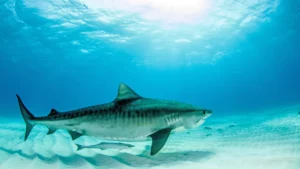
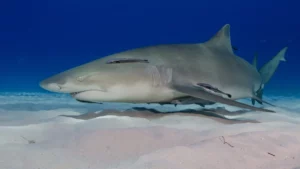
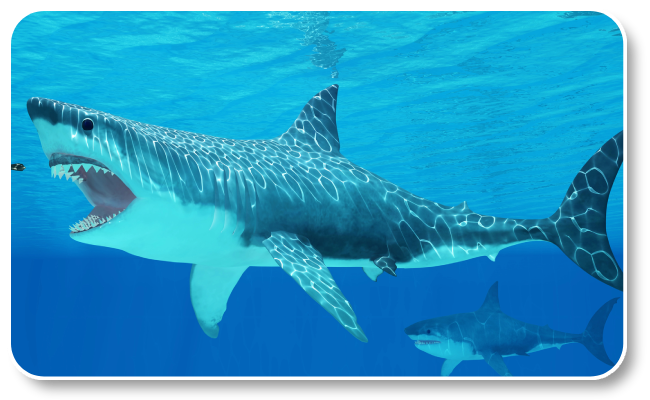
Beyond the teeth, the body is reconstruction. Most workers model megalodon on a scaled-up great white, with a conical snout, a lunate tail, five long gill slits and countershaded colour, and the pictures on this page follow that convention; a 2024 study of the vertebral column argued instead for a longer, slimmer body closer to a mako. Reconstructed jaws hold about 270 teeth in five rows, roughly 46 of them in the front row of the upper jaw (see how many teeth sharks have).
How big was megalodon really?
Every length you have read for megalodon is an estimate from teeth. Because the crown height of a shark tooth scales with body length in living relatives, palaeontologists measure the biggest fossil teeth and apply the great white's ratio. Done carefully, that gives a maximum of about 15 to 16 m: a 2015 survey of hundreds of teeth found an average adult length of around 10 m and a top of 17 to 18 m, a 2019 reanalysis by Kenshu Shimada settled on 14 to 15 m for the largest teeth, and a 2021 study using summed tooth widths put a few exceptional individuals at 20 m. A 2024 reassessment assuming a slimmer body stretched some estimates beyond 20 m, but that remains an outlier.
The only direct measurements come from vertebrae. A partial column from Antwerp with about 150 centra, the largest 15.5 cm across, belonged to a shark of roughly 9 to 11 m; Peruvian and Danish vertebrae are of similar size. Nothing from a 20 m individual has been measured directly.
Weight is a further step of inference. A 16 m three-dimensional reconstruction published in 2022 came out at about 61 tonnes; scaling the same body plan to 20 m gives close to 100 tonnes, and slimmer reconstructions give much less. Newborns were large, about 2 m, judging by the smallest teeth in nursery deposits and the birth ring in the Belgian vertebrae. Whatever the exact figure, an adult megalodon was two to three times the length of the biggest great white and heavier than any whale shark ever weighed. The bar below shows the upper estimate against a 1.8 m diver.

Where megalodon lived
Megalodon teeth have been dug from marine rocks on every continent except Antarctica, which tells us its range: the warm and temperate shelf seas of the whole planet from the North Sea basin and Japan to Australia, South Africa and Chile. Isotope work on the teeth suggests it favoured water above about 20 °C at the surface, but it also turns up in cooler temperate deposits, and a 2023 clumped-isotope study estimated a body temperature of around 27 °C, well above the sea around it, which implies the same partial warm-bloodedness that lets today's great white and mako work in cool water.
Where fossils are dense, the picture is coastal. Shallow, productive shelf and bay deposits hold both adult and juvenile teeth, and several are interpreted as nurseries: the Gatún Formation of Panama, the Bone Valley of Florida, the Calvert Cliffs of Maryland on Chesapeake Bay, and the Tarragona basin of Spain. The rivers of South Carolina and North Carolina are the classic collecting grounds for large teeth today, along with the Atacama coast of Chile and the phosphate mines of Morocco (see where to find shark teeth).
Depth cannot be measured for a fossil. Teeth have been dredged from the deep Pacific floor, where they settled among manganese nodules, but the living whale-hunters it resembled work the upper few hundred metres, and megalodon surely did too.
What megalodon ate and how it hunted
The evidence for diet is direct: fossil bones with bite marks that match megalodon teeth in size and serration. They occur on baleen whales of many sizes, on sperm whales and other toothed whales, on seals, on sea cows and on sea turtles, from Maryland, North Carolina, Peru and Belgium. Isotopes agree: zinc-isotope ratios in the enamel, reported in 2022, place megalodon at the top of its food web, a step above most contemporary sharks.
How it hunted is inferred from the damage. Whale skulls and flippers bear the deepest marks, and some bones show healing, so the shark seems to have attacked the head and the flippers first to immobilise a whale rather than simply slashing at the body, a different approach from the great white's ambush of seals. Estimates of bite force, made by scaling a great white's jaw muscles up to megalodon's dimensions, run from about 110,000 to 180,000 newtons, roughly ten times what a great white can manage and enough to crush a whale's rib cage.
Its prey base was rich. The Miocene seas held dozens of species of small and medium-sized baleen whales, many of them under 10 m, together with early seals and abundant dugong relatives. Bitten teeth and bones show that big sharks also ate smaller sharks, and juveniles in nurseries probably relied on fish and small marine mammals before graduating to whales (sharks and whales).

Behaviour: what can be deduced
Behaviour does not fossilise, so everything here is deduction from anatomy, from living relatives and from where the fossils lie. The warm body temperature inferred from tooth isotopes means megalodon could keep its swimming muscles working across a wide range of sea temperatures and probably cruised at a steady pace with the capacity for short bursts; a 2022 model based on the reconstructed body put its cruising speed at about 5 km/h, above that of any living shark, but the figure depends entirely on the body shape assumed.
A high metabolic rate on that scale demanded an enormous food intake, perhaps 100,000 kilocalories a day for a 16 m animal, one reason palaeontologists doubt megalodon could ever have lived in the deep sea. It also implies a wide-ranging life: teeth from the same rock units occur across whole ocean basins, and the species is best imagined as a nomad following whale populations along coasts and between continents, much as the great white commutes today between seal colonies and offshore waters.
Social life is a blank. Juveniles were concentrated in nurseries, adults apparently were not, and nothing suggests cooperative hunting. The senses were those of any lamniform: keen smell, good low-light vision, a lateral line and the ampullae of Lorenzini for the final approach.

Reproduction and lifespan
No fossil embryo of megalodon has been found, and none is likely: shark embryos leave no hard parts until the teeth form. Everything about reproduction therefore comes from living relatives. All lamniform sharks today, from the great white to the sand tiger, give birth to live young that grow in the uterus by eating unfertilised eggs, and the earliest teeth in nursery deposits are already huge for a newborn. The Belgian vertebral column, analysed in 2021, shows a birth ring that implies a length of about 2 m at birth, the largest of any shark, which makes sense only if the pups ate eggs in the uterus through a long gestation.
Nurseries are the best-documented part of the life cycle. In the Gatún Formation of Panama, described in 2010, most teeth belong to juveniles of 2 to 10 m and adults are scarce; the same pattern appears in the Bone Valley of Florida, at Calvert Cliffs in Maryland and near Tarragona in Spain. Young megalodons spent their first years in warm, shallow, food-rich bays, as young great whites do now.
The Belgian column carries 46 growth bands. If each is annual, that 9 m shark was 46 years old at death and still growing; extrapolating its growth curve gives a potential lifespan of 80 to 100 years, comparable to today's largest sharks (how long sharks live).
Is megalodon dangerous, and is it still alive?
Megalodon poses no danger to anyone, because it has been extinct for about 3.6 million years and the first humans appeared more than a million years after that. No incident is or could be attributed to it, and the SharkSider database, which begins in the sixteenth century, has none. Every "megalodon attack" in fiction and on video is a great white, a basking shark or a computer.
The question people actually ask is whether it might still exist, and the answer from the fossil record is a firm no. Sharks shed thousands of teeth in a lifetime, and megalodon teeth are among the commonest large vertebrate fossils on Earth, yet not one has been found in sediments younger than the late Pliocene; the famous "fresh" teeth dredged by HMS Challenger in 1875 are coated in manganese that took at least tens of thousands of years to form. A 15 m warm-water shark that ate whales would leave bitten whales, stranded carcasses and sightings, none of which exist. What the deep sea hides are small, slow, cold-water animals, not giants that need the productivity of the surface. Read the real record of shark encounters if you want to know what to worry about.
The SharkSider database has no incident attributed to this species. The database draws on the International Shark Attack File, the Global Shark Attack File and verified local reports, and is updated weekly.
Status: extinct, and why
Megalodon has no conservation status because it is gone. The IUCN does not assess species that died out before recorded history, so its category is simply Extinct; the number that matters is the date. Careful re-dating of the youngest fossils, published in 2019, placed the last megalodon at about 3.6 million years ago, in the late Pliocene, earlier than the 2.6 million years that older texts give. It had existed for roughly 20 million years, since the early Miocene.
Why it vanished is a genuine debate. The oceans cooled and sea level fell through the Pliocene, shrinking the warm, shallow shelves that held its nurseries. The small and medium-sized baleen whales it depended on declined at the same time, and the survivors grew larger and shifted toward cold, productive polar waters that a warm-water shark could not follow. And a new competitor arrived: the modern great white, which arose in the Pacific about 6 million years ago, had spread worldwide by about 4 million years ago, and the 2019 study argued that competition from it for the same prey, rather than climate alone, finished megalodon off. Most likely all three worked together.
The lesson is a current one. A giant predator with a narrow diet, slow reproduction and a warm-water range is exactly the profile that fails when the ocean changes, and it is why today's large sharks are on the list of threatened sharks.
Relatives, ancestors and living look-alikes
Megalodon's own family, Otodontidae, is entirely extinct. Its ancestors run back through Otodus chubutensis and Otodus angustidens to the unserrated Otodus obliquus of the Palaeocene and, before that, to the Cretaceous Cretalamna, a lineage that grew larger and more finely serrated over 50 million years. The other ocean giant of its age was the whale-hunting sperm whale Livyatan of Peru, a rival of the same size (more prehistoric sharks).
Among living sharks its closest relatives are the mackerel sharks of the order Lamniformes: the great white, which is not its descendant but its ecological successor, the shortfin mako, the porbeagle and salmon shark, the basking shark that stands in for it in most hoax photographs, and the sand tigers and threshers. The living sharks that come closest to its size are plankton feeders, the whale shark and the basking shark; among predators, the tiger shark and great white are the nearest thing the ocean has to it today (the evolution of sharks).
 Great White Sharkspecies profile
 Shortfin Mako Sharkspecies profile
 Porbeagle Shark Factsspecies profile
 Salmon Sharkspecies profile
 Basking Sharkspecies profile
 Whale Sharkspecies profile
Frequently asked questions
How big was the megalodon?
Estimates from the largest teeth put the biggest megalodons at 15 to 20 m (50 to 65 ft), with an average adult of around 10 m; one 2024 study assuming a slimmer body suggested more. Weight is estimated at 30 to 100 tonnes. No complete skeleton exists, so every figure is an extrapolation from teeth and vertebrae.
When did megalodon live and when did it go extinct?
Megalodon appears in the fossil record about 23 million years ago, in the early Miocene, and the youngest reliably dated fossils are about 3.6 million years old, in the late Pliocene. A 2019 re-dating study moved the extinction earlier than the 2.6 million years quoted in older books.
Is the megalodon still alive?
No. Sharks shed thousands of teeth in a lifetime and megalodon teeth are common fossils, yet none is younger than 3.6 million years. A warm-water whale hunter of 15 m would leave bitten whales, carcasses and sightings, and there are none. The deep sea supports small, slow animals, not giants that need surface productivity.
What did megalodon eat?
Marine mammals above all: baleen whales, sperm whales and other toothed whales, seals and sea cows, plus sea turtles and large fish. Fossil whale bones carry bite marks matching its teeth, and zinc isotopes in the enamel place megalodon at the very top of its food web. Juveniles in nurseries probably ate fish and small mammals.
Was megalodon related to the great white shark?
Only distantly. Megalodon belonged to the extinct family Otodontidae and descended from Otodus sharks; the great white descends from a mako-like ancestor, Carcharodon hubbelli. Both are mackerel sharks of the order Lamniformes and both evolved serrated cutting teeth independently, which is why they were once placed in the same genus.
How big were megalodon teeth?
The largest known megalodon teeth measure 18 to 19 cm (about 7 in) from root corner to tip, roughly three times the size of the biggest great white teeth. They are broad, thick, finely serrated and have a dark chevron-shaped bourlette at the base of the crown. Reconstructed jaws held about 270 teeth in five rows.
How strong was megalodon's bite?
Estimated at 110,000 to 180,000 newtons, based on scaling up the jaw muscles of a great white to megalodon's dimensions. That is roughly ten times the great white's bite force and far more than any living animal. Fossil whale bones with crushed and punctured ribs and flippers show that the estimate is plausible.
Where are megalodon teeth found?
On every continent except Antarctica, in marine rocks of Miocene and Pliocene age. The classic sites are the rivers of South Carolina and North Carolina, the Calvert Cliffs of Maryland, the Bone Valley of Florida, the Atacama coast of Chile and the phosphate mines of Morocco. Nursery deposits are known from Panama, Florida, Maryland and Spain.
How long did megalodon live?
Nobody knows for certain. A vertebral column from Belgium carries 46 growth bands, so that 9 m shark was about 46 years old when it died and still growing. Extrapolating its growth curve gives a potential lifespan of 80 to 100 years, comparable to the largest living sharks.
Why did megalodon go extinct?
Probably a combination of causes. The oceans cooled and sea level fell in the Pliocene, shrinking the warm shelf seas and nurseries it needed; the small and medium-sized whales it ate declined or moved to cold polar waters; and the modern great white had spread worldwide by about 4 million years ago to compete for the same prey.
References

A small team focused on researching sharks and making marine biology easy to understand. Every page is reviewed against current species records and the SharkSider attack database, and updated when new incidents or research appear.
Published December 1, 2014 · Last updated September 22, 2026 · No incident attributed to this species in the SharkSider attack database, which is updated weekly.