
Yes, there are sharks in Greece, 33 species, but the ones you might actually see are small and harmless. The common sharks of Greek waters are the small-spotted catshark, the nursehound, the common smooth-hound, the spiny dogfish and, offshore, the blue shark and the shortfin mako. Basking sharks pass through in spring and the great white is a rare, genuine visitor to the Aegean and Ionian.
The SharkSider database holds 16 dated records for Greece from 1937 to 2014, 9 of them fatal, plus eight older entries reaching back to Herodotus. Nearly all the deaths fall between 1937 and 1965, several of them attributed to white sharks off Corfu and in the Pagasitic Gulf. Since the 1980s the record contains only questionable or minor cases, and no fatal attack on a swimmer at a Greek beach has been confirmed in over half a century.
- Shark species recorded33 with solid records
- ProtectionEU rules; white, basking, angel and porbeagle sharks protected; Alonissos park 1992
- Most seen from the beachSmall-spotted catshark and smooth-hounds
- Signature encounterBlue sharks and makos offshore; spring basking sharks
- Incidents in the database16 dated (1937–2014), 9 fatal; last confirmed fatality 1960s
- Water temperature14–16 °C in February, 24–27 °C in August

On this page
- Where sharks live in Greek waters
- List of the different types of sharks in Greece
- Where to see sharks in Greece
- Best time of year to see sharks in Greece
- Shark attacks in Greece: what the record actually shows
- Is it safe to swim and snorkel in Greece?
- Shark conservation in Greece
- Sharks in neighbouring waters
- Frequently asked questions
- References
Where sharks live in Greek waters
Greece is really two seas. The Aegean, between the mainland and Turkey, is a shallow, island-studded basin whose northern half is fed by the Black Sea outflow through the Dardanelles and by the big rivers of Macedonia and Thrace. That makes the Thermaikos Gulf, the Thracian Sea and the waters around the Sporades the most productive part of the country and the stronghold of the coastal sharks: smooth-hounds, spiny dogfish, catsharks and tope, with sandbar and spinner sharks in the warm gulfs. The southern Aegean and the Cyclades are clearer, saltier and poorer, and their sharks are mostly the deep-water and pelagic species that live along the volcanic arc.
The Ionian, on the western side, is the opposite in shape: a narrow shelf that drops straight into the Hellenic Trench, where the Calypso Deep south of Pylos reaches 5,267 m, the deepest point in the Mediterranean. Deep water this close to land is why Ionian fishermen from Corfu to Kalamata have always seen the big oceanic sharks, the blue, the mako, the thresher and occasionally the great white, within sight of the beaches. It is not a coincidence that most of the serious historical incidents in Greece happened on this side of the country or in the deep gulfs of Thessaly that open onto it.
The third piece is the island shelf itself. With more than 6,000 islands, Greece has a vast area of rocky reef, sand and seagrass between 10 and 100 m, which is exactly the habitat of the small bottom sharks that make up most of the list. Divers who look under ledges at Kalymnos, Milos or the Sporades will find catsharks; trawlers in the gulfs bring up smooth-hounds and dogfish by the crate; and every fish market from Piraeus to Thessaloniki sells them, skinned and headless, as galeos.
List of the different types of sharks in Greece
The table lists every shark with a solid record in Greek waters, based on fisheries landings, research surveys and verified sightings. Sizes are realistic adult lengths, not record fish. The risk column concerns a swimmer or snorkeller at a Greek beach, which for most of these species is academic: the majority live below 100 m or far offshore, and the only species with a real bite history in Greece, the great white, is now a rare visitor. Greek fishermen call any shark karcharias, the small bottom species skylopsaro (dog fish), and the smooth-hounds on the menu galeos.
| Species | Adult size | Risk to swimmers | Where in Greece & notes |
|---|---|---|---|
Blue SharkPrionace glauca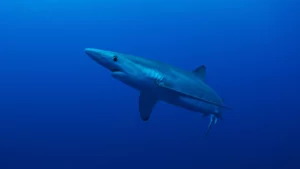 | 2–3 m (7–10 ft) | Low | Open water beyond the shelf, Ionian and southern Aegean; swordfish longline bycatchThe commonest large shark in Greek waters. Slender, deep blue, rarely within sight of a beach. |
Shortfin Mako SharkIsurus oxyrinchus | 2–3 m (7–10 ft) | Moderate | Offshore with tuna and swordfish, summerFast, powerful and quick to react to a hooked or speared fish. Endangered in the Mediterranean; CITES-listed. |
Great White SharkCarcharodon carcharias | 4–6 m (13–20 ft) | High | Rare visitor; Ionian shelf edge, Pagasitic Gulf, CycladesGenuinely recorded in Greece and blamed for the 1951, 1956 and 1963 fatalities, but now seen perhaps once or twice a decade. Critically endangered in the Mediterranean. |
Porbeagle SharkLamna nasus | 1.5–2.5 m (5–8 ft) | Low | Cool northern Aegean water in winter; rareA stocky cold-water relative of the white shark. The Mediterranean population is critically endangered and fully protected. |
Basking SharkCetorhinus maximus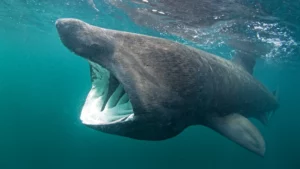 | 6–9 m (20–30 ft) | Low | Surface waters of the Ionian and northern Aegean in springPlankton feeder, harmless. Sightings are reported most years between March and May. |
Common Thresher SharkAlopias vulpinus | 3–5 m (10–16 ft) incl. tail | Low | Offshore; landed at Ionian and Cretan portsHalf tail, used to stun sardines. Timid with people; the source of most “huge shark” photos on Greek quays. |
Bigeye Thresher SharkAlopias superciliosus | 3–4 m (10–13 ft) incl. tail | Low | Deep water south of Crete; longline bycatchHuge upward-facing eyes for hunting in the dark. Never seen by swimmers. |
Sandbar SharkCarcharhinus plumbeus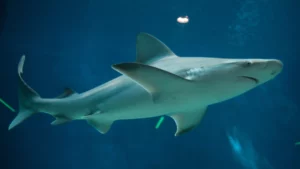 | 1.8–2.4 m (6–8 ft) | Low | Warm northern gulfs and sandy shelves in summerTall dorsal fin, small mouth, no record of unprovoked bites in the Mediterranean. The shark behind most summer “sighting” headlines. |
Spinner SharkCarcharhinus brevipinna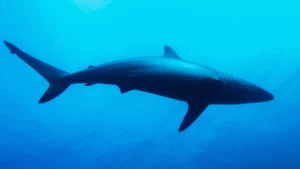 | 2–2.5 m (7–8 ft) | Moderate | Warm coastal water of the eastern Aegean in summerLeaps clear of the surface after schooling fish. Its rare bites, all outside Greece, involve fishermen and nets rather than swimmers. |
Blacktip SharkCarcharhinus limbatus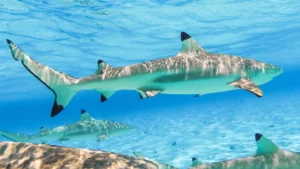 | 1.5–2.5 m (5–8 ft) | Moderate | Rare; warm coastal water of the southern and eastern AegeanA few verified Greek records. Easily confused with the spinner shark; neither is common. |
Copper SharkCarcharhinus brachyurus | 2.5–3.3 m (8–11 ft) | Moderate | Rare; coastal shelves, occasional Ionian recordsThe bronze whaler of Australian beaches. Present in the Mediterranean but scarce in Greece. |
Smooth Hammerhead SharkSphyrna zygaena | 2.5–3.5 m (8–12 ft) | Low | Offshore Aegean and Ionian; once common, now rareThe only hammerhead with regular Mediterranean records. Protected under the Barcelona Convention. |
Small-spotted CatsharkScyliorhinus canicula | 0.6–0.8 m (2–2.5 ft) | Low | Rocky and sandy bottoms from 10 m down, everywhereThe shark a Greek snorkeller is most likely to meet. Its egg cases wash up on beaches after storms. |
| NursehoundScyliorhinus stellaris | 1–1.5 m (3–5 ft) | Low | Rocky reefs and caves; Kalymnos, Milos, the SporadesLarger, boldly blotched. Rests by day in the caves divers explore; harmless. |
Blackmouth CatsharkGaleus melastomus | 0.5–0.7 m (1.5–2.5 ft) | Low | Muddy slopes 200–800 m; a standard trawl bycatchA deep-water catshark with saddle markings and a black mouth lining, landed in the northern Aegean. |
Common Smooth-houndMustelus mustelus | 1–1.5 m (3–5 ft) | Low | Sandy shelves and gulfs nationwide; the <em>galeos</em> of the fish marketFlat crushing teeth for crabs. Timid; the mainstay of Greece's shark landings. |
| Blackspotted Smooth-houndMustelus punctulatus | 0.8–1.2 m (2.5–4 ft) | Low | Same shelves as the common smooth-hound; told apart by black-tipped scalesFound only in the Mediterranean and adjacent Atlantic; regularly logged under the wrong name at the quay. |
Starry Smooth-houndMustelus asterias | 1–1.4 m (3–4.5 ft) | Low | Northern Aegean shelves; less common than its relativesWhite-spotted along the back. Sold under the same galeos name. |
Tope SharkGaleorhinus galeus | 1.2–1.8 m (4–6 ft) | Low | Mid-water over the shelf edge; gulfs of the northern AegeanThe “school shark” of older lists. Listed as critically endangered worldwide and may not be kept if caught in the Mediterranean. |
| Spiny DogfishSqualus acanthias | 0.8–1.2 m (2.5–4 ft) | Low | Cool northern Aegean and Thermaikos Gulf, mainly in winterA spine in front of each dorsal fin. Endangered in the Mediterranean after decades of trawling. |
| Longnose SpurdogSqualus blainville | 0.7–0.9 m (2.5–3 ft) | Low | Shelf and upper slope, 100–400 m, throughout GreeceThe warmer-water dogfish of the Aegean; landed with the smooth-hounds. |
Bluntnose Sixgill SharkHexanchus griseus | 3–4.5 m (10–15 ft) | Low | Deep slopes of the Hellenic Trench and the Aegean basins, usually below 300 mThe largest shark regularly caught in Greece. A slow deep-water hunter with six gill slits that comes up at night and never crosses paths with bathers. |
Sharpnose Sevengill SharkHeptranchias perlo | 0.8–1.2 m (2.5–4 ft) | Low | Deep water 300–700 m; bottom longlinesSmall and big-eyed with seven gill slits. Snaps on deck; that is the whole basis of its “aggressive” reputation. |
| AngelsharkSquatina squatina | 1.2–1.8 m (4–6 ft) | Low | Sandy bottoms 5–150 m; now very rare, northern Aegean and IonianFlat, ray-like ambush hunter, once common. Critically endangered and fully protected, with the smoothback angelshark (Squatina oculata) also recorded. |
Sawback AngelsharkSquatina aculeata | 1.2–1.5 m (4–5 ft) | Low | Deeper muddy bottoms 30–500 m; rareThe deepest of the three Mediterranean angelsharks. Bites only if trodden on or handled. |
Gulper SharkCentrophorus granulosus | 0.8–1.2 m (2.5–4 ft) | Low | Slopes below 300 m; deep longlines south of CreteBig green eyes and a liver rich in squalene; produces a single pup every two years or so, among the slowest rates of any shark. |
Kitefin SharkDalatias licha | 1–1.5 m (3–5 ft) | Low | Deep water 200–1,000 mA chocolate-brown dogfish with thick lips that bites round plugs from larger fish; also the largest known glowing vertebrate. |
Velvet Belly LanternsharkEtmopterus spinax | 0.3–0.45 m (1–1.5 ft) | Low | Slopes below 200 m; the most abundant shark in Aegean trawl surveysLight organs on its belly glow blue-green in the dark. Thrown back dead by the thousand from trawl nets. |
Angular RoughsharkOxynotus centrina | 0.6–1 m (2–3 ft) | Low | Muddy bottoms 60–600 mTriangular body, sail-like fins. On the Mediterranean's critically endangered list and protected from retention. |
Little Sleeper SharkSomniosus rostratus | 0.7–1.2 m (2.5–4 ft) | Low | Deep slopes below 200 m; occasional in deep longlinesA small cousin of the Greenland shark. Sluggish, rare, harmless. |
Smalltooth Sand Tiger SharkOdontaspis ferox | 2.5–3.5 m (8–12 ft) | Low | Deep rocky slopes; scattered Aegean and Ionian recordsBulky and ragged-toothed but placid. Protected under the Barcelona Convention. |
Sand Tiger SharkCarcharias taurus | 2.2–3 m (7–10 ft) | Low | Very rare; historical records from the AegeanOnce present, now almost gone from the Mediterranean. Docile despite the teeth; fully protected. |
Bramble SharkEchinorhinus brucus | 2–3 m (7–10 ft) | Low | Rare; deep water off the Ionian and Cretan slopesThorn-studded skin and a sluggish life below 400 m. A handful of Greek records. |
Several sharks in older Greek lists do not belong there. The bull shark and the tiger shark do not occur in the Mediterranean; the 1983 Antikyra case in the database was blamed on a tiger shark until the coroner found a boat propeller. Blacktip reef sharks and oceanic whitetips are Red Sea and open-Atlantic animals with, at most, a stray record or two in the far south of the basin, and the longfin mako has never been reliably recorded in the Aegean. The great white, on the other hand, is genuine: the Mediterranean holds a small, isolated and critically endangered population centred on the Sicilian Channel, and Greek records, from a 6.4 m fish claimed at Keratsini in 1948 to individuals filmed off the Cyclades in recent years, are real but rare, perhaps one or two verified sightings a decade.
Where to see sharks in Greece
Greece is not a shark-diving destination and nobody sells shark dives here. What it has are marine parks, deep drop-offs and fishing harbours where sharks are part of the scenery if you know what to look for. These are the places with the most reliable records.
- National Marine Park of Alonissos, Northern SporadesEurope's first marine park, created in 1992 for the monk seal, covers 2,200 km² of productive northern Aegean water. Catsharks and nursehounds on the reefs, smooth-hounds and tope over sand, and blue sharks reported by the park's boat crews in summer.
- Corfu and Paxos, Ionian SeaThe deep Ionian shelf edge lies close inshore here, and Corfu has the country's longest incident history, including the 1951 and 1956 white shark cases. Today the same drop-off produces blue sharks, threshers and makos for the local longliners.
- The Pagasitic Gulf and Trikeri, ThessalyAn almost enclosed gulf below Mount Pelion where smooth-hounds and catsharks are trawled and where a 3 m white shark killed a swimmer in 1963. Now a quiet sailing and diving area with rich seagrass beds.
- Thermaikos Gulf and Thessaloniki fish marketThe nutrient-rich northern Aegean, fed by the Axios and Aliakmonas rivers. Spiny dogfish, smooth-hounds, blackmouth catsharks and the occasional angelshark are landed at Nea Michaniona and sold in the city's Kapani and Modiano markets.
- Kalymnos and Symi, DodecaneseThe sponge-diving islands, with sheer walls dropping past 100 m a stone's throw from shore. Nursehounds and blackmouth catsharks in the caves, and the deep water where the database's Symi sponge-diver case took place.
- The Hellenic Trench, south of Crete and the PeloponneseBluewater fishing and research trips out of Pylos, Kalamata and Ierapetra work the edge of the deepest water in the Mediterranean. Blue sharks, shortfin makos and bigeye threshers on the surface; bluntnose sixgills and gulper sharks on the bottom longlines.
- Gyaros marine reserve, CycladesA former prison island turned no-take reserve in 2019, with monk seals and a recovering fish community. Landing is restricted, but boat trips from Syros and Andros pass water where basking sharks have been reported in spring.
- Cretaquarium, Gournes, CreteThe largest public aquarium in Greece, east of Heraklion, keeps several Mediterranean shark species including smooth-hounds and catsharks. The one place in the country where a shark sighting is guaranteed.
For a realistic chance of a live shark, dive the walls at Kalymnos or the Sporades in spring and autumn and look under ledges for catsharks and nursehounds. For pelagic sharks, a bluewater fishing charter out of Crete, Rhodes or the Ionian in late summer is the only practical route, and the good skippers now release blue sharks and makos rather than land them.
Best time of year to see sharks in Greece
Greek waters have a wide seasonal swing, and the sharks follow the temperature.
- June to September: the surface warms from 22 °C to 24–27 °C, higher in the enclosed gulfs. Blue sharks, makos and threshers are on the swordfish and tuna grounds beyond the shelf; sandbar and spinner sharks move into the warm northern gulfs; the great white records, historically, cluster in July and August. The meltemi wind blows hard across the Aegean in July and August, which keeps small boats in port and reduces sightings.
- October to December: the sea is still warm, the wind drops and visibility is at its best. The most comfortable season for diving the walls at Kalymnos, Milos and the Sporades, where nursehounds and catsharks are active.
- January to March: water falls to 14–16 °C, cold enough for spiny dogfish and porbeagles to appear in northern Aegean landings and for the bottom sharks to move into the deeper channels.
- April and May: the plankton bloom. This is basking shark season, with most Greek sightings coming from the Ionian and the northern Aegean in spring, and the time when smooth-hound pups appear in the gulfs.
The eastern Mediterranean warms fast in a heatwave; summers above 28 °C in the Aegean are now common and are one reason Red Sea species are spreading north through the Dodecanese.
Shark attacks in Greece: what the record actually shows
Greece has the longest incident list in the eastern Mediterranean, and it is worth reading properly because most of it is old. SharkSider keeps every case on the shark attacks in Greece page. The database holds 16 dated records from 1937 to 2014, 9 of them fatal, plus eight older or undated entries: five from the 19th century, mostly around Corfu and the Cyclades, two from antiquity, including Herodotus's account of sharks taking Persian sailors off Thessaly in 493 BC, and one undated sponge-diver injury at Symi. These are the six most recent dated records (the full list, updated weekly, is on the attacks page):
- 2014 · 33 nautical miles off Othonoi Island — Of 9 bodies recovered, one was bitten by a sharkSpecies: Shark involvement prior to death still to be determined · not fatal
- 2003 · Near Symi Island, Dodecanese IslandsFree diving for sponges — FatalSpecies not identified · fatal
- 1983 · Andikira FokithesSpearfishing — Coroner determined the man was killed by a boat propeller, not a tiger sharkSpecies: Invalid · not fatal
- 1981 · Pagasitikos GulfFree diving / spearfishing, — Minor injurySpecies not identified · not fatal
- 1980 · Island of KosSurfing — Knee bittenSpecies: Said to involve a white shark but shark involvement not confirmed · not fatal
- 1965 · Eastern shore, Island of VolosSwimming — FatalSpecies not identified · fatal
Two things stand out. First, the deaths are concentrated in one generation: Thessaloniki in 1937, Keratsini in 1948, Piraeus in 1950, Corfu in 1951 (two swimmers attacked at once off the royal residence, one killed) and again in 1956, Kalamata in 1954, Trikeri in 1963 and Volos in 1965. Several of these were attributed at the time to white sharks, and the descriptions, a 3 m fish at Trikeri, a large shark off Corfu, are consistent with that. This was a period when the Mediterranean still held far more large sharks than it does now, and when Greek beaches were filling with swimmers for the first time. The undated Symi case, a sponge diver killed some time before 2003, is the only fatality since and belongs to a dangerous profession rather than to beach bathing.
Second, the modern record is almost empty. Since 1965 the database lists a questionable 1980s knee bite on a surfer at Kos, a minor spearfishing injury in the Pagasitic Gulf in 1981, the 1983 Antikyra case that the coroner ruled a propeller strike, and the 2014 Othonoi entry, a body recovered from a migrant shipwreck with a shark bite that may well have been inflicted after death. That is one possible minor injury to a swimmer in forty years, in a country that receives more than 30 million visitors a summer. The standard advice still applies: do not swim at dusk near fishing boats or fish-cleaning, do not spearfish with a bleeding catch on your belt, and if you do see a large shark, leave the water calmly and tell the coastguard.
Is it safe to swim and snorkel in Greece?
Yes. Sharks are near the bottom of the list of Greek beach hazards, well below rip currents on the exposed Ionian and Cretan coasts, the meltemi blowing inflatables out to sea, sea urchins, jellyfish blooms and, in recent summers, the venomous lionfish and toxic silver-cheeked toadfish that have spread through the Dodecanese from the Red Sea. Greek lifeguards flag currents and jellyfish; no beach in the country has ever needed a shark flag.
The sharks a snorkeller might actually meet are the small-spotted catshark and the nursehound, both of which rest on the bottom or in caves by day and will swim away if approached. Smooth-hounds and tope are timid and fast; you will see a shape and then nothing. A sandbar or spinner shark in a harbour in summer is a rare and harmless sight. Divers on the deep Ionian and Dodecanese walls who meet a blue shark should do what they would anywhere: stay still, keep it in view, and let it lose interest, which takes about a minute.
The one animal to take seriously is the great white, and the honest advice is that it is too rare to plan around. If you spearfish, the two situations that have produced injuries elsewhere in the Mediterranean are a bleeding catch on a stringer and a long swim back to the boat at dusk; avoid both. If you sail, the historical cases involving people swimming off yachts in deep water at Corfu are a reminder to swim near the shore, in daylight, and not alone.
Shark conservation in Greece
Greece is an EU member and its sharks are covered by the union's rules: finning has been banned since 2003, fins must stay naturally attached since 2013, and the great white, basking shark, porbeagle and all three Mediterranean angelsharks are prohibited species that must be released alive. The GFCM, the regional fisheries body, bans retention of the two dozen sharks and rays listed under the Barcelona Convention, which adds the smooth hammerhead, the sand tiger and smalltooth sand tiger, the tope and the angular roughshark. The shortfin mako's CITES listing in 2019 now restricts its trade as well.
The gap, as everywhere in the Mediterranean, is between the paper and the harbour. Greece has one of the largest small-scale fleets in the EU, thousands of boats setting nets and longlines over the same shelves where smooth-hounds, catsharks and dogfish live, and a bottom-trawl fleet in the gulfs that lands them by the tonne. None of those species is protected, and blue sharks taken on swordfish longlines are landed legally. Prohibited species still appear in markets, sometimes mislabelled as galeos. The Mediterranean has lost the great majority of its large sharks over the past century, and the IUCN's regional assessment classes more than half of the basin's sharks and rays as threatened; the angelsharks and the smooth hammerhead, once common in the Aegean, are now critically endangered.
The good news is real, if slow. The Alonissos marine park has protected the northern Sporades since 1992, Gyaros became a no-take reserve in 2019, and the Greek government has committed to protecting 30% of its waters by 2030 and to ending bottom trawling in marine parks. Citizen reporting of sightings, especially of angelsharks, basking sharks and white sharks, is now feeding national databases, and the tagging of blue sharks by Greek research institutes is beginning to show where the pelagic sharks go. For the forces behind those declines, read why sharks are endangered.
Sharks in neighbouring waters
Greece shares its sharks with every country around the Aegean, Ionian and Adriatic. Turkey, across the Aegean, has the region's best-known sandbar shark nursery at Boncuk Cove and a real history of great white records around the Sea of Marmara. Cyprus, to the south-east, has a shorter list and a single incident from 1901. Albania and Montenegro face Corfu across the Strait of Otranto and share the Ionian shelf; Italy and Malta sit on the Sicilian Channel, the heart of the Mediterranean great white's range. Our sharks around the world index links to every coast we have profiled.
Frequently asked questions
Are there sharks in Greece?
Yes. Thirty-three species have solid records in Greek waters, but most are small bottom sharks such as catsharks, smooth-hounds and dogfish, or deep-water species that live below 200 m. Blue sharks, makos and threshers live offshore, basking sharks pass in spring, and the great white is a rare visitor to the Aegean and Ionian.
Have there been shark attacks in Greece?
Yes, historically. The SharkSider database lists 16 dated records from 1937 to 2014, nine of them fatal, plus older cases back to antiquity. Nearly all the deaths fall between 1937 and 1965, several blamed on white sharks off Corfu and in Thessaly. Since the 1980s only minor or questionable cases exist, and no swimmer has been killed at a beach in over 50 years.
Are there great white sharks in Greece?
Yes, but rarely. The Mediterranean holds a small, critically endangered population centred on the Sicilian Channel, and Greek records are genuine: white sharks were blamed for fatalities at Corfu in 1951 and 1956 and at Trikeri in 1963, and individuals are still filmed in the Aegean every few years. Sightings now number one or two a decade.
Is it safe to swim in Greece?
Yes. Sharks are not a realistic risk on Greek beaches; the hazards that actually cause trouble are rip currents, the meltemi wind blowing inflatables offshore, sea urchins, jellyfish and the venomous lionfish spreading through the Dodecanese. No confirmed shark injury to a swimmer has occurred at a Greek beach since the early 1980s.
Are there sharks in Crete, Rhodes and the Greek islands?
Yes, the same species as the rest of the country: catsharks and smooth-hounds on the shelves, blue sharks and makos in the deep water south of Crete, and deep-living sixgills and gulper sharks on the slopes. None of the popular islands has a modern incident on record; the only recent island entry is a questionable 1980s knee bite at Kos.
Are there sharks in Corfu?
Yes, and Corfu has the longest shark history in Greece. The deep Ionian shelf edge lies close to shore, and swimmers were attacked there in 1847, 1853, 1863, 1951 and 1956, with the last two cases blamed on white sharks. Nothing has been recorded there since, and today the drop-off mainly produces blue sharks and threshers for local longliners.
What is the most common shark in Greece?
On the shelf, the small-spotted catshark and the common smooth-hound, which is the galeos sold in every fish market. In the cool northern Aegean the spiny dogfish is landed in numbers, and in deep-water trawls the velvet belly lanternshark outnumbers everything. Offshore, the blue shark is the usual longline bycatch.
When is the best time to see sharks in Greece?
Spring, from March to May, for basking sharks in the Ionian and northern Aegean; summer for blue sharks, makos and threshers offshore and sandbar sharks in the warm gulfs; and October to December for the calmest, clearest diving on the walls where catsharks and nursehounds live. Winter brings spiny dogfish and porbeagles into the northern landings.
Can I dive with sharks in Greece?
Not as an organised activity; no Greek operator runs shark dives. Divers most often meet nursehounds and catsharks in the caves and walls of Kalymnos, Milos and the Sporades, and bluewater fishing charters from Crete, Rhodes or the Ionian encounter blue sharks and makos. Cretaquarium near Heraklion keeps several Mediterranean species.
Is shark fishing legal in Greece?
Partly. EU rules ban finning and require fins to stay attached, and the great white, basking shark, porbeagle, angelsharks, hammerheads, tope and sand tigers must be released. Smooth-hounds, catsharks, dogfish and blue sharks are still caught and sold legally, mostly as bycatch of the trawl and longline fleets.
References

A small team focused on researching sharks and making marine biology easy to understand. Every page is reviewed against current species records and the SharkSider attack database, and updated when new incidents or research appear.
Published December 8, 2022 · Last updated September 21, 2026 · Incident data from the SharkSider attack database (16 records for Greece, 9 fatal).


