
Yes, there are sharks in Italy, 37 species, and the ones you might meet are small and shy. On any Italian fish counter the sharks are small bottom-dwellers: small-spotted catsharks, nursehounds, common smooth-hounds, blackmouth catsharks and spiny dogfish. Offshore, blue sharks and shortfin makos follow the swordfish and tuna, basking sharks surface in the Ligurian Sea in spring, and the Mediterranean's small, critically endangered population of great whites is genuinely recorded around Sicily, Sardinia, Tuscany and in the Adriatic.
The SharkSider database holds 73 entries for Italy: 64 dated from 1900 onward, of which 10 are flagged fatal, plus 9 older cases stretching back to 1721. Read closely, the modern list is far less alarming than the numbers suggest. Six of the ten flagged deaths are confirmed shark kills, and the most recent was a diver at Baratti in Tuscany in 1989; the others are a wartime air crash, a migrant shipwreck, a diver whose death was never linked to a shark and a 1934 report that turned out to be false. Since 1990 the record contains one bitten canoe, one bitten calf and a handful of fishermen's stories.
- Shark species recorded37 with solid records
- ProtectionEU rules; white, basking, porbeagle and angelsharks prohibited; Pelagos Sanctuary 1999; 30+ marine protected areas
- Most seen from the beachSmall-spotted catshark and smooth-hounds (palombo)
- Signature encounterBlue sharks and basking sharks in the Ligurian Sea; sixgills in the Strait of Messina
- Incidents in the database64 (1901–2018), 10 flagged fatal, plus 9 older cases from 1721; last confirmed death 1989
- Water temperature13–15 °C in February, 24–28 °C in August

On this page
- Where sharks live in Italian waters
- List of the different types of sharks in Italy
- Where to see sharks in Italy
- Best time of year to see sharks in Italy
- Shark attacks in Italy: what the record actually shows
- Is it safe to swim and snorkel in Italy?
- Shark conservation in Italy
- Sharks in neighbouring waters
- Frequently asked questions
- References
Where sharks live in Italian waters
Italy's four seas could hardly be more different, and the sharks sort themselves accordingly. The Ligurian Sea in the north-west is deep, cold and productive: an upwelling zone between Genoa, Corsica and the French coast where plankton blooms every spring, fin whales gather, and the big pelagic sharks, blue, mako, thresher and basking, come within a few kilometres of Portofino and the Cinque Terre. The Ligurian coast from Bordighera to La Spezia accounts for more entries in the incident database than any other stretch of Italy.
The Tyrrhenian Sea, between the mainland, Sardinia and Sicily, is where the Mediterranean white shark story is centred on the Italian side. The Tuscan Archipelago, and Elba in particular, produced a run of white shark encounters with boats and divers through the 1980s, and Baratti, Piombino and the Circeo promontory south of Rome are the sites of the country's two best-documented fatal attacks. The Strait of Messina, where the Tyrrhenian meets the Ionian in a churning tidal channel, has been famous for sharks since antiquity: swordfish hunters in their feluche have harpooned white sharks here for centuries, and its deep, cold currents bring bluntnose sixgills and other slope species up to the surface.
The Adriatic is the shallow sea. Its northern basin off Venice, Chioggia, Rimini and Ancona is rarely deeper than 50 m, warm in summer and fed by the Po, which makes it the richest trawling ground in Italy and the home of the coastal sharks: smooth-hounds, catsharks, dogfish, sandbar sharks and, historically, large white sharks that followed the tuna into the shallows. Finally there is the Sicilian Channel in the far south, between Sicily, Lampedusa and Tunisia: the heart of the Mediterranean white shark's range, a tuna highway, and the part of Italy where the largest sharks are still caught most often.
List of the different types of sharks in Italy
The table lists every shark with a solid Italian record from fisheries landings, research trawls, tuna traps and verified sightings. Sizes are realistic adult lengths rather than the biggest fish ever weighed. The risk column is about swimmers at an Italian beach, and for most of these species it is a formality: the majority live below 100 m or well offshore. In the markets the smooth-hounds are sold as palombo, the blue shark as verdesca, the catsharks as gattuccio and the spiny dogfish as spinarolo; a big shark of any species is a pescecane.
| Species | Adult size | Risk to swimmers | Where in Italy & notes |
|---|---|---|---|
Blue SharkPrionace glauca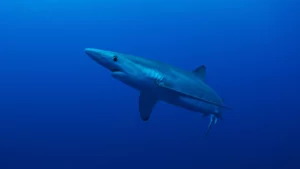 | 2–3 m (7–10 ft) | Low | Offshore in all four seas; Ligurian Sea in summer; swordfish longline bycatchThe verdesca, Italy's commonest large shark. Slim, deep blue, curious around boats and almost never near a beach. |
Shortfin Mako SharkIsurus oxyrinchus | 2–3 m (7–10 ft) | Moderate | Open water with tuna and swordfish; Sicilian Channel, Ionian, LigurianFast and reactive around hooked fish, which is the basis of its reputation; no confirmed unprovoked bite in Italy. Endangered in the Mediterranean and CITES-listed. |
Great White SharkCarcharodon carcharias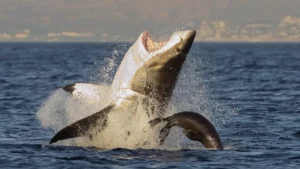 | 4–6 m (13–20 ft) | High | Sicilian Channel, Strait of Messina, Tuscan Archipelago, northern Adriatic; now rareGenuinely Italian and responsible for the 1962 Circeo and 1989 Baratti deaths. A small, critically endangered Mediterranean population; a handful of sightings a year at most. |
Porbeagle SharkLamna nasus | 1.5–2.5 m (5–8 ft) | Low | Cooler water of the Ligurian Sea and northern Adriatic in winter; rareThe smeriglio. The 1942 Savona case, a sculler who hit one with an oar and was capsized, is the only Italian entry involving it. Critically endangered in the Mediterranean and fully protected. |
Basking SharkCetorhinus maximus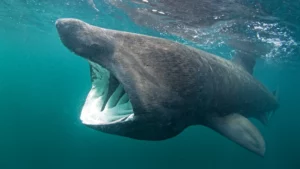 | 6–9 m (20–30 ft) | Low | Surface of the Ligurian and northern Tyrrhenian seas, March to MayThe squalo elefante, a plankton feeder and the largest shark regularly seen in Italy. Harmless; several sightings every spring off Liguria and Tuscany. |
Common Thresher SharkAlopias vulpinus | 3–5 m (10–16 ft) incl. tail | Low | Offshore everywhere; landed at Ligurian, Sicilian and Adriatic portsThe volpe di mare, half of it tail. Timid; the source of most “giant shark on the quay” photographs in Italian newspapers. |
Bigeye Thresher SharkAlopias superciliosus | 3–4 m (10–13 ft) incl. tail | Low | Deep water of the Ionian and Sicilian Channel; swordfish longline bycatchIts oversized eyes look upward to pick out squid against the faint light above. Never seen by swimmers. |
Sandbar SharkCarcharhinus plumbeus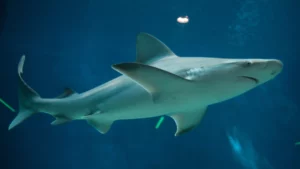 | 1.8–2.4 m (6–8 ft) | Low | Warm sandy shallows of the northern Adriatic and the Sicilian Channel in summerA tall first dorsal fin and a small mouth; not one unprovoked bite anywhere in the Mediterranean. When an Italian newspaper runs a summer “shark alert”, this is usually the fish. |
Spinner SharkCarcharhinus brevipinna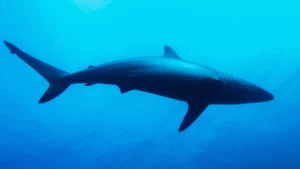 | 2–2.5 m (7–8 ft) | Moderate | Warm coastal water of Sicily and the Ionian in summer; uncommonLeaps and spins after schooling fish. Its rare bites elsewhere involve nets and fishermen, not bathers. |
Blacktip SharkCarcharhinus limbatus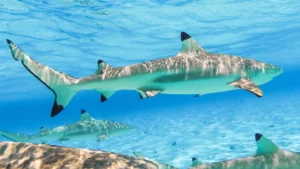 | 1.5–2.5 m (5–8 ft) | Moderate | Rare; southern Sicily, Lampedusa and the IonianA few verified Italian records, easily confused with the spinner. Neither species is common north of Sicily. |
Copper SharkCarcharhinus brachyurus | 2.5–3.3 m (8–11 ft) | Moderate | Rare; coastal shelves of Sicily, Sardinia and the southern TyrrhenianThe bronze whaler of Australian surf beaches, present but scarce in Italian water. |
Dusky SharkCarcharhinus obscurus | 3–3.6 m (10–12 ft) | Moderate | Rare; scattered records from the Sicilian Channel and IonianA large, slow-growing requiem shark, occasionally taken by tuna longliners in the south. |
Smooth Hammerhead SharkSphyrna zygaena | 2.5–3.5 m (8–12 ft) | Low | Offshore Tyrrhenian and Sicilian Channel; once common, now rareThe only hammerhead with regular Italian records. Protected under the Barcelona Convention. |
Scalloped Hammerhead SharkSphyrna lewini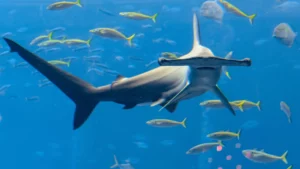 | 2.5–3.5 m (8–12 ft) | Low | Very rare; a few records from the Sicilian Channel and IonianAn occasional visitor from the Atlantic, told from the smooth hammerhead by the notch in the middle of its head. Critically endangered worldwide. |
Small-spotted CatsharkScyliorhinus canicula | 0.6–0.8 m (2–2.5 ft) | Low | Sand and rocky bottoms from 10 m down, in all four seasThe gattuccio, the shark an Italian snorkeller is most likely to meet and the commonest shark in the trawl nets. Harmless. |
| NursehoundScyliorhinus stellaris | 1–1.5 m (3–5 ft) | Low | Rocky reefs and caves: Ustica, Aeolians, Tuscan islands, SardiniaThe gattopardo, bigger and more boldly blotched than its cousin. Rests in the caves divers explore; harmless. |
Blackmouth CatsharkGaleus melastomus | 0.5–0.7 m (1.5–2.5 ft) | Low | Muddy slopes 200–800 m; a standard deep-trawl bycatch off Liguria and SicilySaddle-marked with a black mouth lining, landed as boccanera in the Ligurian markets. |
Common Smooth-houndMustelus mustelus | 1–1.5 m (3–5 ft) | Low | Sandy shelves everywhere; the northern Adriatic above allThe palombo of every Italian fish market. Flat crushing teeth for crabs, timid, and the mainstay of the country's shark landings. |
| Blackspotted Smooth-houndMustelus punctulatus | 0.8–1.2 m (2.5–4 ft) | Low | Adriatic and Sicilian shelves, mixed with the common smooth-houndA Mediterranean near-endemic, sold under the same name and rarely told apart at the quay. |
Starry Smooth-houndMustelus asterias | 1–1.4 m (3–4.5 ft) | Low | Northern Adriatic and Ligurian shelves; less common than its relativesWhite-spotted along the back. The third palombo. |
Tope SharkGaleorhinus galeus | 1.2–1.8 m (4–6 ft) | Low | Mid-water over the shelf edge in all Italian seasThe canesca, or school shark of older lists. Critically endangered globally and may not be retained in the Mediterranean. |
| Spiny DogfishSqualus acanthias | 0.8–1.2 m (2.5–4 ft) | Low | Cooler shelves of the northern Adriatic and Ligurian Sea, mainly in winterThe spinarolo, with a spine ahead of each dorsal fin. Endangered in the Mediterranean after a century of trawling. |
| Longnose SpurdogSqualus blainville | 0.7–0.9 m (2.5–3 ft) | Low | Shelf and upper slope, 100–400 m, throughout ItalyThe warm-water dogfish of the Tyrrhenian and Sicilian slopes, landed with the smooth-hounds. |
Bluntnose Sixgill SharkHexanchus griseus | 3–4.5 m (10–15 ft) | Low | Deep slopes everywhere; drawn to the surface in the Strait of MessinaThe capopiatto, the largest shark regularly caught in Italy. A sluggish deep-water hunter that rises at night and never crosses a bather's path. |
Sharpnose Sevengill SharkHeptranchias perlo | 0.8–1.2 m (2.5–4 ft) | Low | Deep water 300–700 m off Sicily, Calabria and LiguriaSmall, big-eyed, seven gill slits. Snaps on deck, which is the whole basis of its “aggressive” label in older guides. |
| AngelsharkSquatina squatina | 1.2–1.8 m (4–6 ft) | Low | Sandy bottoms 5–150 m; now very rare, Sicilian Channel and SardiniaThe squadro, once a routine catch on the sandy Adriatic shelf and now almost never seen. Critically endangered and fully protected. |
Sawback AngelsharkSquatina aculeata | 1.2–1.5 m (4–5 ft) | Low | Deeper muddy bottoms 30–500 m off Sicily; rareThe deepest of the three Mediterranean angelsharks, with a row of thorns down its back. Bites only if handled. |
| Smoothback AngelsharkSquatina oculata | 1–1.4 m (3–4.5 ft) | Low | Sandy slopes 50–300 m, Sicilian Channel and Ionian; rareTold by the large eye-spots on its pectoral fins. Critically endangered like its two relatives. |
Gulper SharkCentrophorus granulosus | 0.8–1.2 m (2.5–4 ft) | Low | Slopes below 300 m; deep longlines off Sicily, Calabria and SardiniaGreen-eyed, with a liver rich in squalene. A single pup every couple of years makes it one of the slowest-breeding fish alive. |
Kitefin SharkDalatias licha | 1–1.5 m (3–5 ft) | Low | Deep water 200–1,000 m in the Tyrrhenian and IonianA thick-lipped brown dogfish that bites round plugs from larger fish and glows faintly in the dark. |
Velvet Belly LanternsharkEtmopterus spinax | 0.3–0.45 m (1–1.5 ft) | Low | Slopes below 200 m; the most abundant shark in Italian deep-trawl surveysLight organs on its belly glow blue-green. Discarded dead by the thousand from every deep haul. |
Angular RoughsharkOxynotus centrina | 0.6–1 m (2–3 ft) | Low | Muddy bottoms 60–600 m, especially the Ligurian and Adriatic slopesThe pesce porco, triangular in cross-section with sail-like fins. Listed as critically endangered in the Mediterranean and off-limits to fishing. |
Portuguese DogfishCentroscymnus coelolepis | 0.9–1.2 m (3–4 ft) | Low | The deepest Italian slopes, below 1,000 m in the Tyrrhenian and IonianOne of the deepest-living sharks known, taken only by research trawls and the deepest longlines. |
Little Sleeper SharkSomniosus rostratus | 0.7–1.2 m (2.5–4 ft) | Low | Deep slopes of the Ligurian and Tyrrhenian seas; occasionalA small relative of the Greenland shark. Sluggish, rare, harmless. |
Smalltooth Sand Tiger SharkOdontaspis ferox | 2.5–3.5 m (8–12 ft) | Low | Deep rocky slopes; scattered records off Sicily, Sardinia and the IonianA heavy, snaggle-toothed deep-reef shark with a placid temperament; may not be kept under the Barcelona Convention. |
Sand Tiger SharkCarcharias taurus | 2.2–3 m (7–10 ft) | Low | Very rare; historical records from the Tyrrhenian and AdriaticFormerly resident, now close to extinct in the Mediterranean. Gentle for all its teeth, and fully protected. |
Bramble SharkEchinorhinus brucus | 2–3 m (7–10 ft) | Low | Rare; deep water off Sicily, Calabria and the Ligurian slopeA slow, thorn-covered shark of the deep slope, known in Italy from a handful of deep-longline catches. |
A few sharks that appear on older Italian lists do not belong there. The tiger shark and the bull shark have no confirmed Mediterranean record; every Italian “tiger shark” sighting has turned out to be a large blue shark, a sixgill or a white. Reef sharks, hammerheads other than the smooth hammerhead, and the oceanic whitetip are vagrants at best. The great white, on the other hand, is genuine and was once common in these seas. Italy sits inside the range of the Mediterranean's small, isolated and critically endangered white shark population, and its records run from the female with human remains netted off Augusta after the 1908 Messina earthquake to the 4 m animal that bit a canoe off Portofino in 1991. The species is now seen perhaps once or twice a year across the whole country, usually by fishermen in the Sicilian Channel or the Adriatic.
Where to see sharks in Italy
Italy has no shark-diving industry, but it has protected seas, deep water close to shore and old fishing ports where sharks have been part of daily life for centuries. These are the places with the best records.
- Pelagos Sanctuary, Ligurian SeaThe 87,500 km² whale sanctuary between Liguria, Corsica and Sardinia. Whale-watching boats from Genoa, Savona and Imperia regularly meet blue sharks on the surface in summer and basking sharks feeding on the spring bloom.
- Tuscan Archipelago: Elba, Giglio and BarattiThe centre of Italy's white shark history, with boat encounters at Marciana Marina and Lacona through the 1980s and the fatal 1989 attack in the Gulf of Baratti. Today the national park's reefs hold nursehounds and catsharks, and blue sharks pass offshore.
- Strait of MessinaThe tidal channel between Sicily and Calabria, worked by swordfish harpoon boats. Bluntnose sixgills, threshers and, historically, white sharks are drawn up by its upwellings; the database's entries here run from 1738 to 1967.
- Lampedusa and the Sicilian ChannelThe southernmost Italian island, closer to Tunisia than Sicily, on the tuna route through the heart of the Mediterranean white shark's range. Pelagic sharks and large whites are caught here more often than anywhere else in the country.
- Carloforte and the Gulf of Oristano, SardiniaSardinia's west coast, where the ancient tuna trap at Carloforte and the shallow Gulf of Oristano have both recorded white sharks. Blue sharks are common off the island, as the 2012 Muravera rescue shows.
- Chioggia, Rimini and Ancona, northern AdriaticThe trawling capital of Italy. Smooth-hounds, catsharks and spiny dogfish are landed by the crate at Chioggia's market, and the shallow warm sea produced the country's most notorious historical cases, from Ancona in 1904 to the 7 m white shark reported off San Benedetto in 1999.
- Aeolian Islands and UsticaVolcanic islands north of Sicily with sheer walls dropping past 100 m. Divers at Ustica's marine reserve, Italy's first, occasionally meet nursehounds, and deep longlines around the Aeolians bring up sixgills, gulpers and kitefins.
- Acquario di GenovaThe largest aquarium in Italy, on the old port of Genoa, keeps several shark species in a large tank viewed from multiple levels. Guaranteed sharks, in the one Italian building where that is true.
For a wild shark, the most realistic plan is a summer whale-watching trip out of the Ligurian ports, where blue sharks are a regular bonus, or a spring visit when basking sharks surface between Genoa and Livorno. Divers should look under ledges at Ustica, the Aeolians and the Tuscan islands for nursehounds and catsharks. A morning at the Chioggia or Catania fish market will show you more Italian shark species in an hour than a year of diving.
Best time of year to see sharks in Italy
Italian waters swing between a cold, mixed winter and a hot, layered summer, and the sharks follow the change.
- March to May: the Ligurian and northern Tyrrhenian bloom. Basking sharks appear at the surface off Liguria and Tuscany, the season for most Italian sightings of the species, and blue sharks begin to move inshore. Surface water is still only 14–17 °C.
- June to September: the surface warms to 24–28 °C, and to 29 °C in the shallow Adriatic and the Sicilian Channel in a heatwave. Swordfish and tuna longliners meet blue sharks, makos and threshers offshore; sandbar and smooth-hounds move into the warm Adriatic shallows; and the white shark records, historically, cluster from June to September, the same months the beaches fill.
- October and November: the water is still warm, the crowds are gone and visibility is at its best for divers on the Tuscan, Sicilian and Sardinian walls where nursehounds and catsharks live.
- December to February: the sea cools to 13–15 °C, the bottom sharks move deeper, spiny dogfish and porbeagles appear in the northern landings, and almost nothing is seen from shore.
The Mediterranean is warming faster than the global ocean, and Italian summers above 28 °C at the surface are now routine. That favours the warm-water requiem sharks, sandbar, spinner and blacktip, and pushes cold-water species such as the porbeagle and spurdog further north and deeper.
Shark attacks in Italy: what the record actually shows
Italy has the longest incident list in the Mediterranean, and it needs careful reading. Every entry is listed, and updated weekly, on the shark attacks in Italy page. The database holds 73 entries: 64 dated from 1900 onward, of which 10 carry a fatal outcome, and 9 older cases that run back from a bather killed at Bordighera in 1899 and a swimmer's leg injured at Trieste in 1887, through fatalities at Trieste in 1868, the Strait of Messina in 1738 and Sardinia in 1721, to a Greek wine vessel found on Ischia, painted around 725 BC, that shows shipwrecked sailors being attacked by a shark. The six most recent dated cases are shown here:
- 2018 · Torino di Sangro, Chieti, ProvincePlaying — Calf bittenSpecies not identified · not fatal
- 2015 · SardiniaDiving — Fatal, but shark involvement prior to death unconfirmedSpecies: Shark involvement not cofirmed · fatal
- 2012 · Muravera, SardiniaAttempting to rescue an injured & beached shark — Lower left leg injured provoked accidentSpecies: Blue shark, 2.5m · not fatal
- 2006 · Lampedusa IslandSea Disaster — FatalSpecies not identified · fatal
- 2001 · RiminiFishing — No injury to occupantsSpecies not identified · not fatal
- 1999 · San Benedetto, Adriatic SeaFishing — No injury to occupantsSpecies: Said to involve a 7 m [23'] white shark · not fatal
Three things stand out. First, most of the list is not attacks on swimmers at all. Roughly a third of the entries are sharks interacting with boats: white sharks ramming or biting fishing boats at Elba, Chioggia, Catania and the Strait of Messina, a shark striking the Acqua Alta research platform off Venice in 1978, a 4 m white shark biting a canoe 20 miles off Portofino in 1991. Another large group is marked provoked: fishermen bitten by hooked or netted sharks at Genoa, Riva Trigoso, Giulianova and Chioggia, a diver who shot a shark at Brindisi in 1967 and was injured by it, and the 2012 Muravera case of a swimmer hurt while dragging a stranded blue shark back into the sea. Several more are marked invalid or questionable by the investigators themselves.
Second, the genuine fatalities are old and are concentrated in a few places. The confirmed shark deaths are Nicotera in Calabria in 1902, four bathers at Ancona in 1904, after which the town installed steel mesh nets, a swimmer at Varazze in 1926 taken by what witnesses described as a 6–7 m white shark, a swimmer at Amalfi in 1951, the spearfisher killed by a white shark at the Secca del Quadro off Circeo in 1962, and the diver killed by a 6 m white shark in the Gulf of Baratti in February 1989, the last confirmed fatal attack in Italy. The four other entries flagged fatal are of a different kind: airmen who went into the Adriatic in 1944, a shipwreck off Lampedusa in 2006, a diver who died off Sardinia in 2015 with no confirmed shark involvement, and a 1934 report from Kraljevica, on the Croatian coast, which investigators found to be false. The three bodies recovered from a 4.5 m white shark netted off Augusta in January 1909 were almost certainly victims of the Messina earthquake and tsunami a fortnight earlier.
Third, the last thirty years are nearly empty. Since Baratti the record lists a windsurfer bitten on the thigh by a 3 m white shark off Marinella di Carrara four months later, in June 1989, then the Portofino canoe, a shark that ate bait hanging from a boat off Senigallia in 1998, a 7 m white shark reported by fishermen off San Benedetto in 1999, a boat incident at Rimini in 2001, and the 2018 case at Torino di Sangro in Abruzzo, where a bather playing in shallow water had a calf bitten by an unidentified fish. In a country that puts tens of millions of people in the sea every summer, that is the entire modern record. The usual precautions still apply where they matter: spearfishers should not tow a bleeding catch at dusk, and nobody should swim off a boat in deep water at night near fishing activity.
Is it safe to swim and snorkel in Italy?
Yes. On an Italian beach a shark ranks below jellyfish, sea urchins, weever fish buried in the sand, rip currents on the exposed Sardinian and Tyrrhenian coasts and, on the busiest Adriatic beaches, jet skis. Italian lifeguards fly flags for sea state and jellyfish; there has been no need for a shark flag in living memory, and the mesh nets Ancona put up in 1904 came down generations ago.
A snorkeller's realistic shark list is two species long: the small-spotted catshark and the nursehound, both of which spend the day lying under ledges or in caves and slide off when approached. A smooth-hound crossing a sand patch is the third possibility, and it will be gone before you have focused on it. In the warm Adriatic shallows a sandbar shark in a harbour makes local news every summer and has never hurt anyone. A blue shark that appears on a deep wall at the Aeolians, Ustica or the Tuscan islands is investigating, not hunting; stay where you are, watch it, and it will usually have lost interest within a minute.
The great white deserves a straight answer. It is real in Italian water, it has killed people here, and it is now so rare that no sensible visitor plans around it. The two situations that produced the fatal cases, spearfishing with a catch in the water at Circeo and a diver on the surface far from the boat at Baratti, are the same two situations that produce white shark bites everywhere. Avoid them, swim in daylight near the shore, and Italy's seas are as safe from sharks as any in the world.
Shark conservation in Italy
As an EU member Italy applies the union's shark law: no finning since 2003, fins landed naturally attached since 2013, and a prohibited list, the great white, basking shark, porbeagle and the three Mediterranean angelsharks, that must go back alive. On top of that sit the Barcelona Convention species that the GFCM, the Mediterranean fisheries body, forbids anyone to keep, among them the smooth hammerhead, both sand tigers, the tope and the angular roughshark. Italy's own contribution was the 2002 ban on the swordfish driftnets known as spadare, which had killed untold numbers of blue sharks, threshers and makos for decades; the shortfin mako's 2019 CITES listing added a trade control on top.
The problem is scale. Italy has one of the largest fishing fleets in the Mediterranean, thousands of trawlers and longliners working exactly the grounds where the coastal and pelagic sharks live, and it is also the biggest consumer of shark meat in Europe. Palombo on a menu may be a smooth-hound, but it may also be a blue shark, a tope or a protected species mislabelled; studies of Italian markets keep finding prohibited sharks sold under harmless names. More than half of the Mediterranean's sharks and rays are threatened according to the IUCN's regional assessment, and the angelsharks that Chioggia trawlers once landed by the crate have all but vanished from Italian coasts.
The positive side is real. The Pelagos Sanctuary has protected the Ligurian Sea's pelagic ecosystem since 1999; Ustica, Miramare, Portofino, the Tuscan Archipelago and the Egadi Islands anchor a network of more than thirty marine protected areas; and Italian research institutes now tag blue sharks and record every white shark sighting in a national database. To understand the forces driving Mediterranean sharks down, read why sharks are endangered; to understand what the smallest of them are up against, the velvet belly lanternshark that dies by the thousand in every deep trawl is a good place to start.
Sharks in neighbouring waters
Italy sits in the middle of the Mediterranean and shares its sharks with every coast around it. France, across the Ligurian Sea, shares the Pelagos Sanctuary and its blue and basking sharks. Croatia and Montenegro face Italy across the Adriatic and have their own white shark history in the same shallow, warm sea. Malta and Tunisia lie on the Sicilian Channel, the core of the Mediterranean white shark's range, and Greece continues the Ionian to the east with a similar list and a similar string of mid-century cases. Every other coast we have profiled is on the sharks around the world index.
Frequently asked questions
Are there sharks in Italy?
Yes, 37 species with solid records, though the great majority are either small bottom sharks (catsharks, smooth-hounds, dogfish) or deep-water species from below 200 m. Offshore the blue shark, mako and thresher follow the swordfish fleet, basking sharks surface off Liguria each spring, and the great white, though rare, is a genuine Italian shark.
Have there been shark attacks in Italy?
Yes, historically. The SharkSider database lists 64 entries dated from 1900, ten flagged fatal, plus nine older cases back to 1721. Six of the deaths are confirmed shark attacks, the last at Baratti in Tuscany in 1989; the rest are an air crash, a shipwreck, an unconfirmed diving death and a false report. Since 1990 the worst injury is a bitten calf.
Are there great white sharks in Italy?
Yes, but rarely. The Mediterranean holds a small, critically endangered white shark population centred on the Sicilian Channel, and Italian records are among the best documented anywhere: Elba, Baratti, Circeo, the Strait of Messina and the northern Adriatic all have verified cases. Today the species is seen perhaps once or twice a year, almost always by fishermen.
Is it safe to swim in Italy?
Yes. Sharks are not a realistic hazard on Italian beaches; jellyfish, sea urchins, weever fish and rip currents on the exposed coasts cause far more trouble. The only shark injury to a bather this century was a bitten calf at Torino di Sangro in 2018, from an unidentified fish, in a country that puts tens of millions of people in the sea every summer.
Are there sharks in Sardinia and Sicily?
Yes, the same species as the mainland and a few more. Sicily and the Sicilian Channel are the Italian heartland of the great white and of pelagic sharks caught by tuna and swordfish boats, and the Strait of Messina brings up sixgills. Sardinia has blue sharks offshore, catsharks and nursehounds on its reefs, and historical white shark records from the Gulf of Oristano.
What is the most common shark in Italy?
The small-spotted catshark and the common smooth-hound, the palombo of every Italian market, dominate the shelf. In the cool northern Adriatic the spiny dogfish is landed in numbers, in deep trawls the velvet belly lanternshark outnumbers everything, and offshore the blue shark is the standard longline bycatch and the large shark most often seen from boats.
When is the best time to see sharks in Italy?
Basking sharks surface off Liguria and Tuscany from March to May; the swordfish season from June to September brings blue sharks, makos and threshers to the offshore grounds while sandbar sharks move into the warm Adriatic shallows; and October and November give divers the clearest water on the walls where nursehounds and catsharks rest. In winter the northern ports land spiny dogfish and the occasional porbeagle.
Can I dive with sharks in Italy?
Not as an organised activity; no Italian operator runs shark dives. Divers most often meet nursehounds and catsharks at Ustica, the Aeolian Islands, the Tuscan Archipelago and Sardinia, and whale-watching trips from Ligurian ports regularly encounter blue sharks in summer. The Acquario di Genova keeps several species for a guaranteed view.
Where was the last fatal shark attack in Italy?
In the Gulf of Baratti near Piombino in Tuscany, on 2 February 1989, when a diver swimming on the surface was taken by a white shark estimated at 6 m; his body was never recovered. It followed the 1962 death of a spearfisher at Circeo south of Rome, also attributed to a white shark. No confirmed fatal attack has occurred in Italy since.
Is shark fishing legal in Italy?
Partly. Under EU rules finning is banned and fins must stay attached, while great whites, basking sharks, porbeagles, angelsharks, hammerheads, tope and sand tigers have to be released alive. Everything else, smooth-hounds, catsharks, dogfish and blue sharks above all, is landed legally and in quantity, because Italy eats more shark than any other country in Europe.
References

A small team focused on researching sharks and making marine biology easy to understand. Every page is reviewed against current species records and the SharkSider attack database, and updated when new incidents or research appear.
Published December 28, 2022 · Last updated September 21, 2026 · Incident data from the SharkSider attack database (64 records for Italy, 10 fatal).


