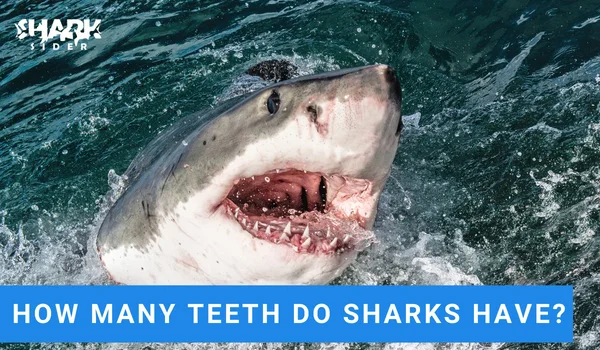
A shark carries anywhere from a few dozen to several thousand teeth at once, and the number depends on the species: an adult great white holds around 300 across its jaws, while a whale shark carries roughly 3,000 tiny ones in about 300 rows.
Only the front row or two does any work. The rest sit folded back in a membrane over the jaw cartilage, moving forward as the working teeth break off or fall out. Because that replacement never stops, a single shark can shed more than 30,000 teeth across a long life, which is why teeth are by far the most common shark fossil.
- Great white, teeth at onceAbout 300
- Whale shark, teeth at onceAbout 3,000 in ~300 rows
- Shed over a lifetime30,000 or more
On this page
The number, species by species
There is no single figure, and any page that gives you one has skipped the interesting part. Tooth count tracks diet and jaw size, so it swings by a factor of a hundred or more between one shark and the next.
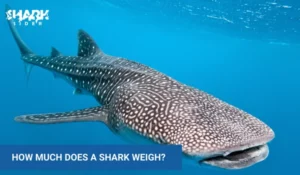
An adult great white shark carries about 300 teeth across both jaws at any moment, counting the working row and the replacements stacked behind it. A tiger shark sits in the same range. At the other end, the whale shark holds roughly 3,000 teeth in something like 300 rows — each one only a few millimetres long and useless for feeding, since the animal strains plankton through pads in its throat instead. The basking shark keeps hundreds of similarly vestigial teeth for the same non-reason.
Smaller sharks carry proportionally fewer. A horn shark or a catshark has a few dozen functional teeth per jaw. The honest answer to the question is a range — dozens to thousands — and the number that actually matters is how many are doing the biting, which is almost always just the first row or two.

Rows, and why the teeth keep moving forward
Shark teeth are not set into sockets in the jaw the way ours are. They sit in a tough fibrous sheet that lies over the jaw cartilage, angled backwards in ranks. Most sharks carry somewhere between five and fifteen of these ranks in each jaw, and the whole sheet creeps forward like a slow conveyor, bringing the next rank upright as the one in front is lost.
That loss happens constantly. Teeth break on bone and shell, they get torn out in a struggling prey animal, and they simply work loose because nothing anchors them. Replacement speed varies with water temperature, age and how hard the shark is feeding: a warm-water species can swing a new tooth into position within a week or two, while cold-water sharks take far longer. Nobody has measured it in most species.
Multiply an unhurried replacement rate by a life that can run to several decades and the totals get large. Estimates of 30,000 teeth or more over a lifetime are routinely quoted for the bigger species, and there is no reason to think that is generous. The mechanism is described in more detail in our guide to shark anatomy.

Four tooth shapes, four ways of eating
Counting teeth tells you less than looking at them. Shark dentition falls into a handful of designs, each matched to what the animal swallows.
Crushing plates are low, flat and pavement-like, and belong to shellfish eaters — the Port Jackson shark and its relatives grind molluscs and urchins with the back of the jaw while the pointed front teeth hold the prey. Grasping needles are long, narrow and smooth-edged, built to spear and hold slippery fish; the shortfin mako and the sand tiger both carry them, which is why their teeth stay visible with the mouth shut.
Cutting blades are broad triangles with serrated edges, and they do what a saw does: the great white's upper teeth slice through blubber and muscle while the narrower lower teeth pin the prey. The tiger shark's version is the most specialised of all — a squat, notched cockscomb with coarse serrations, the same shape top and bottom, capable of shearing through a sea turtle's shell. Vestigial teeth are the fourth design, and they do nothing at all: the filter feeders kept them without keeping a use for them.

Great white: serrated cutting triangles. 
Nurse shark: small crushing teeth behind a powerful suction bite. 
Tiger shark: notched cockscomb teeth that cut turtle shell.
What the best-known sharks actually carry
The shortfin mako has perhaps the most recognisable dentition of any shark: long, curved, smooth-edged spikes that project past the lips even when the jaw is closed. They are grasping teeth, not cutting ones, which fits a shark that chases tuna and swordfish and swallows what it catches.
The nurse shark works the opposite way. Its teeth are small, flattened and many-cusped, arranged in dense rows, and they do less of the work than the mouth itself: a nurse shark drops the floor of its mouth to generate suction strong enough to pull a fish out of a crevice, then holds it with those small teeth. That combination is why nurse shark bites on handlers are so hard to release.
Among the hammerheads, the great hammerhead carries broad, strongly serrated triangles angled towards the corners of the jaw, suited to a diet that includes stingrays. The smaller hammerhead species have weaker serrations and more crushing surface at the back. Different jaw, different menu, same underlying conveyor.

Shortfin mako: long smooth spikes that show even with the mouth closed. 
Great hammerhead: serrated triangles set obliquely in a narrow jaw.
What a shark tooth is made of
A shark tooth is not bone. Sharks have no bone anywhere — the whole skeleton is cartilage, as explained in do sharks have bones — and their teeth are modified skin scales that migrated into the mouth. The same placoid scales that give shark skin its sandpaper feel share the tooth's construction: a core of dentine wrapped in a hard outer layer of enameloid, over a pulp cavity.
That enameloid is harder and more mineralised than the shark's own skeleton, which is the reason a 60-million-year-old tooth survives in sediment while the animal that grew it leaves nothing behind. Size follows the shark: teeth from large adult great whites reach about 7.5 cm along the edge, while the back teeth of the same animal are a fraction of that.
Bite force is the figure everyone wants and nobody has properly measured in a free-swimming great white. The numbers in circulation come from computer models of jaw muscle and lever geometry, one of which put a 6.4 m individual at roughly 18,000 newtons at the rear teeth. It is a modelled value, not a reading from an instrument, and it should be quoted that way.

Why the beach is full of them, and the sea floor is not
Sharks have been shedding teeth into the ocean for more than 400 million years, so the raw supply is enormous. Most of it vanishes: a shed tooth on a reef gets buried, abraded or dissolved long before anything preserves it. What survives is the small fraction that landed in fine sediment and was covered quickly, and those are the fossils that wash out of eroding cliffs and riverbeds today.
This is why shark teeth dominate the fossil record of the group while complete skeletons are vanishingly rare. A cartilage skeleton disintegrates; a mineralised tooth does not. Collectors in Florida, the Carolinas and Morocco pull them out by the bucket, and the same is true anywhere a marine sediment layer of the right age is exposed. Our guide to finding shark teeth covers where to look and how to tell a fossil from a modern shed.
The find rate says nothing about how many teeth the ocean holds now. It is a preservation filter, not a census, and it is heavily biased towards the big triangular teeth that are easy to spot. If you want the species behind the shapes, start with the full list of shark species.

Frequently asked questions
How many teeth does a great white shark have?
About 300 at any one time, counted across both jaws and including the replacement ranks behind the working row. Only the front rank does the cutting. Because the shark keeps shedding and replacing, the running total over a long life is far higher, and estimates of tens of thousands of teeth are normal for a species this size.
Which shark has the most teeth?
The whale shark, by a wide margin. It carries roughly 3,000 teeth in about 300 rows, each only a few millimetres long. They play no part in feeding, since the animal filters plankton through pads in its throat. The old claim that bull and great white sharks hold the record is simply wrong.
How many rows of teeth do sharks have?
Most sharks carry between five and fifteen ranks in each jaw, lying flat behind the upright working row. Great whites sit near the lower end of that range. The whale shark is the extreme case with around 300 rows. The ranks are not sockets but a membrane that slides forward over the jaw cartilage.
How often do sharks replace their teeth?
Continuously, but at a pace nobody has measured in most species. In warm water and in actively feeding sharks a replacement can rotate into place within a week or two; cold-water species are much slower. Feeding intensity, age and temperature all shift the rate, so a single universal figure does not exist.
How big is a great white shark tooth?
Teeth from the largest adults reach about 7.5 cm measured along the cutting edge. Teeth further back in the same jaw are considerably smaller, and juveniles carry narrower, less strongly serrated teeth than adults. Tooth size scales with body length, so a measured tooth gives a rough idea of the animal it came from.
Are shark teeth made of bone?
No. Sharks have no bone in their bodies at all. A shark tooth is a modified skin scale built from dentine and capped with enameloid, the same construction as the placoid scales covering the skin. That mineralised cap is harder than the cartilage skeleton, which is why teeth fossilise and skeletons almost never do.
Do sharks lose their teeth when they bite?
Often, yes. Nothing roots a shark tooth into the jaw, so a tooth that catches on bone, shell or a thrashing prey animal can simply pull free. Broken and shed teeth are recovered from bite wounds and from carcasses routinely. The replacement system exists precisely because losing teeth is a normal cost of feeding.
Why are fossil shark teeth so common?
Because the enameloid surface mineralises and the rest of the animal does not. A cartilage skeleton breaks down within weeks of death, while a tooth buried in fine sediment can survive for tens of millions of years. Add 400 million years of continuous shedding and teeth become the most abundant vertebrate fossil in many marine deposits.
References

A small team focused on researching sharks and making marine biology easy to understand. Every page is reviewed against current species records and the SharkSider attack database, and updated when new incidents or research appear.
Published January 23, 2023 · Last updated September 23, 2026 · Filed under FAQ.