Yes, there are sharks in Morocco, more than most visitors expect. Around 34 species have a solid record along the Atlantic and Mediterranean coasts, and another twenty or so deep-water species turn up in trawl and longline catches. The ones you are most likely to encounter are the blue shark, the shortfin mako, the smooth hammerhead, the small-spotted catshark and the smooth-hounds; critically endangered angel sharks still survive in the sandy shallows of the far south around Dakhla.
Bites are extremely rare. The SharkSider database holds a single incident for Morocco: a swimmer who jumped from a yacht in open water west of Dakhla in September 2024 and lost a leg, in a bite reported at the time as a great white. Nobody has died in a shark attack in Moroccan waters, and there is no modern record of a swimmer or surfer being bitten from a Moroccan beach.
- Shark species recorded34 confirmed (50+ with deep-sea species)
- Protection statusNo national ban; CITES, ICCAT and Barcelona Convention rules apply
- Most seen from the shoreSmooth-hounds and small-spotted catshark
- Signature encounterBlue sharks and makos offshore from Tangier and Agadir
- Incidents in the DB1 (2024, off Dakhla), 0 fatal
- Water temperature16–23 °C Atlantic, 15–26 °C Mediterranean

On this page
- Why Morocco has so many sharks (and why you rarely see them)
- List of the different types of sharks in Morocco
- Where to see sharks in Morocco
- Best time of year to see sharks in Morocco
- Shark attacks in Morocco: what the record actually shows
- Is it safe to swim and snorkel in Morocco?
- Shark conservation in Morocco
- Sharks in neighbouring waters
- Frequently asked questions
- References
Why Morocco has so many sharks (and why you rarely see them)
Two oceanographic engines drive the shark life of Morocco. The first is the Canary Current upwelling. Trade winds blowing along the Atlantic coast push surface water offshore, and cold, nutrient-rich water rises from the deep to replace it, especially between Cape Ghir near Agadir and the wide shelf off Dakhla in the far south. That upwelling is why Morocco is the biggest sardine exporter in the world, and where there are sardines, mackerel and squid in those quantities there are blue sharks, makos, threshers and hammerheads feeding on them. The second engine is the Strait of Gibraltar: only 14 kilometres wide but up to 900 metres deep, with Atlantic water pouring in at the surface and salty Mediterranean water sliding out underneath. Every spring the bluefin tuna run through it into the Mediterranean, and pelagic sharks follow the same road. Moroccan and Spanish longliners have worked this junction for generations because it concentrates animals that are otherwise spread across an ocean.
The Mediterranean side is smaller but not poorer. The Alboran Sea between Morocco and Spain is the coldest, most productive corner of the whole Mediterranean, and off Al Hoceima the seabed falls away to more than a thousand metres within sight of the beach. That brings deep-water sharks such as the bluntnose sixgill, the blackmouth catshark and the gulper sharks close to a coastline where the Mediterranean is elsewhere a warm, nutrient-poor sea.
So why do so few visitors ever see a shark? The Atlantic water is cold, 16 to 20 °C for most of the year, and churned by surf, so the tropical reef sharks people picture are simply absent. Most species that do live here are either pelagic, cruising far beyond the surf zone, or bottom-dwelling and nocturnal. And Morocco has fished its sharks hard for a century: the coastal species that were once common in the shallows, above all the angel shark, have been thinned to the point where a sighting is news.
List of the different types of sharks in Morocco
The table lists every species with a solid record in Moroccan waters on either coast. Sizes are realistic adult lengths rather than the largest fish ever landed. The risk column is about swimmers and surfers in the places they actually go, which is why an animal like the blue shark, dangerous enough to a person adrift in open ocean, is rated low: it almost never comes inside the surf. Local names cause confusion. In the ports a shark is a kelb el bhar (sea dog), which covers everything from a catshark to a mako; the “hammerhead” on a Moroccan stall is nearly always the smooth hammerhead rather than the scalloped or great; and the flat, ray-like “ange de mer” is the angel shark, a species that is now critically endangered.
| Species | Adult size | Risk to swimmers | Where in Morocco & notes |
|---|---|---|---|
Blue SharkPrionace glauca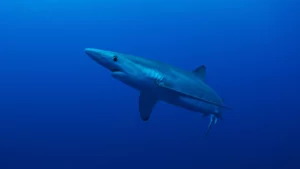 | 2–3 m (7–10 ft) | Low | Open Atlantic and the Strait of Gibraltar, May–OctoberThe most abundant large shark in Moroccan waters and the backbone of the longline fishery. Stays offshore; harmless to beach swimmers. |
Shortfin Mako SharkIsurus oxyrinchus | 2.5–3.5 m (8–11 ft) | Moderate | Deep water off Agadir, Tangier and Dakhla in summerThe fastest shark in the sea and a prized catch. Now must be released alive under ICCAT rules; a possible culprit in the 2024 Dakhla bite. |
Longfin Mako SharkIsurus paucus | 2.5–3.5 m (8–11 ft) | Low | Far offshore over the Atlantic abyss; rareA slower, longer-finned cousin of the shortfin, taken occasionally on tuna longlines. Never inshore. |
Porbeagle SharkLamna nasus | 2–2.5 m (7–8 ft) | Low | Northern Atlantic coast and the Alboran Sea in cooler monthsMorocco is near the southern edge of its range. Landed occasionally at Agadir and Tangier; harmless to swimmers. |
Common Thresher SharkAlopias vulpinus | 3–5 m (10–16 ft) incl. tail | Low | Strait of Gibraltar and the Alboran Sea, spring to autumnOnce the main victim of the swordfish driftnets. Uses its scythe-like tail to stun sardines; timid around people. |
Bigeye Thresher SharkAlopias superciliosus | 3–4 m (10–13 ft) incl. tail | Low | Deep offshore water on both coastsHuge upward-looking eyes for hunting in the dark. Protected under ICCAT; must be released if hooked. |
Basking SharkCetorhinus maximus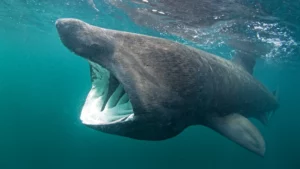 | 6–9 m (20–30 ft) | Low | Alboran Sea off Nador and Al Hoceima in spring; Atlantic offshoreThe second-largest fish in the world, a plankton feeder with no interest in people. Strictly protected in the Mediterranean. |
Great White SharkCarcharodon carcharias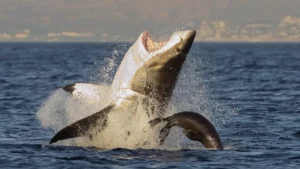 | 4–6 m (13–20 ft) | High | Rare: Alboran Sea and the cold southern AtlanticGenuinely recorded but scarce; years pass between confirmed Moroccan specimens. Reported as the species in the 2024 Dakhla incident, unconfirmed. |
Smooth Hammerhead SharkSphyrna zygaena | 2.5–3.5 m (8–11 ft) | Low | Strait of Gibraltar, Alboran Sea and the Atlantic shelf in summerThe hammerhead of Moroccan fish markets. Tolerates cool water better than its relatives; no incident with a swimmer here. |
Scalloped Hammerhead SharkSphyrna lewini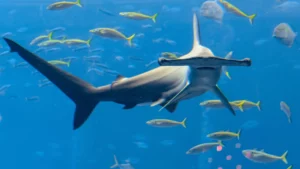 | 2.5–3.5 m (8–11 ft) | Low | Southern Atlantic coast from Agadir to DakhlaWarmer-water hammerhead, more common south of Cape Ghir. Critically endangered worldwide and protected under ICCAT. |
Great Hammerhead SharkSphyrna mokarran | 3.5–4.5 m (11–15 ft) | Moderate | Rare visitor to the far southern Atlantic coastThe largest hammerhead, at the northern limit of its range off Dakhla. Retention banned by ICCAT. |
Blacktip SharkCarcharhinus limbatus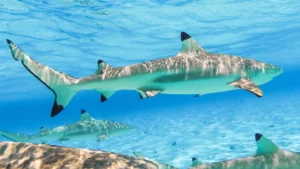 | 1.5–2 m (5–7 ft) | Moderate | Warm southern Atlantic shallows and, rarely, the Alboran SeaA fast, jumping hunter of sardines and mullet. Responsible for many minor bites in Florida; no Moroccan case. |
Spinner SharkCarcharhinus brevipinna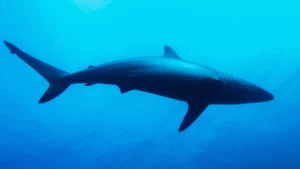 | 2–2.5 m (7–8 ft) | Low | Southern Atlantic coast; occasional in the MediterraneanNamed for its spiralling leaps through baitfish. Easily confused with the blacktip; equally uninterested in people. |
Sandbar SharkCarcharhinus plumbeus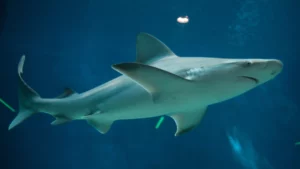 | 1.8–2.4 m (6–8 ft) | Low | Atlantic shelf and the Alboran Sea over sandA tall-finned, heavy-bodied shark that stays near the bottom. Common in the fishery, placid in the water. |
Dusky SharkCarcharhinus obscurus | 3–3.6 m (10–12 ft) | Moderate | Atlantic shelf edge; occasional in the western MediterraneanA large, slow-growing requiem shark that takes 20 years to mature. Endangered; mostly a longline bycatch here. |
Copper Shark (Bronze Whaler)Carcharhinus brachyurus | 2.5–3 m (8–10 ft) | Moderate | Cool Atlantic water from Essaouira south; Alboran SeaA temperate-water shark that follows sardine shoals. Bites surfers occasionally in Australia; no Moroccan record. |
Bull SharkCarcharhinus leucas | 2.2–3.2 m (7–11 ft) | High | Rare; warm southern Atlantic coast near DakhlaMorocco is the northern edge of its eastern Atlantic range and records are few. Far more common off Senegal. |
Tiger SharkGaleocerdo cuvier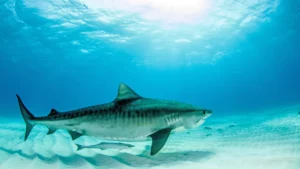 | 3–4.5 m (10–15 ft) | High | Rare stray in the southern Atlantic; exceptional in the MediterraneanA handful of records from Moroccan longliners. Not a species a swimmer will meet here. |
| Oceanic Whitetip SharkCarcharhinus longimanus | 2–3 m (7–10 ft) | High | Open Atlantic far offshore; very rare in the MediterraneanBold pelagic shark that investigates anything floating. A real risk to people adrift in open ocean, irrelevant on the coast. Protected under ICCAT. |
Sand Tiger SharkCarcharias taurus | 2.2–3 m (7–10 ft) | Low | Rocky reefs and wrecks on both coasts; now rareFearsome-looking with its protruding teeth, but sluggish and harmless. Critically endangered in the Mediterranean. |
Smalltooth Sand Tiger SharkOdontaspis ferox | 3–4 m (10–13 ft) | Low | Deep rocky slopes of the Alboran Sea and the Atlantic canyonsA deep-water species seldom seen alive. Occasional Moroccan landings; strictly protected in the Mediterranean. |
| Angel SharkSquatina squatina | 1.2–1.8 m (4–6 ft) | Low | Sandy shallows of Dakhla Bay and the far south; remnant elsewhereCritically endangered and almost gone from Europe. Morocco's southern coast may hold one of the last mainland populations. Bites only if stepped on. |
Sawback AngelsharkSquatina aculeata | 1.2–1.5 m (4–5 ft) | Low | Muddy shelf and slope off the Atlantic and Alboran coastsA deeper-living angel shark with a row of thorns down its back. Critically endangered; occasional trawl bycatch. |
Tope Shark (School Shark)Galeorhinus galeus | 1.4–1.8 m (5–6 ft) | Low | Atlantic coast, caught from beaches and small boatsSlender, fast and shy. A favourite of surfcasters from Essaouira to Tan-Tan and a common sight on port stalls. |
Common Smooth-houndMustelus mustelus | 1–1.5 m (3–5 ft) | Low | Sandy shallows on both coasts, all yearThe shark you are most likely to see inshore. Flat crushing teeth for crabs; harmless. Heavily fished for its meat. |
Starry Smooth-houndMustelus asterias | 1–1.4 m (3–4.5 ft) | Low | Northern Atlantic coast and the MediterraneanRecognised by white spots along its back. Pups in shallow bays in spring; harmless. |
Small-spotted CatsharkScyliorhinus canicula | 60–80 cm (2–2.5 ft) | Low | Everywhere on sand and rock from the shallows to 400 mThe most numerous shark on both coasts and the one Mediterranean divers actually meet. Lays eggs in leathery cases. |
| NursehoundScyliorhinus stellaris | 1.2–1.6 m (4–5 ft) | Low | Rocky reefs and ledges of the Mediterranean coastThe larger, bigger-spotted catshark. Rests under overhangs by day around Al Hoceima and M'diq; completely placid. |
Blackmouth CatsharkGaleus melastomus | 60–90 cm (2–3 ft) | Low | Deep muddy slopes of the Alboran Sea and the Atlantic shelf edgeA small deep-water catshark with a jet-black mouth lining, abundant in trawl catches. Never seen by swimmers. |
| Spiny Dogfish (Spurdog)Squalus acanthias | 0.8–1.2 m (2.5–4 ft) | Low | Cool Atlantic shelf water and the Alboran SeaA small schooling shark with a venomous spine in front of each dorsal fin. Handle with care on a fishing deck; harmless in the water. |
Bluntnose Sixgill SharkHexanchus griseus | 3.5–4.8 m (11–16 ft) | Low | Deep water off Al Hoceima and the Atlantic slope, 200–1,500 mA primitive giant that rises toward the surface at night. Landed by deep longliners; no contact with swimmers. |
Sharpnose Sevengill SharkHeptranchias perlo | 1–1.4 m (3–4.5 ft) | Low | Deep slopes of both coastsSmall, slim and seven-gilled, with huge green eyes. A regular in deep trawl catches. |
Bramble SharkEchinorhinus brucus | 2–3 m (7–10 ft) | Low | Rare; deep water off the Atlantic and Mediterranean coastsA flabby, thorn-studded deep-sea shark recorded occasionally by Moroccan trawlers. Endangered and seldom seen. |
Whale SharkRhincodon typus | 6–12 m (20–40 ft) | Low | Occasional late-summer visitor offshore in the far south; absent from the MediterraneanA filter feeder at the extreme northern edge of its eastern Atlantic range. Records exist but nobody should travel to Morocco expecting one. |
What is not in Morocco matters just as much. There are no reef sharks: the blacktip reef, whitetip reef and grey reef sharks that fill photographs from the Red Sea and the Maldives are Indo-Pacific species that never reach the Atlantic. Whale sharks are a rare, late-summer visitor to the deep water of the far south and do not enter the Mediterranean at all. The great white shark is genuinely present but scarce: the Alboran Sea is a recognised, if thinly populated, part of the Mediterranean white shark range, and individuals have been landed on both Moroccan coasts over the decades, yet years can pass between confirmed records. Bull sharks and tiger sharks sit at the very northern edge of their eastern Atlantic range here, and both are far more likely off Senegal than off Agadir.
Beyond the table, Moroccan trawlers and deep longliners bring up a long list of small deep-water sharks a swimmer will never meet: the gulper shark, the kitefin shark, the Portuguese dogfish, the velvet belly lanternshark, the angular roughshark and even the primitive frilled shark. Together they push the true species count for Moroccan waters past fifty.
Where to see sharks in Morocco
Morocco is not a shark-diving destination in the way South Africa or the Maldives are. Nobody runs cage dives, and the Mediterranean reefs off Tetouan and Al Hoceima hold catsharks rather than anything big. The realistic ways to see a Moroccan shark are from a boat over deep water, on a surfcasting beach in the south, or on the concrete of a port auction at dawn. These are the places that reliably deliver.
- Strait of Gibraltar, off TangierThe busiest shark corridor in the region. Blue sharks, shortfin makos and common threshers follow the tuna migration through the strait from May to September, and sport-fishing boats out of Tangier reach the deep channel within an hour. Most whale-watching trips still leave from the Spanish side, but the sharks belong to both.
- Al Hoceima National Park, Mediterranean coastMorocco's only marine national park, with 40 km of cliffs and coves on the Alboran Sea and water that plunges to over 1,000 m close inshore. Dive centres in Al Hoceima and Cala Iris find nursehounds and small-spotted catsharks on the rocky reefs; threshers and smooth hammerheads are seen from boats in summer.
- Nador and Cap des Trois FourchesThe eastern end of the Moroccan Mediterranean. The Beni Ansar fishing fleet lands smooth hammerheads, blue sharks and spiny dogfish, and basking sharks are reported off the cape in spring when the plankton blooms.
- M'diq and Marina Smir, near TetouanThe main Mediterranean diving area for Moroccans and visitors. Shark encounters are limited to catsharks and the occasional angel shark on sand, but it is the easiest place in the country to get in the water with a guide.
- Agadir and TaghazoutMorocco's biggest fishing port and its surf capital. Offshore charters run to the Cape Ghir upwelling for blue sharks and makos from June to October; the port auction is a lesson in what the fleet catches, from smooth-hounds and tope to the odd porbeagle. Surfers at Taghazout, Anchor Point and Tamraght have never had a recorded shark incident.
- EssaouiraA wind-blown fishing town where the small wooden boats still land catsharks, smooth-hounds and tope at the harbour. Watch the catch come in at the fish stalls beside the Skala; it is the most honest shark census on the coast.
- Sidi Ifni to Tan-TanThe empty southern Atlantic coast, where the upwelling is strongest and surfcasters catch tope, smooth-hounds and spiny dogfish from the beach. Sea temperatures here can be colder in August than in January because of the upwelling.
- Dakhla Bay and the Dakhla peninsulaA 40 km lagoon in the far south, famous for kitesurfing. The sandy shallows are one of the last places on the African mainland where angel sharks are still seen, and smooth-hounds and guitarfish share the flats. The 2024 incident happened in open ocean west of the peninsula, not in the bay.
If you want to get in the water with a shark rather than look at one on a slab, the Mediterranean dive centres are your best chance, and the animal will almost certainly be a nursehound or a small-spotted catshark lying under a ledge. For blue sharks and makos, book a summer charter out of Tangier or Agadir and ask specifically for a shark trip; a handful of skippers now run catch-and-release days instead of selling the catch.
Best time of year to see sharks in Morocco
Morocco's two coasts run on different clocks. The Atlantic is cold all year and coldest, strangely, in the middle of summer wherever the upwelling is strongest; the Mediterranean warms up like any other Mediterranean beach.
- Atlantic, May to October: the season for pelagic sharks. Blue sharks arrive in numbers from late spring, shortfin makos peak from July to September, and the tuna run through the Strait of Gibraltar pulls threshers and hammerheads into the channel from May onward. Surface water is 18–22 °C off Agadir but can drop to 16 °C at Cape Ghir on a strong upwelling day.
- Atlantic, November to April: rougher seas and fewer boats offshore. Catsharks, smooth-hounds and tope stay inshore all year and move onto shallow sand in spring to pup, which is when surfcasters catch the most of them.
- Mediterranean, March to May: the plankton bloom in the Alboran Sea. Basking sharks are reported off Nador and Al Hoceima, and diving visibility is at its best before the summer crowds. Water 15–18 °C.
- Mediterranean, June to September: warm water of 22–26 °C, calm seas and the peak of the dive season. Smooth hammerheads and threshers are landed most often in these months.
- Far south, August to October: the only window in which a whale shark is a realistic, if unlikely, sighting in deep water off Dakhla.
For the angel shark there is no season worth planning around; the few remaining animals are on the sand of Dakhla Bay all year, and the best way to find one is to ask the local fishermen where they last saw a ange de mer.
Shark attacks in Morocco: what the record actually shows
Morocco receives well over ten million tourists a year, a large share of them on Atlantic and Mediterranean beaches, and the shark incident record is almost empty. SharkSider tracks every reported case worldwide in its own database, which feeds the global shark attacks section, and for Morocco it contains exactly one entry:
- 2024 · West of Dakhla, Southern MoroccoSwimming - jumped off yacht — Leg severedSpecies: Reportedly a Great White · not fatal
That single record is the September 2024 case west of Dakhla. A tourist swimming in open water after jumping from a yacht was bitten and lost a leg, and survived. The species was never confirmed from bite evidence, and the “great white” identification circulated in the press within hours of the event. A white shark is possible in those cold, sardine-rich waters, but a shortfin mako would fit the open-ocean setting just as well, and no photograph or tooth fragment has settled it. It is the only shark bite ever documented in Morocco by the international attack files, and it was not fatal.
The pattern matches what we see in neighbouring Spain and Portugal: the dangerous species are pelagic, and the only people who share the water with them are those who go offshore, whether swimming from a boat, spearfishing over deep reefs or handling a shark on a fishing deck. Beach swimmers, surfers and kitesurfers in Morocco have no incident to their name. That does not make the Atlantic a safe playground: rip currents at Agadir, Essaouira and Rabat kill swimmers every summer, and the sea is a far bigger danger than anything in it. If you do swim offshore, the standard advice applies: stay in a group, keep close to the boat, avoid dusk, and never swim where fish are being cleaned.
Is it safe to swim and snorkel in Morocco?
As far as sharks are concerned, yes. The species you could conceivably meet in the shallows are all harmless. Small-spotted catsharks and nursehounds are docile bottom-dwellers with tiny teeth. Smooth-hounds have flat crushing plates for eating crabs rather than cutting teeth, and they bolt from a swimmer. Tope and spiny dogfish are shy and mostly nocturnal inshore. The one animal worth a little respect is the angel shark: it lies buried in sand in water knee to waist deep, and if you step on one it can whip round and bite the foot that trod on it. Around Dakhla Bay, shuffle your feet on the flats rather than stamping, exactly as you would for stingrays.
Snorkelling in Morocco is a Mediterranean activity. The Atlantic is too cold and too turbid for it outside a few sheltered coves, and the visibility at Agadir or Essaouira is often under two metres. On the Mediterranean side, the coves of Al Hoceima National Park and the rocky points near M'diq and Cabo Negro offer 10–15 m of visibility in summer and a genuine chance of a catshark under a ledge. Mediterranean sharks large enough to matter, the smooth hammerhead and the occasional white, live over the deep basin and have no interest in a snorkeller on a rocky reef.
Where common sense matters is around fishing. Moroccan harbours gut fish at the water's edge, and blood and offal in the water is exactly what draws a larger shark inshore anywhere in the world, so swim away from the ports. Spearfishers on the deep drop-offs off Al Hoceima should keep their catch on a float line, not on their belt. And if you are on a yacht offshore, treat the sea around it as open ocean, because that is what it is.
Shark conservation in Morocco
Morocco is one of the most important shark-fishing nations in Africa and consistently ranks among the top twenty in the world in the FAO catch statistics. Blue shark makes up the bulk of the landings, followed by shortfin mako, threshers, smooth hammerhead, tope and the small coastal smooth-hounds and catsharks. The meat is eaten locally and exported to Spain and Italy, and until recently the fins went to Asia. There is no national shark sanctuary and no blanket ban like the one in the Maldives; protection comes instead through the international agreements Morocco has signed, and it has moved further than many people realise.
The first big change was the end of driftnets. For decades the swordfish fleets of the Strait and the Alboran Sea used drift gillnets that killed thousands of threshers, blue sharks and makos a year as bycatch. Under pressure from ICCAT, Morocco completed its driftnet phase-out in 2012, buying back nets and retraining crews, and the Alboran thresher catch fell sharply as a result. Under the same commission Moroccan boats may no longer keep bigeye threshers, oceanic whitetips, silky sharks or hammerheads caught on the high seas, and since 2022 the North Atlantic shortfin mako, assessed as overfished, must be released alive. In the Mediterranean, the Barcelona Convention's protocol on specially protected areas lists 24 sharks and rays as strictly protected, the angel sharks, white shark, basking shark, hammerheads, threshers and sand tigers among them, and the regional fisheries commission requires them to be released. CITES export permits now govern the trade in makos, threshers, hammerheads and other listed species, which has cut the legal fin trade out of Moroccan ports.
The gap is enforcement and the small stuff. Smooth-hounds, catsharks and spiny dogfish are unregulated and landed by the tonne, angel sharks still turn up on stalls despite their protected status, and species-level monitoring of the catch by Morocco's fisheries research institute, the INRH, is recent. The country is nonetheless a priority in the Eastern Atlantic and Mediterranean angel shark conservation strategy, because its southern coast may hold one of the last mainland populations. What a visitor can do is simple: do not buy shark meat or fins, report angel shark sightings at Dakhla to local dive and kite operators, and choose charter skippers who release their sharks. Our guide on why sharks are endangered explains the wider picture, and our page on bycatch covers the driftnet problem.
Sharks in neighbouring waters
Morocco's shark fauna is shared with everyone else on the eastern Atlantic and the western Mediterranean. Across the strait, Spain works the same tuna run and the same Alboran deep basin, and the Canary Islands, Spanish territory 100 km off the southern Moroccan coast, are the world stronghold of the angel shark. Portugal shares the blue shark and mako fishery to the north and Gibraltar sits at the mouth of the strait itself. East along the African shore, Algeria and Tunisia continue the Mediterranean list, while to the south Senegal is where the tropical species begin in earnest: bull sharks, tiger sharks and nurse sharks that Morocco only sees as strays. Both oceans and every other coast we cover are mapped on the sharks around the world page.
Frequently asked questions
Are there sharks in Morocco?
Yes. Around 34 shark species have a solid record on Morocco's Atlantic and Mediterranean coasts, and more than fifty if the small deep-water species from trawl catches are counted. Blue sharks, shortfin makos, smooth hammerheads, smooth-hounds and small-spotted catsharks are the most common; angel sharks survive around Dakhla.
Have there been shark attacks in Morocco?
One. The SharkSider database records a single incident: in September 2024 a tourist who jumped from a yacht in open water west of Dakhla was bitten and lost a leg. She survived and the species was never confirmed, though it was widely reported as a great white. No swimmer or surfer has been bitten from a Moroccan beach in the modern record.
Are there great white sharks in Morocco?
Yes, but rarely. The Alboran Sea on the Mediterranean side is a recognised part of the Mediterranean white shark range, and specimens have been landed on both Moroccan coasts over the decades. Confirmed records are years apart. The 2024 Dakhla bite was attributed to a great white by the press, but that was never proven.
Is it safe to swim in Morocco with sharks around?
As far as sharks go, yes. The inshore species, catsharks, smooth-hounds, tope and dogfish, are harmless, and the larger sharks live in deep water offshore. The real hazards on Moroccan beaches are rip currents and heavy Atlantic surf, which cause drownings every summer. Swim between the flags and away from fishing harbours.
Are there sharks in Dakhla?
Yes. Dakhla Bay is one of the last places on the African mainland where critically endangered angel sharks are still seen on the sandy flats, and smooth-hounds are common in the lagoon. The 2024 bite happened in open ocean west of the peninsula, not in the bay where kitesurfers and swimmers gather.
What is the most common shark in Morocco?
Offshore, the blue shark, which makes up most of the Moroccan longline catch. Inshore, the common smooth-hound and the small-spotted catshark are the sharks fishermen land every day and the only ones a beach visitor is likely to see, usually on a fish stall in Essaouira or Agadir rather than in the water.
Are there sharks in the Strait of Gibraltar off Tangier?
Plenty. The strait is a migration bottleneck where blue sharks, shortfin makos, common threshers and smooth hammerheads follow the bluefin tuna into the Mediterranean from May to September. Sport-fishing boats out of Tangier reach the deep channel within an hour, and catch-and-release shark trips are starting to appear.
Can you dive with sharks in Morocco?
Not in the organised way you can in South Africa or the Maldives; there are no cage dives or shark feeds. Mediterranean dive centres at Al Hoceima, M'diq and Marina Smir regularly find nursehounds and small-spotted catsharks under ledges, and summer boat charters from Tangier and Agadir can put you alongside blue sharks and makos.
Are there bull sharks in Morocco?
Only as rare strays. Morocco sits at the northern edge of the bull shark's eastern Atlantic range, and the few records come from the warm southern coast near Dakhla. Bull sharks become common further south off Senegal and The Gambia, where rivers and estuaries suit them. Morocco has no bull shark incident.
Is shark fishing legal in Morocco?
Yes, for most species, and Morocco is one of Africa's biggest shark-fishing nations. Blue shark, smooth-hounds, catsharks and tope are landed by the tonne. Under ICCAT and Barcelona Convention rules, however, threshers, hammerheads, oceanic whitetips, angel sharks, basking sharks and North Atlantic shortfin makos must be released, and CITES permits govern any export of listed species.
References

A small team focused on researching sharks and making marine biology easy to understand. Every page is reviewed against current species records and the SharkSider attack database, and updated when new incidents or research appear.
Published February 1, 2023 · Last updated September 21, 2026 · Incident data from the SharkSider attack database (1 records for Morocco, 0 fatal).


