
Yes, there are sharks in Vanuatu, at least 23 species with solid records. The ones divers and snorkellers actually meet are the whitetip reef shark, the blacktip reef shark, the grey reef shark, the silvertip and, in sandy lagoons, the sicklefin lemon shark. Offshore the tuna grounds hold silky, blue, oceanic whitetip and mako sharks, and the deep slopes have produced lanternsharks, dogfish and the bramble shark.
The safety picture depends entirely on where you are. The SharkSider database holds 16 records for Vanuatu from 1835 to 2025, 9 of them fatal; 15 of those records date from 1900 onward and 8 of those were deaths. Almost every serious case comes from one province, Malampa, and specifically from the bays and small islands of Malakula, where villagers have long avoided the water. On the tourist reefs of Efate and Tanna the record is blank; Espiritu Santo has one entry, a swimmer badly injured off South Santo in 2025.
- Shark species recorded23 confirmed
- ProtectionFinning banned (fins attached rule); oceanic whitetip and silky no-retention under WCPFC; no full sanctuary
- Most seen from the beachBlacktip reef shark
- Signature encounterReef sharks on the Coolidge and Tutuba Point, Santo
- Incidents in the database16 (1835–2025), 9 fatal; nearly all in Malakula
- Water temperature23–24 °C in August, 28–29 °C in February

On this page
- Where sharks live in Vanuatu's waters
- List of the different types of sharks in Vanuatu
- Where to see sharks in Vanuatu
- Best time of year to see sharks in Vanuatu
- Shark attacks in Vanuatu: what the record actually shows
- Is it safe to swim and snorkel with sharks in Vanuatu?
- Shark conservation in Vanuatu
- Sharks in neighbouring waters
- Frequently asked questions
- References
Where sharks live in Vanuatu's waters
Vanuatu's islands are the tops of volcanoes, and volcanoes do not come with shallow shelves. A typical island here is ringed by a fringing reef a few hundred metres wide, then a wall that drops to several hundred metres within a kilometre of the beach, and beyond that the floor of the North Fiji Basin at 2,000–3,000 m. West of the chain the New Hebrides Trench goes below 7,000 m. For sharks this means the reef species, the oceanic species and the deep-slope species all live within a short boat ride of each other, which is why a country of only 300,000 people has a shark list that runs from the blacktip reef shark to lanternsharks that never see daylight.
The reefs themselves are best developed where the islands are oldest and the water clearest: around Efate and its offshore islets, along the sheltered east coast of Espiritu Santo, and around the raised-coral islands of Tafea Province in the south, Aneityum in particular. These are the places with resident whitetip, blacktip and grey reef sharks, silvertips on the deeper points, zebra sharks resting on the sand and sicklefin lemon sharks in the lagoons. The big oceanic sharks, silky, blue, oceanic whitetip, mako and the two tropical threshers, follow the tuna along the drop-offs and are mostly seen by the longline fleet rather than by divers.
Malakula and Ambrym in the centre of the chain are different. Malakula's eastern side has mangroves, muddy rivers and long, sheltered inlets such as Port Sandwich, with poor visibility and plenty of freshwater run-off. That is exactly the habitat that bull sharks and tiger sharks favour, and it is where nearly all of Vanuatu's shark attacks have happened. Local people know it: villages around Port Sandwich and the small islands of Atchin and Vao have treated the sea as off-limits for swimming for generations, and Vanuatu's kastom stories are full of sharks as spirits and, in one 1965 case in the database, as sorcerers in disguise.
List of the different types of sharks in Vanuatu
The table lists every shark with a solid record in Vanuatu, from dive-site regulars to the deep-water species dredged up by the French research cruises that surveyed the slopes around Santo and Efate in the 1990s. Sizes are typical adults, not record specimens, and the risk column is about a swimmer or snorkeller in normal conditions, not a diver who goes looking. Two naming corrections from the original list: the “leopard shark” of Vanuatu is the Indo-Pacific zebra shark (Stegostoma tigrinum), not the Californian leopard shark, and the local nurse shark is the tawny nurse shark, a different animal from the Atlantic species.
| Species | Adult size | Risk to swimmers | Where in Vanuatu & notes |
|---|---|---|---|
Whitetip Reef SharkTriaenodon obesus | 1.2–1.6 m (4–5 ft) | Low | Resting on sand around the Coolidge and under ledges on every reefThe shark Vanuatu divers see most. Slender, sluggish by day, harmless unless handled. |
Blacktip Reef SharkCarcharhinus melanopterus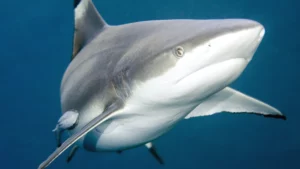 | 1.2–1.6 m (4–5 ft) | Low | Lagoon shallows and reef flats: Mele, Hideaway Island, Mystery IslandThe species snorkellers meet from the beach. Timid; the rare bite is to the foot of a wader. |
Grey Reef SharkCarcharhinus amblyrhynchos | 1.5–2.5 m (5–8 ft) | Moderate | Current-swept points and pinnacles: Tutuba Point, Hat Island, Paul's RockBold and territorial toward divers who crowd it; no record of biting a swimmer here. |
Silvertip SharkCarcharhinus albimarginatus | 2–2.5 m (7–8 ft) | Moderate | Deep walls and outer points off Santo and EfateHeavy-bodied reef shark with white fin margins; approaches divers closely on the deeper sites. |
Sicklefin Lemon SharkNegaprion acutidens | 2.5–3 m (8–10 ft) | Low | Sandy lagoons and mangrove edges; Aneityum, Santo's east coastThe Pacific lemon shark. Slow and yellowish; harmless unless cornered in shallow water. |
Tawny Nurse SharkNebrius ferrugineus | 2.5–3.2 m (8–10 ft) | Low | Caves and ledges on the fringing reefs by dayVanuatu's nurse shark; the Atlantic nurse shark does not occur here. Docile. |
Zebra Shark ('Leopard Shark' locally)Stegostoma tigrinum | 2–2.5 m (7–8 ft) | Low | Sand patches beside reefs; Maskelynes, SantoThe animal the old list called a leopard shark. Spotted adults, striped juveniles; completely placid. |
Whale SharkRhincodon typus | 6–12 m (20–40 ft) | Low | Occasional in open water off Santo in the warm monthsNo aggregation in Vanuatu; sightings are sporadic. Filter feeder, harmless. |
Tiger SharkGaleocerdo cuvier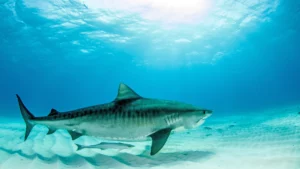 | 3–4.5 m (10–15 ft) | High | Outer drop-offs; enters bays and channels at nightA prime suspect for the large unidentified sharks in the Malakula record, though never confirmed there. |
Bull SharkCarcharhinus leucas | 2.2–3.2 m (7–10 ft) | High | Muddy inlets and river mouths of eastern Malakula and SantoThrives in exactly the low-visibility bays where Vanuatu's attacks cluster. Give brown water a miss. |
Scalloped Hammerhead SharkSphyrna lewini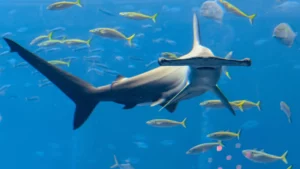 | 2.5–3.5 m (8–12 ft) | Low | Deep outer reefs and channels; a large hammerhead figures in one provoked case at HokaiCritically endangered worldwide; schools at depth and rarely approaches the surface. |
| Oceanic Whitetip SharkCarcharhinus longimanus | 2–3 m (7–10 ft) | High | Blue water beyond the drop-offs; caught by longliners and game boatsBold pelagic shark that follows boats. A real hazard to people adrift, not to reef swimmers. WCPFC no-retention species. |
Silky SharkCarcharhinus falciformis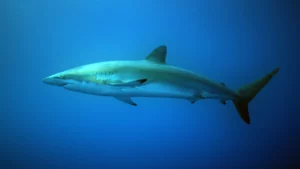 | 2–3 m (7–10 ft) | Moderate | Open ocean over the tuna grounds, sometimes at FADsThe most common shark on Vanuatu's longlines; also a WCPFC no-retention species. |
Blue SharkPrionace glauca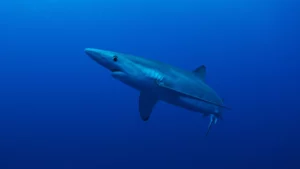 | 2–3 m (7–10 ft) | Low | Offshore, mostly in the cooler dry-season monthsSlender oceanic wanderer; never on the reefs. |
Shortfin Mako SharkIsurus oxyrinchus | 2.5–3.5 m (8–12 ft) | Moderate | Deep water off the trench side of the islandsFastest shark in the sea; a game-fish catch, not a reef sighting. |
Bigeye Thresher SharkAlopias superciliosus | 3–4 m (10–13 ft) incl. tail | Low | Deep offshore water, mostly a longline recordBig upward-set eyes for hunting in near-darkness. Harmless. |
Pelagic Thresher SharkAlopias pelagicus | 2.5–3.5 m (8–12 ft) incl. tail | Low | Open ocean; occasionally along deep walls at dawnThe tropical thresher; replaces the common thresher of the old list, which is a temperate species. |
Galapagos SharkCarcharhinus galapagensis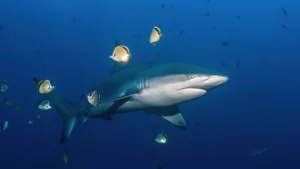 | 2.5–3 m (8–10 ft) | Moderate | Offshore seamounts and isolated outer reefsAn oceanic-island specialist; recorded around Vanuatu's remoter reefs but not a dive-site regular. |
Cookiecutter SharkIsistius brasiliensis | 40–55 cm (1.3–1.8 ft) | Low | Deep water by day, rising at night; leaves round scars on tuna and dolphinsTiny deep-sea parasite of large animals. Bites on people are almost unknown and never here. |
Bramble SharkEchinorhinus brucus | 2.5–3 m (8–10 ft) | Low | Deep slopes below 200 mSluggish, thorn-skinned deep-water shark known from research trawls, never from the reef. |
Blackbelly LanternsharkEtmopterus lucifer | 30–45 cm (1–1.5 ft) | Low | Continental slope, 200–1,000 mBioluminescent dwarf shark from the 1990s deep-sea surveys around the islands. |
Longsnout DogfishDeania quadrispinosa | 0.9–1.1 m (3–3.6 ft) | Low | Deep slopes, 400–800 mSpoon-nosed deep-water dogfish; a trawl record only. |
| Mandarin DogfishCirrhigaleus barbifer | 0.9–1.2 m (3–4 ft) | Low | Deep slopes, 150–650 mRecognised by long nasal barbels like a mandarin's moustache; known here from research cruises. |
Great White SharkCarcharodon carcharias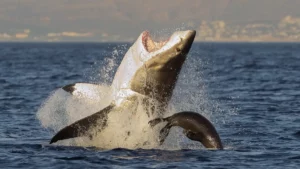 | 4–6 m (13–20 ft) | n/a | No confirmed record in VanuatuListed only because the old page claimed sightings. The nearest confirmed animals are in New Caledonia and New Zealand. |
Three species get asked about and deserve a straight answer. The great white shark has no confirmed record from Vanuatu; the water is too warm and there are no seal colonies, and the 4.3 m animal blamed for the 1987 Vao Island death was never identified. The original version of this page said great whites were “occasionally spotted” here, and that is not supported by any record we can find. The porbeagle, also on the old list, is a cool-water shark of the Tasman Sea and southern ocean and does not reach these latitudes. The common thresher is mostly a temperate species too; the threshers seen off Vanuatu are the pelagic and bigeye threshers.
Where to see sharks in Vanuatu
Vanuatu is better known for wrecks than for sharks, but the same steep reefs that make the diving dramatic also hold reliable reef shark populations. These are the sites where sightings are regular rather than lucky.
- SS President Coolidge, Espiritu SantoThe 200 m troopship off Luganville is the country's signature dive. Whitetip reef sharks rest in the sand around the bow and stern, and grey reef sharks patrol the deeper end of the wreck on the outgoing tide.
- Tutuba Point, Espiritu SantoA current-swept point at the mouth of the Segond Channel with a wall that drops well past sport-diving depth. Grey reef sharks, silvertips and the occasional eagle ray; the best big-shark site around Santo.
- Cindy's Reef and Million Dollar Point, SantoShallow coral gardens beside the famous dump of wartime equipment. Blacktip and whitetip reef sharks in a few metres of water, ideal for snorkellers.
- Hat Island (Eretoka) and Paul's Rock, EfateOffshore pinnacles west of Port Vila with steep walls and strong current. Grey reef sharks and whitetips are usual; silvertips turn up on the deeper corners.
- Mele Reef and Hideaway Island, EfateThe house reefs closest to Port Vila. Juvenile blacktip reef sharks in the lagoon and whitetips under the ledges, all within a short swim of the beach.
- Mystery Island (Inyeug), AneityumA tiny sand cay with a clear lagoon that cruise passengers snorkel. Blacktip reef sharks work the reef edge at high tide and sicklefin lemon sharks cruise the sandy shallows.
- Maskelyne Islands, southern MalakulaClear-water reefs off the south-east tip of Malakula, far from the muddy bays to the north. Reef sharks on the outer walls and zebra sharks on the sand; visited by liveaboards and village-run dive operations.
- Offshore drop-offs and seamountsSport-fishing charters out of Port Vila and Luganville regularly hook silky sharks, oceanic whitetips and makos over the deep water. This is where the pelagic species on the list are actually recorded.
If sharks are the goal rather than wrecks, base yourself in Luganville and dive Tutuba Point and the Coolidge on the same day; Santo's east coast has the clearest water and the most reliable grey reef and silvertip sightings in the country. Efate's offshore pinnacles are the alternative if you are staying in Port Vila.
Best time of year to see sharks in Vanuatu
Vanuatu sits between 13° and 20° south, so it has a genuine dry season and a wet, cyclone-prone season rather than the year-round sameness of the equatorial Pacific.
- May to October (dry season): south-east trade winds, cooler water of 23–26 °C and the best visibility, often 30 m or more on Santo and Efate. This is the main diving season and the best time for reef sharks on the walls and pinnacles, because the current runs and the sharks hold station in it.
- November to April (wet season): warmer water of 27–29 °C, more rain and run-off, and the cyclone risk that peaks from January to March. Visibility drops on the fringing reefs, especially near river mouths. Reef sharks are still present, and the warmest months bring the big requiem sharks into the shallow bays. The dated Malakula cases, though, mostly fall in April to June, at the turn of the seasons, so the bays there deserve caution in any month.
- Pelagic sharks: the tuna season from roughly September to December brings silky and oceanic whitetip sharks closest to the islands, and that is when fishing charters report them most.
- Whale sharks: genuinely occasional. There is no reliable aggregation in Vanuatu; the odd animal is seen off Santo or in the Bougainville Strait during the warmer months.
For most visitors the answer is simple: come between June and September, dive Santo, and you will see sharks on most days.
Shark attacks in Vanuatu: what the record actually shows
Vanuatu's record is small in number but unusually severe. The SharkSider database holds 16 entries for the country going back to 1835; 15 of them are dated 1900 or later, and 8 of those were fatal. Every case is listed and updated weekly on the shark attacks in Vanuatu page. The six latest entries are shown here:
- 2025 · Espiitu Santo Island, South SantoSwimming — Multiple injuries to body one hand and leg bitten offSpecies not identified · not fatal
- 2005 · Atchin Island off Malakula, Malampa ProvinceSwimming — FatalSpecies: On 8/13/2005 anglers from New Zealand caught a 2.8 m [9'3"], 140-kg [309-lb] shark at the same spot. It was believed this was the same shark that killed Alysha · fatal
- 2004 · Malakula (Malakula Island), Malampa ProvinceSnorkeling — Thigh bittenSpecies not identified · not fatal
- 1994 · Aniwa Island, Tafea Province — No detailsSpecies not identified · not fatal
- 1992 · Port Sandwich, Malakula, Malampa ProvinceSwimming — Right leg was bitten above and below the knee and an artery was puncturedSpecies not identified · not fatal
- 1989 · Malakula, Malampa Province — FatalSpecies not identified · fatal
The pattern is geographic before it is anything else. Every one of the eight fatal cases since 1900 happened in Malampa Province, most of them on the east coast of Malakula and its offshore islets: Atchin Island in 1983, 1984 and 2005, Port Sandwich Bay at Lamap in 1985, Vao Island in 1987, plus Ranon on Ambrym in 1978, Paama in 1965 and an undated Malakula death before 1989. The victims were swimmers and bathers close to shore in murky, sheltered water, not divers or surfers. The 2005 death of a child at Atchin is the best documented: two months later anglers caught a 2.8 m, 140 kg shark at the same spot and it was widely assumed to be the same animal, but the species was never formally recorded. The same is true of nearly every Vanuatu case. The database has no confirmed species for any fatality; a “large hammerhead” is named in a provoked, non-fatal case at Hokai, and the 4.3 m animal at Vao in 1987 was never identified. The environment, warm river-influenced bays with low visibility, points strongly to the bull shark and the tiger shark, but that is inference, not record.
Outside Malakula the record is thin: an entry from Aniwa Island in Tafea Province in 1994 with no details recorded, a canoe bitten and overturned at Lelepa Island near Efate in 1961 with no injury to the paddler, and the most recent case, a swimmer off South Santo in May 2025 who lost a hand and a leg but survived. The 1942 entry is not a Vanuatu incident at all: it records the sinking of USS Juneau north of Guadalcanal, with the ship en route to the New Hebrides, and belongs to the Solomon Islands. If you swim in Vanuatu, the advice is straightforward and local people already follow it: stay out of the muddy bays of eastern Malakula, avoid river mouths, dusk and dawn everywhere, and read our guide on how to survive a shark attack before an open-water swim.
Is it safe to swim and snorkel with sharks in Vanuatu?
On the resort and cruise-ship reefs, yes, with the ordinary precautions. The sharks a snorkeller meets at Hideaway Island, Champagne Beach or Mystery Island are blacktip reef sharks and whitetip reef sharks, both timid, both far more interested in small fish than in people. Grey reef sharks on the offshore pinnacles are bolder and will come in to look at a diver, but they are territorial rather than predatory; if one hunches its back and drops its pectoral fins, it wants space, and the correct response is to move calmly back along the reef. Silvertips behave much the same way at greater depth. None of these species appears in Vanuatu's incident record.
Sicklefin lemon sharks and zebra sharks on the sand are slow and easily approached, and the tawny nurse shark spends the day wedged under a ledge; the only realistic way to be bitten by any of them is to grab one. Whale sharks are harmless too, although the encounter is so rare here that nobody should plan a trip around it.
The real caution is about place, not species. The murky inlets of eastern Malakula, the bays near villages where fish waste and animal remains go into the water, and any river mouth after heavy rain are where Vanuatu's large requiem sharks hunt, and where every fatal case in the database happened. Vanuatu has no lifeguarded beaches and no shark-spotting programmes, so the judgement is yours: clear water over reef and sand is where the safe, watchable sharks live; brown water in a sheltered bay is where you do not swim.
Shark conservation in Vanuatu
Vanuatu is not a shark sanctuary in the way that Palau, the Marshall Islands or French Polynesia are, and there is no blanket ban on catching sharks. What it does have is a set of rules that matter in practice. Shark finning is prohibited in Vanuatu's fisheries regulations, with fins required to be landed naturally attached, and as a member of the Western and Central Pacific Fisheries Commission the country applies the regional no-retention rules for the oceanic whitetip and the silky shark, the two pelagic species hit hardest by tuna longlining. The whale shark is protected internationally under CITES, to which Vanuatu is a party.
The complication is that Vanuatu is a major flag state: hundreds of distant-water longliners fly the Vanuatu flag and fish far outside its waters, so the country's real shark footprint is much larger than what happens around its own islands. Closer to home, the pressures are the ones familiar across Melanesia: subsistence and small-scale fishing on the reefs, which takes juvenile reef sharks in nets, coral damage from cyclones (Pam in 2015 and Harold in 2020 stripped reefs on Efate, Tanna and Santo), and sediment from logging and land clearing that smothers fringing reefs. Community-managed tabu areas, where a village closes a stretch of reef to fishing for a period of years, are the country's most effective conservation tool and have restored fish and reef shark numbers around several islands. Our overview of why sharks are endangered explains why slow-breeding reef sharks recover so slowly once they are gone.
Sharks in neighbouring waters
Vanuatu sits at the centre of the Melanesian arc, and its shark fauna is shared with the whole region. Fiji, 800 km to the east, has the region's most famous shark diving at Beqa Lagoon, with bull and tiger sharks on a scale Vanuatu cannot match. Papua New Guinea to the north-west has the richest reef shark populations in the Coral Triangle, and the Solomon Islands lie between the two. Tonga and Samoa continue the same tropical reef fauna eastward, the Cook Islands protect theirs in a nationwide sanctuary, and New Zealand to the south is where the cool-water species such as the great white and porbeagle actually live. Our guide to sharks around the world covers every country on the site.
Frequently asked questions
Are there sharks in Vanuatu?
Yes. At least 23 species have solid records around the islands. Divers and snorkellers usually meet whitetip reef sharks, blacktip reef sharks, grey reef sharks and silvertips, with sicklefin lemon sharks and zebra sharks on the sand. Silky, blue, oceanic whitetip and mako sharks live offshore, and deep-water dogfish and lanternsharks on the slopes.
Have there been shark attacks in Vanuatu?
Yes, and a high share of them were fatal. The SharkSider database lists 16 incidents from 1835 to 2025, nine of them deaths. Almost all the fatal cases happened around Malakula in Malampa Province, at Atchin, Vao, Port Sandwich and nearby islands. The most recent case was a swimmer seriously injured off South Santo in May 2025.
Which shark killed Alysha Webster in Vanuatu in 2005?
The species was never confirmed. The child was killed while swimming at Atchin Island off Malakula in June 2005. Two months later anglers from New Zealand caught a 2.8 m, 140 kg shark at the same spot and it was assumed to be the same animal, but no formal identification was recorded in the database.
Is it safe to swim in Vanuatu?
On the clear reefs of Efate, Tanna and Aneityum, yes; the sharks there are small reef species with no record of harming swimmers, and Santo's dive reefs are the same, although a swimmer was badly injured off South Santo in 2025. The caution applies to the muddy, sheltered bays of eastern Malakula, where nearly every fatal attack in the country's history occurred. Avoid brown water, river mouths and swimming at dusk.
Are there great white sharks in Vanuatu?
There is no confirmed record. Vanuatu's water stays above 23 °C and has no seal colonies, and the large sharks involved in the Malakula attacks were never identified. Earlier claims of occasional great white sightings are not backed by any specimen or verified report; the nearest confirmed great whites are in New Caledonia and New Zealand.
Are there bull sharks or tiger sharks in Vanuatu?
Both are recorded. Tiger sharks patrol the outer drop-offs and enter channels at night, and bull sharks are the likely residents of Malakula's mangrove-lined inlets such as Port Sandwich. Neither has been formally confirmed as the species in any fatal case, but the habitat where the attacks cluster fits both animals.
Where is the best place to see sharks in Vanuatu?
Espiritu Santo. Tutuba Point at the mouth of the Segond Channel has grey reef sharks and silvertips in the current, and the SS President Coolidge wreck has resting whitetip reef sharks around its bow. From Port Vila, the offshore pinnacles at Hat Island and Paul's Rock are the best bet, and Mystery Island's lagoon is good for blacktips.
When is the best time to dive with sharks in Vanuatu?
June to September, in the dry season. Water is 23–26 °C, visibility is at its best and the trade-wind currents keep grey reef sharks and silvertips on the points. The wet season from November to April is warmer but murkier, with cyclone risk peaking from January to March.
Can you see whale sharks in Vanuatu?
Only by luck. Whale sharks are recorded off Santo and in the Bougainville Strait now and then during the warmer months, but Vanuatu has no seasonal aggregation and no operator can promise one. For a reliable whale shark trip in the region, look to Australia or the Philippines instead.
Is shark fishing legal in Vanuatu?
Catching sharks is not banned outright, so Vanuatu is not a shark sanctuary. Finning is prohibited and fins must be landed attached, oceanic whitetip and silky sharks may not be retained under Western and Central Pacific Fisheries Commission rules, and whale sharks are protected through CITES. Village tabu closures protect reef sharks locally.
References

A small team focused on researching sharks and making marine biology easy to understand. Every page is reviewed against current species records and the SharkSider attack database, and updated when new incidents or research appear.
Published January 11, 2023 · Last updated September 21, 2026 · Incident data from the SharkSider attack database (15 records for Vanuatu, 8 fatal).


