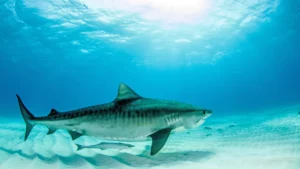
The silky shark (Carcharhinus falciformis) is a slender oceanic requiem shark of warm seas worldwide, usually 2–2.5 m long and at most about 3.3 m (11 ft) and 346 kg. Its densely scaled skin feels smooth to the hand, and it is recognised by sickle-shaped pectoral fins and a low first dorsal fin set well behind them.
It eats tuna, mackerel, sardines, squid and pelagic crabs, and follows tuna schools, which is why purse-seine nets catch it by the hundred thousand. Females bear 2–14 live pups after about a year and the species lives at least 22–25 years. It is Vulnerable on the IUCN Red List and on CITES Appendix II. Four bites are on record, none fatal.
- Maximum length3.3 m (11 ft); most adults 2–2.5 m
- WeightUp to 346 kg (763 lb); adults usually 80–200 kg
- LifespanAt least 22–25 years
- Depth rangeSurface to 500 m (1,640 ft), mostly above 200 m
- DietTuna, mackerel, sardines, squid, pelagic crabs
- IUCN statusVulnerable (assessed 2017)

- Kingdom
- Animalia
- Phylum
- Chordata
- Class
- Chondrichthyes
- Order
- Carcharhiniformes
- Family
- Carcharhinidae
- Genus
- Carcharhinus
- Species
- Carcharhinus falciformis
- Family (common)
- Requiem sharks
- Also known as
- Silky whaler, Blackspot shark, Olive shark, Sickle shark, Grey whaler shark
On this page
- How to identify a silky shark
- How big do silky sharks get?
- Where silky sharks live
- What silky sharks eat and how they hunt
- Behaviour and senses
- Reproduction and lifespan
- Are silky sharks dangerous to people?
- Conservation status and fisheries
- Similar species and close relatives
- Frequently asked questions
- References
How to identify a silky shark
Silky sharks are easy to misname because they carry no obvious marking, so identification rests on proportions. The pectoral fins are the first clue: long, narrow and curved like a sickle, which is what falciformis means. The first dorsal fin is small for a shark this size, rounded at the top, and begins behind the free rear tips of the pectorals rather than above them, as it does on the dusky shark. The second dorsal fin is tiny but trails a free tip more than twice as long as the fin is tall, and a low ridge of skin runs along the back between the two dorsals.
The snout is moderately long and rounded from above, the eyes fairly small, and the body slim compared with a bull shark or a sandbar shark. Colour is dark grey to bronze above and white below; juveniles may show dusky fin tips, adults usually none.
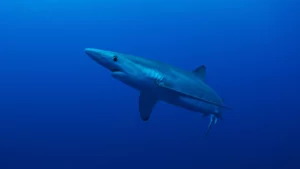
Run a hand along one and the name explains itself. The placoid scales are small, flattened and densely overlapping, so the hide feels smooth in both directions instead of rasping like sandpaper. The teeth are typical of the genus: upper teeth broad, triangular and serrated, fourteen to seventeen a side; lower teeth narrow, upright and smooth-edged, thirteen to seventeen a side. In the water the usual confusions are with the blue shark (far longer pectorals, an indigo back) and the oceanic whitetip, whose paddle-shaped white-tipped fins are unmistakable side by side.

How big do silky sharks get?
The largest silky sharks with credible measurements are about 3.3 m (11 ft) long, and the heaviest on record weighed 346 kg (763 lb). Adults met at sea are typically 2 to 2.5 m and 80 to 200 kg, and a very large female is 2.8 m. The 3.5 m figure repeated on older pages is a rounded-up estimate rather than a tape measure.
Pups are born at 56 to 87 cm, usually 70 to 80 cm, which is large for a requiem shark. Maturity differs by ocean: in the western Atlantic and Gulf of Mexico males mature at about 2.1 to 2.2 m and females at 2.2 to 2.5 m, roughly six to ten and seven to twelve years respectively, while in the eastern Pacific both sexes mature smaller, at around 1.8 to 2.1 m. Adult females run slightly larger than males. Silky sharks are still growing at 20 years, and vertebral bands give a lifespan of at least 22 to 25 years. The bar below sets the maximum length against a diver.
Where silky sharks live
Silky sharks are animals of warm blue water. They occur right around the globe between about 40°N and 40°S, in the Atlantic, Indian and Pacific Oceans and the Red Sea, concentrated where the sea is warmer than about 23 °C; the Mediterranean sees only strays. In the Atlantic the species ranges from North Carolina and the Gulf of Mexico through the Caribbean to southern Brazil, and from Spain to Angola on the eastern side. In the Indo-Pacific it runs from the Red Sea and east Africa to southern Japan, northern Australia and Hawaii, and down the eastern Pacific from Baja California to Peru.
Unlike most of its relatives it is more oceanic than coastal: it lives over the outer shelf, along the slope, around seamounts and in the open ocean, and it is the shark most often found under floating logs and fish-aggregating devices. Famous places to meet one include the Jardines de la Reina in Cuba, Cocos Island off Costa Rica, the Revillagigedo Islands of Mexico and the Brothers reefs in the Egyptian Red Sea.
Vertically they stay near the surface. Tagged sharks spend most of their time in the upper 50 m and dive to 200 m or more after prey; the deepest reliable records are around 500 m. Juveniles favour the shelf edge, adults the open ocean; no regular basin-scale migration has been proven.

- Florida3 records
- Spain1 record
- Alabamalisted
- Anguillalisted
- Arubalisted
- Bahamaslisted
- Barbadoslisted
- Belizelisted
- Bermudalisted
- Brazillisted
- Chinalisted
- Colombialisted
Show all 68 places
- Cook Islandslisted
- Costa Ricalisted
- Cubalisted
- Curaçaolisted
- Dominicalisted
- Dominican Republiclisted
- Ecuadorlisted
- Egyptlisted
- El Salvadorlisted
- Fijilisted
- French Polynesialisted
- Ghanalisted
- Grenadalisted
- Guamlisted
- Guatemalalisted
- Haitilisted
- Hawaiilisted
- Honduraslisted
- Indialisted
- Indonesialisted
- Jamaicalisted
- Japanlisted
- Kenyalisted
- Louisianalisted
- Malaysialisted
- Mexicolisted
- Mississippilisted
- Nicaragualisted
- Nigerialisted
- Omanlisted
- Pakistanlisted
- Panamalisted
- Papua New Guinealisted
- Perulisted
- Portugallisted
- Puerto Ricolisted
- Saint Lucialisted
- Samoalisted
- Saudi Arabialisted
- Senegallisted
- Somalialisted
- Sri Lankalisted
- Texaslisted
- The British Virgin Islandslisted
- The Cayman Islandslisted
- The Gambialisted
- The Maldiveslisted
- The Philippineslisted
- The U.S. Virgin Islandslisted
- Tongalisted
- Trinidad and Tobagolisted
- Uruguaylisted
- Vanuatulisted
- Venezuelalisted
- Vietnamlisted
- Virginialisted
61 countries and 7 US states list the silky shark in their species guide; the count is the number of incidents attributed to it there in the SharkSider database. Browse every guide on sharks around the world and sharks in the US.
What silky sharks eat and how they hunt
Silky sharks eat what the tuna eat, and the tuna themselves. Stomach studies from the Pacific and the Gulf of Mexico are dominated by schooling bony fish: yellowfin and skipjack tuna, mackerel, sardines, flying fish, scads and lanternfish. Squid come next, including the argonauts that drift near the surface, and in the eastern Pacific the pelagic red crab is seasonally the main item.
The hunting is opportunistic. A silky shark cruises with a tuna school and picks off fish that are injured, slow or separated, and when a purse-seine net closes on a school it moves in on the fish trapped against the mesh. Around a bait ball several sharks feed together, each driving into the school with jaws open and snapping sideways, but there is no evidence of coordinated cooperation; it is many hungry animals at the same meal. Their attraction to floating objects is probably a shortcut to the same food.
Hearing matters more to this species than legend allows. Silky sharks arrive within minutes when low-frequency pulsed sounds, the noise of a struggling fish, are played underwater, and they react from further away than they could see or smell. That trait, not any special appetite, is why they turn up so quickly at spearfishing boats.

Behaviour and senses
The silky is one of the more inquisitive sharks a diver is likely to meet. In open water it circles a boat or a swimmer at a few metres, comes in for a closer pass and drifts off; around spearfishermen with fish on a stringer it grows noticeably bolder and returns again and again. When agitated it gives a display shared by several requiem sharks: back arched, pectoral fins dropped, snout lifted, swimming stiff and exaggerated from side to side. Divers who recognise the posture back away; those who do not sometimes get nipped.
The species is often seen in groups, and there is some evidence that they sort by size and sex, juveniles over the outer shelf and larger adults offshore. Gatherings of dozens form at seamounts such as Malpelo and at fish-aggregating devices, but these look like responses to food and shelter rather than social bonds.
Its senses are those of a hunter of open water. The lateral line and inner ear pick up the pressure pulses of a distressed fish at long range, the eyes suit the bright blue light of the surface layer, and the ampullae of Lorenzini on the snout guide the final strike. The nose is good, but the idea that sharks smell blood miles away is a myth for this species as for every other.

Reproduction and lifespan
Like the rest of Carcharhinus, the silky shark is placentally viviparous. Once the yolk is used up the embryo’s yolk sac attaches to the uterine wall and the mother feeds the pups directly until birth. Litters hold 2 to 14 pups, most often 6 to 12, and gestation is close to 12 months. Most females give birth every second year, so one may produce only a few dozen pups in her life.
Mating and pupping are seasonal but the timing shifts with latitude: late spring and early summer in the Gulf of Mexico and western Atlantic, the first half of the year off Central America, mid-year in the north-western Indian Ocean. Nursery grounds lie on the outer edge of the continental shelf rather than in bays or estuaries, which is unusual for the family and means the young are exposed to fishing from the start.
Age is read from the growth bands in the vertebrae. Males mature at roughly six to ten years and females at seven to twelve, depending on region, and the oldest sharks in published studies are in their early to mid twenties. The biggest animals are rarely aged, so the true maximum may be a little higher, but not much. Late maturity, small litters and a two-year cycle give the population a low rate of increase, which is why heavy fishing has hit it so hard. Our page on how long sharks live explains how these ages are measured.
Are silky sharks dangerous to people?
Rarely, and the record is thin. The SharkSider database holds four incidents attributed to the silky shark between 1963 and 2015, none fatal. Three were in Florida: a provoked, injury-free incident in 1963 in which a shark tested an anti-shark cage off Elliot Key, a 1968 case at Palm Beach Shores in which a 2.7 m shark bit a person’s buttock, legs and arm, and a 1985 bite to the hand of a scuba diver off Palm Beach. The fourth is a swimmer who received forearm lacerations at Arinaga Beach on Gran Canaria, Spain, on Christmas Day 2015.
The species owes its reputation to boldness rather than to that record. Silky sharks live far from beaches, so they meet people mainly through divers, spearfishers and fishing crews. A diver in blue water off Cuba or Egypt can expect a silky within arm’s reach, and a spearfisher with bleeding fish on a line can expect several. Bites in that setting are usually a snap at the fish that catches a hand instead.
The rules are the ones for any oceanic shark: keep speared fish on a float line, stay in a group, do not chase or corner an animal that is circling closely, and leave the water if its posture stiffens. Our guide to what to do in a shark encounter applies. Most Florida bites are the work of the bull, blacktip and spinner sharks of the surf zone (see Florida shark attacks).
Silky Shark incidents in the SharkSider database
- Records attributed4
- Fatal0 (0%)
- Years covered1963–2015
- Since 20001 incidents, 0 fatal
- Most common activityOther / not stated
- Most recordsUSA (3)
The six most recent records attributed to the silky shark
- 25 December 2015 · Arinaga Beach, Aguimes, Gran Canaria, Grand Canary Island, SpainSwimming — Lacerations to left forearmRecorded as: Silky shark, 6.5' · not fatal
- 8 September 1985 · Palm Beach, Palm Beach County, Florida, USAScuba diving — Laceration and 4 puncture wounds to left handRecorded as: 1.8 m silky shark · not fatal
- 20 April 1968 · Palm Beach Shores, Riviera Beach, Singer Island, Palm Beach County, Florida, USAActivity not stated — Buttock, both legs & arm bittenRecorded as: 2.7 m [9'] silky shark · not fatal
- 12 November 1963 · 8 miles south of Elliot Key, Miami-Dade County, Florida, USATesting anti-shark cage — No injury provoked incidentRecorded as: Silky shark, 1.9 m [6.5'] · not fatal
Records are matched on the shark named in each report (“silky”), so they include incidents where the species was reported rather than confirmed. Full records by country on the shark attacks pages.
Conservation status and fisheries
The IUCN Red List assessed the silky shark as Vulnerable in 2017, with a decreasing trend, on an estimated global decline of 47 to 54 per cent over three generations. The species was added to CITES Appendix II at the 2016 conference, effective October 2017 so international trade in fins and meat now needs permits. It is also on Appendix II of the Convention on Migratory Species.
The threat is simple: the silky shark lives with the tuna, and the world fishes very hard for tuna. Purse-seiners setting on fish-aggregating devices catch silky sharks in enormous numbers, most of them juveniles; the fleets of the Pacific and Indian Oceans each take tens of thousands to hundreds of thousands a year, and many die in the net or on deck. Longliners for tuna and swordfish hook the adults. Because the fins are large and the species abundant where the fleets work, silky fins have ranked second only to the blue shark’s in the Hong Kong trade, a subject covered under shark fin soup and bycatch.
The regional tuna commissions have answered with retention bans: ICCAT in the Atlantic from 2011, the Western and Central Pacific Fisheries Commission from 2014 and the Inter-American Tropical Tuna Commission in the eastern Pacific, alongside live-release rules. Enforcement is patchy and a shark hauled aboard often dies anyway. It sits squarely on our list of why sharks are endangered.
Similar species and close relatives
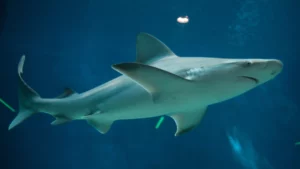
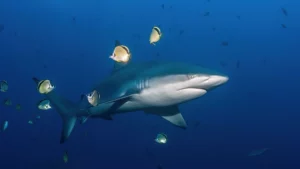
The silky shark belongs to Carcharhinus, the largest genus of requiem sharks, and its nearest relatives are the other big oceanic and outer-shelf members of the group. The dusky shark is the one most often confused with it: heavier, with a larger first dorsal fin that starts over the pectoral insertion, a shorter second-dorsal tip and broader pectorals. The sandbar shark has a tall, almost triangular first dorsal fin that no silky ever shows. The Galapagos shark and the bignose shark also carry the interdorsal ridge and are separated only by fin proportions and tooth counts in the hand. The night shark, another slope species of the western Atlantic, has green eyes and a very long snout.
In blue water the look-alikes differ. The oceanic whitetip has rounded, white-tipped fins and a stockier body; the blue shark is slimmer still, with enormous pectorals and a colour no silky matches; and a young shortfin mako has a pointed snout and a crescent tail. Old names such as “grey whaler” and “olive shark” refer to this same species, not separate ones. The wider family is covered in our introduction to requiem sharks.
 Dusky Sharkspecies profile
 Sandbar Sharkspecies profile
 Galapagos Sharkspecies profile
- Bignose Sharkspecies profile
- Night Sharkspecies profile
 Blue Sharkspecies profile
Frequently asked questions
Why is it called the silky shark?
Because of its skin. The tooth-like scales that armour every shark are unusually small, flat and tightly overlapping on this species, so the hide feels smooth rather than rough when stroked in either direction. The scientific name falciformis refers to something else: the long, sickle-shaped pectoral fins.
How big is a silky shark?
Most adults are 2 to 2.5 m long and weigh 80 to 200 kg. The largest reliably measured individuals reach about 3.3 m (11 ft), and the heaviest recorded weighed 346 kg. Newborn pups are already 56 to 87 cm long. Older claims of 3.5 m sharks are rounded estimates rather than measurements.
Where do silky sharks live?
In warm water around the world between about 40°N and 40°S, wherever the sea is warmer than roughly 23 °C. They favour the outer continental shelf, seamounts and the open ocean rather than beaches, and spend most of their time in the upper 50 m, diving to 200 m and occasionally 500 m.
What do silky sharks eat?
Mainly schooling fish such as tuna, mackerel, sardines and flying fish, plus squid and, in the eastern Pacific, pelagic red crabs. They follow tuna schools and gather under floating objects where small fish collect, which is exactly why tuna purse-seine nets catch so many of them.
Are silky sharks dangerous to humans?
Only slightly. The SharkSider database records four incidents attributed to silky sharks since 1963, none fatal and only one since 2000. They are bold and will approach divers and spearfishers closely, and most bites involve speared fish or a shark that has already given its hunched warning display.
How do silky sharks reproduce?
Females bear live pups nourished through a yolk-sac placenta; litters contain 2 to 14 pups, usually 6 to 12, after a gestation of about 12 months, and females typically breed every second year. Pups are born on the outer edge of the continental shelf rather than in coastal bays.
How long do silky sharks live?
At least 22 to 25 years, based on counts of growth bands in the vertebrae. Males mature at about six to ten years and females at seven to twelve, depending on the ocean. Slow maturity, small litters and breeding only every second year make the species vulnerable to heavy fishing.
Are silky sharks endangered?
They are listed as Vulnerable on the IUCN Red List (2017) with a declining trend, and the species has been on CITES Appendix II since October 2017. The main threat is bycatch in tuna purse-seine and longline fisheries, and silky fins have been the second most common in the Hong Kong fin trade.
Can you dive with silky sharks?
Yes, and it is one of the classic open-water shark dives. Reliable sites include the Jardines de la Reina in Cuba, the southern Red Sea reefs of Egypt, Cocos Island, Malpelo and the Revillagigedo Islands. The sharks approach closely, so operators brief divers to stay together and avoid carrying fish or bait.
What is the difference between a silky shark and a dusky shark?
Both are large grey requiem sharks with a ridge between the dorsal fins. The silky is slimmer, its first dorsal fin is smaller and starts behind the pectoral fins, and its second dorsal fin has a very long trailing tip. The dusky is heavier, with a bigger first dorsal fin placed over the pectoral base.
References

A small team focused on researching sharks and making marine biology easy to understand. Every page is reviewed against current species records and the SharkSider attack database, and updated when new incidents or research appear.
Published December 1, 2014 · Last updated September 22, 2026 · 4 incidents attributed to the silky shark in the SharkSider attack database (0 fatal), updated weekly.