
Yes, there are sharks in Russia, though almost all of them live far from the beaches most Russians swim on. Fifteen species have solid records. In the Black Sea it is essentially one animal, the spiny dogfish or katran. In the Far East the regulars are the salmon shark, the Pacific sleeper shark and the North Pacific spiny dogfish, with blue sharks and the occasional great white arriving in the warm months. The Barents Sea has Greenland sharks and dogfish; the Baltic has almost nothing.
The safety record is short and recent. The SharkSider database holds four incidents for Russia, none fatal: a diver bitten by a white shark off Kunashir in the Kurils in 2004, and three swimmers injured in ten days of August 2011 in Peter the Great Bay, Primorsky Krai, one of them losing both hands. Nothing has been recorded before or since, and no shark bite has ever been recorded on the Black Sea coast.
- Shark species recorded15 across four seas
- ProtectionNo shark-specific law; Far Eastern Marine Reserve 1978; salmon driftnets banned 2016
- Most seen from the shoreSpiny dogfish (katran), Black Sea
- Signature encounterSalmon sharks off Kamchatka and the Kurils
- Incidents in the database4 (2004–2011), 0 fatal
- Water temperature0–5 °C Arctic; 20–27 °C Sea of Japan and Black Sea in August

On this page
- Where sharks live in Russian waters
- List of the different types of sharks in Russia
- Where to see sharks in Russia
- Best time of year to see sharks in Russia
- Shark attacks in Russia: what the record actually shows
- Is it safe to swim in Russia's seas?
- Shark conservation in Russia
- Sharks in neighbouring waters
- Frequently asked questions
- References
Where sharks live in Russian waters
Russia touches four separate shark habitats, and they have almost nothing in common. Start with the Black Sea, where the holiday coast from Anapa through Novorossiysk and Tuapse to Sochi is the only part of the country with warm, swimmable summer water. Below 150 m the Black Sea is anoxic and lifeless, so everything that lives there is squeezed into a shallow shelf, and its one abundant shark is the spiny dogfish, known to every Black Sea fisherman as katran. It grows to little more than a metre, has a venomous spine in front of each dorsal fin, and is sold smoked in every seaside market. The small-spotted catshark reaches the Black Sea too, but it is rare in the Russian sector, and no other shark lives there. The Sea of Azov, shallower and fresher still, has no sharks at all.
The Baltic, at Kaliningrad and the Gulf of Finland, is so brackish that sharks are little more than accidents; a spiny dogfish or a lost porbeagle occasionally turns up in a net. The Arctic seas are the opposite problem: full salinity but near freezing. The Barents Sea off Murmansk holds Greenland sharks, which live for centuries in water at 1–4 °C, along with spiny dogfish and the odd porbeagle or basking shark that follows the warm Atlantic current up the Norwegian coast to the Murman shore. The White, Kara, Laptev and East Siberian seas are effectively sharkless.
The Pacific coast is where the real diversity is. From Vladivostok in the south, up the Sea of Okhotsk past Sakhalin, along Kamchatka and out through the Kuril and Commander islands to the Bering Sea, cold subarctic water meets the warm Tsushima and Kuroshio currents that push north from Japan every summer. The cold-water residents are the salmon shark, a warm-bodied relative of the great white that hunts salmon at 2–10 °C, the Pacific sleeper shark in the deep basins, and the North Pacific spiny dogfish. The summer visitors are the interesting part: blue sharks, threshers, the occasional shortfin mako and smooth hammerhead, and, in the warmest years, the great white. Peter the Great Bay, where Vladivostok sits, warms to 20–24 °C in August, and in 2011 that was enough.
List of the different types of sharks in Russia
Each row below is a species with a reliable record from Russian waters, arranged roughly from commonest to rarest. Sizes are typical adults. The earlier version of this page put the milk shark on the list, a tropical species of the Indian Ocean and West Africa that has never been within a thousand kilometres of Russia; it has been removed. The old table also gave “an assumed 40 species”, which is a figure for the whole north-west Pacific rather than for anything recorded on the Russian side.
| Species | Adult size | Risk to swimmers | Where in Russia & notes |
|---|---|---|---|
| Spiny Dogfish (katran)Squalus acanthias | 0.8–1.2 m (2.5–4 ft) | Low | Black Sea shelf; Barents Sea; rare in the BalticThe only common shark on the Black Sea coast. Venomous dorsal spines; harmless unless handled. |
Salmon SharkLamna ditropis | 2–3 m (7–10 ft) | Low | Sea of Okhotsk, Kamchatka, Kurils, Bering Sea; Peter the Great Bay in summerA warm-blooded cousin of the great white built for cold water. Follows the salmon runs; no record of biting people. |
North Pacific Spiny DogfishSqualus suckleyi | 0.9–1.3 m (3–4 ft) | Low | Sea of Japan, Okhotsk and Bering seasThe Pacific counterpart of the katran, split off as its own species in 2010. Abundant, small, harmless. |
Pacific Sleeper SharkSomniosus pacificus | 3.5–4.4 m (11–14 ft) | Low | Deep water of the Okhotsk and Bering seas, Kurils and CommandersHuge, slow, deep-living scavenger; bycatch on halibut longlines. Never near swimmers. |
Greenland SharkSomniosus microcephalus | 2.5–4.5 m (8–15 ft) | Low | Barents Sea off Murmansk; occasionally the White and Kara seasThe Arctic's longest-lived vertebrate, at 1–4 °C. Sluggish and harmless to people. |
Blue SharkPrionace glauca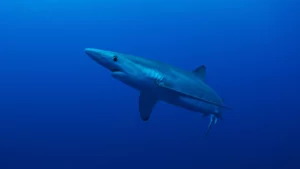 | 2–3 m (7–10 ft) | Low | Southern Kurils and Peter the Great Bay, July to SeptemberThe commonest warm-season visitor to the Far East. Oceanic; rarely close to a beach. |
Great White SharkCarcharodon carcharias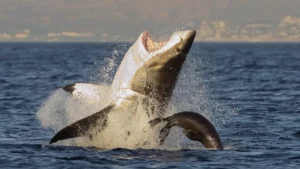 | 4–6 m (13–20 ft) | High | Rare late-summer straggler: Kunashir 2004, Peter the Great Bay 2011Genuinely recorded, but as single animals in warm years. The probable culprit in all four Russian incidents. |
Common Thresher SharkAlopias vulpinus | 3–5 m (10–16 ft) incl. tail | Low | Sea of Japan and southern Kurils in summerIts upper tail lobe is as long as the rest of the fish. Timid; no risk to swimmers. |
Shortfin Mako SharkIsurus oxyrinchus | 2–3.2 m (7–10 ft) | Moderate | Rare summer visitor to Primorye and the southern KurilsA handful of records from fishermen in warm years. Stays offshore. |
Smooth Hammerhead SharkSphyrna zygaena | 2.5–4 m (8–13 ft) | Low | Rare summer visitor to Peter the Great BayThe most cold-tolerant hammerhead, which is why it alone reaches Russian water. Not a danger to swimmers. |
Basking SharkCetorhinus maximus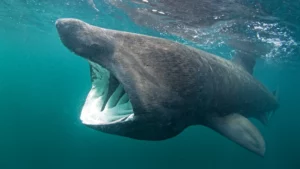 | 6–9 m (20–30 ft) | Low | Rare: Murman coast of the Barents Sea; Kurils and KamchatkaPlankton feeder, harmless. A few records at each end of the country. |
Porbeagle SharkLamna nasus | 2–2.5 m (7–8 ft) | Low | Barents Sea; very rare stray in the BalticThe Atlantic twin of the salmon shark. Follows Atlantic water up the Norwegian coast to Murmansk. |
Broadnose Sevengill SharkNotorynchus cepedianus | 2–3 m (7–10 ft) | Moderate | Rare in the Sea of Japan off PrimoryeA primitive seven-gilled shark known in Russia from a few specimens. Bold toward divers elsewhere in its range. |
Whale SharkRhincodon typus | 5–9 m (16–30 ft) | Low | Very rare summer straggler to the Sea of Japan and southern KurilsSighted a few times in exceptionally warm years, following the current from Japan. Harmless. |
Small-spotted CatsharkScyliorhinus canicula | 0.6–0.8 m (2–2.6 ft) | Low | Rare in the Black Sea, mostly near the Bosphorus; occasional in the Russian sectorThe only other shark that enters the Black Sea. Tiny, spotted, completely harmless. |
The species people ask about most are the ones missing from the Black Sea. There are no tiger sharks, bull sharks or hammerheads in the Black Sea and there never have been; the Bosphorus is a narrow, brackish filter and the sea beyond it is too cold in winter and too poor in oxygen at depth. Great whites do not occur there either, whatever a summer tabloid may claim after a dolphin sighting off Sochi. On the Pacific side the reverse caution applies: the great white is genuinely on the Russian list, but as a rare summer straggler from Japanese waters rather than a resident, and the mako and hammerhead records are single animals in unusually warm years.
Where to see sharks in Russia
Nobody comes to Russia for shark diving, and there is no cage operation or feeding site anywhere in the country. What exists is a handful of places where sharks are part of the wildlife, mostly seen from boats or by cold-water divers.
- Peter the Great Bay, Primorsky KraiThe bay around Vladivostok, including the Far Eastern Marine Reserve and the Khasan coast. Blue sharks and salmon sharks in August and September; the site of all three 2011 incidents. Local dive clubs run the reserve's islands in summer.
- Kunashir and the southern KurilsVolcanic islands 70 km from Hokkaido, washed by warm current in summer. Salmon and blue sharks are common, and the country's first confirmed white shark bite happened here in 2004.
- Avacha Bay and the Kamchatka coastSport-fishing boats out of Petropavlovsk hook salmon sharks that follow the pink and chum salmon runs in July and August. Sleeper sharks come up on deep halibut lines.
- Sea of Okhotsk: Sakhalin and the Shantar IslandsCold, plankton-rich and full of salmon. Salmon sharks are seen at the surface from whale-watching boats that go for the bowhead whales of the Shantars.
- Commander IslandsA nature reserve at the western end of the Aleutian chain. Pacific sleeper sharks and salmon sharks live around the islands' steep drop-offs; access is by expedition vessel only.
- Black Sea coast: Anapa, Novorossiysk, SochiDivers on the deeper reefs and wrecks meet katran at 20–40 m, usually in cool water below the summer thermocline. The species is on every fish stall in Sochi, which is the easier way to see one.
- Teriberka and the Murman coast, Barents SeaGreenland sharks are caught, and usually released, by the cod and halibut boats working out of Murmansk. There is no diving with them; the water is 3–5 °C in summer.
For a realistic shark encounter, a summer trip to Kamchatka or the southern Kurils is the best bet, and it will be a salmon shark seen from a boat. Divers in Primorye should treat any large shark in August as potentially a white shark and leave the water.
Best time of year to see sharks in Russia
Every sea has its own calendar, but the rule is simple: the warm-water visitors arrive in late summer and leave with the first autumn storms, and the cold-water residents are there all year but hard to reach in winter.
- July to September, Far East: Peter the Great Bay reaches 20–24 °C, the Tsushima current pushes north and blue sharks, threshers and the rare great white follow it. All four incidents in the database fall in July and August. Salmon sharks are most visible during the salmon runs of July and August off Kamchatka, Sakhalin and the Kurils.
- June to September, Black Sea: the coast warms to 24–27 °C at the surface, but katran stay below the thermocline in 10–15 °C water. Divers see them mostly in early summer and autumn, and fishermen catch them year-round.
- Summer, Barents Sea: the only months boats work the Murman coast comfortably. Greenland sharks are taken on deep lines at any time of year; basking sharks are a rare late-summer sight.
- Winter: Peter the Great Bay freezes over, the Okhotsk Sea is ice-covered and the Black Sea drops to 7–9 °C. The visiting sharks are gone and the residents are deep.
Surface temperatures run from near freezing in the Arctic and the winter Sea of Japan to 27 °C on a Sochi beach in August, which is a wider range than any other country on this site.
Shark attacks in Russia: what the record actually shows
Russia had no recorded shark bite of any kind until this century, and then four in seven years, all in the Far East. SharkSider keeps every case on the shark attacks in Russia page. The database holds four records, none of them fatal, and all four are shown below (the list, updated weekly, is on the attacks page):
- 2011 · Slavyanka, Primorsky KraiStanding, collecting sea stars — Superficial laceration to shoulderSpecies not identified · not fatal
- 2011 · Zheltukhin Island, Peter the Great Bay, Khasan, Primorsky Krai (Far East)Swimming — Lacerations to hip, thigh and kneeSpecies not identified · not fatal
- 2011 · Vityaz, Telyakovsky Bay, Khasan, Primorsky Krai (Far East)Swimming — Hands severedSpecies: 4 m shark · not fatal
- 2004 · Kunashir Island, 70 km from northern Japan, Kuril Islands in the PacificDiving & fishing with net — Thigh & calf bittenSpecies: White shark · not fatal
The first case was on 30 July 2004 off Kunashir Island in the Kurils, 70 km from northern Japan, where a man diving and fishing with a net was bitten on the thigh and calf by a shark identified as a white shark. Then came the ten days that made Russian sharks a news story. On 17 August 2011 a swimmer at Vityaz in Telyakovsky Bay, in the Khasan district of Primorsky Krai, was attacked by a shark estimated at 4 m and lost both hands. The next day, 18 August, a swimmer off Zheltukhin Island in Peter the Great Bay was left with lacerations to the hip, thigh and knee. On 26 August a person standing in the shallows at Slavyanka, collecting sea stars, was bitten on the shoulder, a superficial wound. Beaches across the district were closed and the regional authorities announced a hunt for the shark, which was never caught.
What the record shows is a single unusual summer. The 2011 bites came at the end of an exceptionally warm August in a bay that had already recorded blue and salmon sharks, and the 4 m estimate, the severity of the first injury and the 2004 Kunashir identification all point to the great white shark, though no animal was ever recovered to confirm it. It has not happened again in the fifteen years since. The Black Sea coast, where millions of Russians swim every summer, has never recorded a shark bite, because the only shark there is a dogfish that would struggle to break the skin. Our guide to surviving a shark attack matters only to late-summer swimmers and divers in Primorye and the southern Kurils.
Is it safe to swim in Russia's seas?
On the Black Sea, completely, at least where sharks are concerned. A swimmer at Sochi or Gelendzhik is more likely to be stung by a jellyfish or a weever fish than to see a katran, which lives below the warm surface layer and flees from people. The only way to be hurt by one is to handle a live fish and get a dorsal spine in the hand.
In the Far East the answer is still yes, with a footnote. Peter the Great Bay is a popular summer swimming area for Vladivostok, and the 2011 events did not change that; the beaches reopened within weeks and have stayed open. But the bay is the one place in Russia where a large warm-water shark can turn up in August, so the standard precautions apply for that month: swim in groups, stay close to shore, avoid dawn, dusk and river mouths, and get out if a large fin appears. Divers in Primorye and the Kurils should treat a salmon shark with respect, since it is a big, fast lamnid with a great white's build, but it feeds on salmon and has no record of attacking people anywhere in its range.
Cold is the real risk in the north. The Barents Sea and Sea of Okhotsk are 3–12 °C in summer and hypothermia will kill an unprotected swimmer long before any Greenland or sleeper shark takes an interest; both species are sluggish scavengers of the deep and have never been implicated in an attack on a living person.
Shark conservation in Russia
Russia has no law aimed at sharks specifically, and sharks barely feature in its fisheries statistics. The exceptions are the Black Sea katran, which is fished under quota and has declined sharply since Soviet times through overfishing and the collapse of its prey, and the Far East, where salmon sharks have been the main casualty of the salmon fishery. For decades tens of thousands died every year in Japanese and Russian driftnets set for salmon in the Russian economic zone; Russia's ban on driftnet salmon fishing, in force from 2016, removed the largest single source of that mortality. Greenland sharks in the Barents Sea and sleeper sharks in the Okhotsk are bycatch on longlines and are usually released, though survival after a deep haul is poor.
Habitat protection is stronger than species protection. The Far Eastern Marine Reserve in Peter the Great Bay, established in 1978, was the Soviet Union's first marine reserve and still bans fishing across most of its area; the Commander Islands and Kronotsky reserves protect large stretches of the Pacific coast, and the Kuril islands have a patchwork of protected areas. Russia is a party to CITES, so the great white, basking shark, porbeagle, makos and threshers on the convention's appendices require permits to trade. What is missing is data: nobody counts the sharks of the Okhotsk Sea, and the size of the Black Sea katran population is a matter of argument between fishermen and scientists. Slow-breeding species such as the katran and the salmon shark recover slowly once fished down; our page on why sharks are endangered explains the biology.
Sharks in neighbouring waters
Russia's sharks are borrowed from its neighbours. Every summer visitor to Peter the Great Bay comes up the coast from Japan, which shares the Sea of Japan and the Kuril chain and has far more great white records, and from South Korea, where white sharks have killed divers on the west coast. China lies at the warm end of the same current system. On the other side of the country, Norway shares the Barents Sea's Greenland sharks and porbeagles, Finland shares the near-empty Baltic, and Turkey shares the Black Sea katran and controls the Bosphorus that keeps everything else out. Our sharks around the world page is the index to every other country.
Frequently asked questions
Are there sharks in Russia?
Yes, fifteen species have solid records, but they are spread across four very different seas. The Black Sea has the spiny dogfish or katran, the Barents Sea has Greenland sharks, and the Pacific coast has salmon sharks, sleeper sharks, blue sharks and occasional great whites in late summer.
Have there been shark attacks in Russia?
Four are in the SharkSider database, none fatal, and all in the Far East. A diver was bitten by a white shark off Kunashir in the Kurils in 2004, and three swimmers were injured in Peter the Great Bay near Vladivostok in August 2011, one losing both hands. The earlier claim that all four happened in 2011 was wrong.
Are there great white sharks in Russia?
Yes, but only as rare visitors. Great whites follow the warm Tsushima current north from Japan into the Sea of Japan in the hottest weeks of summer; the 2004 Kunashir bite was attributed to one, and the 4 m shark behind the 2011 Primorye attacks was almost certainly a white shark too. None has been recorded in the Black Sea.
Are there sharks in the Black Sea?
Only the spiny dogfish, known locally as katran, plus the rare small-spotted catshark near the Bosphorus. The katran grows to about a metre, lives in cool water below the summer thermocline and has never been recorded biting a swimmer. Tiger, bull, hammerhead and great white sharks do not enter the Black Sea.
Is it safe to swim in Sochi and the Russian Black Sea coast?
From a shark point of view, entirely. No shark bite has ever been recorded anywhere on the Black Sea coast. The only shark there is a small dogfish that avoids people, and the genuine hazards for swimmers are jellyfish, weever fish and rip currents on the open beaches.
Is it safe to swim near Vladivostok?
Normally, yes. Peter the Great Bay is Vladivostok's summer swimming area and has had exactly one bad fortnight, in August 2011, in more than a century of bathing. In late July and August, when the water is warmest and large sharks can arrive from Japan, swim in groups, stay close to shore and avoid dawn and dusk.
What is the most common shark in Russia?
By numbers, the spiny dogfish of the Black and Barents seas and its Pacific relative, the North Pacific spiny dogfish. Among large sharks, the salmon shark is the most abundant and most often seen, following the salmon runs off Kamchatka, Sakhalin and the Kuril Islands every summer.
Can you see whale sharks in Russia?
Only by luck. A handful of whale sharks have strayed into the Sea of Japan and the southern Kurils in exceptionally warm summers, but there is no season, no site and no operator. For a reliable whale shark encounter you need to travel south to the Philippines, Thailand or the Maldives.
When is the best time to see sharks in Russia?
July to September in the Far East, when salmon sharks follow the salmon runs off Kamchatka and the Kurils and blue sharks reach Peter the Great Bay. Black Sea katran are seen by divers in early summer and autumn below the thermocline. Winter ice closes most of the Pacific coast entirely.
Is shark fishing legal in Russia?
Yes. There is no shark-specific ban; katran are fished under quota in the Black Sea and Greenland and sleeper sharks are taken as bycatch. The most important protection came indirectly, when Russia banned driftnet salmon fishing in its economic zone from 2016, ending the largest source of salmon shark deaths.
References
- International Shark Attack File: Yearly Worldwide Shark Attack Summary (Florida Museum of Natural History, University of Florida)
- Carcharodon carcharias (great white shark), Convention on the Conservation of Migratory Species of Wild Animals
- Florida Museum of Natural History: Salmon shark species profile

A small team focused on researching sharks and making marine biology easy to understand. Every page is reviewed against current species records and the SharkSider attack database, and updated when new incidents or research appear.
Published February 3, 2023 · Last updated September 21, 2026 · Incident data from the SharkSider attack database (4 records for Russia, 0 fatal).


