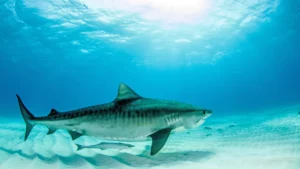
The salmon shark (Lamna ditropis) is a stocky mackerel shark of the North Pacific, reaching about 3 m (10 ft) and 175 kg, and closely related to the porbeagle. It is dark grey to blue-black above and white below, with dark blotches on the belly in adults, a crescent tail carrying two keels on each side, and blade-like teeth with a small cusplet on either side of the main point.
Adults eat Pacific salmon, walleye pollock, herring and squid, and they keep their muscles, gut and brain up to about 11 °C warmer than the sea. Females bear two to five live pups after a gestation of around nine months. The IUCN rates the species Least Concern. Four incidents worldwide are attributed to it and none was fatal.
- Maximum length3.05 m (10 ft); most adults 1.8–2.5 m
- WeightUp to about 175 kg (385 lb); claims of 450 kg are unverified
- LifespanMales at least 27 years, females 20 (eastern North Pacific)
- Depth rangeSurface to at least 650 m (2,130 ft)
- DietPacific salmon, walleye pollock, herring, squid, sablefish
- IUCN statusLeast Concern

- Kingdom
- Animalia
- Phylum
- Chordata
- Class
- Chondrichthyes
- Order
- Lamniformes
- Family
- Lamnidae
- Genus
- Lamna
- Species
- Lamna ditropis
- Family (common)
- Mackerel sharks
- Also known as
- Pacific porbeagle, Mackerel shark, Mōkazame (Japan)
On this page
- How to recognise a salmon shark
- How big do salmon sharks get?
- Where salmon sharks live
- What salmon sharks eat and how they hunt
- Warm blood, senses and behaviour
- Reproduction and lifespan
- Are salmon sharks dangerous to people?
- Conservation status and fisheries
- Relatives and look-alikes
- Frequently asked questions
- References
How to recognise a salmon shark
A salmon shark looks like a great white that has been shortened and thickened. The body is a heavy spindle, the snout a short cone, the first dorsal fin tall and triangular and set well forward, and the tail a near-symmetrical crescent. Where it differs from the great white is in the details: the salmon shark is far smaller at maturity, its snout is shorter and blunter, and its teeth are the wrong shape.
Those teeth are the surest check. Salmon shark teeth are narrow, smooth-edged blades with a small extra cusplet standing on each side of the main point, like a tooth flanked by two miniature teeth. A great white's are broad triangles with coarse serrations and no cusplets; a shortfin mako's are long, hooked and entirely smooth without cusplets.
Then look at the tail stalk. Lamna means two things in this shark's name, and ditropis means two keels: alongside the strong primary keel that every mackerel shark carries, there is a short secondary keel below it on the tail base. Only the salmon shark and the porbeagle have that second keel.
Colour completes it. The back is dark grey to blue-black, the belly white, and in adults the white is broken by irregular dark blotches that juveniles lack. The porbeagle shows a clean white patch on the rear edge of the first dorsal fin; the salmon shark does not.

How big do salmon sharks get?
The largest reliably measured salmon sharks are around 3.05 m (10 ft) in total length, and the heaviest recorded weight in the scientific literature is about 175 kg (385 lb). Most animals encountered in Alaskan and Japanese waters are considerably smaller, between 1.8 and 2.5 m and between 90 and 140 kg. The figure of 992 lb, roughly 450 kg, that circulates for this species is unsubstantiated and should not be repeated; it is far outside anything that has been weighed.
Females grow larger than males and mature much later. Males reach sexual maturity at around five years of age and roughly 1.25 to 1.45 m in fork length, while females need eight to ten years and about 1.7 to 2.0 m. That difference shapes the whole population: a mature female is a substantially bigger animal than a mature male and has spent twice as long getting there.
Pups are already large at birth, around 65 cm, a consequence of the way they are fed in the womb. Growth is rapid at first and slows at maturity, and the sharks anglers catch off Alaska in summer are mostly adult females on the salmon runs. The bar below sets the maximum recorded length against a diver.
Where salmon sharks live
Salmon sharks are confined to the North Pacific. The range runs from the coasts of Japan and Korea north through the Sea of Okhotsk and along the Kamchatka coast of Russia, across the Bering Sea, then south along the American side through the Gulf of Alaska, British Columbia in Canada, Washington, Oregon and northern California to Baja. They are animals of cold water, comfortable between about 2 and 24 °C, and much of their year is spent in seas that would immobilise almost any other shark of their size.
Most of the time they are pelagic, but they come inshore in summer to follow salmon into bays and sounds. Prince William Sound and Sitka Sound in Alaska hold well-known summer aggregations, and the fish there are predominantly female, while the Asian catch is predominantly male. That split is a genuine segregation of the sexes across the basin, not an artefact of fishing, as the old story that Japanese anglers simply remove the males suggests.
Tagging has stretched the depth picture a long way. Salmon sharks spend much of their time in the top 50 m but dive regularly to several hundred metres and have been recorded below 650 m, and tagged individuals from Alaska have reached Hawaii and Baja and returned within a year. They are among the few sharks that routinely work the edge of the sub-Arctic.

- California2 records
- Alaska1 record
- Canada1 record
- Japanlisted
- Oregonlisted
- Russialisted
- South Korealisted
- Washingtonlisted
4 countries and 4 US states list the salmon shark in their species guide; the count is the number of incidents attributed to it there in the SharkSider database. Browse every guide on sharks around the world and sharks in the US.
What salmon sharks eat and how they hunt
The name is well earned but slightly misleading. Salmon sharks do concentrate on Pacific salmon during the summer runs, taking pink, chum, sockeye, coho and king salmon as the fish mass at river mouths, and a salmon shark can open a fish with one pass. For the rest of the year they are broad opportunists, eating walleye pollock, Pacific herring, capelin, sablefish, rockfish, lancetfish, daggertooth and a good deal of squid.
Their appetite has been blamed for salmon declines, and that claim deserves care. These sharks do eat large numbers of salmon in a season, but runs are driven principally by ocean conditions, freshwater habitat and fishing, and no study has shown the shark to be the cause of a collapse in any run.
The hunting method is speed from below. A salmon shark cruises deeper than its prey, picks out a fish against the light and accelerates vertically, which is the standard mackerel shark attack and the reason the family evolved warm muscle in the first place. Claims that the species reaches 50 mph, second only to the mako, have never been measured; no instrument has recorded a salmon shark at anything close to that, and our page on the fastest sharks explains how few of these figures rest on real data. What is certain is that it is fast enough, in water cold enough, to catch an adult salmon.

Warm blood, senses and behaviour
The defining feature of this shark is its temperature. Like the other mackerel sharks it carries a rete mirabile, a dense counter-current mesh of arteries and veins that traps the heat generated by the swimming muscles instead of losing it at the gills. The salmon shark uses the system harder than any of its relatives: it holds a core temperature of roughly 25 °C, typically 8 to 11 °C above the water around it, and elevations above 20 °C have been recorded in sharks working in near-freezing sea.
Warm muscle contracts faster and a warm gut digests faster, so the animal hunts effectively where a cold-blooded predator would be sluggish. The cost is a constant, enormous demand for food, and a shark that cannot stop swimming: salmon sharks are obligate ram ventilators and die quickly if held still in a net.
Their senses are those of a fast open-water hunter. The ampullae of Lorenzini read the electrical field of prey in the last moments of an attack, the eyes are large and well adapted to the dim green light of the sub-Arctic, and the sense of smell works over hundreds of metres down-current rather than over the miles of legend. Socially they are tolerant rather than gregarious, feeding in loose groups at a salmon run with no evidence of coordinated hunting.
Reproduction and lifespan
Salmon sharks are ovoviviparous with oophagy, the reproductive pattern of the whole mackerel shark family. The eggs hatch inside the mother, and the embryos then feed on a continuous supply of unfertilised eggs she keeps producing, growing enormous stomachs to hold them. There is no placenta and no yolk left by the end; the pups are effectively fed by their mother throughout.
Litters are small: two to five pups, usually four, born at around 65 cm after a gestation of roughly nine months. Mating takes place in late summer and autumn, and pupping in spring, chiefly in the more southerly and offshore parts of the range. Juveniles spend their first years well away from the adult feeding grounds, and every year a number of young salmon sharks wash up alive or dead on the beaches of Oregon, Washington and northern California, which is the most common way the public sees one.
The lifespan figures are frequently misquoted. Vertebral ageing in the eastern North Pacific found males of at least 27 years and females of 20, and those are the oldest individuals found, not averages; a page that describes 27 years as the average lifespan of a male has inverted the meaning. Given how late females mature, at eight to ten years, a female salmon shark may only have a decade of breeding life. Our page on how long sharks live explains how those ages are read from growth bands and why the method has produced so many corrections.

Are salmon sharks dangerous to people?
Barely, and the record below says so plainly. Four incidents in the SharkSider database are attributed to salmon sharks, none of them fatal, spread between 2000 and 2018 and confined to Alaska, California and British Columbia. Read them individually and the picture gets gentler still: one was a researcher bitten on the leg while handling a shark caught in a net in Prince William Sound, one was a woman at Trinidad Beach, California, whose foot was touched by a dying shark washing against her, one a bitten foot at Montecito, and one a surfer in British Columbia whose finger lacerations were never confirmed as shark.
In other words, this is a two-and-a-half-metre predator with no confirmed unprovoked attack anywhere in its range, and the reason is geography rather than temperament. Salmon sharks hunt in cold open water along coasts where almost nobody swims without a drysuit.
They are still strong enough to be taken seriously by anyone handling one, and fishing crews are the people most likely to be hurt. Treat a salmon shark alongside a boat as you would any large shark, and read our guidance on what to do in a shark encounter before you need it.
Salmon Shark incidents in the SharkSider database
- Records attributed4
- Fatal0 (0%)
- Years covered2000–2018
- Since 20004 incidents, 0 fatal
- Most common activitySwimming & wading
- Most recordsUSA (3)
The six most recent records attributed to the salmon shark
- 14 July 2018 · Trinidad Beach, Huboldt County, California, USAWading — Surf washed the dying shark against her foot provoked incidentRecorded as: Salmon shark, juvenile · not fatal
- 31 August 2013 · Butterfly Beach, Montecito, Santa Barbara County, California, USASwimming — Foot bittenRecorded as: Salmon shark · not fatal
- 19 July 2012 · Tofino, Vancouver, British Colombia, CanadaSurfing — Lacerations to 2 fingers, but shark involvement unconfirmedRecorded as: Salmon shark suspected, but unlikely · not fatal
- 27 August 2000 · Prince William Sound, Alaska, USAConducting research — Leg bitten by netted shark provoked incidentRecorded as: Salmon shark · not fatal
Records are matched on the shark named in each report (“salmon”), so they include incidents where the species was reported rather than confirmed. Full records by country on the shark attacks pages.
Conservation status and fisheries
The IUCN Red List assesses the salmon shark as Least Concern. The population of the eastern North Pacific appears stable, the species is not the target of any large directed fishery on the American side, and its combination of fast growth and relatively early maturity gives it more resilience than most large sharks have.
The pressure is heavier in the west. Salmon sharks have long been taken in Japanese and Russian driftnet, gillnet and longline fisheries, both as target and as bycatch, and Kesennuma in northern Japan has landed them for generations as mōkazame, with the heart eaten raw as a local delicacy. The western population is fished considerably harder than the eastern one and is more poorly monitored, which is the main uncertainty behind the global rating.
In the United States the species is managed rather than protected: Alaska allows sport anglers one salmon shark per day and two per year. The salmon shark is not listed on any CITES appendix, although its close relative the porbeagle and all the makos are, so its fins and meat move in trade without the permits those species require. Given how similar the products look once processed, that gap is worth watching, and our page on why sharks are endangered shows how fast a Least Concern rating can change.
Relatives and look-alikes
The salmon shark's closest relative by a wide margin is the porbeagle, the other member of the genus Lamna. The two are so alike that they were long treated as one species, and separating a photograph of one from the other is genuinely difficult; the white patch on the rear of the porbeagle's first dorsal fin is the classic mark, and the dark belly blotches of an adult salmon shark are the counterpart. Range settles it in practice, since the porbeagle lives in the North Atlantic and the cool Southern Hemisphere and never enters the North Pacific.
Beyond the genus, the family holds the great white shark, which shares the Pacific coast and is routinely reported when a salmon shark is seen, and the two makos: the shortfin mako, slimmer and metallic blue with a pointed snout, and the longfin mako of warmer water. All four share warm muscle, a crescent tail and the same hunting style, and their common ancestry is one of the clearer stories in the evolution of sharks.
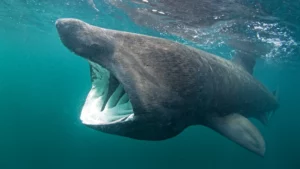
Two big North Pacific sharks are sometimes confused with it for no good reason. The basking shark is a plankton feeder with gill slits that almost encircle the head, and the Pacific sleeper shark is a slow, soft-bodied deep-water animal with tiny fins. Neither has a keeled tail stalk or a conical snout.
 Porbeagle Shark Factsspecies profile
 Great White Sharkspecies profile
 Shortfin Mako Sharkspecies profile
 Longfin Mako Sharkspecies profile
 Basking Sharkspecies profile
- Pacific Sleeper Sharkspecies profile
Frequently asked questions
How big do salmon sharks get?
The largest reliably measured individuals are about 3.05 m, or 10 feet, in total length, and the heaviest weighed in the literature is around 175 kg. Most salmon sharks are between 1.8 and 2.5 m. The commonly repeated weight of 992 lb, about 450 kg, is unsubstantiated and should be disregarded.
Where do salmon sharks live?
Only in the North Pacific. Their range runs from Japan, Korea and the Sea of Okhotsk north through the Bering Sea, then south along the American coast through the Gulf of Alaska and British Columbia to California and Baja. They prefer water between about 2 and 24 °C and come inshore in summer.
Are salmon sharks warm-blooded?
They are regionally endothermic, and no shark does it more strongly. A heat-exchange network of blood vessels keeps their muscles, gut, brain and eyes around 25 °C, usually 8 to 11 °C above the surrounding water, with elevations above 20 °C recorded in near-freezing seas. That lets them hunt fast in the sub-Arctic.
What do salmon sharks eat?
Pacific salmon during the summer runs, which gives them their name, plus walleye pollock, Pacific herring, capelin, sablefish, rockfish, lancetfish, daggertooth and squid for the rest of the year. They are broad opportunists rather than salmon specialists, and no study has shown them to cause a collapse in any salmon run.
How fast can a salmon shark swim?
Nobody knows precisely. The widely quoted figure of 50 mph, second only to the mako, has never been measured on this species and rests on no published instrument record. Salmon sharks are fast enough to catch adult salmon from below in cold water, which is the only claim the evidence actually supports.
How long do salmon sharks live?
Vertebral ageing in the eastern North Pacific found males of at least 27 years and females of 20. Those are the oldest individuals aged, not average lifespans, and the two are frequently confused online. Males mature at about five years, females much later at eight to ten.
How do salmon sharks reproduce?
They are ovoviviparous with oophagy. The eggs hatch inside the mother and the embryos then feed on a supply of unfertilised eggs she keeps producing until birth. Litters are small, two to five pups and usually four, born at around 65 cm after a gestation of roughly nine months.
Are salmon sharks dangerous to humans?
Very rarely. Four incidents worldwide are attributed to the species in the SharkSider database, none fatal, and every one involved a netted, dying or unconfirmed shark. There is no confirmed unprovoked attack anywhere in its range. Their cold, remote habitat means they and swimmers almost never meet.
Why do young salmon sharks wash up on Pacific beaches?
Juveniles spend their first years away from the adult feeding grounds, in the coastal waters off Oregon, Washington and northern California, and a number strand there each year. The causes are not fully understood but include disease, parasites and exhaustion. Stranded animals should be reported to a marine mammal or fisheries hotline rather than handled.
Are salmon sharks endangered?
No. The IUCN Red List rates the salmon shark Least Concern. The eastern North Pacific population appears stable and is managed in the United States, though the western population is fished harder by Japanese and Russian fleets and monitored less well. The species is not listed on any CITES appendix.
References

A small team focused on researching sharks and making marine biology easy to understand. Every page is reviewed against current species records and the SharkSider attack database, and updated when new incidents or research appear.
Published July 26, 2022 · Last updated September 22, 2026 · 4 incidents attributed to the salmon shark in the SharkSider attack database (0 fatal), updated weekly.