
Yes, there are sharks in Peru, more than 60 species in all, and the ones a visitor is likely to come across are harmless. The country's everyday sharks are the smooth hammerhead, the blue shark, the shortfin mako, the common thresher and the humpback and speckled smooth-hounds sold in every coastal market. In the warm north, whale sharks visit Mancora and Los Organos, and blacktip, silky and bull sharks live along the Tumbes coast.
The safety record could hardly be shorter. The SharkSider database holds only two entries for Peru, both older than 1900: a fatal attack on a swimmer at Tumbes in October 1849, and a skeleton with shark-bite marks from the Paloma archaeological site dated to around 4000 BC. No incident has been recorded in Peruvian waters in more than 170 years, which for a coastline with millions of beachgoers each summer is remarkable, and the cold, murky Humboldt water explains most of it.
- Shark species recorded60+ nationally; 37 profiled here
- ProtectionNational Plan of Action 2014; finning banned, fins attached; hammerhead closed season and minimum size
- Most seen from the beachSmooth-hounds and smooth hammerheads (at the fish landings)
- Signature encounterWhale sharks off Mancora and Los Organos
- Incidents in the database2, both before 1900 (1849 fatal; c. 4000 BC); none since
- Water temperature14–18 °C Lima to Tacna; 22–27 °C Tumbes and Mancora

On this page
- Where sharks live in Peruvian waters
- List of the different types of sharks in Peru
- Where to see sharks in Peru
- Best time of year to see sharks in Peru
- Shark attacks in Peru: what the record actually shows
- Is it safe to swim and snorkel with sharks in Peru?
- Shark conservation in Peru
- Sharks in neighbouring waters
- Frequently asked questions
- References
Where sharks live in Peruvian waters
The Humboldt Current is the reason Peru has so many sharks and so few encounters. Cold water wells up along the whole coast from Tacna to Paita, carrying nutrients that feed the largest single-species fishery in the world, the Peruvian anchoveta, and everything that eats it. Sharks are part of that food web at every level: small smooth-hounds and catsharks on the shelf, tope and sevengills in the bays, smooth hammerheads, blue sharks, makos and threshers over the shelf edge. But the same upwelling keeps the sea at 14–18 °C, green with plankton and often fogged by the garua mist that hangs over Lima for half the year. Peruvians swim in it for a few weeks in January and February and otherwise leave it to the fishermen. Sharks and people rarely share the water, and the record shows it.
North of the Illescas Peninsula and Paita the coast bends east and the Humboldt swings away offshore. From Talara through Mancora and Punta Sal to the Ecuadorian border at Tumbes the water is 22–27 °C, there are mangroves, sandy beaches and Peru's only real surf-and-beach tourism. This is the tropical Peru of whale sharks, hammerhead schools, blacktips, silky sharks, bull sharks in the Tumbes mangrove channels and the big makos that Ernest Hemingway came to Cabo Blanco to fish for in 1956. The transition zone between the two seas, roughly Paita to Sechura Bay, holds species from both and moves north or south with every El Nino.
Offshore, Peru's exclusive economic zone drops into the Peru-Chile Trench at more than 6,000 m, and the deep slope adds sixgills, prickly sharks, pygmy sharks and cookiecutters to the list. Peru's marine institute, IMARPE, has catalogued more than 60 shark species in national waters, most of them recorded from the landings of the artisanal fleet at Paita, Salaverry, Chimbote, Callao, Pucusana, Pisco and Ilo rather than from anyone seeing them alive.
List of the different types of sharks in Peru
The table lists the species with a solid record in Peruvian waters that a visitor, angler, diver or fish-market browser could actually run into, from the tropical north to the cold south and the deep slope. Lengths are for typical adults. The risk column is judged for a swimmer on a Peruvian beach, and for most of these species it is a formality: they live in cold offshore water or on the bottom. Peruvian Spanish has its own names, and they matter at the market: tollo covers the smooth-hounds and small sharks, tiburon martillo or cachuda is the hammerhead, tiburon azul the blue, diamante the mako and zorro the thresher. Several corrections from the original list: Peru's nurse shark is the Pacific nurse shark (Ginglymostoma unami), its angel shark is the Chilean angelshark rather than the Californian species, and the horn shark of the north is the Mexican hornshark, not the Californian horn shark.
| Species | Adult size | Risk to swimmers | Where in Peru & notes |
|---|---|---|---|
Smooth Hammerhead SharkSphyrna zygaena | 2.5–4 m (8–13 ft) | Low | Whole coast over the shelf; the most landed shark in PeruTiburon martillo. Pregnant females come inshore in summer, hence the closed season. Vulnerable globally. |
Scalloped Hammerhead SharkSphyrna lewini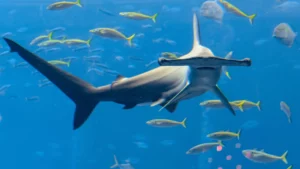 | 2.5–3.5 m (8–12 ft) | Low | Warm north from Paita to Tumbes; juveniles in Sechura BayThe tropical hammerhead, critically endangered worldwide; northern Peru is a nursery area. |
Blue SharkPrionace glauca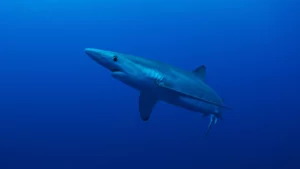 | 2–3 m (7–10 ft) | Low | Offshore along the whole coast; longline catchTiburon azul. The commonest large shark in Peruvian landings after the hammerhead. |
Shortfin Mako SharkIsurus oxyrinchus | 2.5–3.5 m (8–12 ft) | Moderate | Deep water off Cabo Blanco, Mancora and the shelf edgeDiamante. Hemingway's fish at Cabo Blanco; still a sport and longline target. |
Common Thresher SharkAlopias vulpinus | 3–5 m (10–16 ft) incl. tail | Low | Cool water off central and southern PeruZorro. Landed regularly at Pucusana and Pisco; harmless. |
Pelagic Thresher SharkAlopias pelagicus | 2.5–3.5 m (8–12 ft) incl. tail | Low | Tropical north, offshoreThe warm-water thresher; replaces the common thresher north of Paita. |
Bigeye Thresher SharkAlopias superciliosus | 3–4 m (10–13 ft) incl. tail | Low | Deep offshore water, longline recordHuge eyes for hunting below the thermocline. Harmless. |
Great White SharkCarcharodon carcharias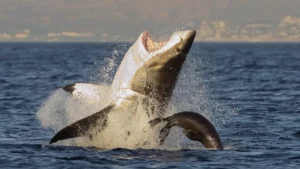 | 4–6 m (13–20 ft) | High | Rare; cool north-central coast and Paracas, near sea-lion coloniesA handful of verified captures and sightings. No incident with a person in Peru. |
Tiger SharkGaleocerdo cuvier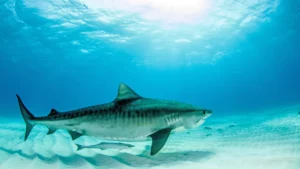 | 3–4.5 m (10–15 ft) | High | Tropical north only; strays south in El Nino yearsUncommon in Peru; the warm Tumbes coast is the southern edge of its normal range here. |
Bull SharkCarcharhinus leucas | 2.2–3.2 m (7–10 ft) | High | Tumbes mangroves and river mouthsJuveniles use the mangrove channels of the Tumbes sanctuary. The likely species in the 1849 case. |
Blacktip SharkCarcharhinus limbatus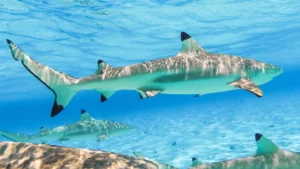 | 1.5–2.5 m (5–8 ft) | Moderate | Surf zone and shallows from Tumbes to MancoraThe shark northern surfers share the water with. Fast, nervous, fish-eating. |
Silky SharkCarcharhinus falciformis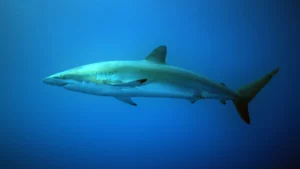 | 2–3 m (7–10 ft) | Moderate | Warm offshore water north of Paita; tuna and mahi-mahi groundsA major bycatch of the northern longline fleet. |
| Oceanic Whitetip SharkCarcharhinus longimanus | 2–3 m (7–10 ft) | High | Far offshore in the tropical northBold open-ocean shark; a hazard to people adrift, never seen from a beach. |
Galapagos SharkCarcharhinus galapagensis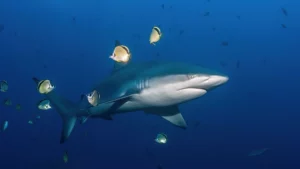 | 2.5–3 m (8–10 ft) | Moderate | Offshore islands and banks in the northOceanic-island specialist ranging down from the Galapagos and Ecuador. |
Copper Shark (Bronze Whaler)Carcharhinus brachyurus | 2.5–3.3 m (8–11 ft) | Moderate | Temperate coast from Lima to TacnaThe one large requiem shark of the cold south; follows fish schools inshore, rarely seen by swimmers. |
Whale SharkRhincodon typus | 6–12 m (20–40 ft) | Low | Mancora, Los Organos and Punta Sal, mainly Aug–JanPeru's only organised shark encounter. Filter feeder, harmless. |
Basking SharkCetorhinus maximus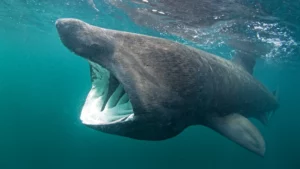 | 6–9 m (20–30 ft) | Low | Rare in cold water off central and southern PeruOccasional captures and strandings; the south-east Pacific population is poorly known. |
Broadnose Sevengill SharkNotorynchus cepedianus | 2–3 m (7–10 ft) | Low | Cold bays: Paracas, Pisco, IloGato. A heavy bottom-hunter that has bitten divers elsewhere when handled; no Peruvian case. |
Sharpnose Sevengill SharkHeptranchias perlo | 1–1.4 m (3–4.5 ft) | Low | Outer shelf and slopeSmall, big-eyed deep-water cousin of the broadnose; a trawl and longline record. |
Bluntnose Sixgill SharkHexanchus griseus | 3.5–4.8 m (11–16 ft) | Low | Deep slope along the whole coastAncient deep-water giant; caught on deep longlines, never near shore. |
Prickly SharkEchinorhinus cookei | 3–4 m (10–13 ft) | Low | Deep water and submarine canyonsThorn-skinned Pacific relative of the bramble shark; sluggish and harmless. |
| Chilean AngelsharkSquatina armata | 1–1.5 m (3–5 ft) | Low | Sandy bottoms from Paita to TacnaAngelote. Peru's angel shark, replacing the Californian species on the old list. Heavily fished, critically endangered. |
| Humpback Smooth-houndMustelus whitneyi | 0.8–1.1 m (2.6–3.6 ft) | Low | Shelf along the whole coastThe classic tollo of Peruvian ceviche and one of the most fished sharks in the country. |
| Speckled Smooth-houndMustelus mento | 0.9–1.3 m (3–4.3 ft) | Low | Cold central and southern shelfTollo mantequero; a Humboldt Current endemic sold fresh at every southern port. |
Spotted HoundsharkTriakis maculata | 1.5–2.4 m (5–8 ft) | Low | Rocky shallows and bays from Paracas southLarge, spotted houndshark of the Peru-Chile coast; crab-eater, harmless. |
Tope Shark (School Shark)Galeorhinus galeus | 1.3–1.8 m (4–6 ft) | Low | Cold water south of Lima; Ilo landingsCazon. A slender, migratory school shark, critically endangered worldwide. |
| Red-spotted CatsharkSchroederichthys chilensis | 50–65 cm (1.6–2.1 ft) | Low | Kelp and rocky shallows from Paita southPintarroja. The small shark snorkellers in Lima's coves are most likely to see. |
| Spiny DogfishSqualus acanthias | 0.8–1.2 m (2.6–4 ft) | Low | Cold southern shelf, Moquegua and TacnaTollo de espina; the southern limit of its Pacific range. |
Galapagos Bullhead SharkHeterodontus quoyi | 0.6–1 m (2–3.3 ft) | Low | Rocky reefs of the northern and central coastSpotted, pig-snouted bottom shark shared with the Galapagos. Completely harmless. |
| Mexican HornsharkHeterodontus mexicanus | 0.6–0.7 m (2–2.3 ft) | Low | Tropical north, Tumbes to PaitaThe horn shark of the old list is this species, not the Californian one. |
Bonnethead SharkSphyrna tiburo | 0.9–1.2 m (3–4 ft) | Low | Shallow bays and mangroves of the tropical northSmallest hammerhead; the Pacific population reaches its southern limit around Tumbes. |
Pacific Sharpnose SharkRhizoprionodon longurio | 1–1.3 m (3–4.3 ft) | Low | Inshore in the north; common in Tumbes landingsSmall schooling requiem shark; harmless. |
Whitenose SharkNasolamia velox | 1.2–1.5 m (4–5 ft) | Low | Coastal north, Tumbes and PiuraAn eastern Pacific endemic with a long pale snout; a gill-net species. |
Pacific Nurse SharkGinglymostoma unami | 2–2.8 m (7–9 ft) | Low | Reefs and rocky shallows of the tropical northPeru's nurse shark, described as a separate species in 2015; the Atlantic nurse shark does not occur here. |
Crocodile SharkPseudocarcharias kamoharai | 0.9–1.1 m (3–3.6 ft) | Low | Oceanic, offshore northSmall, huge-eyed pelagic shark; a longline bycatch record. |
Cookiecutter SharkIsistius brasiliensis | 40–55 cm (1.3–1.8 ft) | Low | Deep offshore water; scars on tuna and dolphinsPlug-biting deep-sea parasite. Bites on people are near-unknown and never here. |
Pygmy SharkEuprotomicrus bispinatus | 22–27 cm (9–11 in) | Low | Open ocean off the whole coastOne of the smallest sharks alive; rises from the deep at night. |
Megamouth SharkMegachasma pelagios | 4–5.5 m (13–18 ft) | n/a | Unconfirmed in PeruReported from the south-east Pacific but without a well-documented Peruvian specimen; listed as unconfirmed. |
Some species that appear on older lists for Peru need a caveat. The megamouth shark has been reported from the south-east Pacific but has no well-documented Peruvian specimen, so it is listed as unconfirmed. The Pacific sleeper shark is a North Pacific animal; the sleeper sharks of the Peru-Chile slope belong to the southern species. The porbeagle reaches southern Chile and is at best a stray off southern Peru, and the sandbar and dusky sharks of the eastern Pacific are seldom recorded this far south. The great white, on the other hand, is genuine: it has been caught and photographed on several occasions along the cool north-central coast, though it has never been involved in an incident here.
Where to see sharks in Peru
Peru is not a shark-diving destination in the way its neighbours Ecuador (Galapagos) and Colombia (Malpelo) are, and most sightings are from boats, beaches and markets rather than underwater. These are the places where sharks are part of the scenery.
- Mancora, Los Organos and El Nuro, PiuraPeru's whale shark coast. Boats from Los Organos and Mancora run snorkelling trips when the animals are close inshore, mainly from August to January, sharing the water with green turtles at the El Nuro pier and humpback whales in winter.
- Punta Sal and the Tumbes coastWarm, clear water at the tropical end of the country. Blacktip, silky and scalloped hammerhead sharks are seen from fishing boats, and the Tumbes mangrove sanctuary is a bull shark nursery.
- Cabo Blanco, PiuraThe old big-game capital where Hemingway fished in 1956 and where black marlin records were set. The same deep water off the point still produces shortfin makos and threshers for sport boats and the local longliners.
- Isla Foca and the Paita landingsA sea-lion island south of Paita at the meeting point of the two currents, with hammerheads and smooth-hounds in the surrounding water. Paita's fish terminal is where a large share of Peru's hammerheads and blue sharks are landed.
- Paracas National Reserve and the Ballestas Islands, IcaCold, sheltered bays where broadnose sevengills, tope, spotted houndsharks and smooth-hounds live on the bottom, and where Pisco's fishermen bring them in. Occasional basking shark and great white records come from this stretch.
- Pucusana and Chorrillos, LimaThe fishing coves closest to the capital. Smooth-hounds, catsharks and the occasional angel shark come ashore with the morning catch; snorkellers in the coves meet nothing bigger than a red-spotted catshark.
- Ilo and the far south, Moquegua and TacnaThe coldest Peruvian water and the southern sharks: tope, spiny dogfish, sevengills and copper sharks, plus sixgills on the slope. Landings-only country for shark spotting.
- Offshore longline grounds, 50–200 km outWhere the blue sharks, makos, threshers, silky and oceanic whitetip sharks actually are. Sport-fishing charters out of Mancora and Cabo Blanco are the only practical way for a visitor to see them alive.
For a shark you can swim with, Mancora and Los Organos between August and January are the only real option, and even there the whale sharks come and go with the water temperature. Everywhere else the best shark-watching in Peru is at dawn on a fishing quay, and Paita and Pucusana are the two to visit.
Best time of year to see sharks in Peru
Peru's seasons are reversed from the northern hemisphere, and the two coasts behave differently.
- December to March (austral summer): the warmest water everywhere, 20–22 °C at Lima and 26–27 °C at Tumbes. Beach season, and the months when tropical species push furthest south. The hammerhead closed season falls in this period, when the females move inshore to pup.
- April to November (winter): cold, grey and foggy from Lima south, with water down to 14–15 °C. The Humboldt fishery is at full strength and the coastal shark landings peak, but nobody swims.
- August to January, the north: the whale shark window off Mancora and Los Organos, overlapping with the humpback whale season from July to October. Sightings peak when warm water sits close inshore.
- El Nino years: warm water floods south, the anchoveta collapse, and tropical sharks such as blacktips, silkies and even tiger sharks turn up off Lima and Pisco where they are normally absent. The 1982–83, 1997–98 and 2023 events all produced unusual shark records.
For a swimmer, the practical point is that Peruvian beaches are used in summer, when the sharks that might matter, the tropical requiem sharks, are furthest south, and the record still shows no incident. The cold water is a better deterrent than any net.
Shark attacks in Peru: what the record actually shows
Peru has one of the cleanest records of any country with a long coastline. The SharkSider database holds only two entries, both from before 1900, so the automatic list of modern incidents below is empty: there is no recorded shark bite on a person in Peruvian waters since the 19th century. The full record is kept on the shark attacks in Peru page.
No incidents are recorded in the SharkSider database for this country.
The two historical entries are worth knowing. The only documented attack is from 4 October 1849 at Tumbez (modern Tumbes), the tropical northern port near the Ecuadorian border, where a swimmer was killed; no species was recorded, but the warm mangrove-lined water there is bull shark and tiger shark habitat, which fits. The second entry is not an attack in the usual sense at all: it is an archaeological find from the Paloma site on the central coast, a skeleton from around 4000 BC bearing shark-bite marks, recorded because it is one of the oldest pieces of evidence anywhere of a person being bitten by a shark. Whether the individual died from the bite or was scavenged is unknowable.
The absence of anything since 1849 is not a gap in reporting. Peru's beaches are crowded every summer, its artisanal fleet handles tens of thousands of sharks a year, and its newspapers would not miss a bite. The explanation is the water: cold, turbid, and short on the warm-water species that account for most bites worldwide. The tropical north, where blacktips, bulls and tigers live, has a small population and a short beach season. If anything ever happens, it will be there, and the ordinary rules apply: stay out of the mangrove channels and river mouths of Tumbes at dusk, and our guide on how to survive a shark attack is worth ten minutes before you swim anywhere sharks are fished.
Is it safe to swim and snorkel with sharks in Peru?
Yes, and the question rarely comes up. On the central and southern coast the sharks a swimmer could conceivably meet, smooth-hounds, catsharks, tope and the occasional angel shark, are bottom-dwellers that eat crabs and small fish and pose no threat. Sevengills are bigger and have bitten divers who handled them in other countries, but in Peru they live in cold bays that few people enter without a wetsuit and a purpose.
The whale shark trips from Los Organos and Mancora are the only organised shark encounter in the country. Whale sharks are harmless, but the trips are young and lightly regulated, so choose an operator that briefs you properly: slip in quietly, stay three metres off the flank and well behind the tail, no touching, no flash, a handful of swimmers per animal. Our page on swimming safely with whale sharks covers the etiquette. The same boats sometimes meet blacktips and silky sharks on the way out; both are fast, nervous and uninterested in snorkellers.
Surfers at Mancora, Lobitos and Chicama share the line-up with blacktip sharks in the warm months and have never had a problem. The genuinely cautious advice concerns the Tumbes mangroves, where bull sharks pup, and the fish-cleaning areas at any northern port, where sharks feed on discards close to shore.
Shark conservation in Peru
Peru is one of the largest shark-fishing and shark-fin-exporting countries in the eastern Pacific, and its conservation effort goes into regulating that fishery rather than shutting it. Sharks are landed by the artisanal fleet at dozens of ports and the meat is a staple: tollo is a regular ingredient in Lima's ceviche and the smooth hammerhead is the single most landed species. The Ministry of Production (PRODUCE) adopted a National Plan of Action for the conservation of sharks in 2014, following the FAO framework, and in the years since it has banned finning with a fins-attached rule, set a minimum landing size for the smooth hammerhead and introduced a closed season during the months when pregnant females come inshore. Peru is also a party to the Convention on Migratory Species and its shark memorandum, which covers the whale shark, basking shark, great white, makos, threshers and hammerheads.
Enforcement is the weak point. The coast is long, the landings are scattered, and hammerhead fins from Peru have surfaced in seizures bound for Asia; juvenile hammerheads well under the legal size still turn up on the quays at Paita and Salaverry. Blue sharks and makos are taken in large numbers by the longline fleet targeting mahi-mahi and tuna, and the eastern Pacific stocks of both hammerheads and threshers are assessed as declining. The positive side is that Peru has strong marine science through IMARPE, a growing whale shark tourism industry in the north that gives live sharks a value, and protected areas at Paracas and the Tumbes mangroves that shelter key habitat. Our page on why sharks are endangered explains why hammerheads in particular recover so slowly from this kind of pressure.
Sharks in neighbouring waters
Peru's shark fauna continues north and south along the same coast. Chile shares the Humboldt species, the smooth-hounds, tope, sevengills and the great whites that occasionally reach the northern Chilean coast. Ecuador has the tropical set, and the Galapagos Islands are the region's premier shark destination, with hammerhead schools that dwarf anything off Peru. Further north, Colombia's Malpelo Island and Panama's Coiba, Costa Rica's Cocos Island and the Pacific coast of Mexico complete the eastern Pacific hammerhead highway. For every other coast on the site, start at sharks around the world.
Frequently asked questions
Are there sharks in Peru?
Yes, more than 60 species. The common ones are the smooth hammerhead, blue shark, shortfin mako, common thresher and the smooth-hounds sold as tollo in every coastal market. The tropical north around Mancora and Tumbes adds whale sharks, blacktips, silky sharks, scalloped hammerheads and bull sharks, while the cold south has tope, sevengills and catsharks.
Have there been shark attacks in Peru?
Only one on record. A swimmer was killed at Tumbes in October 1849, and the species was never identified. The database's other Peruvian entry is a skeleton with shark-bite marks from the Paloma archaeological site, dated to around 4000 BC. No incident has been recorded in Peruvian waters since 1849.
Is it safe to swim at Peru's beaches?
Yes. Peru has no recorded shark bite in more than 170 years. The cold Humboldt Current keeps the central and southern coast at 14–20 °C and the sharks there are small bottom-dwellers. In the warm north the ordinary rules apply: avoid the Tumbes mangrove channels and river mouths at dusk and stay clear of fish-cleaning areas.
Are there great white sharks in Peru?
Yes, but rarely. Great whites have been caught and photographed a few times along the cool north-central coast and near the sea-lion colonies of Paracas, and they are on Peru's official species list. They have never been involved in an incident with a person in Peruvian waters.
Can you swim with whale sharks in Peru?
Yes, off the far north. Boats from Los Organos and Mancora in Piura run snorkelling trips when whale sharks are close inshore, mostly between August and January. Sightings depend on water temperature and are less reliable than in Ecuador, so book with an operator that follows a no-touch, small-group briefing.
When is the best time to see sharks in Peru?
August to January for whale sharks off Mancora, overlapping the humpback whale season. December to March is beach season with the warmest water. For the cold-water species, the winter landings from April to November at Paita, Pucusana and Pisco are the best place to see hammerheads, smooth-hounds and threshers up close.
What is the most common shark in Peru?
By landings, the smooth hammerhead, followed by the blue shark and the humpback smooth-hound. Smooth-hounds, sold as tollo, are the sharks most Peruvians actually encounter, on a plate. Inshore snorkellers on the central coast are most likely to see the small red-spotted catshark.
Are there bull sharks or tiger sharks in Peru?
Both occur, but only in the tropical north. Bull sharks use the mangrove channels of the Tumbes sanctuary as a nursery and are the likely species in the 1849 case. Tiger sharks are uncommon visitors to the Tumbes and Piura coast and stray further south only during strong El Nino years.
Is shark fishing legal in Peru?
Yes. Peru is one of the largest shark-fishing nations in the eastern Pacific and shark meat is a staple. Since the 2014 National Plan of Action it has banned finning with a fins-attached rule and set a minimum size and a closed season for smooth hammerheads. Whale sharks and giant mantas are protected from capture.
Do megamouth sharks live in Peru?
Not confirmed. Megamouth sharks have been reported from the south-east Pacific, and the original version of this page repeated that claim, but there is no well-documented Peruvian specimen in the scientific record. We list the species as unconfirmed until a verified capture or sighting is published.
References

A small team focused on researching sharks and making marine biology easy to understand. Every page is reviewed against current species records and the SharkSider attack database, and updated when new incidents or research appear.
Published February 6, 2023 · Last updated September 21, 2026 · Incident data from the SharkSider attack database (0 records for Peru, 0 fatal).


