
Yes, Hawaii has sharks around every island, and about 40 species have been recorded, most of them deep-water. The 21 in this guide are the ones people meet: whitetip and blacktip reef sharks and grey reef sharks on the reefs, sandbar and Galapagos sharks on the North Shore cage dives, scalloped hammerheads nursing in Kāneʻohe Bay, and the tiger shark, which is present in every month around every island.
The record is long and specific. SharkSider's database holds 351 incidents for Hawaii (1779–2026), 328 of them since 1900, and 46 that were fatal. Since 2000 there have been 182 records and 8 deaths, every one of them on Maui, the last a surfer at Baby Beach in December 2023. Where the shark was identified it was a tiger shark in 93 cases, and the next species on the list has 4.
- Shark species in this guide21 (about 40 recorded)
- Protected in state watersAll sharks since 1 Jan 2022 (Act 51)
- Most seen from the beachWhitetip reef shark
- Signature encounterGalapagos & sandbar sharks off Haleʻiwa
- Incidents in the database351 (1779–2026), 46 fatal
- Water temperature24–27 °C (75–81 °F)

On this page
- Where Hawaii's sharks live and why
- List of the different types of sharks in Hawaii
- Where to see sharks in Hawaii
- Best time of year to see sharks in Hawaii
- Shark attacks in Hawaii: what the record actually shows
- Is it safe to swim and snorkel in Hawaii?
- Shark conservation in Hawaii
- Sharks in nearby states and waters
- Frequently asked questions
- References
Where Hawaii's sharks live and why
The Hawaiian chain is a line of volcanoes rising from four kilometres of water, and that shapes everything about its sharks. There is almost no continental shelf. A reef flat runs a few hundred metres out from most beaches, drops over a steep slope, and within a mile of shore the seabed is a thousand metres down. Reef sharks live on the shallow shelf, tiger sharks cruise the slope and cross the deep channels between islands, and open-ocean species such as oceanic whitetips, silkies and makos hunt in blue water that is closer to a Hawaiian beach than it is to almost any beach on the mainland. Nutrients are scarce in mid-ocean, so there is no equivalent of Florida's baitfish-choked inlets; the sharks are fewer, but the big ones are big.
Two features of the geography matter to swimmers. The first is Maui Nui, the shallow basin between Maui, Molokaʻi, Lānaʻi and Kahoʻolawe: a broad, turbid, productive shelf that adult female tiger sharks favour, especially in autumn, and the area where the majority of Hawaii's serious incidents have happened. The second is river mouths and harbours after heavy rain, when brown runoff pushes offshore and the tiger sharks follow the flushed-out food. The islands also hold two hammerhead nurseries, Kāneʻohe Bay on Oʻahu and Hilo Bay on Hawaiʻi Island, where scalloped hammerhead pups are born each summer, and beyond Kauaʻi the uninhabited Northwestern Hawaiian Islands hold reefs where Galapagos and grey reef sharks are still as abundant as they were before people arrived.
List of the different types of sharks in Hawaii
About 40 sharks appear on the Hawaiian list, but half of them are lanternsharks, gulper sharks and other deep-slope animals seen only by research submersibles and longliners. The table keeps to the species with a solid record in water people use. The risk column rates the danger to a swimmer or snorkeller, not to a diver who seeks the species out. Three naming notes: the local nurse-shark-like animal seen resting in caves is the whitetip reef shark (manō lālākea), the “reef shark” of Hawaiian dive briefings is usually the grey reef, and what North Shore cage boats call a “Galapagos” is a genuine species, Carcharhinus galapagensis, not a nickname.
| Species | Adult size | Risk to swimmers | Where in Hawaii & notes |
|---|---|---|---|
Tiger SharkGaleocerdo cuvier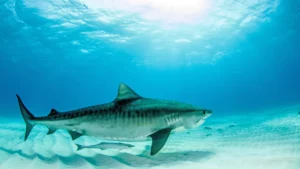 | 3–4.5 m (10–15 ft), females to 5 m | High | Every island, every month; Maui Nui shelf in autumn; harbour mouths after rainIdentified in 93 Hawaiian records and behind nearly every modern fatality. Niuhi in Hawaiian; tagged animals roam the whole archipelago. |
Galapagos SharkCarcharhinus galapagensis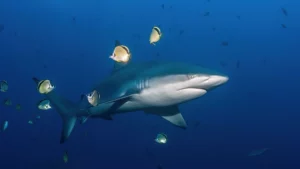 | 2.5–3 m (8–10 ft) | Moderate | North Shore cage grounds off Haleʻiwa; walls off Niʻihau; abundant in the Northwestern Hawaiian IslandsA big, confident reef shark of oceanic islands. Three older records plus the 2026 Cromwell's bite; bold around divers, rarely near beaches. |
Sandbar SharkCarcharhinus plumbeus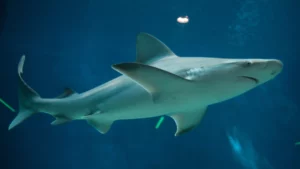 | 1.8–2.4 m (6–8 ft) | Low | The main shark of the Haleʻiwa cage dives; deep sand slopes around all islandsTall dorsal fin, heavy body, timid nature. The species most Hawaii visitors actually swim with. |
Scalloped Hammerhead SharkSphyrna lewini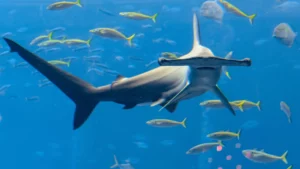 | 2.5–3.5 m (8–12 ft) | Low | Kāneʻohe Bay and Hilo Bay nurseries in summer; adults in deep waterPups are born in the bays from May to September and leave in autumn. Critically endangered worldwide; the nurseries are a research focus. |
Whitetip Reef SharkTriaenodon obesus | 1.2–1.6 m (4–5 ft) | Low | Caves and ledges on every island: Makaha, Molokini, KonaManō lālākea. The shark snorkellers see most, resting motionless by day. Docile; the old table's “moderately aggressive” was wrong. |
Blacktip Reef SharkCarcharhinus melanopterus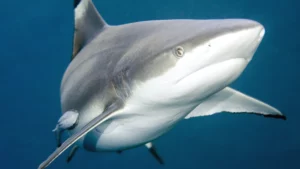 | 1.2–1.6 m (4–5 ft) | Low | Shallow flats and lagoons, Kāneʻohe Bay, Hawaiʻi Island's south coastLess common in Hawaii than elsewhere in the Pacific. The December 2025 Big Island record was a man bitten while freeing one from a net. |
Grey Reef SharkCarcharhinus amblyrhynchos | 1.5–2 m (5–6.5 ft) | Moderate | Outer reef drop-offs: Molokini back wall, Lehua Rock, the Northwestern islandsTerritorial toward divers who crowd it, with a famous hunched warning display. Not the “highly aggressive” shark of the old table; no swimmer fatality. |
| Oceanic Whitetip SharkCarcharhinus longimanus | 2.5–3 m (8–10 ft) | High | Open ocean off Kona and the channels, often with pilot whalesBold, persistent pelagic shark that follows boats and swimmers offshore; a real risk to people in deep water, essentially never at a beach. Federally threatened. |
Silky SharkCarcharhinus falciformis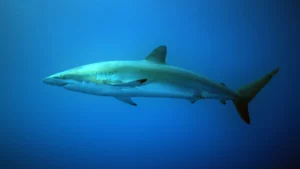 | 2–3 m (7–10 ft) | Moderate | Blue water around fish-aggregating buoys and tuna schoolsThe most common shark caught by the Hawaii longline fleet. Curious around divers offshore, absent from reefs. |
Great White SharkCarcharodon carcharias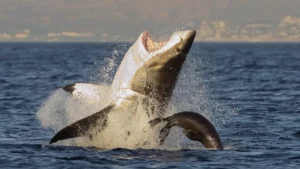 | 4–6 m (13–20 ft) | High | Rare winter visitor, January–April, mostly offshore of Oʻahu and MauiA few dozen confirmed sightings in decades; three records including the 1926 Haleʻiwa fatality. Not common in any season, whatever the old page said. |
Shortfin Mako SharkIsurus oxyrinchus | 2.5–3.5 m (8–11 ft) | Low | Deep offshore water; a longline and sport-fishing catchThe fastest shark, seen by fishermen far more than by divers. No Hawaiian beach record. |
Longfin Mako SharkIsurus paucus | 2.5–4 m (8–13 ft) | Low | Deep tropical water far offshoreSlower, bigger-finned cousin of the shortfin, known mainly from longline catches. Endangered. |
Blue SharkPrionace glauca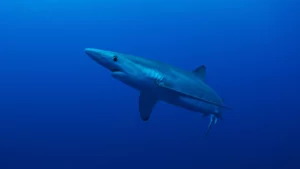 | 2–3 m (7–10 ft) | Low | Cooler open water north of the islandsAbundant offshore, historically the main longline bycatch. Almost never seen from shore. |
Whale SharkRhincodon typus | 6–10 m (20–33 ft), rarely 12 m+ | Low | Kona coast and the channels, most often in spring and early summerSightings are unpredictable but regular enough that Kona boats keep a lookout. Filter feeder; fully protected. |
Pelagic Thresher SharkAlopias pelagicus | 2.5–3.5 m (8–12 ft) including the tail | Low | Open ocean; occasionally seen on Kona blackwater divesThe thresher of tropical Pacific water. Stuns fish with its tail; harmless. |
Bigeye Thresher SharkAlopias superciliosus | 3–4 m (10–13 ft) | Low | Deep water; a regular longline catchHuge upturned eyes for hunting squid in the dark. Rarely seen alive by anyone but fishermen. |
Cookiecutter SharkIsistius brasiliensis | 0.4–0.5 m (16–20 in) | Low | Deep water by day, rising toward the surface at night in the inter-island channelsTakes round plugs of flesh from tuna, whales and, three times in the record, long-distance swimmers crossing the Kaiwi Channel at night. |
Bignose SharkCarcharhinus altimus | 2.5–3 m (8–10 ft) | Low | Deep slopes below 90 m around the islandsA deep-water requiem shark known from longlines. The old table called it highly aggressive; it never meets swimmers. |
Smooth Hammerhead SharkSphyrna zygaena | 2.5–3.5 m (8–12 ft) | Low | Rare; cooler offshore waterRecorded only occasionally; the hammerhead Hawaiians see is almost always the scalloped. |
Bluntnose Sixgill SharkHexanchus griseus | 3–4.8 m (10–16 ft) | Low | Deep slopes off Kona and Oʻahu, filmed by research submersiblesAncient six-gilled giant of the deep. Rises to a few hundred metres at night; no swimmer record. |
Megamouth SharkMegachasma pelagios | 4–5.5 m (13–18 ft) | Low | Deep water; the first specimen ever found was tangled in a navy sea anchor off Oʻahu in 1976Hawaii's gift to shark science, a filter-feeding family unknown until that catch. Seen a handful of times since. |
Some entries from the old version of this page had to go. The spotted eagle ray, manta ray, stingrays, torpedo ray and two chimaeras it listed are not sharks at all. There are no bull sharks in Hawaii: the species needs rivers and estuaries and has never been confirmed in the islands. And the great white shark is not “common” here in any season. Adult white sharks tagged in California and Mexico do cross to Hawaiian waters between roughly January and April, but sightings amount to a few dozen in living memory, mostly off Oʻahu and Maui; the famous 6-metre female filmed feeding on a whale carcass off Oʻahu in 2019 was an event precisely because it was so rare.
Where to see sharks in Hawaii
Most Hawaiian shark encounters happen by boat, because the reef shelf is narrow and the sharks are a short ride offshore. These are the places and operators' grounds that deliver, island by island.
- North Shore, Oʻahu (Haleʻiwa Boat Harbor)The centre of Hawaiian shark tourism. Boats run three miles out to crab-pot grounds where Galapagos and sandbar sharks gather, viewed from a cage or, with the free-diving operators, in open water. Tiger sharks and the occasional oceanic whitetip show up in the mix.
- Kāneʻohe Bay, OʻahuThe largest sheltered bay in the islands and a nursery for scalloped hammerheads, whose pups are born here from May to September. Seen from kayaks and sandbar tours; also home to blacktip reef sharks on the flats.
- Makaha Caverns and the Waiʻanae coast, OʻahuLava tubes and arches where whitetip reef sharks rest by day in numbers. A relaxed shore or boat dive with spinner dolphins and turtles on the same reef.
- Kona coast, Hawaiʻi IslandBlue water within a mile of shore. Blackwater night dives, offshore fishing grounds where oceanic whitetips follow pilot whales, and whale shark sightings in spring and early summer. Tiger sharks patrol the harbour mouths.
- Molokini Crater, MauiThe crescent islet off Kīhei with the clearest water on Maui. Whitetip reef sharks under the ledges of the back wall, grey reef sharks in the deep, and the occasional passing hammerhead or tiger shark for divers.
- Lehua Rock and Niʻihau, off KauaʻiThe wildest diving in the main islands: grey reef sharks, whitetips and Galapagos sharks on vertical walls with monk seals and huge schools of fish. Boats leave from Port Allen on Kauaʻi's south shore in summer.
- Hilo Bay, Hawaiʻi IslandThe second scalloped hammerhead nursery, where juveniles cruise the murky inner bay each summer. Seen from the breakwater and by kayakers rather than by divers.
- Maui Ocean Center, MāʻalaeaThe largest aquarium in Hawaii, with reef and open-ocean sharks in a walk-through tunnel and a dive programme for certified visitors. A useful way to learn the species before a snorkelling trip.
If you have one morning, take the Haleʻiwa boat: Galapagos and sandbar sharks are close to guaranteed and the free-diving version puts you in the water with animals of two to three metres in gin-clear blue. For families, the Makaha caverns or a Molokini snorkel are the gentlest introductions, and the whitetips will not move.
Best time of year to see sharks in Hawaii
Hawaiian water barely changes through the year, so the calendar is about behaviour and weather rather than temperature.
- September to December: tiger shark season. Adult females move into the shallow waters of Maui Nui to give birth, the old Hawaiian saying that sharks bite more when the wiliwili trees bloom (autumn) has held up in the modern statistics, and lifeguards post more warnings. Seas are calm on most coasts and visibility is at its best.
- January to April: humpback whale season and the only months with a chance of an adult white shark, usually far offshore. Big north swells close the North Shore cage grounds on some days, so book flexible dates.
- May to September: the settled season. Hammerhead pups fill Kāneʻohe and Hilo bays, whale sharks are reported most often off Kona, and the Niʻihau and Lehua boats run from Kauaʻi. Whitetip reef sharks, Galapagos and sandbar sharks are present all year.
- After heavy rain, any month: stay out of the water near river mouths for a day or two. Brown, murky runoff carries dead animals and fish out to sea and draws tiger sharks close to shore; a disproportionate number of Hawaiian incidents happen in exactly those conditions.
Sea temperature runs from about 24 °C (75 °F) in February to 27 °C (81 °F) in September, warm enough that the tropical reef sharks never leave and cool enough at the edges that a white shark can visit in winter.
Shark attacks in Hawaii: what the record actually shows
Hawaii has fewer incidents than Florida but a far higher share of serious ones, and the reason is one species. The SharkSider database holds 351 incidents for Hawaii, the oldest a surfer at Maliu on Hawaiʻi Island in 1779, the year Captain Cook died at Kealakekua Bay; 328 records date from 1900 onward, and 46 in total were fatal, 36 of them since 1900. The complete list, updated weekly, is on our shark attacks in Hawaii page. Here are the six most recent recorded incidents:
- 2026 · Portlock near China Walls OahuSurfing — Surfboard tail bitten shark then approached the surfer no injuriesTiger shark 4m
- 2026 · Ala Moana Beach Park Concessions OahuSurfing — Surfboard bumped and bitten no injuriesTiger shark 3m
- 2026 · Cromwell's beach OahuPaddling surfboard — Serious injuries to lower legs2.4m (8ft) Galopogos shark
- 2025 · Ka'alu"alu BeachFreeing trapped shark — Bite wounds to thighBlack Tip Reef Shark
- 2025 · Pine Trees Hanalei Bay KauiSwimming — Injuries to legsSpecies not identified
- 2025 · Off Haleiwa Boat Harbour OahuDiving — Bitten on the armSpecies not identified
Three patterns define the record. First, the species: where a shark was identified it was a tiger shark in 93 cases, and the runners-up (reef sharks with 4, white sharks 3, Galapagos 3, cookiecutter 3) barely register. Second, the island: of the 8 deaths since 2000, all 8 happened on Maui, at Kahana Beach in 2004, off Mākena in August and December 2013, Kanahena Cove in 2015, Honokōwai in 2019, Honolua Bay in 2020, Keawakapu in 2022 and Baby Beach in December 2023. Maui Nui's shallow, murky shelf is where the big females feed in autumn, and four of those eight deaths fell in December. Third, the activity: surfers and board riders account for 147 records, swimmers and waders 92, divers and spearfishers 40, and people fishing or on boats 40. Snorkellers far from shore over deep water, as at Mākena and Keawakapu, appear in the fatal list more often than they do anywhere else in the United States.
The 2010s were the busiest decade with 90 records and 4 deaths, and the 35 records of the 2020s include 3 fatalities, all on Maui. The 2026 case at Cromwell's on Oʻahu, a Galapagos shark biting a paddling surfer's legs, is a reminder that the North Shore's cage-dive species can also bite; the December 2025 Big Island record, a blacktip reef shark biting a man who was freeing it from a net, is the kind of provoked incident that makes up a steady minority of the list. Three cookiecutter shark bites on marathon swimmers crossing the Kaiwi Channel at night are a Hawaiian speciality found in no other state's record. If the rare bad case does happen, our guide to surviving a shark attack explains how to respond in the water and on the beach.
Is it safe to swim and snorkel in Hawaii?
For the great majority of beaches and days, yes: millions of people snorkel Hanauma Bay, Kāʻanapali and Kealakekua every year without seeing anything larger than a whitetip reef shark asleep under a ledge. The Hawaiian rules are simple and local. Do not enter murky water, especially near stream mouths after rain; do not swim at dawn, dusk or night; stay close to shore and in groups rather than snorkelling out over deep water alone; and get out if you see turtles, seals or fish behaving oddly, or a sign posted by lifeguards, who close beaches on Maui and Oʻahu several times a year after a sighting and reopen them the next day. Spearfishers should keep their catch on a float line, not on their belt.
Species behaviour helps you read an encounter. Whitetip reef sharks and blacktip reef sharks are timid and will leave if you look at them. A grey reef shark that hunches its back and drops its pectoral fins is asking a diver to retreat, and you should. Sandbar and Galapagos sharks at the North Shore cages are bold but are managed by experienced crews. A tiger shark seen from a beach is the one case to leave the water calmly and immediately; they are curious, they investigate with their mouths, and in murky water they do not always look first. On the offshore whale shark trips off Kona the animal is harmless; enter quietly and keep your distance from the tail.
Shark conservation in Hawaii
Hawaii has moved from culling sharks to protecting all of them within a single lifetime. Between 1959 and 1976 the territory and then the state ran control programmes that killed 4,668 sharks, mostly tigers, and a later analysis found no measurable effect on the rate of bites; the state stopped and has refused to cull since, even after clusters of incidents on Maui. In 2010 Hawaii became the first place in the United States to ban the possession, sale and distribution of shark fins, and on 1 January 2022 Act 51 made it the first state to prohibit knowingly capturing, entangling or killing any shark in state waters, with narrow exemptions for permitted research, subsistence practice and accidental catch that is released. Beyond the main islands, the Papahānaumokuākea Marine National Monument, created in 2006 and expanded in 2016 to 1.5 million square kilometres, protects the reefs of the Northwestern Hawaiian Islands where Galapagos and grey reef sharks still dominate the fish biomass.
The cultural side is as important as the legal one. Sharks are manō, and for many Hawaiian families a particular shark was an ʻaumakua, a deified ancestor who protected fishermen and was fed and honoured in return; killing one was unthinkable. That view is now written into policy: shark research in Hawaii, including the University of Hawaiʻi's tiger shark tagging around Maui, is conducted with community consultation, and the state responds to incidents with education, signage and closures rather than nets or drumlines. The threats that remain are offshore, in the longline fishery's bycatch of oceanic whitetips and silkies, now heavily regulated, and in the warming of reef water. Our page on why sharks are endangered covers the wider picture.
Sharks in nearby states and waters
Hawaii's nearest American neighbours are a long way off, but they share the same ocean. California's adult white sharks are the ones that occasionally visit Hawaiian waters in winter, and the makos, blues and threshers of the eastern Pacific range across to the islands. Alaska, Washington and Oregon cover the cold northern end of the same ocean. Closer in character are the other tropical Pacific islands: Guam, Samoa, Fiji and French Polynesia have the same reef sharks, tigers and oceanic species, often in greater numbers, and Japan shares the North Pacific pelagics. For the warm-water states on the mainland, see Florida and Texas; every state we cover is on Sharks in the US.
Frequently asked questions
Are there sharks in Hawaii?
Yes, around every island, all year. About 40 species have been recorded, most of them deep-water. Snorkellers mostly meet whitetip reef sharks resting in caves; divers and cage-boat visitors see sandbar, Galapagos and grey reef sharks; hammerheads nurse in Kāneʻohe and Hilo bays; and tiger sharks are present around all the islands in every month.
Are there great white sharks in Hawaii?
Rarely. Adult white sharks tagged off California and Mexico cross to Hawaiian waters in winter, roughly January to April, but confirmed sightings amount to a few dozen over decades, mostly offshore of Oʻahu and Maui. They are not common in any season, and the shark behind almost every serious Hawaiian incident is the tiger shark.
Are there bull sharks in Hawaii?
No. Bull sharks depend on rivers, estuaries and continental coastlines, and they have never been confirmed in the Hawaiian Islands, 2,400 miles from the nearest continent. Hawaii's inshore predators are the tiger shark, the Galapagos shark and the grey reef shark.
How many shark attacks have there been in Hawaii?
The SharkSider database records 351 incidents for Hawaii from 1779 to 2026, 46 of them fatal. Since 2000 there have been 182 records and 8 deaths, all of them on Maui, the latest a surfer at Baby Beach in December 2023. Where the shark was identified, it was a tiger shark in 93 cases.
Which Hawaiian island has the most shark attacks?
Maui. Its shallow, murky shelf between Maui, Molokaʻi, Lānaʻi and Kahoʻolawe is favoured by large female tiger sharks, especially from October to December, and every one of the eight fatal incidents in Hawaii since 2000 happened on Maui. Oʻahu has the most people in the water and a steady number of minor bites.
Is it safe to swim and snorkel in Hawaii?
Yes for the overwhelming majority of beaches and days. Avoid murky water and stream mouths after heavy rain, do not swim at dawn, dusk or night, stay near shore in groups rather than snorkelling alone over deep water, and respect lifeguard closures, which usually last a day. Those habits remove most of the risk that the record describes.
Can you swim with sharks in Hawaii?
Yes. Boats from Haleʻiwa on Oʻahu's North Shore run cage dives and free-diving encounters with Galapagos and sandbar sharks, often with tiger sharks passing through. Off Kona on Hawaiʻi Island you can join blackwater dives and offshore trips where oceanic whitetips and whale sharks appear, and any Molokini or Makaha snorkel will show you whitetip reef sharks.
When is tiger shark season in Hawaii?
Tiger sharks are present all year, but adult females move into the shallow waters around Maui from September to December to give birth, and incidents rise in those months. The old Hawaiian saying that sharks bite more when the wiliwili trees bloom, in autumn, matches the modern statistics closely.
Is shark fishing legal in Hawaii?
No, not in state waters. Since 1 January 2022, under Act 51, it is illegal to knowingly capture, entangle or kill any shark in Hawaiian state waters, with limited exemptions for permitted research, traditional practice and accidental catch that is released. Hawaii also banned shark fins in 2010, the first US state to do so.
What do sharks mean in Hawaiian culture?
Sharks are manō, and many Hawaiian families regarded a particular shark as an ʻaumakua, a guardian ancestor who protected fishermen and was fed and honoured rather than harmed. The tiger shark, niuhi, was reserved for chiefs. That respect underlies Hawaii's modern refusal to cull sharks and its 2022 law protecting them all.
References

A small team focused on researching sharks and making marine biology easy to understand. Every page is reviewed against current species records and the SharkSider attack database, and updated when new incidents or research appear.
Published November 30, 2022 · Last updated September 28, 2026 · Incident data from the SharkSider attack database (330 records for Hawaii, 36 fatal).


