
Yes, there are sharks in Nicaragua, in three different waters. Eighteen species are recorded across the Caribbean coast, the Pacific coast and the Lake Nicaragua–Río San Juan system. On the Caribbean side, around the Corn Islands and the cays, the common ones are the nurse shark, the Caribbean reef shark, the blacktip shark and the lemon shark; the Pacific belongs to scalloped hammerheads, silky sharks and blacktips; and the bull shark is the one species found in all three, including fresh water 180 km from the sea.
The bite record is small and old. SharkSider's database holds six entries dated 1900 or later, three of them fatal, plus an 1850 fatality at Granada, and every death happened in the lake or the Río San Juan, not on a beach. Nothing has been recorded since a swimmer survived a large shark at San Juan del Sur in 1960, and there has never been a recorded bite at the Corn Islands.
- Shark species recorded18 with solid records
- ProtectionFins-attached rule (OSPESCA 2011); Miskito Cays reserve 1991; Río San Juan biosphere reserve 2003
- Most seen from the beachNurse shark (Corn Islands)
- Signature encounterBull sharks of Lake Nicaragua and the Río San Juan
- Incidents in the database6 (1902–1960), 3 fatal, plus 1 in 1850; none since 1960
- Water temperature27–29 °C Caribbean; 24–29 °C Pacific; lake ~27 °C

On this page
- Why Nicaragua has sharks in the sea and in a lake
- List of the different types of sharks in Nicaragua
- Where to see sharks in Nicaragua
- Best time of year to see sharks in Nicaragua
- Shark attacks in Nicaragua: what the record actually shows
- Is it safe to swim and snorkel with sharks in Nicaragua?
- Shark conservation in Nicaragua
- Sharks in neighbouring waters
- Frequently asked questions
- References
Why Nicaragua has sharks in the sea and in a lake
Nicaragua is shaped like a funnel between two oceans, and the plumbing is what makes its sharks unusual. On the east, the Mosquito Coast faces the wide, shallow Nicaraguan Rise, a limestone shelf that runs out for 200 kilometres under 20 to 40 metres of warm Caribbean water, dotted with the Corn Islands, the Pearl Cays and the Miskito Cays. Seagrass, mangrove lagoons and patch reefs on that shelf are nursery habitat for nurse sharks, lemon sharks and blacktips, and the reef edges hold Caribbean reef sharks. On the west, the Pacific coast drops quickly into deep water and is swept from December to April by the Papagayo winds, which blow across the isthmus and drive an upwelling of cool, nutrient-rich water. That upwelling feeds the sardine and anchovy schools that scalloped hammerheads, silky sharks and blacktips follow, and the mangrove-lined Gulf of Fonseca in the north-west is a known pupping ground for hammerheads.
Between the two lies Lake Nicaragua, or Cocibolca, the largest lake in Central America at more than 8,000 square kilometres, sitting just 32 metres above sea level. It drains to the Caribbean through the Río San Juan, a slow brown river with a few rapids at El Castillo. Bull sharks, which can regulate the salt in their blood, swim up that river from the sea, and in 1966 to 1968 the American biologist Thomas Thorson tagged sharks at both ends and showed that they make the trip in as little as a week, negotiating the rapids on the way. That finding ended the myth of a separate “Lake Nicaragua shark”, Carcharhinus nicaraguensis, which was simply the bull shark. The lake also held largetooth sawfish and tarpon for the same reason.
Why sharks are less visible today than in the old accounts is explained by fishing. A shark-processing plant at Granada on the lake shore, operating from the late 1960s into the 1970s, is estimated to have taken tens of thousands of bull sharks for fins, skins and meat, and the lake population has never recovered. Sightings inside the lake are now rare enough to make the news, and the sawfish is close to gone. The river and the coasts still have their sharks; the lake is a shadow of what Thorson saw.
List of the different types of sharks in Nicaragua
The list below covers both coasts and the lake system, and every species on it has a confirmed Nicaraguan record. Sizes are typical adults, not record specimens, and the risk column refers to swimmers rather than divers. Two names in the older version of this list have been corrected: the “nurse shark” of the Pacific coast is the Pacific nurse shark, Ginglymostoma unami, described as a separate species in 2015, while the Caribbean one is the familiar Atlantic nurse shark; and the great hammerhead, once labelled highly aggressive, is a shy, critically endangered fish that has never been implicated in a Nicaraguan incident.
| Species | Adult size | Risk to swimmers | Where in Nicaragua & notes |
|---|---|---|---|
Bull SharkCarcharhinus leucas | 2–3.4 m (7–11 ft) | High | Both coasts, the Río San Juan and Lake Nicaragua; Gulf of Fonseca nurseryThe freshwater shark of Lake Nicaragua, responsible for every fatality in the record. Now rare in the lake after the 1970s fishery. |
Nurse SharkGinglymostoma cirratum | 2.2–3 m (7–10 ft) | Low | Corn Islands, Pearl Cays and Miskito Cays reefs and seagrassThe shark snorkellers meet at the Corn Islands. Placid unless grabbed or fed. |
Pacific Nurse SharkGinglymostoma unami | 2–2.8 m (7–9 ft) | Low | Rocky and mangrove shallows of the Pacific coast and Gulf of FonsecaSplit from the Atlantic nurse shark in 2015. Caught by the artisanal fleet; seldom seen by visitors. |
Caribbean Reef SharkCarcharhinus perezi | 1.5–2.5 m (5–8 ft) | Moderate | Reef edges at Blowing Rock, the outer Pearl Cays and Miskito CaysThe classic Caribbean dive shark. Confident around divers, indifferent to snorkellers on the surface. |
Lemon SharkNegaprion brevirostris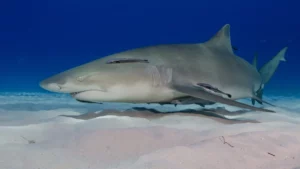 | 2.4–3 m (8–10 ft) | Low | Seagrass and mangrove nurseries at the Pearl Cays and Big Corn; also Pacific estuariesJuveniles spend years in the cays' shallows. Yellow-brown, slow, easy to watch from a kayak. |
Blacktip SharkCarcharhinus limbatus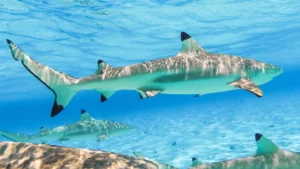 | 1.5–2.5 m (5–8 ft) | Moderate | Both coasts, following sardine schools; nurseries in the cays and the Gulf of FonsecaFast, leaping hunter. Occasional bites to surfers elsewhere in its range; none recorded in Nicaragua. |
Tiger SharkGaleocerdo cuvier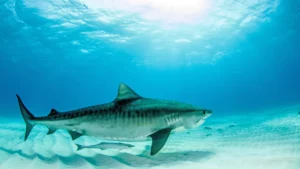 | 3–4.5 m (10–15 ft) | High | Outer Caribbean cays and deep water off the Corn Islands; rarePresent but seldom seen. Not linked to any recorded Nicaraguan incident. |
Scalloped Hammerhead SharkSphyrna lewini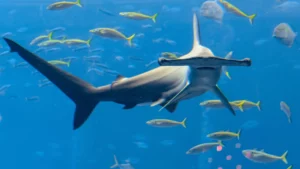 | 2.5–3.5 m (8–12 ft) | Low | Pacific upwelling zone; Gulf of Fonseca pupping ground; Blowing Rock in the cool monthsCritically endangered. Juveniles are a major part of the Pacific artisanal catch. |
Great Hammerhead SharkSphyrna mokarran | 3.5–4.5 m (11–15 ft) | Low | Caribbean shelf edge and outer cays; occasionalSolitary ray-hunter with a tall first dorsal fin. Shy of divers; never implicated in a Nicaraguan bite. |
Bonnethead SharkSphyrna tiburo | 0.9–1.2 m (3–4 ft) | Low | Seagrass and mangrove shallows of the Caribbean coastThe smallest hammerhead here, with a rounded head, a diet of crabs and a taste for seagrass. Harmless. |
| Caribbean Sharpnose SharkRhizoprionodon porosus | 0.8–1.1 m (2.5–3.5 ft) | Low | Inshore Caribbean shelf; common in the artisanal catchSlender, fast-breeding shark of the shallows. No risk to people. |
Pacific Sharpnose SharkRhizoprionodon longurio | 0.9–1.1 m (3–3.5 ft) | Low | Pacific shelf and the Gulf of FonsecaThe Pacific counterpart, landed in numbers at Corinto and Puerto Morazán. |
| Smalltail SharkCarcharhinus porosus | 0.9–1.2 m (3–4 ft) | Low | Muddy river mouths on both coastsSmall estuarine shark, critically endangered through overfishing across its range. |
Whitenose SharkNasolamia velox | 1.2–1.5 m (4–5 ft) | Low | Pacific coastal watersAn Eastern Pacific endemic with a pale patch on its long snout. Taken by longlines and gillnets. |
Silky SharkCarcharhinus falciformis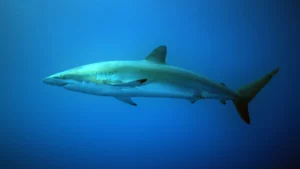 | 2–3 m (7–10 ft) | Moderate | Offshore on both coasts, especially the Pacific tuna groundsThe main bycatch shark of the Pacific longline and purse-seine fleets. Bold near boats, rarely near beaches. |
Shortfin Mako SharkIsurus oxyrinchus | 2.5–3.5 m (8–12 ft) | Moderate | Deep Pacific waters beyond the shelfFast pelagic hunter caught on longlines. Never inshore in Nicaragua. |
Bigeye Thresher SharkAlopias superciliosus | 3–4 m (10–13 ft) incl. tail | Low | Deep Pacific offshore; longline bycatchEnormous eyes set high on the head for hunting in deep, dim water. Harmless; the common thresher is also taken offshore. |
Whale SharkRhincodon typus | 5–10 m (16–33 ft) | Low | Pacific upwelling zone in the dry season; occasional in the CaribbeanA seasonal visitor rather than a resident; no organised tours yet. Filter feeder, harmless. |
The great white shark is absent. There is no Nicaraguan record from either coast: the Caribbean is too warm, and the Eastern Pacific white sharks that visit Guadalupe and the Gulf of California do not travel this far south along the shelf. Reports of white sharks at San Juan del Sur have always turned out to be bull sharks or large blacktips. The tiger shark is genuinely present but rarely seen, mostly at the outer cays and in deep water off the Corn Islands, and the whale shark is a seasonal visitor to the Pacific upwelling rather than a resident.
Where to see sharks in Nicaragua
The Caribbean islands are where visitors actually meet sharks; the Pacific is a surf coast where sharks are present but seldom seen, and the lake is history you can visit. Here is the honest picture, site by site.
- Little Corn Island (Blowing Rock, Tarpon Channel)The best shark diving in the country. Blowing Rock, a pinnacle 12 km offshore, brings Caribbean reef sharks, nurse sharks and, in the cooler months, hammerheads cruising the deep side. Night dives on the island's reefs show nurse sharks feeding. Small dive shops, no crowds.
- Big Corn IslandShallow reefs and wrecks with resident nurse sharks and juvenile lemon sharks over the seagrass; snorkellers see nurse sharks resting under ledges off the eastern shore. The ferry port for Little Corn.
- Pearl Cays (Cayos Perlas)A scattering of mangrove-and-sand cays off Pearl Lagoon with lemon shark and blacktip nurseries in the shallows and Caribbean reef sharks on the outer reefs. Reached by boat from Pearl Lagoon or Bluefields; a hawksbill turtle nesting area too.
- Miskito CaysThe remote northern reef system protected since 1991. Seagrass, patch reef and the most intact shark populations on the coast: nurse, lemon, blacktip, Caribbean reef and occasional tiger sharks. Expedition territory from Bilwi (Puerto Cabezas).
- Río San Juan and El CastilloThe bull shark highway between the sea and the lake. Sharks still move through the river, especially at the Caribbean end near San Juan de Nicaragua (Greytown), but sightings are luck rather than schedule. The 1938 and 1902 incidents in the record both happened here.
- Lake Nicaragua (Granada, Ometepe)The historic home of the freshwater bull shark and the site of the 1850 and 1957 fatalities in the record. After the Granada processing plant of the 1970s, sharks are now very rarely reported in the lake; go for the volcanoes and the story, not for a sighting.
- Gulf of Fonseca (Potosí, Puerto Morazán)Mangrove estuaries shared with Honduras and El Salvador that serve as a nursery for scalloped hammerheads and bull sharks. Juveniles are caught by the artisanal fleet; there is no dive tourism, but this is where the Pacific's sharks are born.
- San Juan del Sur and Popoyo (Pacific)Surf beaches with warm water and offshore sardine runs. Blacktips, silky sharks and the occasional bull shark are present, and the only Pacific entry in the database, a 1960 bather who survived a very large shark, was here. Sightings from the beach are rare.
If you have one trip, Little Corn Island gives the most reliable sharks in Nicaragua and the easiest logistics. The Pearl Cays are a good day trip for snorkellers who want juvenile lemon sharks in a metre of water. A boat up the Río San Juan from San Carlos to El Castillo is worth it for the history and the wildlife even though a bull shark sighting is not something anyone can promise.
Best time of year to see sharks in Nicaragua
The two coasts run on different calendars, and the lake is warm all year.
- Caribbean, February to May: the driest, calmest stretch at the Corn Islands and the cays, with 20–30 m visibility and the best chance of hammerheads at Blowing Rock. Water 27–28 °C.
- Caribbean, June to January: the rainy season, wettest from September to November, with rougher seas and river run-off reducing visibility near the mainland. The Corn Islands still dive year-round; nurse sharks and reef sharks do not go anywhere.
- Pacific, December to April: the dry season and the Papagayo upwelling. Cooler water of 24–26 °C, bait schools close to shore and the peak of hammerhead and silky shark activity offshore; also the surf season at Popoyo.
- Pacific, May to November: warmer, greener water and rain. Bull sharks and blacktips are more often noticed near river mouths when the rivers are high.
- Río San Juan: the river is navigable all year; sharks move between sea and lake in every season, and there is no known peak.
Hurricane season on the Caribbean coast runs from June to November, with the mainland north of Bluefields the most exposed; the Corn Islands were hit hard by Hurricane Eta and Iota in 2020, and reef recovery there is still under way.
Shark attacks in Nicaragua: what the record actually shows
For a country whose sharks once lived in a lake full of swimmers and fishermen, the incident list is short. All of it is on the shark attacks in Nicaragua page. The database holds six records dated between 1902 and 1960, three of them fatal, plus one older entry: a bather killed at Granada on Lake Nicaragua in 1850. All six dated entries are rendered below; the 1850 case is on the attacks page:
- 1960 · San Jan del Sur, Pacific coastBathing — SurvivedSpecies: 3.7 m to 4.6 m [12' to 15'] shark · not fatal
- 1957 · A village north of San Carlos, Lake Nicaragua (fresh water)Lashing logs together when he fell into the water — Fatal, leg severed Species: Bull shark caught, leg recovered & buried beside the man's body · fatal
- 1944 · Lake Nicaragua (fresh water) — Some killed & others severely injuredSpecies: Bull sharks to 1.5 m [5'] in length · not fatal
- 1938 · Lower San Juan RiverThe schooner Elizabeth, bound from Bluefields, Nicaragua to the river port of San Carlos foundered — Fatal x 2, all other passengers & crew reached shore after a long swimSpecies: Thought to involve bull sharks · fatal
- 1927 · A shark was caught, its head severed from body and hung from the anchor davit onboard the U.S.S. Borie, Salinas BayFeeling the shark’s teeth — Sharks’s jaws snapped shut, lacerating his right hand provoked incidentSpecies not identified · not fatal
- 1902 · Greytown, Rio San JuanSwimming — FatalSpecies not identified · fatal
Read them together and one fact jumps out: almost the entire record is fresh water. The 1850 Granada death and the case logged as before 1957, a man who fell into the lake north of San Carlos while lashing logs together and lost a leg to a bull shark that was later caught with the leg inside it, both happened in Lake Nicaragua. The 1944 entry, which the database does not mark as fatal because it gives no names, describes a period in which bull sharks up to 1.5 m killed some people and badly injured others in the lake. The 1938 case was the schooner Elizabeth foundering on the lower Río San Juan, with two people taken by what were thought to be bull sharks while the rest swam for shore, and the 1902 fatality was a swimmer at Greytown at the river's mouth. Only two entries are from the sea, and neither was a beach attack in the usual sense: a sailor on the USS Borie in Salinas Bay in 1927 who put his hand in the jaws of a severed shark head, and a bather at San Juan del Sur in 1960 who was bitten by a shark estimated at 3.7 to 4.6 m and survived.
Since 1960 the database has nothing at all, a 65-year gap during which the lake's bull sharks were fished down to rarity, and during which the Corn Islands and the Pacific surf beaches grew into tourist destinations without a single recorded bite. The lesson is the one that applies to bull shark country everywhere: the risk was in murky river and lake water where people and sharks shared fish, not on the reefs. The standard advice for the river and the lake still stands, and for the Caribbean islands the main thing to remember is not to feed or grab the nurse sharks.
Is it safe to swim and snorkel with sharks in Nicaragua?
On the Caribbean side, yes, and the Corn Islands are a good place for a first shark. Nurse sharks lie under ledges by day and let snorkellers approach to within a couple of metres; the only people they bite are those who pull their tails or hand-feed them. Caribbean reef sharks at Blowing Rock keep to the deep edge and treat divers as scenery. Juvenile lemon sharks and blacktips in the seagrass around the Pearl Cays are skittish and bolt from a snorkeller's shadow. Hammerheads, when they appear, are the shyest of all and vanish the moment a diver exhales too loudly.
The Pacific is a surf coast rather than a snorkelling coast, and its sharks are mostly out of sight. Sensible rules apply at Popoyo, San Juan del Sur and the beaches near Masachapa: avoid surfing alone at dusk, stay away from river mouths after heavy rain when the water runs brown and bait fish crowd the outflow, and keep clear of fishing pangas landing their catch. Lake Nicaragua and the Río San Juan deserve more respect than they get. Sharks are now rare there, but the record shows what bull sharks in murky fresh water can do, and swimming from the river banks near El Castillo or from the lake shore at dusk, where the old incidents happened, is still not wise.
Whale sharks on the Pacific coast are an occasional bonus rather than an industry. If a boat finds one, it is harmless; keep a few metres away, do not touch, and slip in quietly so it stays at the surface.
Shark conservation in Nicaragua
Nicaragua's sharks are managed through the fisheries law of 2004 and its regulations, administered by the fisheries institute INPESCA, and through the Central American rules that Nicaragua shares with its neighbours in the SICA bloc. The most important of those is the 2011 OSPESCA regulation that requires sharks to be landed with their fins naturally attached, which ended legal finning at sea across the region. Nicaragua is also a party to CITES, so the scalloped and great hammerheads, silky shark, both threshers, the whale shark and the oceanic whitetip now need export permits based on evidence that the trade is sustainable. There is no national shark sanctuary of the kind Honduras declared in 2011, and artisanal and semi-industrial fleets on both coasts still land sharks, with juveniles from the Gulf of Fonseca nursery a particular concern.
Protected areas do some of the work. The Miskito Cays and their coastal strip have been a reserve since 1991, the Río San Juan Biosphere Reserve, recognised by UNESCO in 2003, covers the river corridor and the Indio Maíz forest, and the Pearl Cays are a wildlife refuge best known for hawksbill turtles. The lake's bull sharks and sawfish, however, have no specific protection, and the sawfish in particular is now on the edge of disappearing from Nicaraguan fresh water. What has changed for the better is attention: the Corn Islands' dive community reports sightings, the hammerhead nursery in the Gulf of Fonseca is the subject of regional research, and the memory of the Granada shark plant is now a warning rather than a business plan. Visitors help by diving with operators that do not feed sharks, refusing shark meat and fins in coastal restaurants, and reading up on why sharks are endangered before buying anything made from them.
Sharks in neighbouring waters
Nicaragua's sharks belong to two regional faunas. To the south, Costa Rica shares the Río San Juan and the Papagayo upwelling and adds the hammerhead schools of Cocos Island; Panama continues the same Pacific and Caribbean pattern down to Coiba. To the north, Honduras shares the Gulf of Fonseca and the Miskito reefs and has a whale shark season at Utila, while El Salvador is the third country on the Gulf of Fonseca hammerhead nursery. Guatemala is the next Pacific coast up, and Colombia's San Andrés islands sit on the same Caribbean rise as the Corn Islands. The full set of country pages lives on our sharks around the world index.
Frequently asked questions
Are there sharks in Nicaragua?
Yes, on both coasts and in fresh water. Eighteen species are recorded. Nurse sharks, Caribbean reef sharks, lemon sharks and blacktips live around the Corn Islands and the cays; scalloped hammerheads, silky sharks and blacktips dominate the Pacific; and bull sharks occur everywhere, including the Río San Juan and Lake Nicaragua.
Are there really sharks in Lake Nicaragua?
Yes, bull sharks. They swim up the 200 km Río San Juan from the Caribbean, negotiating the rapids at El Castillo, and tagging in the 1960s proved the journey takes about a week. A shark-processing plant at Granada in the 1970s killed tens of thousands, and sightings in the lake are now rare, though sharks still use the river.
Have there been shark attacks in Nicaragua?
A few, all long ago. SharkSider's database lists six cases from 1902 to 1960, three fatal, plus a fatality at Granada in 1850. Every death happened in Lake Nicaragua or the Río San Juan, where bull sharks hunted in murky water. The only sea cases were a provoked injury from a severed shark head in 1927 and a bather who survived at San Juan del Sur in 1960.
Is it safe to swim at the Corn Islands?
Yes. No shark bite has ever been recorded at the Corn Islands. The sharks there are nurse sharks, Caribbean reef sharks and juvenile lemon sharks, none of which bothers swimmers who leave them alone. Do not feed or handle nurse sharks, and avoid swimming near boats cleaning fish, and the risk is negligible.
Can you dive with sharks in Nicaragua?
Yes, mainly from Little Corn Island. Blowing Rock, a pinnacle offshore, has Caribbean reef sharks and nurse sharks year-round and hammerheads in the cooler months from February to May, and night dives show nurse sharks hunting. Big Corn has nurse sharks on its shallow reefs. There is no shark-feeding tourism in Nicaragua.
Are there great white sharks in Nicaragua?
No. There is no record from either coast. The Caribbean is too warm, and the Eastern Pacific white sharks that gather off Mexico's Guadalupe Island do not range this far south along the Central American shelf. Large sharks reported by surfers at San Juan del Sur have been bull sharks or blacktips.
Are there hammerhead sharks in Nicaragua?
Yes. Scalloped hammerheads pup in the mangrove estuaries of the Gulf of Fonseca and follow the sardine schools along the Pacific coast in the dry season, and both scalloped and great hammerheads are seen occasionally at Blowing Rock off Little Corn Island. They are critically endangered and heavily fished as juveniles.
When is the best time to see sharks in Nicaragua?
February to May on the Caribbean side, when the Corn Islands have their calmest, clearest water and hammerheads visit Blowing Rock. On the Pacific, the dry season from December to April brings the Papagayo upwelling, cooler water and the most shark activity offshore. Nurse sharks and reef sharks at the islands are present all year.
Is shark fishing legal in Nicaragua?
Yes, with rules. Sharks are landed by artisanal and semi-industrial fleets on both coasts under the 2004 fisheries law, but the 2011 Central American OSPESCA regulation requires fins to arrive attached to the body, and CITES-listed species such as hammerheads, silky sharks and threshers need export permits. Nicaragua has no shark sanctuary like Honduras.
References

A small team focused on researching sharks and making marine biology easy to understand. Every page is reviewed against current species records and the SharkSider attack database, and updated when new incidents or research appear.
Published December 29, 2022 · Last updated September 21, 2026 · Incident data from the SharkSider attack database (6 records for Nicaragua, 3 fatal).


