
Yes, Kenya has sharks, and a good variety of them. Eighteen species have solid records in Kenyan waters. On the reefs the blacktip reef shark, whitetip reef shark and grey reef shark are the everyday sightings, tawny nurse sharks and zebra sharks rest in the caves, and whale sharks pass along the south coast between November and March.
Safety is a story of place rather than of numbers. SharkSider's database holds 10 incidents for Kenya between 1947 and 2016, 7 of them fatal, but eight of the ten happened in one spot: the Kilindini harbour and Likoni channel at Mombasa, a turbid commercial port, not a tourist beach. The reefs of Watamu, Malindi, Diani and Kisite have produced one minor foot bite in more than fifty years.
- Shark species recorded18 with solid records
- ProtectionFour no-take marine parks since 1968; whale shark protected by law; no full shark sanctuary
- Most seen from the beachBlacktip reef shark on the reef flats at Watamu and Diani
- Signature encounterWhale sharks off Diani and Shimoni, November to March
- Incidents in the database10 (1947–2016), 7 fatal; 8 of them around Mombasa harbour
- Water temperature25 °C in August, 29–30 °C in March

On this page
- Where sharks live along the Kenyan coast
- List of the different types of sharks in Kenya
- Where to see sharks in Kenya
- Best time of year to see sharks in Kenya
- Shark attacks in Kenya: what the record actually shows
- Is it safe to swim and snorkel with sharks in Kenya?
- Shark conservation in Kenya
- Sharks in neighbouring waters
- Frequently asked questions
- References
Where sharks live along the Kenyan coast
Kenya's coast is a narrow shelf. A fringing reef runs a few hundred metres to a couple of kilometres offshore from the Tanzanian border almost to Somalia, broken only where rivers such as the Sabaki and the Tana push fresh water and silt into the sea. Inside the reef is a shallow lagoon of seagrass and sand; outside it the bottom falls quickly to 200 metres and, off Shimoni, into the 800-metre-deep Pemba Channel. That compression is what makes the country interesting for sharks: a snorkeller on the reef flat at Watamu and a game boat trolling for makos over the Pemba drop-off are only an hour apart.
The East African Coastal Current flows north along the shore all year, carrying warm equatorial water at 25 to 30 °C, so the shark fauna is thoroughly tropical. The two monsoons decide the rest. The north-east kaskazi from December to March brings calm seas and clear water; the south-east kusi from May to October stirs the shelf, cools the surface a few degrees and drives the plankton pulses that whale sharks follow along the south coast. The river mouths add a third habitat: turbid, brackish channels where bull sharks hunt, which is the environment of Mombasa's Kilindini harbour and the reason the country's attack record looks the way it does.
Kenya was early to marine protection. Malindi and Watamu became national marine parks in 1968, the first in Africa, followed by Kisite-Mpunguti in 1978 and Mombasa in 1986. Fishing is banned inside the parks, and the reef sharks inside them are noticeably tamer and more numerous than on the fished reefs between.
List of the different types of sharks in Kenya
The table covers every species with a dependable record in Kenyan waters, from the lagoon to the Pemba Channel. Sizes are typical adults rather than record fish. The risk column judges the danger to a swimmer or snorkeller, not to a diver who goes looking for the species. A note on names: the nurse shark of East Africa is the tawny nurse shark, the lemon shark is the sicklefin lemon shark, and the spotted “leopard shark” that Kenyan dive guides point out is the zebra shark. The Swahili word for any shark is papa.
| Species | Adult size | Risk to swimmers | Where in Kenya & notes |
|---|---|---|---|
Blacktip Reef SharkCarcharhinus melanopterus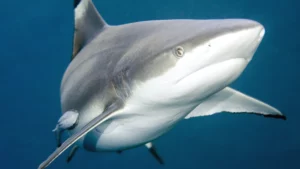 | 1.2–1.6 m (4–5 ft) | Low | Lagoon edges and reef flats at Watamu, Diani, KisiteThe shark most visitors see, often in water that barely covers its back. Skittish; keep your feet off the bottom when wading at high tide. |
Whitetip Reef SharkTriaenodon obesus | 1.2–1.6 m (4–5 ft) | Low | Caves and overhangs on the park reefs, resting by daySlim, white-tipped and sluggish until dark. Tolerates divers closely; the 'sleeping shark' of every Kenyan dive briefing. |
Grey Reef SharkCarcharhinus amblyrhynchos | 1.5–2.5 m (5–8 ft) | Moderate | Outer walls and drop-offs: Vuma, Kisite, KiungaBolder than the other reef sharks and territorial toward divers who crowd it. The original page called it highly aggressive; it is not, but it does warn. |
Tawny Nurse SharkNebrius ferrugineus | 2.5–3.2 m (8–10 ft) | Low | Caves at Vuma, Galu and Kisite by dayEast Africa's nurse shark, a different species from the Atlantic nurse shark. Placid; bites only when grabbed. |
Zebra Shark ('Leopard Shark' locally)Stegostoma tigrinum | 2–2.5 m (7–8 ft) | Low | Sand patches beside the Diani and Watamu reefsSpotted adults, striped young; dive guides call it a leopard shark. Sleeps on the sand and ignores people. |
Sicklefin Lemon SharkNegaprion acutidens | 2.5–3 m (8–10 ft) | Low | Mangrove creeks and seagrass channels, Lamu and KiungaThe Indo-Pacific lemon shark. Slow and yellow-brown, most often met in the shallow creeks of the north coast. |
Blacktip SharkCarcharhinus limbatus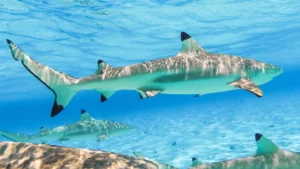 | 1.5–2.5 m (5–8 ft) | Moderate | Open water beyond the reef, river mouthsThe larger, offshore blacktip; a mainstay of the coastal fishery. Fast, jumps when hooked, not the lagoon shark. |
Spinner SharkCarcharhinus brevipinna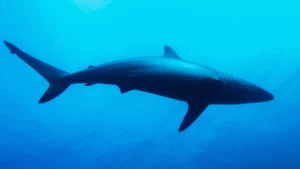 | 2–2.5 m (6.5–8 ft) | Moderate | Shelf waters with baitfish schools, off Malindi and LamuNamed for its spinning leaps through sardine shoals. Regular in gill-net landings along the north coast. |
Bull SharkCarcharhinus leucas | 2.2–3.4 m (7–11 ft) | High | Kilindini harbour, the Likoni channel, the Sabaki and Tana river mouthsKnown locally as the Zambezi shark. The most likely author of Mombasa's harbour deaths; stays in turbid, brackish water and rarely visits the clear park reefs. |
Tiger SharkGaleocerdo cuvier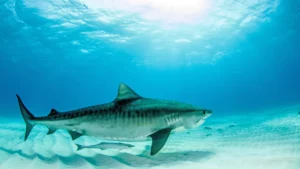 | 3–4.5 m (10–15 ft) | High | Outer reefs and the Pemba Channel, mostly at nightPresent along the whole coast but seldom seen by divers. Taken on game-fishing charters out of Shimoni and Watamu. |
Scalloped Hammerhead SharkSphyrna lewini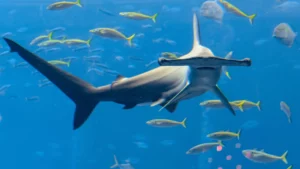 | 2.5–3.5 m (8–12 ft) | Low | Deep dives at Vuma and off Watamu; the Pemba ChannelSchools at depth in the kaskazi months. Critically endangered worldwide and still landed by Kenyan longliners. |
Great Hammerhead SharkSphyrna mokarran | 3.5–4.5 m (11–15 ft) | Moderate | Offshore banks and the Pemba ChannelSolitary, rarely seen by divers, occasionally hooked by game boats. A ray specialist that shows little interest in people. |
Whale SharkRhincodon typus | 5–9 m here (adults to 12 m+) | Low | Diani, Galu and Shimoni, November to MarchPapa shillingi, the shilling-spotted shark. Filter feeder, harmless, and the reason to visit the south coast in January. |
Shortfin Mako SharkIsurus oxyrinchus | 2.5–3.5 m (8–11 ft) | Low | Pemba Channel and the shelf edgeThe fastest shark, caught by the Shimoni and Watamu game fleet. Dangerous to anglers at the boat, not to swimmers; the old 'highly aggressive' label was wrong. |
Blue SharkPrionace glauca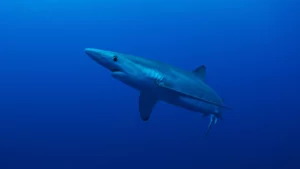 | 2–3 m (7–10 ft) | Low | Open ocean well beyond the reefA longline bycatch species off Kenya rather than a sighting. Never approaches the coast. |
Silky SharkCarcharhinus falciformis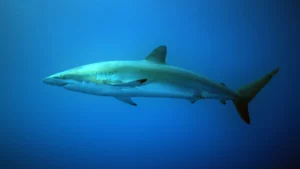 | 2–3 m (7–10 ft) | Moderate | Blue water over the Pemba Channel, with tunaFollows the tuna schools and the game boats. Curious about divers on offshore dives but not on the reefs. |
| Oceanic Whitetip SharkCarcharhinus longimanus | 2–3 m (7–10 ft) | High | Far offshore in the Indian Ocean; rare inshoreA bold open-ocean shark that matters to shipwreck survivors, not to reef snorkellers. Caught on Kenyan longlines. |
Silvertip SharkCarcharhinus albimarginatus | 2–2.5 m (7–8 ft) | Moderate | Deep outer walls on the south coast and off PembaWhite-edged fins, confident approach. Seen occasionally on the deepest Kisite and Vuma dives. |
The species people ask about most is the one that is not here. There is no confirmed record of a great white shark from Kenya; the nearest reliable records are far to the south off Mozambique and South Africa, in water that drops below 20 °C. Kenyan surface water never does. Every “great white” report on this coast has turned out to be a tiger, bull or mako shark. The bull shark, by contrast, is genuinely present, and it deserves the respect the harbour record gives it.
Where to see sharks in Kenya
Kenya is not a shark-diving destination in the way the Maldives or South Africa are; nobody feeds sharks here and there is no cage. What it offers is reliable reef sharks inside the marine parks and a genuine whale shark season on the south coast. These are the places the dive centres from Diani to Lamu actually go.
- Kisite-Mpunguti Marine Park, ShimoniFour coral islands off Wasini Island near the Tanzanian border, protected since 1978. Whitetip and blacktip reef sharks are routine on the Kisite walls, and between November and March whale sharks feed in the channel between the park and the mainland.
- Diani Beach and Galu-Kinondo reefThe whale shark centre of the country. Boats out of Diani look for papa shillingi from November to February, with the most sightings in January. The MV Alpha Funguo wreck and the Galu reef hold zebra sharks and tawny nurse sharks under the ledges.
- Watamu Marine National ParkTurtle Reef, The Canyon and Moray Reef sit inside a no-take park that dates from 1968. Whitetip reef sharks sleep in the overhangs, blacktips patrol the lagoon edge in front of the hotels, and whale sharks pass the outer reef in the kaskazi season.
- Vuma Cliffs and the Kilifi drop-offA deep wall between Kilifi and Vipingo where the shelf ends. Grey reef sharks hold in the current, tawny nurse sharks rest in the caves, and scalloped hammerheads are seen at depth early in the morning.
- Pemba Channel, off ShimoniNot a dive site but a game-fishing ground: the 800-metre trench between the Kenyan coast and Pemba Island. Shortfin makos, silky sharks, hammerheads and tiger sharks follow the tuna and billfish here. Most charters now tag and release.
- Mombasa Marine National Park, NyaliThe reef off Nyali and Bamburi, with the MV Dania wreck as its centrepiece. Whitetip reef sharks and the occasional blacktip; the easiest shark dive for anyone staying in Mombasa's north-coast hotels.
- Kiunga Marine Reserve and the Lamu ArchipelagoThe remote far north, toward the Somali border. Fifty-odd islands, mangroves and unfished reefs where grey reef and blacktip sharks are common and the seagrass channels hold sicklefin lemon sharks. Reached by boat from Lamu.
If you want one trip that covers the most ground, base yourself at Diani or Shimoni between December and February: the whale sharks are in, the sea is calm, and Kisite's reef sharks are a short boat ride away. Watamu is the choice for families, since the blacktips can be watched from the beach at high tide.
Best time of year to see sharks in Kenya
The monsoon calendar sets the diving season, and the diving season is the shark season.
- Kaskazi (north-east monsoon), December to March: the prime months. Flat seas, 20 to 30 metres of visibility and surface water at 28 to 30 °C. Reef sharks are on every park dive, and this is when whale sharks are most often found off Diani, Galu and Shimoni.
- Long rains, April to May: river run-off clouds the inshore water and many dive centres close. The river mouths are at their most turbid, which is bull shark weather but not diving weather.
- Kusi (south-east monsoon), June to October: windier, choppier, with water down to about 25 °C in August. Visibility drops, but the plankton that arrives with the cooler water is what draws the whale sharks back in from November.
- Whale sharks: November to March on the south coast, with January and February the surest. Sightings are of individual animals, not the aggregations of Mafia Island or the Maldives, so a full-day boat search is normal.
- Hammerheads: the deep dives at Vuma and off Watamu produce scalloped hammerheads most reliably from January to March, at dawn.
Kenya never gets cold. The 25 to 30 °C range keeps every resident species on the reef all year and rules out the cool-water sharks of the south.
Shark attacks in Kenya: what the record actually shows
Kenya's list is short but its fatality rate is startling, and it needs explaining rather than fearing. SharkSider logs every case on the shark attacks in Kenya page. The database holds 10 records between 1947 and 2016, and 7 of them were fatal; three of the entries carry only an approximate year (one dated simply “before 2016”, one “1990 or 1991”, one a newspaper report from March 1948). The six latest entries are shown below; the complete list is kept current on the attacks page:
- 2016 · Kilindini, MombasaDiving — FatalSpecies not identified · fatal
- 2011 · Mama Ngina Beach, Mombasa, Coast ProvinceSwimming — FatalSpecies not identified · fatal
- 2009 · Likoni Channel, MombasaWashing his feet — FatalSpecies not identified · fatal
- 1991 · Kilindini, MombasaDiving — Conway's leg was bitten higgs injury was fatalSpecies not identified · fatal
- 1980 · South of Lamu Island, Lamu ArchipelagoSpearfishing — Ankle & foot laceratedSpecies: 2.2 m shark · not fatal
- 1971 · Watamu, Coast ProvinceSwimming — Right foot bittenSpecies: 2 m [6'9"] shark · not fatal
Look at the place names and the pattern is obvious. Eight of the ten cases come from one small area: Kilindini harbour, the Likoni channel that leads into it, and Mama Ngina beach on the headland beside the channel. Kilindini is East Africa's largest port: a deep, silty natural inlet with ship traffic, a ferry crossing, fish landings and waste in the water, which is exactly the habitat bull sharks favour. Not one Kenyan record names the species, but the setting, the deaths of two divers working in the harbour (one in 1990 or 1991, when a colleague was also bitten, and one before 2016), the 1964 fisherman pulled in by a hand line tied to his wrist, the 2009 man washing his feet at the Likoni edge and the 2011 swimmer at Mama Ngina all fit that animal. The port is not a place to swim, and Mombasa residents generally do not.
Away from the harbour the record is thin: a spearfisher bitten on the ankle south of Lamu in 1980 by a 2.2-metre shark, and a swimmer at Watamu in 1971 bitten on the foot by a shark of about 2 metres. Those are the only two incidents on the entire tourist coast in the database, across decades of snorkelling in the marine parks. Nothing at all has been recorded at Diani, Malindi, Kilifi or Shimoni. The standard precautions cover the real risk here: stay out of turbid harbour and river-mouth water, do not swim where fish are being landed or cleaned, and avoid the channels at dusk.
Is it safe to swim and snorkel with sharks in Kenya?
On the reefs, yes. The blacktip reef sharks that cruise the lagoon edge at Watamu and Diani are nervous animals that turn away from a snorkeller; the only bites they inflict anywhere in the world are to the feet of people wading through their hunting flats in murky water, so keep your feet up and your eyes open at high tide. Whitetip reef sharks will let you approach a ledge to within a metre or two before they slide off. Grey reef sharks on the outer walls are more assertive and will occasionally hold their ground; if one stiffens, lowers its pectoral fins and starts swimming in jerky arcs, it wants space, and you give it by moving back along the reef.
Whale sharks are harmless, and the Kenyan operators who run the Diani and Shimoni encounters follow a simple code: slip in from the side of the boat rather than jumping, stay three metres from the head and further from the tail, no touching, no flash, no more than a handful of swimmers in the water at once. Read our notes on swimming safely with whale sharks before you go; the rules exist as much to protect a slow, easily injured animal as to protect you.
The one place the advice changes is the water around Mombasa island and the river mouths. That is bull shark country, the water is opaque, and the harbour record above is the reason no dive centre operates there.
Shark conservation in Kenya
Kenya has never declared a national shark sanctuary, and shark meat is a normal part of the artisanal catch along the whole coast, sold fresh and dried in the fish markets of Mombasa, Kilifi and Malindi. Landings are dominated by small coastal species, but scalloped hammerheads, grey sharks, guitarfish and rays turn up in the gill nets and on the longlines too, and fins from the coast have historically flowed into the Asian trade. The picture is improving. Kenya's marine parks, among the oldest in Africa, are genuine no-take zones where reef shark numbers are visibly higher than outside. The whale shark is listed as a protected species under the Wildlife Conservation and Management Act of 2013, and a local trust at Diani has logged and photographed the south-coast animals for two decades. Kenya is a party to CITES and to the Convention on Migratory Species, whose Appendix listings cover the whale shark, the hammerheads, the oceanic whitetip, the makos and the thresher sharks that pass through its waters, and the Kenya Fisheries Service has drawn up a national plan of action for sharks and rays.
What still needs work is enforcement outside the parks and better catch records from the beach landings, where most sharks are counted by the basket rather than by species. Visitors can help in small ways: choose operators that follow the whale shark code, report tagged or scarred whale sharks to the local monitoring group, and leave dried shark and ray products in the market. Our guide to why sharks are endangered explains why slow-breeding coastal species recover so slowly once they are fished down.
Sharks in neighbouring waters
Kenya's reef sharks are the same animals found the length of the East African coast. To the north, Somalia has a wilder, less studied version of the same fauna. Across the Gulf of Aden, Oman and further up the Red Sea Egypt add oceanic whitetips and grey reef sharks on deep walls. Out in the ocean, the Maldives shows what the same species look like after fifteen years of full protection, and Sri Lanka and India hold the northern rim of the Indian Ocean. At the cold end of the continent, South Africa is where the great whites Kenya lacks begin. The full list of countries is on our sharks around the world page.
Frequently asked questions
Are there sharks in Kenya?
Yes. Eighteen species have solid records along the Kenyan coast. Blacktip reef sharks, whitetip reef sharks and grey reef sharks live on the fringing reefs and inside the marine parks, tawny nurse and zebra sharks rest in the caves, and whale sharks visit the south coast every northern winter.
Have there been shark attacks in Kenya?
SharkSider's database lists ten incidents between 1947 and 2016, seven of them fatal. Eight of the ten happened in and around Kilindini harbour and the Likoni channel at Mombasa, a busy commercial port. The tourist reefs account for only two minor bites, at Watamu in 1971 and near Lamu in 1980.
Is it safe to swim in the sea in Kenya?
On the beaches and reefs of Diani, Watamu, Malindi and Shimoni, yes; decades of snorkelling in the marine parks have produced almost no incidents. The water to avoid is the turbid harbour and channel at Mombasa and the river mouths, which are bull shark habitat and where nearly every recorded case occurred.
Can you swim with whale sharks in Kenya?
Yes. Boats from Diani and Shimoni search for whale sharks between November and March, with January and February the most reliable months. Encounters are with single animals feeding along the reef edge, so operators spend the day looking, and swimmers enter quietly, keep three metres away and never touch.
Are there great white sharks in Kenya?
No. Great whites are cool-water sharks and there is no confirmed record from Kenya, where the sea stays between 25 and 30 °C all year. The nearest dependable sightings are off southern Mozambique and South Africa. Every 'great white' reported on the Kenyan coast has proved to be a tiger, bull or mako shark.
Are there bull sharks in Kenya?
Yes. Bull sharks, called Zambezi sharks locally, live in the muddy water of Kilindini harbour, the Likoni channel and the mouths of the Sabaki and Tana rivers. None of the Kenyan incident records names a species, but the harbour setting of most of the deaths points strongly to this shark.
What is the most common shark in Kenya?
The blacktip reef shark. It patrols the lagoon edge and reef flats in front of the hotels at Watamu, Diani and inside Kisite-Mpunguti park, often in water less than a metre deep at high tide. Underwater, whitetip reef sharks resting in the caves are the most familiar sight for divers.
When is the best time to see sharks in Kenya?
December to March, during the calm north-east monsoon. The sea is flat, visibility reaches 30 metres, water is 28 to 30 °C, and this is the whale shark season on the south coast. June to October is rougher and cooler, and many dive centres close for the April to May rains.
Can you go shark diving in Kenya?
Yes, but it is reef diving with sharks rather than baited shark diving. Kisite-Mpunguti, Watamu, Vuma Cliffs and the Mombasa marine park all offer whitetip, blacktip and grey reef sharks, with hammerheads on the deep walls in season. Nobody feeds sharks in Kenya and there are no cage operations.
Is shark fishing legal in Kenya?
Yes, outside the marine parks. Sharks are part of the artisanal catch along the whole coast and are sold in the fish markets. Whale sharks are protected under the 2013 wildlife act, fishing is banned inside the four marine parks, and Kenya applies the CITES and migratory-species listings for hammerheads, makos and threshers.
References

A small team focused on researching sharks and making marine biology easy to understand. Every page is reviewed against current species records and the SharkSider attack database, and updated when new incidents or research appear.
Published January 20, 2023 · Last updated September 21, 2026 · Incident data from the SharkSider attack database (10 records for Kenya, 7 fatal).


