
Yes, there are sharks in India, on every coast and in some of its rivers. Twenty-eight species have solid, repeated records. The ones people most often meet are the whale shark off Gujarat, the blacktip reef, grey reef and whitetip reef sharks of the Andaman and Lakshadweep islands, and the small inshore sharks of the mainland fishery: the spadenose shark, the milk shark, the spot-tail shark and the blacktip. Bull sharks push far up the Ganges, Hooghly and other big rivers, and the critically endangered Ganges shark is found nowhere else.
The attack record is long because Indian records go back further than almost any other country's, and old because almost all of it is from the 19th century. SharkSider's database holds 41 entries for India from 1595 to 2024; 14 are dated 1900 or later, four of them marked fatal, and one 1959 episode at the mouth of the Devi River in Odisha killed five people. The two 21st-century cases are a minor finger injury to a swimmer at Mahabalipuram in 2003 and a fisherman's calf bitten by a 2 m bull shark in the Vaitarna River, Maharashtra, in February 2024. Nobody has been killed by a shark on an Indian beach since the 1950s.
- Shark species recorded28 with solid records (about 70 in total)
- ProtectionWhale, Ganges and Pondicherry sharks fully protected since 2001; fins-attached rule since 2013
- Most seen from the beachBlacktip reef shark (Lakshadweep and Andaman lagoons)
- Signature encounterWhale sharks off Saurashtra, Gujarat, November to May
- Incidents in the database41 (1595–2024); 14 since 1900, 4 fatal plus the 1959 Devi River deaths
- Water temperature26–30 °C; 23–25 °C off Gujarat in January

On this page
- Why India has so many sharks, and why you rarely see them
- List of the different types of sharks in India
- Where to see sharks in India
- Best time of year to see sharks in India
- Shark attacks in India: what the record actually shows
- Is it safe to swim and snorkel with sharks in India?
- Shark conservation in India
- Sharks in neighbouring waters
- Frequently asked questions
- References
Why India has so many sharks, and why you rarely see them
India's coast is really four coasts. The west faces the Arabian Sea, where the south-west monsoon drives a powerful upwelling from June to September that turns the water off Kerala, Karnataka and Maharashtra green with plankton and feeds the sardine and mackerel shoals that sharks follow. The east faces the Bay of Bengal, a warmer, fresher sea fed by the Ganges, Brahmaputra, Mahanadi, Godavari and Krishna rivers, whose muddy deltas and mangroves are the domain of bull sharks, the river sharks and a crowd of small requiem sharks. Then there are the islands. Lakshadweep, 200 to 400 km off Kerala, is the northern end of the same submerged ridge that carries the Maldives and holds real coral atolls with lagoons, channels and reef sharks. The Andaman and Nicobar Islands, 1,200 km east of the mainland in the Bay of Bengal, sit on a volcanic arc with clear water, fringing reefs and a fauna closer to Thailand's than to Chennai's.
The catch, in every sense, is fishing. India is one of the two or three largest shark-fishing nations in the world, landing on the order of 50,000 tonnes of sharks and rays in a typical year from trawlers, gillnetters and longliners working out of Veraval, Mumbai, Mangalore, Kochi, Tuticorin, Chennai and Visakhapatnam. Sharks here are food first: dried, salted and curried along the whole coast, with fins exported and liver oil used for centuries to waterproof wooden boats. The effect is that mainland India's sharks are mostly seen on the fish-landing slabs at dawn rather than underwater, and that the big coastal species, the hammerheads, tigers and bulls that were common in the 19th-century records, are far scarcer than they were.
What survives in numbers is the small stuff. The spadenose shark, a half-metre fish of muddy shallows that an earlier version of this page called extremely rare, is in fact one of the most abundant sharks in Indian trawl catches, breeding fast enough to withstand the pressure. The same goes for milk sharks, sharpnose sharks and the spot-tail shark. And on the islands, where fishing pressure is lower and reefs are intact, the classic Indo-Pacific reef sharks still patrol the lagoons in daylight.
List of the different types of sharks in India
India's chondrichthyan checklist runs to around 160 species, of which some 70 are sharks; the table keeps to the 28 with solid, repeated records that a visitor, a diver or a fish-market regular could actually encounter. Sizes are typical adults, and the risk column concerns swimmers and snorkellers. Names matter here: the nurse shark of Indian waters is the tawny nurse shark, the lemon shark of Lakshadweep is the sicklefin lemon shark, and the “leopard shark” of Andaman dive briefings is the zebra shark. The bull shark and the Ganges shark are constantly confused in the rivers, and most historical “Ganges shark” attacks at the Calcutta ghats were almost certainly bull sharks; the true Ganges shark has tiny eyes, a narrow upturned mouth and slender teeth built for fish, not for the wide-gape bites described in the old reports.
| Species | Adult size | Risk to swimmers | Where in India & notes |
|---|---|---|---|
Whale SharkRhincodon typus | 6–12 m (20–40 ft) | Low | Saurashtra coast of Gujarat, November–May; Lakshadweep, Andamans, NetraniFully protected since 2001. India's flagship shark, released from nets by Gujarat's fishermen under the Vhali campaign. |
Ganges SharkGlyphis gangeticus | 1.8–2.5 m (6–8 ft) | Low | Hooghly–Ganges delta, Brahmaputra and Mahanadi; extremely rareA true river shark, critically endangered and protected since 2001. Small-eyed fish-eater; the attacks blamed on it were probably bull sharks. |
Bull SharkCarcharhinus leucas | 2–3.4 m (7–11 ft) | High | River mouths and deltas on both coasts; far up the Ganges, Hooghly and VaitarnaThe likely culprit in the 19th-century Hooghly cases and the confirmed one in the 2024 Vaitarna River bite. |
Tiger SharkGaleocerdo cuvier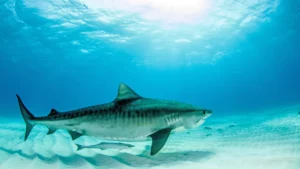 | 3–4.5 m (10–15 ft) | High | Both coasts offshore, the Andamans and Lakshadweep; landed at Kochi and ChennaiSuspected in the 2003 Mahabalipuram case. Rarely seen by divers in India. |
Blacktip Reef SharkCarcharhinus melanopterus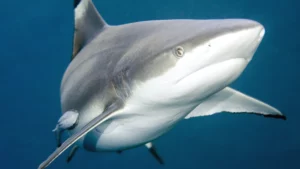 | 1.2–1.6 m (4–5 ft) | Low | Lagoons of Lakshadweep and the Andamans; Netrani; Gulf of MannarThe shark island visitors see from the jetty. Timid; the odd nip to a wader's ankle is its worst. |
Grey Reef SharkCarcharhinus amblyrhynchos | 1.5–2.5 m (5–8 ft) | Moderate | Channels and pinnacles of the Andamans (Johnny's Gorge, Barren Island) and LakshadweepThe main dive shark of the islands. Territorial toward divers who push in; no concern for snorkellers. |
Whitetip Reef SharkTriaenodon obesus | 1.2–1.6 m (4–5 ft) | Low | Under ledges on island reefs, Andamans and LakshadweepRests by day, hunts at night. Harmless. |
Blacktip SharkCarcharhinus limbatus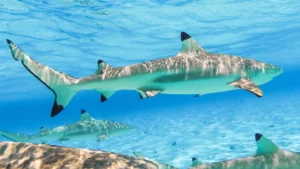 | 1.5–2.5 m (5–8 ft) | Moderate | Coastal waters on both mainland coasts; a major fishery speciesFast schooling hunter of sardines. No confirmed Indian incident. |
| Spot-tail SharkCarcharhinus sorrah | 1.2–1.6 m (4–5 ft) | Low | Continental shelf on both coasts; abundant in landingsA mid-sized requiem shark, black on the lower tail lobe, and one of the pillars of the Indian shark fishery. |
Spadenose SharkScoliodon laticaudus | 0.5–0.7 m (1.5–2.5 ft) | Low | Muddy inshore water and estuaries, both coasts; very commonNot rare at all, despite old claims: one of the most numerous sharks in Indian trawl catches. Harmless. |
Milk SharkRhizoprionodon acutus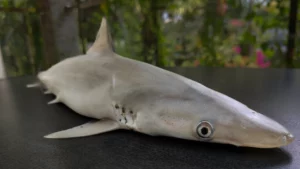 | 0.8–1.1 m (2.5–3.5 ft) | Low | Sandy shelf on both coastsFast-breeding small shark of the markets; the name comes from a folk belief about its meat and nursing mothers. |
Grey Sharpnose SharkRhizoprionodon oligolinx | 0.6–0.8 m (2–2.5 ft) | Low | Inshore shelf, particularly the west coastSlender and abundant; often mixed with milk sharks in landings. |
Whitecheek SharkCarcharhinus dussumieri | 0.7–1 m (2.5–3.5 ft) | Low | Shelf waters of both coastsSmall, plain requiem shark with a black-tipped second dorsal, a staple of Gujarat and Tamil Nadu landings. |
| Hardnose SharkCarcharhinus macloti | 0.7–1 m (2.5–3.5 ft) | Low | Coastal shelf, Bay of Bengal and Arabian SeaNamed for the hardened cartilage of its snout. Harmless. |
| Sliteye SharkLoxodon macrorhinus | 0.7–0.9 m (2.5–3 ft) | Low | Clear shelf waters, both coasts and the islandsBig-eyed small shark with a distinctive notch at the eye's rear corner. |
Pigeye SharkCarcharhinus amboinensis | 2–2.5 m (7–8 ft) | Moderate | Turbid coastal water and estuaries on both coastsA bull shark look-alike with a smaller range; confused with it in landings and probably in old attack reports. |
Scalloped Hammerhead SharkSphyrna lewini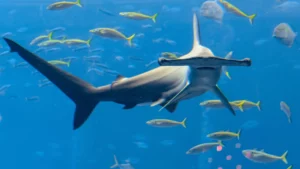 | 2.5–3.5 m (8–12 ft) | Low | Offshore on both coasts; Barren Island in the AndamansCritically endangered and still landed in numbers at Indian ports despite its CITES listing. |
Great Hammerhead SharkSphyrna mokarran | 3.5–4.5 m (11–15 ft) | Low | Continental shelf edge, both coasts; uncommonOccasional in longline catches. Shy; no Indian incident on record. |
Winghead SharkEusphyra blochii | 1.2–1.6 m (4–5 ft) | Low | Shallow muddy coasts of the Bay of Bengal and GujaratThe hammerhead with the widest head of all, half its body length. Endangered by gillnetting. |
Silky SharkCarcharhinus falciformis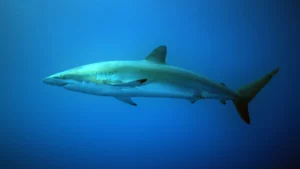 | 2–3 m (7–10 ft) | Moderate | Oceanic waters off both coasts and around the islandsThe main shark of the tuna longline bycatch. Rarely inshore. |
| Oceanic Whitetip SharkCarcharhinus longimanus | 2–3 m (7–10 ft) | High | Open ocean, Arabian Sea and Bay of Bengal; beyond the AndamansA real danger to shipwreck survivors in open water, which may explain the 1888 Dwarka deaths. Never on a beach. |
Blue SharkPrionace glauca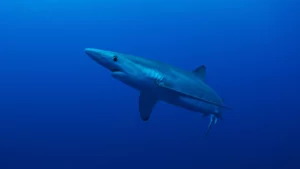 | 2–3 m (7–10 ft) | Low | Deep offshore water, mostly the Arabian SeaLongline catch; landed at Kochi and Mumbai. Stays well out over deep water. |
Shortfin Mako SharkIsurus oxyrinchus | 2.5–3.5 m (8–12 ft) | Moderate | Offshore, both coasts; longline bycatchFast pelagic hunter. Never inshore. |
Pelagic Thresher SharkAlopias pelagicus | 2.5–3.5 m (8–12 ft) incl. tail | Low | Offshore, both coasts and around the AndamansHarmless; the bigeye thresher is landed alongside it. |
Sicklefin Lemon SharkNegaprion acutidens | 2.5–3 m (8–10 ft) | Low | Sandy lagoons of Lakshadweep and the AndamansThe Indo-Pacific lemon shark. Slow, yellowish, easy to watch in shallow water. |
Tawny Nurse SharkNebrius ferrugineus | 2.5–3.2 m (8–10 ft) | Low | Reef caves in Lakshadweep and the Andamans; Gujarat coastIndia's nurse shark. Placid unless grabbed. |
Zebra Shark ('Leopard Shark' locally)Stegostoma tigrinum | 2–2.5 m (7–8 ft) | Low | Sand beside reefs in the Andamans, Gulf of Mannar and GujaratSpotted adults, striped young; completely docile. Increasingly rare in mainland landings. |
Grey Bamboo SharkChiloscyllium griseum | 0.6–0.75 m (2–2.5 ft) | Low | Inshore reefs and muddy bottoms on both coastsSmall egg-laying carpet shark, common in trawl bycatch and on Gulf of Mannar reefs. |
The great white shark is not on the list. A handful of 19th- and 20th-century claims from the Indian coast have never been supported by a specimen, jaws or a photograph, and the species' nearest confirmed populations are in South Africa and the temperate south of Australia; Indian water is simply too warm for it to linger. The sharks reported as great whites off Chennai or Mumbai have been bull sharks, tiger sharks or whale sharks. The Pondicherry shark, once presumed extinct and named after the Tamil coast, has turned up again in the region since 2016, but records from Indian waters remain too sparse to place it in the table as a resident.
Where to see sharks in India
Underwater encounters in India are concentrated on the islands and a couple of mainland sites; the whale shark is the one big animal you can see from a boat off the mainland coast. These are the places that actually deliver.
- Saurashtra coast, Gujarat (Veraval, Sutrapada, Dhamlej)The whale shark capital of India. From November to May whale sharks feed close to shore and are regularly caught in gillnets; since 2004 fishermen have released more than 900 of them under the Vhali campaign. There is no formal swim tourism, but the Forest Department and Wildlife Trust of India run boat-based monitoring.
- Havelock (Swaraj Dweep), Andaman IslandsIndia's best diving. Johnny's Gorge and Dixon's Pinnacle hold grey reef sharks and whitetip reef sharks in current, and the shallow reefs at Elephant Beach have blacktip reef sharks for snorkellers. Season October to May.
- Barren Island, Andaman IslandsSouth Asia's only active volcano, reached by liveaboard or long day trip from Havelock, with black-sand slopes and clear water. Grey reef sharks, whitetips, occasional silvertips and, in season, hammerheads and manta rays on the deep walls.
- Kadmat, Agatti and Bangaram, LakshadweepCoral atolls with Maldives-style lagoons and channels. Blacktip reef sharks in knee-deep lagoon water, grey reef and whitetip reef sharks in the channels, sicklefin lemon sharks and tawny nurse sharks on the sand. Access requires a permit and a resort or scuba-centre booking.
- Netrani Island, KarnatakaA heart-shaped island 19 km off Murudeshwar and the mainland's most reliable dive site. Blacktip reef sharks and the occasional whale shark, plus turtles, on the boulder reef between November and April.
- Grande Island, GoaShallow, easy diving from October to May with reasonable visibility on the best days. Sharks are uncommon; small bamboo sharks and, rarely, a blacktip or a passing whale shark are the extent of it.
- Sundarbans and the Hooghly, West BengalThe historic shark waters of the record: the Calcutta bathing ghats where sharks took bathers through the 1870s and 1880s. Bull sharks still enter the delta, and it is the core range of the Ganges shark, though seeing either from a boat is a matter of enormous luck.
- Gulf of Mannar, Tamil NaduA marine national park of 21 islands off Tuticorin and Rameswaram. Not a shark-diving destination, but the seagrass and reefs shelter juvenile blacktips, grey bamboo sharks and zebra sharks, and the dugongs draw more visitors than the fish.
If you want a certain encounter, go to the islands: Havelock for grey reef sharks in current, Lakshadweep for blacktips in the lagoon. For whale sharks, Gujarat between December and March is the place, arranged through the Forest Department's monitoring programme rather than a tour operator. On the mainland's dive sites, treat a shark as a bonus.
Best time of year to see sharks in India
The monsoon runs the calendar. The sea is closed or unpleasant for most of June to September along the whole west coast and much of the east, and everything opens up again from October.
- October to May, Andaman Islands: the dive season, with the best visibility from January to April. Grey reef sharks, whitetips and blacktips are resident; hammerheads and mantas are more likely at Barren Island from February to April.
- October to May, Lakshadweep: calm lagoons and 20–30 m visibility. Reef sharks are present all year; December to March is the most comfortable window.
- November to May, Gujarat whale sharks: peak sightings and net entanglements from December to March, when plankton-rich water sits close to the Saurashtra shore. Whale sharks give birth in this region, and newborns of under a metre have been recorded here.
- October to April, mainland diving (Netrani, Goa): the only months when the west-coast sea is clear enough to dive.
- June to September: south-west monsoon. Rough seas, fishing bans of 45 to 61 days on both coasts, and murky, plankton-rich water that brings the sharks close to shore but keeps people out of it.
Water temperature stays between 26 and 30 °C almost everywhere; only the northern Arabian Sea off Gujarat cools to 23–25 °C in January, which is one reason the whale sharks concentrate there in winter.
Shark attacks in India: what the record actually shows
India's shark record is one of the oldest in the world and it needs to be read in two halves. Every entry is filed on the shark attacks in India page. The database holds 41 entries in total, from a Portuguese sailor mauled at Cochin in 1595 to a fisherman bitten in a Maharashtra river in 2024. Fourteen are dated 1900 or later, four of them marked fatal; the other 27 are 19th-century and earlier, and 15 of those were deaths. The six most recent dated entries are rendered below; the attacks page holds all 41:
- 2024 · Vaitarna River, Palghar District, MaharashtraFishing — Calf of lower left leg injuredSpecies: Bull shark, 7' · not fatal
- 2003 · Mahabalipuram beach, 37 km south of Chennai, Tamil NaduSwimming or surfing — Left index finger laceratedSpecies: Tiger shark? · not fatal
- 1959 · Machhagan, Orissa — 5 fatalities, 30 injuredSpecies: 6' shark · not fatal
- 1959 · Mouth of Devi River at Machgaon, Orissa — 5 people killed by sharks, 30 others injuredSpecies: 1.5 m to 1.8 m [5' to 6'] sharks · not fatal
- 1958 · Malwan, near Ratnagiri, Maharashtra — FatalSpecies not identified · fatal
- 1955 · Vanagiri, Madras (Chennai), Bay of Bengal, Tamil NaduFishing — Leg bittenSpecies not identified · not fatal
The 19th-century half is a story about one river. Between 1868 and 1881 the Hooghly at Calcutta produced a run of bathers bitten or killed at the ghats, the stone steps where thousands washed every morning: a man who lost a leg at the hip in 1868, whose attacker the surgeon Joseph Fayrer identified as the Ganges shark, four separate bites in May and June 1870 alone, two deaths on the same day in May 1880, and a report from 1881 of more than twenty people severely bitten in a single year along the stretch from Barrackpore to the Bagh Bazar ghats, almost all of them fatally. Add the Madras bathers killed in 1830, 1842 and 1889, the 1879 swimmer taken by three sharks at Port Blair in the Andamans, and the crew of the Dwarka lost off the Kutch coast in 1888, and you have the bulk of India's toll. That river cluster is what made the “Ganges shark” notorious, although modern biologists believe the culprit at the ghats was usually the bull shark, which is common in the delta, rather than the fish-eating Glyphis.
The 20th- and 21st-century half is thin. Chennai's beaches produced the last cluster: a bather killed at Triplicane Beach in 1944, another in 1939, serious injuries to a bather in 1946, a fisherman's leg bitten at Vanagiri in 1955 and, much later, a swimmer's finger lacerated at Mahabalipuram in 2003, possibly by a tiger shark. The Hooghly claimed one more bather in 1938. The worst single episode is from Odisha: between July and September 1959 sharks of 1.5 to 1.8 m killed five people and injured 30 at the mouth of the Devi River near Machgaon, an event the database records twice and which is not counted in the “fatal” total because the entries describe the deaths without the word. A fatality at Malwan in Maharashtra some time before 1958, a fisherman's lower leg cut by a small shark beside a purse net off Trivandrum in 1952, and a fisherman's arm cut while roping a shark complete the list of people hurt. Since then, in a country of 1.4 billion people with a coast used by millions daily, there are exactly two incidents in 65 years, both minor. The standard advice covers the remaining risk: stay out of muddy river mouths and delta channels, do not bathe near fish landings, and avoid the water at dusk.
Is it safe to swim and snorkel with sharks in India?
On the islands, yes. The reef sharks of Lakshadweep and the Andamans are the same shy species that snorkellers meet in the Maldives and Thailand: blacktip reef sharks bolt from a shadow, whitetips lie under ledges, and grey reef sharks mind their own business unless a diver crowds them in a channel. Tawny nurse sharks and zebra sharks will let you look for as long as you keep your hands to yourself. There is no shark feeding in India and no baited diving, which helps keep it that way.
Whale sharks off Gujarat are harmless, but the encounter here is a conservation programme, not a tourist product: boats keep their distance, and if you are lucky enough to be on one, the guidelines are the usual ones, enter quietly, stay 3 to 4 m off the body and further from the tail, and never touch. Netrani's occasional whale shark should be treated the same way.
The mainland beaches are a different question, and sharks are near the bottom of the list of things to worry about. Rip currents kill hundreds of people a year on Indian beaches; sharks have hurt two in this century. The habitats to respect are the ones the historical record points at: the muddy channels of the Ganges delta and other big river mouths, especially in the monsoon when the water is opaque and bull sharks move inshore, and anywhere fish are being landed or cleaned. Goa's, Kerala's and Tamil Nadu's tourist beaches have no modern shark incident at all.
Shark conservation in India
India protects a few sharks completely and manages the rest hardly at all. In 2001 the whale shark became the first fish placed on Schedule I of the Wildlife (Protection) Act, the same tier as the tiger, and the Ganges shark, the Pondicherry shark, the speartooth shark and the sawfishes joined it; catching, killing or trading any of them carries a prison term. The whale shark listing came after decades of hunting on the Saurashtra coast, where the animals were harpooned for liver oil and meat, and it has been backed since 2004 by the Vhali campaign, in which Gujarat's fishermen, encouraged by the religious leader Morari Bapu and compensated for damaged nets, cut whale sharks free instead of landing them. More than 900 releases have been documented and the programme has become a model for the region. The other landmark is the 2013 fins-attached rule, which requires every shark landed in India to arrive with its fins naturally attached, ending the practice of finning at sea and slicing away the incentive to take fins only.
Everything else is under pressure. India's shark fishery is largely unregulated by species, hammerheads and threshers are landed in quantity despite their CITES listings, and the small coastal sharks that fill the markets have no size limits or quotas. Marine protected areas help at the edges, the Gulf of Mannar and Gulf of Kutch marine national parks, the Mahatma Gandhi Marine National Park in the Andamans and the reef reserves of Lakshadweep, but none was designed with sharks in mind. The rivers are the least protected of all: the Ganges shark's habitat is dammed, dredged and polluted along its length, and the species is known from only a few dozen specimens in 150 years. Visitors can help by refusing shark curry and dried shark in coastal towns, choosing island dive centres that report sightings to the Forest Department, and supporting the fishermen's release programmes in Gujarat. Our guide to why sharks are endangered explains why a fishery this size cannot be sustained on slow-breeding species.
Sharks in neighbouring waters
India's sharks are shared with the whole northern Indian Ocean. Sri Lanka, across the Palk Strait, has the same reef species plus a whale shark and blue whale season off its south coast; the Maldives continue the Lakshadweep atoll chain southwards with the region's best-protected reef sharks. Pakistan shares the Arabian Sea fishery and the whale sharks of the Gujarat–Sindh coast, and Oman holds the western side of the same sea. Eastwards, Thailand faces the Andaman Islands across the Andaman Sea with a near-identical reef fauna, and Malaysia continues it towards the South China Sea. Every country we have written up is collected on the sharks around the world hub.
Frequently asked questions
Are there sharks in India?
Yes, about 70 species in total, with 28 having solid, repeated records. Whale sharks gather off Gujarat in winter, reef sharks live in the lagoons and channels of Lakshadweep and the Andaman Islands, small requiem sharks fill the mainland fish markets, and bull sharks and the rare Ganges shark enter the big rivers of the Bay of Bengal coast.
Have there been shark attacks in India?
Yes, but almost all are historical. SharkSider's database lists 41 entries from 1595 to 2024, mostly 19th-century bathers on the Hooghly at Calcutta and at Madras. Since 1900 there are 14 entries, four marked fatal, plus a 1959 episode in Odisha that killed five people. The only cases this century are a minor injury at Mahabalipuram in 2003 and a fisherman bitten in a river in 2024.
Are there great white sharks in India?
No confirmed record exists. A few old claims from the Indian coast were never supported by a specimen or photograph, and the species' nearest populations are off South Africa and southern Australia. Indian water is too warm for great whites to stay, and reported sightings have proved to be bull sharks, tiger sharks or whale sharks.
What is the Ganges shark?
A true river shark, Glyphis gangeticus, found only in the Ganges-Hooghly delta and a few other rivers of the Bay of Bengal. It is critically endangered, protected under Schedule I of India's Wildlife Protection Act since 2001, and known from only a few dozen specimens. Its small eyes and slender teeth suit fish, and the old attacks blamed on it were probably bull sharks.
Are there sharks in the Ganges River?
Yes, two kinds. Bull sharks swim far up the Ganges and Hooghly and were the likely attackers at the Calcutta bathing ghats in the 1870s and 1880s. The Ganges shark is a separate, much rarer river species. Neither is a realistic danger today, and there has been no shark bite recorded on the Hooghly since 1938.
Can you see whale sharks in India?
Yes, off the Saurashtra coast of Gujarat between November and May, with the peak from December to March. The whale shark has been fully protected since 2001, and Gujarat's fishermen have released more than 900 from their nets under the Vhali campaign. There is no organised swimming tourism; encounters happen through the Forest Department's monitoring boats or by chance at Netrani and the islands.
Is it safe to swim in the sea in India?
Yes, as far as sharks are concerned. Only two minor incidents have been recorded this century, and none on the tourist beaches of Goa, Kerala or Tamil Nadu. Rip currents are a far greater hazard. Avoid muddy river mouths and delta channels, especially in the monsoon, and stay away from fish landings, and the shark risk is negligible.
Where is the best diving with sharks in India?
The Andaman Islands, from Havelock: Johnny's Gorge and Dixon's Pinnacle for grey reef and whitetip reef sharks, and Barren Island for hammerheads and mantas in season. Lakshadweep's atolls, Kadmat, Agatti and Bangaram, have blacktip reef sharks in the lagoons and grey reef sharks in the channels. Netrani Island off Karnataka is the mainland's best site.
Is shark fishing legal in India?
Mostly, yes. India is one of the world's largest shark-fishing nations, landing tens of thousands of tonnes a year. The whale shark, Ganges shark, Pondicherry shark, speartooth shark and sawfishes have been fully protected since 2001, and since 2013 every shark must be landed with its fins attached, but the rest of the catch has no species quotas or size limits.
When is the best time to see sharks in India?
October to May, outside the south-west monsoon. The Andamans dive best from January to April, Lakshadweep from December to March, and Gujarat's whale sharks peak from December to March. From June to September rough seas and fishing bans close most of the coast, although that is when plankton brings sharks closest to shore.
References

A small team focused on researching sharks and making marine biology easy to understand. Every page is reviewed against current species records and the SharkSider attack database, and updated when new incidents or research appear.
Published December 10, 2022 · Last updated September 21, 2026 · Incident data from the SharkSider attack database (14 records for India, 4 fatal).


