
Yes, there are sharks in Colombia, around 70 species on the national list and 30 you can count on, and they are one of the country's great natural assets. The Pacific coast has scalloped hammerheads, silky sharks, Galapagos sharks, whitetip reef sharks and whale sharks at Malpelo and Gorgona, plus the smalltooth sand tiger at depth. The Caribbean coast has nurse sharks, Caribbean reef sharks, lemon sharks and blacktips on the Seaflower reef and the Rosario Islands, with tiger and bull sharks in deeper or muddier water on both sides.
The safety record is about as short as a two-coast country can have. The SharkSider database holds just two records for Colombia, 2018 and 2023, both in the San Andrés and Providencia archipelago, and no shark fatality. The 2018 case was a fisherman off Providencia whose autopsy showed he drowned, with shark bites inflicted after death; the 2023 case was a freediver at the Nirvana site off San Andrés bitten on the lower right leg, attributed to an oceanic whitetip. No swimmer at a Colombian beach and no diver at Malpelo has ever been recorded as attacked.
- Shark species recorded30 with solid records (about 70 on the national list)
- ProtectionFinning banned 2007; targeted shark fishing prohibited by Law 2244 of 2022; Malpelo sanctuary (UNESCO 2006), Seaflower reserve (2000)
- Most seen from the beachNurse sharks and juvenile blacktips on the Caribbean reefs
- Signature encounterHammerhead schools at Malpelo; whale sharks off Chocó and Gorgona
- Incidents in the database2 (2018–2023), 0 shark fatalities
- Water temperatureCaribbean 26–29 °C; Pacific 24–28 °C, thermoclines to 15 °C at Malpelo

On this page
- Where sharks live in Colombian waters
- List of the different types of sharks in Colombia
- Where to see sharks in Colombia
- Best time of year to see sharks in Colombia
- Shark attacks in Colombia: what the record actually shows
- Is it safe to swim and snorkel in Colombia?
- Shark conservation in Colombia
- Sharks in neighbouring waters
- Frequently asked questions
- References
Where sharks live in Colombian waters
Colombia's Pacific coast is one of the wettest places on Earth, a 1,300 km wall of rainforest, mangrove and cliff from the Panamanian border to Ecuador, with almost no roads and very few people. Rivers pour fresh water and sediment into the sea, so the inshore water of Chocó, Buenaventura and Tumaco is warm, green and rich, and it is the domain of the estuary sharks: bull sharks, blacktips, Pacific sharpnose sharks, smalltail sharks and the tiny, endangered scalloped bonnethead in the mud. Offshore the picture changes completely. Gorgona, a forested island 35 km out that was a penal colony until 1984, has clear water and reef sharks, and 500 km further west, on the submarine ridge that runs from Panama's Coiba to Ecuador's Galápagos, rises Malpelo.
Malpelo is a bare rock 1.6 km long with sheer walls that drop into 3,000 m of ocean, and it sits where warm surface water from the Panama Bight meets the cold, nutrient-rich upwelling of the eastern Pacific. The mix produces an explosion of life. Scalloped hammerheads gather in schools of several hundred to be cleaned by the island's barberfish, silky sharks swarm the surface, Galapagos and whitetip reef sharks patrol the walls, whale sharks pass through in the warm months, and at 60–90 m, in the cold water below the thermocline, divers found a population of the smalltooth sand tiger, the monster shark of Malpelo, a deep-water species never before seen alive by divers in numbers. The Colombian government allows one liveaboard at the island at a time, under permit, which is why it remains one of the wildest dive sites in the world.
The Caribbean coast is drier, warmer and busier. From the Gulf of Urabá east through Cartagena, the Rosario Islands, Santa Marta and Tayrona to the desert of La Guajira, the shelf carries coral, seagrass and, off La Guajira and Santa Marta, a seasonal upwelling driven by the trade winds that cools the water in the dry season and feeds a large artisanal fishery. Nurse sharks, blacknose and Caribbean sharpnose sharks live on the shelf, bull sharks use the Magdalena and Sinú river mouths, and tigers work the deeper edges. Far offshore, 700 km north-west of the mainland and closer to Nicaragua than to Cartagena, lie San Andrés, Providencia and the banks of the Seaflower Biosphere Reserve, a 32 km barrier reef with the Caribbean reef sharks, nurse sharks, lemon sharks and hammerheads of the open western Caribbean. That archipelago is where both of Colombia's recorded incidents happened.
List of the different types of sharks in Colombia
The table lists the sharks with a solid, repeatable record in Colombian waters, on either coast. Colombia's national checklist runs to around 70 species when deep-water lanternsharks, catsharks and dogfish from research trawls are included, but most of those are known from a handful of specimens; the 30 here are the sharks that divers, fishermen and scientists actually encounter. Sizes are typical adults. The risk column concerns swimmers and snorkellers at a Colombian beach and not divers who go to Malpelo to be surrounded. Colombian fishermen call any shark tiburón and small ones tollo; the hammerhead is the martillo and the whale shark the tiburón ballena.
| Species | Adult size | Risk to swimmers | Where in Colombia & notes |
|---|---|---|---|
Scalloped Hammerhead SharkSphyrna lewini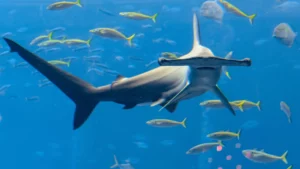 | 2.5–3.5 m (8–12 ft) | Low | Malpelo in schools of hundreds; Gorgona; deep edge of the Seaflower reefColombia's signature shark. Shy of divers' bubbles; critically endangered and still targeted by illegal longliners. |
Silky SharkCarcharhinus falciformis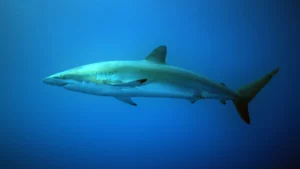 | 2–3 m (7–10 ft) | Moderate | Malpelo surface waters, often dozens at once; offshore both coastsBold and curious around liveaboard divers. The main shark caught on tuna longlines off both coasts. |
Galapagos SharkCarcharhinus galapagensis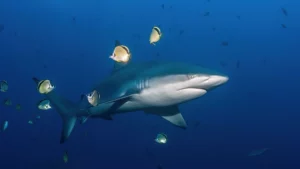 | 2.5–3 m (8–10 ft) | Moderate | Malpelo's walls and GorgonaConfident island shark that approaches closely; not the “highly aggressive” animal of older lists. No incident in 30 years at Malpelo. |
Whitetip Reef SharkTriaenodon obesus | 1.2–1.6 m (4–5 ft) | Low | Reefs and ledges at Malpelo and GorgonaRests in caves by day, hunts at night. Placid with divers. |
Whale SharkRhincodon typus | 6–10 m (20–33 ft) | Low | Malpelo June–November; Chocó and Gorgona July–October; occasional off the Caribbean coastHarmless filter feeder; protected. The Chocó sightings coincide with the humpback whale season. |
Smalltooth Sand Tiger SharkOdontaspis ferox | 3–4 m (10–13 ft) | Low | Malpelo below 60 m, El Bajo del MonstruoThe “monster shark” of Malpelo, a deep-water species divers found here in numbers. Sluggish and harmless. |
Smooth Hammerhead SharkSphyrna zygaena | 2.5–3.5 m (8–12 ft) | Low | Cooler water at Malpelo and the Pacific shelf edgeMixes with scalloped hammerhead schools in the cool season; distinguished by its unnotched head. |
Great Hammerhead SharkSphyrna mokarran | 3.5–4.5 m (11–15 ft) | Moderate | Deep edges of the Seaflower reef and the Pacific shelf; uncommonA solitary ray-hunter seen occasionally off Providencia. Critically endangered. |
Bull SharkCarcharhinus leucas | 2.2–3.2 m (7–10 ft) | High | River mouths and estuaries on both coasts: Magdalena, Sinú, Buenaventura, UtríaPresent in muddy water on both coasts, yet with no recorded incident in Colombia. Avoid river mouths at dusk. |
Tiger SharkGaleocerdo cuvier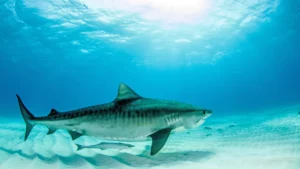 | 3–4.5 m (10–15 ft) | High | Deep shelf edges on both coasts; landed by La Guajira fishermenRarely seen by divers; recorded mainly from fisheries and the Seaflower drop-offs. |
Blacktip SharkCarcharhinus limbatus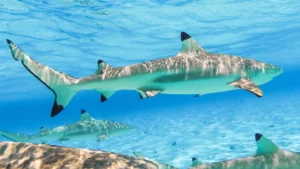 | 1.5–2 m (5–7 ft) | Moderate | Bays and reef edges on both coasts; juveniles at the Rosario IslandsThe black-tipped shark of Colombian bays, not the Indo-Pacific reef species. Fast and jumpy. |
Dusky SharkCarcharhinus obscurus | 3–3.6 m (10–12 ft) | Moderate | Outer shelf and offshore water, both coastsA large, slow-growing requiem shark taken as longline bycatch. Endangered. |
Nurse SharkGinglymostoma cirratum | 2.2–3 m (7–10 ft) | Low | Caribbean reefs: San Andrés, Providencia, Rosario Islands, TayronaThe shark Colombian snorkellers see most. Asleep under coral by day; bites only when grabbed. |
Pacific Nurse SharkGinglymostoma unami | 2–2.8 m (7–9 ft) | Low | Gorgona and the rocky Chocó coastThe Pacific species, recognised as distinct in 2015. Docile. |
Caribbean Reef SharkCarcharhinus perezi | 2–2.5 m (7–8 ft) | Moderate | Outer wall of the Seaflower reef, Providencia and San AndrésThe resident reef predator of the archipelago. Confident but rarely troublesome. |
Lemon SharkNegaprion brevirostris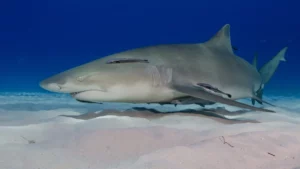 | 2.4–3 m (8–10 ft) | Low | Mangroves and lagoons: McBean Lagoon, Rosario Islands, Gulf of UrabáJuveniles nurse in the Caribbean mangroves. Slow, yellowish, shallow-loving. |
| Caribbean Sharpnose SharkRhizoprionodon porosus | 0.8–1.1 m (2.6–3.6 ft) | Low | Shallow Caribbean shelf; common in artisanal netsSmall and harmless; one of the most-landed sharks at Caribbean fish markets. |
Pacific Sharpnose SharkRhizoprionodon longurio | 0.9–1.1 m (3–3.6 ft) | Low | Inshore Pacific from Chocó to TumacoThe Pacific counterpart, sold as tollo in Buenaventura. Timid. |
Blacknose SharkCarcharhinus acronotus | 1.2–1.4 m (4–4.6 ft) | Low | Sand and seagrass of the Caribbean shelf, Tayrona to La GuajiraSmall, shy and marked by a dark snout tip. |
Spinner SharkCarcharhinus brevipinna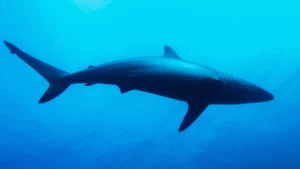 | 2–2.5 m (7–8 ft) | Moderate | Caribbean coast, chasing sardine schools in the upwellingLeaps and spins through baitfish. Occasional minor bites to waders elsewhere in its range, none in Colombia. |
| Smalltail SharkCarcharhinus porosus | 1–1.3 m (3–4 ft) | Low | Muddy estuaries of the Caribbean coast and the PacificA small estuary shark hit hard by shrimp trawls and gillnets. Critically endangered. |
Bonnethead SharkSphyrna tiburo | 0.9–1.2 m (3–4 ft) | Low | Shallow Caribbean bays and seagrassA crab-eating miniature hammerhead. Completely harmless. |
Scalloped BonnetheadSphyrna corona | 70–90 cm (2.3–3 ft) | Low | Pacific estuaries and mud flats around Buenaventura and TumacoNo hammerhead is smaller, and none has a smaller range: the eastern Pacific mud flats only. Endangered and barely studied. |
Shortfin Mako SharkIsurus oxyrinchus | 2–3 m (7–10 ft) | Moderate | Offshore on both coasts; longline bycatchFast, powerful, endangered. Dangerous mainly when hooked and boated. |
Blue SharkPrionace glauca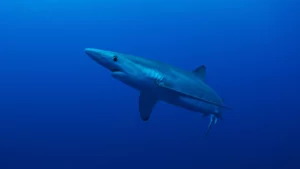 | 2–3 m (7–10 ft) | Low | Deep oceanic water beyond both shelvesAn open-ocean wanderer never seen from shore. |
Pelagic Thresher SharkAlopias pelagicus | 2.5–3.5 m (8–12 ft) incl. tail | Low | Open Pacific around Malpelo and the shelf edgeOccasionally seen at depth by Malpelo divers; stuns fish with its tail. |
Bigeye Thresher SharkAlopias superciliosus | 3–4 m (10–13 ft) incl. tail | Low | Deep water on both coasts; longline bycatchA deep-living thresher with huge eyes. Harmless. |
Common Thresher SharkAlopias vulpinus | 3–4.5 m (10–15 ft) incl. tail | Low | Offshore, mainly the cooler Pacific waterRecorded on both coasts; a rare sight for divers. |
| Oceanic Whitetip SharkCarcharhinus longimanus | 2–3 m (7–10 ft) | High | Deep ocean off both coasts; the Seaflower drop-offsAttributed with the 2023 bite to a freediver off San Andrés. Bold, but now critically endangered and rare. |
Great White SharkCarcharodon carcharias | 4–6 m (13–20 ft) | n/a | No confirmed Colombian recordA row for the question everyone asks: white sharks cross the eastern Pacific at depth, but none has been verified off Colombia. |
The great white shark has no confirmed Colombian record on either coast. Tagged white sharks from Mexico do travel deep across the eastern tropical Pacific, and a sighting at Malpelo is not impossible, but none has been verified, and the Caribbean coast is far too warm. The Indo-Pacific blacktip reef shark, sometimes listed for the Caribbean islands, does not occur in the Atlantic; the black-tipped sharks of the Rosario Islands and San Andrés are the Atlantic blacktip shark. Colombia's Galapagos sharks, incidentally, were labelled “highly aggressive” in older lists; they are confident island sharks that approach divers, with no incident recorded at Malpelo in three decades of diving.
Where to see sharks in Colombia
Colombia has one of the world's great shark dives and several very good ordinary ones. Nothing is baited; the sharks are resident or migratory, and the encounters depend on currents, cleaning stations and season. These are the sites with the strongest records.
- Malpelo Fauna and Flora Sanctuary, PacificA UNESCO World Heritage Site 500 km off Buenaventura, reached by a 30-hour liveaboard crossing, one boat at a time by government permit. Scalloped hammerheads in schools of hundreds at sites like La Nevera and El Arrecife, silky sharks by the dozen at the surface, Galapagos and whitetip reef sharks on every wall, whale sharks in the warm months, and the smalltooth sand tigers of El Bajo del Monstruo below 60 m for technical divers. Advanced divers only; strong currents and cold thermoclines.
- Gorgona National Natural Park, PacificA former prison island 35 km off the Cauca coast, now a national park with limited visitor numbers. Whitetip reef sharks on the reefs, hammerhead schools off the points in the cooler months, whale sharks in season, and humpback whales calving from July to October. Diving is arranged through the park concession.
- Bahía Solano, Nuquí and Utría National Park, ChocóThe wild Pacific mainland, reached by small plane. Whale sharks feed off Cabo Marzo and Punta Piñas, blacktips and hammerheads pass the points, and the mangrove inlets of Utría are a nursery for bull sharks and hammerhead pups. Sightings run alongside the humpback whale season.
- Providencia and Santa Catalina, Seaflower Biosphere ReserveThe quieter island of the archipelago, ringed by the 32 km Seaflower barrier reef. Caribbean reef sharks on the outer wall at sites like Tete's Place and Manta City, nurse sharks in the shallows, hammerheads off the deep edge, and lemon sharks in the mangroves of McBean Lagoon. The 2018 database entry comes from here.
- San AndrésThe busy island of the group, with easy reef diving on the leeward west side. Nurse sharks at Blue Wall and the wrecks, Caribbean reef sharks on the drop-off, and the Nirvana site where a freediver was bitten in 2023, the only injury on Colombia's record.
- Rosario and San Bernardo Islands, CartagenaCorales del Rosario y San Bernardo National Park, an hour by boat from Cartagena. Nurse sharks under the coral heads, juvenile blacktips and lemon sharks over the seagrass, and the Oceanario aquarium on Isla San Martín, where nurse sharks can be seen up close by non-divers.
- Tayrona National Park and Santa MartaRocky bays and reefs below the Sierra Nevada. Nurse sharks in the caves at Taganga and Tayrona's dive sites, blacknose and sharpnose sharks over the sand, and the dry-season upwelling that brings cooler, richer water and bigger fish from December to April.
- La Guajira and Cabo de la VelaColombia's desert peninsula, where Wayuu fishermen land the country's largest artisanal shark catch in the upwelling months. Not a dive area, but the beaches and fish landings at Cabo de la Vela and Riohacha are where blacktips, hammerheads and tiger sharks are most often seen in the Caribbean.
Malpelo is the trip of a lifetime and needs advanced certification, a liveaboard booking months ahead and a tolerance for rough crossings. For an easier Colombian shark, dive the Seaflower reef from Providencia, where reef and nurse sharks are on most dives, or snorkel the Rosario Islands from Cartagena for nurse sharks and juvenile blacktips in a metre of water.
Best time of year to see sharks in Colombia
Colombia's two coasts run on different clocks, and Malpelo runs on its own.
- Malpelo, December to May: the cool season, when the thermocline rises and the water at depth drops to 15–18 °C. This is when the scalloped hammerhead schools are largest and shallowest, and when the smalltooth sand tigers are within reach of technical divers. Surface water is 24–26 °C; visibility can be lower but the shark action is at its peak.
- Malpelo, June to November: warmer water of 27–28 °C, clearer, with fewer hammerheads but the best months for whale sharks and for the silky shark aggregations at the surface. Humpback whales pass through from July to October.
- Chocó and Gorgona, July to October: the humpback whale season, and the most reliable window for whale sharks off Bahía Solano and Nuquí. The rest of the year the Pacific mainland is diveable but very wet.
- The Caribbean coast, December to April: the dry season and the trade-wind upwelling off Santa Marta and La Guajira, which cools the water to 22–25 °C and concentrates baitfish and sharks; also the calmest, clearest diving at Tayrona and the Rosario Islands.
- San Andrés and Providencia, year-round: water of 27–29 °C in every month and reef sharks that do not move. May to June and September to November are the wettest and roughest; the best visibility is from January to April.
The Pacific coast is warm at the surface all year, 26–28 °C off Chocó, but Malpelo's thermoclines are the reason a 7 mm wetsuit is standard on the liveaboards.
Shark attacks in Colombia: what the record actually shows
For a country with 3,200 km of coastline on two oceans, Colombia's incident list is remarkably short. SharkSider keeps every case on the shark attacks in Colombia page. The database holds only two records, both from the San Andrés and Providencia archipelago, and both are shown below (the attacks page is updated weekly):
- 2023 · Nirvana, San Andrés IslandFreediving — Lower right leg bittenla patria, 7/20/2023wSpecies: Oceanic whitetip shark · not fatal
- 2018 · Provencia, San Andres and Providencia ArchipelagoFishing — Autopsy confirmed death by drowning, shark bite were post-mortemSpecies not identified · not fatal
Neither case is a shark killing a person. The 2018 entry from Providencia is a fisherman whose body was recovered with shark bites; the autopsy confirmed he had drowned, and the bites were inflicted after death, which is why the database counts no fatality for Colombia. The 2023 case is the country's only recorded injury: a freediver at the Nirvana site off San Andrés, bitten on the lower right leg on 18 July 2023, reported in the Colombian press two days later and attributed to an oceanic whitetip shark, a bold open-ocean species that does occasionally come in over the deep drop-offs of the archipelago. The diver survived.
The pattern, such as it is, points offshore. Both records come from the deep-water edge of a remote reef 700 km from the mainland, not from the beaches of Cartagena or Santa Marta, where millions of Colombians swim every year, and not from Malpelo, where thirty years of shark diving with hundreds of hammerheads and silkies in the water have produced no incident at all. Colombia's mainland Caribbean coast has bull sharks in its river mouths and tigers on its shelf edge, and its Pacific estuaries are full of bulls, yet neither coast has a single recorded case. The standard precautions are still worth following at the river mouths and fish landings of La Guajira and Chocó: no swimming in murky water at dusk, no speared fish on the body, and calm exit if a large shark shows interest.
Is it safe to swim and snorkel in Colombia?
Yes, and the numbers say so: two records, one injury, no deaths, in a country whose Caribbean beaches from Cartagena to Santa Marta are among the most visited in South America. The sharks a snorkeller might meet at the Rosario Islands, Tayrona or San Andrés are nurse sharks resting under coral heads, juvenile blacktips and lemon sharks hunting over seagrass, and the occasional blacknose or sharpnose shark on the sand, all of which move away from people. Rip currents on the open beaches of Tayrona and the Pacific, box jellyfish in the wet season, sea urchins and, in the mangroves and estuaries of the Pacific, American crocodiles are the hazards that actually put people in hospital.
Divers at Malpelo are in a different world, and the liveaboards manage it. Hammerheads are shy of bubbles and drift away if chased, so the technique is to hold the rock, breathe slowly and let the school come. Silky and Galapagos sharks are the confident ones; they will approach to a metre or two, and divers are briefed to stay in a group, keep the sharks in view and never dangle a camera or a hand in the blue. The smalltooth sand tigers at depth are sluggish and ignore divers entirely. In three decades no one has been bitten at Malpelo.
Whale sharks off Chocó, Gorgona and Malpelo are harmless and the encounters are usually from the surface: keep a few metres from the body, stay clear of the tail, no touching and no flash, and let the animal set the pace. Nurse sharks at San Andrés and the Rosario Islands tolerate a close look but will bite a hand that grabs their tail, and that reflex, not aggression, is the source of most nurse shark injuries in the Caribbean.
Shark conservation in Colombia
Colombia's legal position on sharks has swung dramatically in a decade and ended up among the strongest in Latin America. Finning was banned in 2007 and sharks have had to be landed with fins attached since. Then, in 2017, a fisheries resolution set catch quotas for sharks as if they were an ordinary fishery resource, including tonnes of hammerheads, and provoked a national outcry, court challenges and years of argument. The answer came in July 2022 with Law 2244, which removed sharks, rays and chimaeras from the list of fishery resources altogether, prohibited targeted shark fishing and the fin trade, and left only incidental catch by artisanal fishers, who must land the whole animal. Colombia also protected Malpelo as a Fauna and Flora Sanctuary in 1995, won UNESCO World Heritage status for it in 2006 and expanded the sanctuary to about 27,000 km² in 2017; the Seaflower Biosphere Reserve around San Andrés and Providencia dates from 2000, with a large marine protected area added in 2005. By 2022 the country had placed more than 30% of its ocean under protection, and it works with Panama, Costa Rica and Ecuador in the Eastern Tropical Pacific Marine Corridor to safeguard the hammerhead and whale shark route between Malpelo, Coiba, Cocos and the Galápagos.
On the water the picture is harder. Malpelo is patrolled by the Colombian navy, but foreign longliners and illegal fishing boats still target the hammerheads and silkies at the edge of the sanctuary, and rangers regularly haul in kilometres of abandoned line. On the Caribbean coast, the artisanal fisheries of La Guajira and the Gulf of Urabá still land large numbers of sharks as incidental catch, which in practice includes juvenile hammerheads and blacktips, and monitoring is thin. In the Pacific estuaries the scalloped bonnethead and the smalltail shark are caught in shrimp trawls and gillnets, and both are endangered. Mangrove loss around Buenaventura and Tumaco removes the nurseries that bull sharks and hammerheads depend on. Scalloped and great hammerheads are critically endangered, oceanic whitetips are critically endangered, and the smalltooth sand tiger is vulnerable and known from very few places, which makes Malpelo's population globally important.
If you dive here, use the licensed Malpelo operators and the park concessions at Gorgona, report hammerhead and whale shark sightings to the Colombian research groups that track them, and never buy shark meat, sold as tollo or cazón, or anything made from fins. For the wider story, read our guide on why sharks are endangered.
Sharks in neighbouring waters
Colombia's sharks belong to two regional systems. On the Pacific ridge, Panama's Coiba, Costa Rica's Cocos Island and Ecuador's Galápagos share Malpelo's hammerheads, silkies and whale sharks along one migration corridor, and Peru to the south adds the cold-water species of the Humboldt Current. On the Caribbean side, Venezuela shares the southern Caribbean shelf and the same artisanal shark fisheries, while Brazil, around the corner of the continent, has the Atlantic's longest incident record at Recife. Our sharks around the world page lists every coast we cover.
Frequently asked questions
Are there sharks in Colombia?
Yes, on both coasts. Around 70 species appear on the national list and 30 have solid, repeatable records. The Pacific has hammerheads, silky, Galapagos and whitetip reef sharks and whale sharks at Malpelo and Gorgona; the Caribbean has nurse, Caribbean reef, lemon and blacktip sharks on the Seaflower reef, the Rosario Islands and Tayrona. Bull and tiger sharks occur on both sides.
Have there been shark attacks in Colombia?
Only two records exist, both from the San Andrés and Providencia archipelago, and neither is a shark death. A fisherman found off Providencia in 2018 had drowned, with shark bites inflicted after death. In July 2023 a freediver at the Nirvana site off San Andrés was bitten on the lower leg, attributed to an oceanic whitetip, and survived. The mainland coasts have no recorded case.
Can you go shark diving in Colombia?
Yes, and Malpelo is one of the world's great shark dives. The sanctuary lies 500 km off Buenaventura, is reached by liveaboard only, and the government permits one boat at a time. Divers see schools of hundreds of scalloped hammerheads, silky and Galapagos sharks, whale sharks and the deep-water smalltooth sand tiger. Gorgona and the Seaflower reef off Providencia are easier alternatives.
Is it safe to swim in Colombia?
Yes. Millions of people swim at Cartagena, Santa Marta, Tayrona and San Andrés every year and no swimmer has ever been recorded as attacked by a shark in Colombia. Rip currents on the open beaches, jellyfish in the wet season and crocodiles in the Pacific mangroves are the real hazards. Avoid swimming in murky river mouths at dusk, where bull sharks feed.
Are there great white sharks in Colombia?
No confirmed record exists on either coast. Tagged white sharks from Mexico are known to cross the eastern tropical Pacific at depth, so a visitor to Malpelo is not impossible, but none has ever been verified, and the Caribbean coast is far too warm. Large grey sharks reported off Colombia are Galapagos, silky, bull, dusky or tiger sharks.
When is the best time to dive with hammerheads at Malpelo?
December to May, the cool season, when the thermocline rises, deep water drops to 15–18 °C and the scalloped hammerhead schools are largest and shallowest. June to November is warmer and clearer, with fewer hammerheads but the best whale shark and silky shark encounters. A 7 mm wetsuit is standard on the liveaboards year-round.
Are there whale sharks in Colombia?
Yes. Whale sharks visit Malpelo mainly from June to November, and the Pacific mainland off Bahía Solano, Nuquí and Gorgona from about July to October, alongside the humpback whales. They are occasionally reported off the Caribbean coast and the Seaflower reef. They are harmless and protected; keep a few metres away and never touch.
What is the most common shark in Colombia?
On the Caribbean coast, the nurse shark, seen on most snorkelling trips at the Rosario Islands, San Andrés and Providencia. In the fisheries, the small Caribbean and Pacific sharpnose sharks are the most landed. For divers who make the Malpelo crossing, the scalloped hammerhead is the animal they see in the greatest numbers anywhere in Colombia.
Is shark fishing legal in Colombia?
Targeted shark fishing is not. Finning has been banned since 2007, and Law 2244 of 2022 removed sharks, rays and chimaeras from the list of fishery resources, prohibiting directed fishing and the fin trade and allowing only incidental artisanal catch landed whole. Malpelo and the Seaflower reserve are protected areas, and more than 30% of Colombia's ocean is now under protection.
Are there sharks in San Andrés and Providencia?
Yes. The Seaflower barrier reef around the islands has nurse sharks in the shallows, Caribbean reef sharks on the outer wall, lemon sharks in the mangroves and hammerheads and oceanic whitetips off the deep edge. Both of Colombia's recorded incidents happened here, in 2018 and 2023, but reef diving on the leeward sides is routine and safe.
References
- International Shark Attack File: Yearly Worldwide Shark Attack Summary (Florida Museum of Natural History, University of Florida)
- Malpelo Fauna and Flora Sanctuary, UNESCO World Heritage List
- Oceanic whitetip shark, NOAA Fisheries species directory
- Sphyrna lewini (scalloped hammerhead shark), Convention on the Conservation of Migratory Species of Wild Animals

A small team focused on researching sharks and making marine biology easy to understand. Every page is reviewed against current species records and the SharkSider attack database, and updated when new incidents or research appear.
Published January 3, 2023 · Last updated September 21, 2026 · Incident data from the SharkSider attack database (2 records for Colombia, 0 fatal).


