
Yes, there are sharks in Canada on every coast, 20 species with solid records, but almost none of them come near swimmers. The common ones are the spiny dogfish on both coasts, the blue shark, porbeagle and shortfin mako off Nova Scotia and Newfoundland in summer, the basking shark in the Bay of Fundy and the Gulf of St. Lawrence, the salmon shark and bluntnose sixgill off British Columbia, and the Greenland shark in the St. Lawrence estuary and the Arctic. Great whites now visit the Maritimes every summer and autumn.
The SharkSider database holds 15 records for Canada from 1691 to 2026, 10 of them dated 1900 or later and none of those fatal; the four deaths on file all happened before 1892 and mostly involved men thrown into the sea by shipwrecks. Since 1900 the list is mostly sharks biting boats, hooked or harpooned sharks fighting back, one swimmer with a thigh wound off Cape Breton in 2021 and one scuba diver seriously bitten off Ile Bonaventure, Quebec, in 2026. Water below 20 °C, short seasons and empty beaches keep the risk close to zero.
- Shark species recorded20 with solid records
- ProtectionFinning banned 1994; fin trade banned 2019; white, basking and porbeagle protected under SARA/Fisheries Act
- Most seen from the beachSpiny dogfish (both coasts)
- Signature encounterSixgill sharks at Hornby Island, BC; Greenland sharks in the St. Lawrence
- Incidents in the database15 (1691–2026), 4 fatal, all before 1892
- Water temperature2–20 °C Atlantic, 7–16 °C Pacific, below 4 °C Arctic

On this page
- Where sharks live in Canadian waters
- List of the different types of sharks in Canada
- Where to see sharks in Canada
- Best time of year to see sharks in Canada
- Shark attacks in Canada: what the record actually shows
- Is it safe to swim in Canada?
- Shark conservation in Canada
- Sharks in neighbouring waters
- Frequently asked questions
- References
Where sharks live in Canadian waters
Think of Canada's sharks as three separate faunas that barely overlap. On the Atlantic, the Scotian Shelf, the Bay of Fundy, the Gulf of St. Lawrence and the Grand Banks of Newfoundland form one of the most productive shelf seas in the world, where the cold Labrador Current meets warm Gulf Stream eddies. From June to October that boundary fills with the pelagic sharks of the temperate North Atlantic: blue sharks in enormous numbers, porbeagles, shortfin makos, the occasional thresher and, increasingly, great whites, which follow the seals up the coast of Nova Scotia and into the Gulf of St. Lawrence. Beneath them, spiny dogfish are so numerous that they are a nuisance to every groundfish fisherman from Yarmouth to St. John's, and the deep slope holds black dogfish, Portuguese dogfish and deep-sea catsharks.
The Pacific coast of British Columbia is a different world: cold, deep fjords, strong tides and the Strait of Georgia between Vancouver Island and the mainland. Its famous shark is the bluntnose sixgill, a deep-water giant that comes up into 20–30 m of water at Hornby Island in summer, close enough for divers to meet it on a shore dive. The North Pacific spiny dogfish is the most abundant shark on the coast, salmon sharks follow the salmon runs off the west side of Vancouver Island, Pacific sleeper sharks and brown catsharks live in the deep, and blue sharks, makos and threshers reach the offshore banks in warm years. Basking sharks were once so common in BC's inlets that the federal government spent 14 years killing them; today a sighting is news.
The Arctic, from Hudson Bay through the Northwest Passage to Baffin Bay and the Beaufort Sea, is Greenland shark country. These slow, sluggish sharks, some of them born before the Hudson's Bay Company, live under the ice and turn up as bycatch in the turbot fishery out of Pangnirtung and Cumberland Sound. The same species reaches south into the deep, cold St. Lawrence estuary, where a research group has been diving with them in shallow water since the early 2000s. Nothing else in Canada's Arctic is confirmed beyond the Pacific sleeper shark in the Beaufort Sea; our page on sharks of the Arctic covers the polar fauna in more detail.
List of the different types of sharks in Canada
The table lists every shark with a solid Canadian record, from research surveys, fisheries observer data and verified sightings on all three coasts. Lengths are typical adults; the previous version of this page gave 15–20 ft for the sixgill and 12–15 ft for the Pacific sleeper shark, which are exceptional individuals rather than the animals divers meet. The risk column concerns a swimmer at a Canadian beach, which in water this cold is a very short list. Two names need care: the spiny dogfish of the Atlantic and the Pacific are now recognised as different species, and the “school shark” of the old table is the tope, a very rare stray in BC.
| Species | Adult size | Risk to swimmers | Where in Canada & notes |
|---|---|---|---|
Greenland SharkSomniosus microcephalus | 3–5 m (10–16 ft) | Low | Arctic (Baffin Bay, Cumberland Sound, Hudson Strait); St. Lawrence estuary; deep Atlantic slopeThe longest-lived vertebrate known, with individuals aged at over 270 years. Sluggish and nearly blind; no confirmed bite on a person anywhere. |
Pacific Sleeper SharkSomniosus pacificus | 3–4.4 m (10–14 ft) | Low | Deep water off British Columbia; Beaufort SeaThe Greenland shark's Pacific counterpart, taken as bycatch on deep longlines and trawls. Never seen by swimmers. |
Basking SharkCetorhinus maximus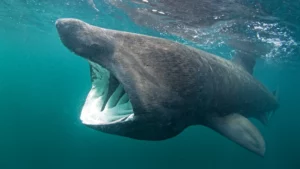 | 6–9 m (20–30 ft) | Low | Bay of Fundy, Gulf of St. Lawrence and Scotian Shelf in summer; very rare in BCHarmless plankton feeder. The Pacific population was deliberately destroyed by a 1955–1969 eradication programme and is listed as endangered. |
Great White SharkCarcharodon carcharias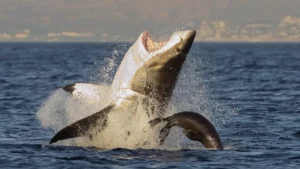 | 4–6 m (13–20 ft) | High | Nova Scotia, Bay of Fundy, Gulf of St. Lawrence and Newfoundland, July–November; rare stray in BCA regular summer visitor, not a stray: tagged adults return to the Maritimes yearly. Blamed for the 1932 and 1953 boat attacks; listed as endangered under SARA. |
Porbeagle SharkLamna nasus | 2–2.5 m (7–8 ft) | Low | Scotian Shelf, Bay of Fundy, Grand Banks, all year; peaks in summerCanada's cold-water mako, the target of a fishery closed in 2013. Circled an urchin diver in the Bay of Fundy in 2000 without touching him. |
Shortfin Mako SharkIsurus oxyrinchus | 2–3 m (7–10 ft) | Moderate | Warm Gulf Stream edges off Nova Scotia in late summer; rare off BCFast pelagic hunter caught on tuna and swordfish gear. Retention banned in the North Atlantic since 2022. |
Blue SharkPrionace glauca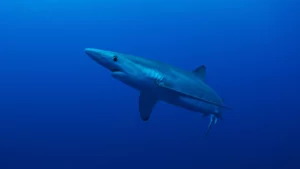 | 2–3 m (7–10 ft) | Low | Everywhere offshore in the Atlantic from June to October; offshore BC in warm yearsThe most abundant large shark in Canada and the star of Nova Scotia's charter trips. Curious around divers, not dangerous. |
Common Thresher SharkAlopias vulpinus | 3–4.5 m (10–15 ft) incl. tail | Low | Scotian Shelf and Bay of Fundy in late summer; occasional off BCRecognised by the scythe-shaped tail it uses to stun herring and mackerel. Harmless to people. |
Salmon SharkLamna ditropis | 2–2.6 m (6.5–8.5 ft) | Low | Offshore British Columbia, following salmon runs in late summerA warm-blooded Pacific cousin of the porbeagle. Suspected but judged unlikely in the 2012 Tofino case. |
Bluntnose Sixgill SharkHexanchus griseus | 3–4.5 m (10–15 ft) | Low | Strait of Georgia (Hornby Island), Barkley Sound and BC fjords; deep Atlantic slopeCanada's signature dive shark, rising into 20–30 m at Hornby Island in summer. Placid; species of special concern under SARA. |
Broadnose Sevengill SharkNotorynchus cepedianus | 2–3 m (7–10 ft) | Moderate | Southern British Columbia inlets; rareA bold coastal hunter at the northern limit of its range. Few Canadian records. |
| Spiny DogfishSqualus acanthias | 80–110 cm (2.6–3.6 ft) | Low | Scotian Shelf, Bay of Fundy, Gulf of St. Lawrence and Grand Banks in vast schoolsThe most numerous shark on the Atlantic coast. Venomous dorsal spines for handlers; harmless to swimmers. |
North Pacific Spiny DogfishSqualus suckleyi | 0.9–1.3 m (3–4.3 ft) | Low | Strait of Georgia and the entire BC coast, shallow to deepSplit from the Atlantic species in 2010. One of the longest-lived and slowest-breeding sharks; BC's commonest shark by far. |
Black DogfishCentroscyllium fabricii | 60–90 cm (2–3 ft) | Low | Deep water of the Gulf of St. Lawrence, Laurentian Channel and Labrador slopeSmall, black, bioluminescent deep-sea shark, abundant in trawl surveys below 300 m. |
Portuguese DogfishCentroscymnus coelolepis | 0.9–1.2 m (3–4 ft) | Low | Continental slope off Nova Scotia and Newfoundland below 800 mOne of the deepest-living sharks; halibut and turbot longline bycatch. |
Brown CatsharkApristurus brunneus | 50–65 cm (1.6–2 ft) | Low | Deep water off British Columbia, 100–900 mThe smallest shark in Canada, a soft-bodied deep-sea catshark taken in shrimp trawls. |
| Deepwater CatsharkApristurus profundorum | 50–60 cm (1.6–2 ft) | Low | Slope off Nova Scotia and the Grand Banks, 1,000 m and deeperKnown from a few trawl specimens; adult size is poorly known. |
Iceland CatsharkApristurus laurussonii | 60–70 cm (2–2.3 ft) | Low | Deep Atlantic slope off Newfoundland and LabradorA deep-sea catshark of the North Atlantic slope, recorded in Canadian deep-water surveys. |
Tope SharkGaleorhinus galeus | 1.5–1.9 m (5–6 ft) | Low | Rare stray off southern British ColumbiaThe soupfin or school shark, at the northern edge of its Pacific range. Species of special concern in Canada. |
| Dusky Smooth-houndMustelus canis | 1–1.5 m (3–5 ft) | Low | Occasional summer visitor to the Bay of Fundy and southern Scotian ShelfA warm-temperate Atlantic hound that follows warm water north in some years. Harmless crab-eater. |
The species people ask about most are the ones that are not here. The bull shark has never been confirmed in Canadian waters; it is a warm-water species whose northern limit on the Atlantic coast is Massachusetts in a hot summer. The tiger shark has a handful of stray records off Nova Scotia but is far too rare to belong in the table, and the same goes for the smooth hammerhead and the sand tiger, which occasionally follow warm eddies onto the Scotian Shelf. There are no reef sharks, no nurse sharks and no lemon sharks; the Canadian shark list is a cold-water list. The one warm-water surprise is the great white, which is not a stray at all: satellite tags have shown that adults from the US east coast summer off Nova Scotia every year, and detections in the Gulf of St. Lawrence and off Newfoundland have multiplied since the mid-2010s.
Where to see sharks in Canada
Canada is not a shark-diving destination in the tropical sense, but it offers two encounters found almost nowhere else on Earth, sixgills on a shore dive and Greenland sharks in a river estuary, plus some of the best blue shark and basking shark boat trips in the North Atlantic.
- Hornby Island, British ColumbiaThe world's most reliable place to meet a bluntnose sixgill shark without a submarine. In summer, especially in the 1990s and 2000s, sixgills of 3–4 m rose to 20–30 m along the Flora Islet wall. Sightings are fewer now, but divers still find them, along with spiny dogfish, most years.
- Baie-Comeau and the St. Lawrence estuary, QuebecThe Greenland shark research group GEERG has documented sharks of 3–4 m cruising the shallow, cold north-shore bays since 2003. Extremely cold, dark diving for experienced drysuit divers; the only place in the world with regular shallow Greenland shark encounters.
- Brier Island and the Bay of Fundy, Nova ScotiaWhale-watching boats from Brier Island and Grand Manan regularly see basking sharks feeding on the surface from July to September, and porbeagles and blue sharks in the tide rips. The database's 2000 encounter, a porbeagle circling an urchin diver, was here.
- Halifax and the Scotian ShelfCharter boats out of Halifax, Lunenburg and Yarmouth run blue shark trips in August and September, and the Yarmouth shark scramble has been a summer fixture for decades. Blue sharks are almost guaranteed; makos and porbeagles are the bonus.
- Cape Breton and the Gulf of St. LawrenceThe new great white hotspot. Acoustic receivers around Cape Breton, the Northumberland Strait and the Magdalen Islands log tagged white sharks every summer and autumn, and the 2021 swimmer injury happened off Cape Breton's west coast. Sightings from shore remain rare.
- Tofino and the west coast of Vancouver IslandSalmon sharks follow the salmon runs offshore in late summer, blue sharks reach the shelf edge, and sixgills and spiny dogfish live in the sounds. Surfers at Tofino share the water with sharks that ignore them; the 2012 finger laceration here was never confirmed as a shark.
- Cumberland Sound and Pangnirtung, NunavutGreenland sharks are a routine bycatch of the Inuit turbot longline fishery through the sea ice. Not a tourist encounter, but the place where Canadian scientists have tagged and aged the species.
- Ripley's Aquarium of Canada, TorontoThe Dangerous Lagoon tunnel holds sand tiger sharks, sandbar sharks and nurse sharks, none of which live in Canadian seas. The one place in the country where a large shark is guaranteed year-round.
For a wild shark, the choice is between a summer blue shark trip out of Nova Scotia, which works for anyone who can sit on a boat, and the two cold-water specialities, Hornby Island sixgills and St. Lawrence Greenland sharks, which demand drysuit experience and a tolerance for 6–8 °C water.
Best time of year to see sharks in Canada
Canadian shark watching is a summer activity on every coast. The water is coldest in February and March, 2–4 °C on the Atlantic shelf and 7–8 °C in BC, and warmest from August to early October, when Nova Scotia's surface layer reaches 16–20 °C, the Strait of Georgia 14–16 °C and the outer BC coast 12–14 °C.
- June and July: the pelagic sharks arrive on the Scotian Shelf as the water passes 12 °C. Blue sharks first, then porbeagles and makos. Basking sharks begin surface feeding in the Bay of Fundy. The first white shark detections of the year appear off southern Nova Scotia.
- August and September: peak season everywhere. Blue shark charters and derbies out of Nova Scotia, basking sharks off Brier Island, sixgills at Hornby Island, salmon sharks off Vancouver Island and the highest white shark activity of the year around Cape Breton and in the Gulf of St. Lawrence. Every Atlantic incident since 1900 with a month attached fell between June and September, with one December exception noted below; the 2021 Cape Breton bite was on 13 August.
- October and November: white sharks linger in the Gulf until the water drops below about 10 °C, then move south; the last detections are usually in November. Greenland sharks are diveable in the St. Lawrence estuary as the surface cools.
- December to May: the pelagic sharks are gone from Canadian waters, the Gulf of St. Lawrence freezes, and only the residents remain: dogfish in deep water, sixgills and sleeper sharks in the Pacific fjords, Greenland sharks under the Arctic ice. The 2000 Bay of Fundy porbeagle encounter, on 5 December, is the only winter record.
The Arctic has no season at all: Greenland sharks are caught through the ice in Cumberland Sound in winter and from open water in the brief summer.
Shark attacks in Canada: what the record actually shows
Canada's incident list is one of the shortest for any country with this much coastline, and most of it concerns boats rather than people. The complete file, boats and all, is on the shark attacks in Canada page. The database holds 15 records from 1691 to 2026: ten dated 1900 or later, none fatal, plus five from before 1900 that include all four deaths. Below are the six latest dated entries; the attacks page lists all fifteen and is updated as new reports arrive:
- 2026 · Le Bilbo dive site Ile Bonaventure off Perce Gaspesie, QuebecScuba diving — Serious bite wounds to the upper bodySpecies: Great White shark · not fatal
- 2021 · Cape Breton Island, Nova ScotiaSwimming — Thigh injuredSpecies not identified · not fatal
- 2012 · Tofino, Vancouver, British ColombiaSurfing — Lacerations to 2 fingers, but shark involvement unconfirmedSpecies: Salmon shark suspected, but unlikely · not fatal
- 2000 · Bay of Fundy, New BrunswickDiving for sea urchins — No injurySpecies: Porbeagle shark, 3 m [10']rk · not fatal
- 1953 · Fourchu, Cape Breton Island, Nova ScotiaFishing for lobsters — Burns drowned as result of attack on boatSpecies: White shark, 3.7 m [12'], 500 to 500-kg [1,200 lb], identified by W. C. Shroeder based on tooth fragment ebedded in gunwale · not fatal
- 1939 · Grand BanksFishing — Arm bittenSpecies not identified · not fatal
Read in order, the file tells a clear story. The deaths belong to the age of sail. A man was killed at Gaspé in 1691, two fishermen died when a Gloucester schooner was run down off Cape Canso in 1860, a passenger died after the steamships Thingvalla and Geiser collided off Sable Island in 1888, and a man knocked overboard off Cape Breton in 1891 was taken by a shark. In every case the victim was already in the water because of a wreck or a fall, in an era when the North Atlantic held far more large sharks and far more men in small boats. The 20th-century records are almost all boats and white sharks. A 4.6 m white shark bumped a fishing boat repeatedly west of Digby Gut in 1932 and left teeth in the hull; a hooked six-metre shark, logged as a “shovelnose” but at that size almost certainly a basking shark, leapt aboard a cod boat on Georges Bank in 1936; a harpooned shark at Hubbard Cove near Halifax struck the boat hard enough to throw a man overboard in 1920. The most serious modern case is Fourchu, Cape Breton, in July 1953: a 3.7 m white shark, identified by a tooth fragment embedded in the gunwale, attacked a lobster dory and one of the two fishermen drowned. The database does not count it as a shark fatality, because the shark never touched him, but it is the closest Canada has come to one in 130 years.
Injuries to people in the water are almost non-existent. A diver repairing a water main at 27 m in Vancouver's Burrard Inlet in 1925 was approached by a 2.1 m shark, probably a sixgill, and stunned it with an iron bar; a fisherman on the Grand Banks had his arm bitten some time before 1939; an urchin diver in the Bay of Fundy was circled by a 3 m porbeagle in 2000 and not touched; a Tofino surfer's cut fingers in 2012 were never confirmed as a shark bite. That leaves the one genuine modern case: on 13 August 2021 a young woman swimming from a boat off Cape Breton Island was bitten on the thigh and recovered after surgery. The species was not confirmed, though the timing and place fit the white sharks now tagged in the Gulf every summer. The standard advice applies, and in Canada it is mostly for boaters and divers: do not swim from a boat in deep water near seal colonies in late summer, and give a hooked or harpooned shark far more room than it seems to need.
Is it safe to swim in Canada?
Yes, and the sea itself is the hazard rather than anything in it. Atlantic water below 15 °C for most of the year and Pacific water that rarely passes 14 °C mean cold-water shock and hypothermia dwarf any shark risk, and rip currents on the open beaches of Nova Scotia, Prince Edward Island and Vancouver Island injure people every summer. Beach swimmers in Canada are almost never in the water with a large shark, and the one swimmer injury in seventy years happened to someone who jumped from a boat offshore, not from a beach.
The sharks a swimmer or snorkeller might actually see are spiny dogfish, which are small, timid and armed only with a venomous dorsal spine that matters to people handling them on a boat. Divers at Hornby Island who meet a sixgill should stay still on the wall and let it pass; sixgills are slow, curious and have never injured a diver in BC, and the same goes for Greenland sharks in the St. Lawrence, which are so sluggish that researchers swim alongside them. Blue sharks met on a charter are inquisitive and will bump a camera, but they do not attack people in the water; a snorkeller who keeps them in sight is in no danger.
The great white changes the calculation only for a narrow group: people who swim from boats, spearfish or paddle near seal haul-outs off Nova Scotia and in the Gulf of St. Lawrence between July and October. Public warnings at Cape Breton beaches after 2021 and the growing number of tag detections are a reason for those groups to keep to the shallows, swim in daylight and avoid seals, not a reason for anyone to stay out of the water. Canada has never recorded a shark death at a beach.
Shark conservation in Canada
Canada was early to shark protection and has kept moving. It banned shark finning in its waters in 1994, one of the first countries to do so, and in 2019 became the first G20 country to ban the import and export of shark fins not naturally attached to a carcass. The directed porbeagle fishery, once the largest in the world and the reason the Northwest Atlantic porbeagle collapsed in the 1960s and again in the 1990s, was closed in 2013. Under the Species at Risk Act, the Atlantic population of the white shark is listed as endangered, the Pacific basking shark as endangered, and the bluntnose sixgill and tope as species of special concern; the Fisheries Act prohibits retaining white sharks and basking sharks anywhere in Canadian waters.
The history is worth knowing because it shows how fast things can change. From 1955 to 1969 the federal fisheries department ran a basking shark eradication programme in British Columbia at the request of salmon fishermen whose nets the sharks fouled, fitting a patrol vessel with a blade on its bow and slicing hundreds of animals in half. Basking sharks have not recovered on the Pacific coast, and a sighting off Vancouver Island now prompts a press release. On the Atlantic, the recovery of the grey seal population from a few thousand animals to several hundred thousand is the main reason white sharks now summer off Nova Scotia in numbers that would have seemed impossible in the 1980s.
The remaining pressures are bycatch and slow biology. Blue sharks are caught by the tens of thousands on Canadian and foreign swordfish longlines, porbeagles and makos still die on tuna gear, and spiny dogfish, which take 20 years to mature and carry their pups for two years, were fished commercially on both coasts until markets collapsed. Greenland sharks, which may not breed until they are 150 years old, are killed in unknown numbers in Arctic turbot fisheries, and Fisheries and Oceans Canada is still working out how many the population can afford. Canada's shark research, from the OCEARCH and Atlantic White Shark Conservancy tagging off Nova Scotia to the Greenland shark ageing studies out of Nunavut, is now among the best in the world; the wider forces behind shark declines are explained on our page on why sharks are endangered.
Sharks in neighbouring waters
Canada's Atlantic sharks are the same animals that summer off New England; our sharks in the United States guide covers the American side of the Gulf of Maine and Cape Cod's white sharks, which are often the very individuals later detected off Nova Scotia. To the north-east, Denmark, through Greenland, and Iceland share the Greenland shark and the porbeagle, and Norway has the same cold-water list on the far side of the Atlantic. Across the Pacific, Russia and Japan hold the salmon shark and Pacific sleeper shark on the western rim of the North Pacific, while Mexico is where many of the blue sharks and makos tagged off British Columbia spend the winter. For other cold-water coasts and the rest of the map, start at sharks around the world.
Frequently asked questions
Are there sharks in Canada?
Yes, on all three coasts. Twenty species have solid records: blue sharks, porbeagles, makos, basking sharks, spiny dogfish and great whites in the Atlantic; sixgills, salmon sharks, Pacific sleeper sharks and North Pacific spiny dogfish in British Columbia; and Greenland sharks in the Arctic and the St. Lawrence estuary. Almost all live offshore or in deep, cold water.
Have there been shark attacks in Canada?
Very few. The SharkSider database lists 15 records from 1691 to 2026, and the four deaths all happened before 1892, mostly to men thrown into the sea by shipwrecks. Since 1900 the cases are mostly sharks biting boats or fighting hooks, plus one swimmer bitten on the thigh off Cape Breton Island in August 2021 and one scuba diver seriously bitten by a great white off Ile Bonaventure, Quebec, in September 2026, both of whom recovered.
Are there great white sharks in Canada?
Yes, and more than people realise. Tagged white sharks from the US east coast summer off Nova Scotia every year, and detections in the Bay of Fundy, the Gulf of St. Lawrence and off Newfoundland have multiplied since the mid-2010s as grey seal numbers have grown. They are present from roughly July to November and are listed as endangered under Canada's Species at Risk Act.
Are there bull sharks in Canada?
No. Bull sharks are a warm-water species whose northern limit on the Atlantic coast is southern New England in a hot summer, and they have never been confirmed in Canadian waters. Canada's shark list is a cold-water one: no bull sharks, no reef sharks, no nurse or lemon sharks.
Is it safe to swim in Canada?
Yes. Cold water, rip currents and boating accidents are the real coastal hazards; sharks have caused one confirmed swimmer injury in seventy years and no death at a beach in recorded history. The only sensible caution is for people swimming from boats, spearfishing or paddling near seal colonies off Nova Scotia and in the Gulf of St. Lawrence between July and October.
Are there sharks in British Columbia?
Yes. The North Pacific spiny dogfish is the commonest shark on the coast, bluntnose sixgills rise into shallow water at Hornby Island in summer, salmon sharks follow the salmon runs offshore, and Pacific sleeper sharks and brown catsharks live in deep water. Blue sharks, threshers and makos reach the shelf edge in warm years. Basking sharks, once abundant, are now very rare.
Can I dive with sharks in Canada?
Yes, in two unusual ways. Hornby Island in British Columbia offers shore dives with bluntnose sixgill sharks in summer, and the north shore of the St. Lawrence estuary near Baie-Comeau is the only place in the world where divers regularly meet Greenland sharks in shallow water. Both need drysuit experience. Blue shark boat trips run from Nova Scotia in August and September.
What is the most common shark in Canada?
The spiny dogfish. On the Atlantic coast Squalus acanthias forms schools of thousands on the Scotian Shelf and in the Bay of Fundy, and in British Columbia its Pacific relative Squalus suckleyi is the most abundant shark in the Strait of Georgia. Offshore in summer, the blue shark is the most numerous large species.
When is the best time to see sharks in Canada?
August and September. That is when blue shark charters run from Nova Scotia, basking sharks feed at the surface off Brier Island, sixgills are shallow at Hornby Island, salmon sharks are off Vancouver Island and white shark activity peaks around Cape Breton and in the Gulf of St. Lawrence. Greenland sharks in the St. Lawrence are best in the cooler months of autumn.
Is shark fishing legal in Canada?
Only in limited ways. Finning has been banned since 1994 and the trade in detached fins since 2019. White sharks and basking sharks may not be kept, the porbeagle fishery closed in 2013, and makos may not be retained in the North Atlantic. Blue sharks and spiny dogfish are still caught, mostly as bycatch, and recreational catch-and-release blue shark charters operate in Nova Scotia.
References
- International Shark Attack File: Yearly Worldwide Shark Attack Summary (Florida Museum of Natural History, University of Florida)
- Carcharodon carcharias (great white shark), Convention on the Conservation of Migratory Species of Wild Animals
- Florida Museum of Natural History: Basking shark species profile

A small team focused on researching sharks and making marine biology easy to understand. Every page is reviewed against current species records and the SharkSider attack database, and updated when new incidents or research appear.
Published January 31, 2023 · Last updated September 28, 2026 · Incident data from the SharkSider attack database (10 records for Canada, 0 fatal).


