
Yes, the Bahamas has sharks everywhere, and it is famous for them. Seventeen species have solid records across the archipelago. The Caribbean reef shark is the one you meet on almost any dive, nurse sharks and lemon sharks share the shallows and the marinas, tiger sharks gather on the banks off Grand Bahama, and great hammerheads winter at Bimini.
The record is long but readable. SharkSider's database holds 145 incidents for the Bahamas going back to 1860, 15 of them fatal; 138 date from 1916 onward, with 10 deaths. Spearfishers with bleeding fish on a stringer account for well over a third of the cases, bull sharks are the species most often identified, and the five deaths between 2019 and 2023 all involved snorkellers, paddleboarders or divers on the busy day-trip waters around Nassau and Grand Bahama.
- Shark species recorded17 with solid records
- Protected sinceJuly 2011 (nationwide sanctuary); longlining banned 1993
- Most seen from the beachNurse and lemon sharks in the shallows and marinas
- Signature encounterTiger sharks at Tiger Beach; great hammerheads at Bimini
- Incidents in the database145 (1860–2026), 15 fatal; 138 since 1916, 10 fatal
- Water temperature23–25 °C in February, 28–30 °C in September

On this page
- Why the Bahamas has so many sharks
- List of the different types of sharks in the Bahamas
- Where to see sharks in the Bahamas
- Best time of year to see sharks in the Bahamas
- Shark attacks in the Bahamas: what the record actually shows
- Is it safe to swim and snorkel with sharks in the Bahamas?
- Shark conservation in the Bahamas
- Sharks in neighbouring waters
- Frequently asked questions
- References
Why the Bahamas has so many sharks
The Bahamas is not a chain of islands so much as two enormous shallow limestone platforms, the Great and Little Bahama Banks, standing in deep ocean. The banks are a few metres deep and hundreds of kilometres across, covered in sand, seagrass and patch reef; their edges fall vertically into water two kilometres deep in the Tongue of the Ocean and Exuma Sound. That layout gives sharks every habitat they could want within a short swim: mangrove nurseries for lemon shark pups, warm flats for nurse sharks, reef walls for Caribbean reef sharks, and deep blue water along the edge for tigers, hammerheads, silkies and oceanic whitetips. The Gulf Stream and the Florida Current run past the western banks, bringing in migrating animals from the whole western Atlantic.
Law did the rest. The Bahamas banned commercial longlining in 1993, mainly to protect its fisheries, and the accidental effect was to stop the shark fishery before one really began. In July 2011 the government went further and declared its entire exclusive economic zone a shark sanctuary: no commercial shark fishing, no sale, no export of shark products. By then the numbers already showed why. Shark diving had been running out of Nassau, Grand Bahama and Bimini since the 1980s, and a single reef shark on a dive site was estimated to be worth far more alive over its lifetime than as a one-off catch. The result is a population that has never been fished down, on reefs that are among the healthiest in the region, with research stations at Bimini and Eleuthera that have studied the same lemon and tiger sharks for decades.
List of the different types of sharks in the Bahamas
The table gathers every species with a reliable record in Bahamian waters, from the marinas to the deep edge of the banks. Sizes are realistic adults, not the outsized figures that circulate on dive-shop boards. The risk column is a judgement about swimmers and snorkellers, not about divers who deliberately sit on the bottom at a feeding site. Because the Bahamas is Atlantic, the names are the Atlantic ones: this is the true nurse shark, the true lemon shark and the Caribbean reef shark, not their Indo-Pacific look-alikes.
| Species | Adult size | Risk to swimmers | Where in Bahamas & notes |
|---|---|---|---|
Caribbean Reef SharkCarcharhinus perezi | 1.5–2.5 m (5–8 ft) | Moderate | Reef walls everywhere: Nassau, Andros, Grand Bahama, the ExumasThe everyday Bahamian shark and the star of the baited dives. Named in 18 incidents, nearly all spearfishing or feeding-related. |
Nurse SharkGinglymostoma cirratum | 2.2–2.8 m (7–9 ft) | Low | Flats, marinas and blue holes; Compass CaySluggish bottom-dweller with a powerful suction bite. Ten records, all minor, all involving hands, feet or touching. |
Lemon SharkNegaprion brevirostris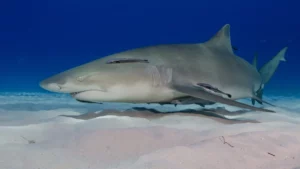 | 2.4–3 m (8–10 ft) | Low | Mangrove nurseries at Bimini; Tiger Beach sandThe most studied shark in the world thanks to the Bimini lab. Nine records, mostly at tagging and feeding sites. |
Tiger SharkGaleocerdo cuvier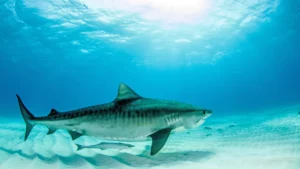 | 3–4.5 m (10–15 ft) | High | Tiger Beach, Grand Bahama; bank edges elsewhereBig females, many of them pregnant, winter on the Little Bahama Bank. Six records, including a 2017 snorkeller who lost a forearm at Athol Island. |
Great Hammerhead SharkSphyrna mokarran | 3.5–4.5 m (11–15 ft) | Moderate | South Bimini sand flats, December to AprilThe old page's 15–20 feet is fantasy; 4 m is a big one. Approaches divers closely at Bimini, has never bitten anyone in the Bahamian record. |
Bull SharkCarcharhinus leucas | 2.2–3.4 m (7–11 ft) | High | Cuts, creeks and marinas: Bimini, Abaco, Andros, Grand BahamaNamed in 19 incidents, more than any other species, and blamed for the 2022 Green Cay death. The shark that finds spearfishers. |
Blacktip SharkCarcharhinus limbatus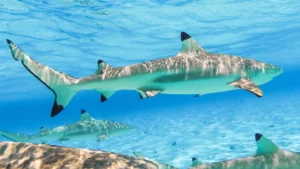 | 1.5–2.5 m (5–8 ft) | Moderate | Bank edges and baitfish schools, Abaco and Grand BahamaFast, nervous, hooked often by anglers. Four spearfishing bites in the record, none serious. |
Blacknose SharkCarcharhinus acronotus | 1.2–1.4 m (4–4.5 ft) | Low | Seagrass and sand on the banksSmall, common, dusky-snouted shark of the shallows. Not dangerous; rarely noticed by divers. |
Sandbar SharkCarcharhinus plumbeus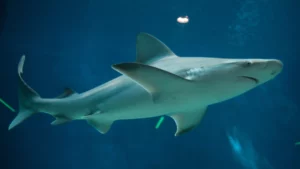 | 2–2.5 m (6.5–8 ft) | Low | Deeper sand and reef edges, Andros and the northern banksTall-finned, cautious. One 1967 record of a sandbar shark hitting a photographer's camera off Andros, no injury. |
Dusky SharkCarcharhinus obscurus | 3–3.6 m (10–12 ft) | Moderate | Offshore along the bank edges, passing throughA large, slow-growing migrant that is heavily depleted in the western Atlantic. Seen occasionally on the deep walls. |
Silky SharkCarcharhinus falciformis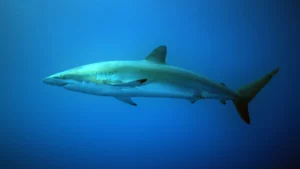 | 2–3 m (7–10 ft) | Moderate | Blue water over the Tongue of the Ocean and Exuma SoundFollows tuna and dive boats in from the deep. Bold with divers, rarely met by snorkellers. |
| Oceanic Whitetip SharkCarcharhinus longimanus | 2–3 m (7–10 ft) | High | Off Cat Island, April to June; open oceanOne of the largest known gatherings of this endangered shark. A 1966 record notes one buzzing a photographer in the Tongue of the Ocean. Guided blue-water dives only. |
Scalloped Hammerhead SharkSphyrna lewini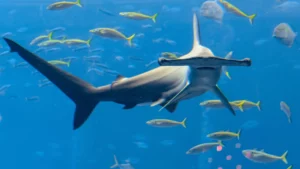 | 2.5–3.5 m (8–12 ft) | Low | Deep bank edges, less often than the great hammerheadSchooling species seen at depth off the walls. Critically endangered globally; protected here by the sanctuary. |
Shortfin Mako SharkIsurus oxyrinchus | 2.5–3.5 m (8–11 ft) | Low | Open Atlantic beyond the banksA blue-water sprinter that seldom crosses onto the banks. The 1981 bite on a snorkeller off Grand Bahama was confirmed by tooth fragments. |
Whale SharkRhincodon typus | 6–10 m (20–33 ft) | Low | Deep bank edges in spring; no reliable siteOccasional visitor, not a dependable encounter as the old page implied. Harmless filter feeder. |
Great White SharkCarcharodon carcharias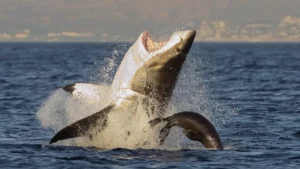 | 4–6 m (13–20 ft) | Low | Rare winter transient along the deep edges, December to MarchTracked by satellite tags passing the banks in winter. An old Andros record and a 2015 Elbow Cay bite attributed to a white or oceanic whitetip are the only entries. |
Bluntnose Sixgill SharkHexanchus griseus | 3.5–4.8 m (11–16 ft) | Low | Below 500 m in Exuma Sound and the Tongue of the OceanA deep-sea giant filmed and tagged from submersibles off the Exumas. Never seen by swimmers. |
Two species need a word. The great white shark does reach the Bahamas, but only as a rare winter traveller: satellite-tagged adults from the north-west Atlantic have been tracked along the deep edges of the banks between December and March, and the database holds an old Andros record and a 2015 bite at Elbow Cay attributed to either a white or an oceanic whitetip. Nobody goes to the Bahamas to see one, and no dive operator has a site for them. The bull shark, on the other hand, is far more important here than the old page suggested: it is the species named most often in the incident list, and the animal behind nearly every serious spearfishing injury in the Abacos and Grand Bahama.
Where to see sharks in the Bahamas
Most Bahamian shark encounters are organised: baited dives run by operators who have worked the same sites for decades, under sanctuary rules that ban spearfishing and shark fishing in the areas they use. These are the places that put the country on the map.
- Tiger Beach, West End, Grand BahamaA shallow sand bank on the edge of the Little Bahama Bank where tiger sharks, lemon sharks and Caribbean reef sharks gather at baited dives in six to ten metres of water. The most reliable tiger shark site in the world; large females peak from October to January.
- BiminiHome of the Bimini Shark Lab, which has tagged lemon sharks in the mangroves since 1990. In winter the deep sand off South Bimini draws great hammerheads to within touching distance of divers, with bull sharks and nurse sharks alongside.
- Cat Island (Columbus Point)The blue water off the south tip of Cat Island hosts one of the largest known gatherings of oceanic whitetip sharks, which follow the tuna and mahi-mahi in from the deep. Drift dives in open ocean between April and June, for experienced divers only.
- Compass Cay, ExumasA marina where nurse sharks lie in the shallows and swim between visitors' legs. The most family-friendly shark encounter in the country, and, because people feed and touch the sharks, also the source of a string of minor hand and leg injuries in the record.
- New Providence (Nassau) wallsThe classic Caribbean reef shark dives on the drop-offs south-west of Nassau, run since the 1980s. Shark Wall and the wrecks used as film sets bring in twenty or more reef sharks at a time, with the occasional silky from the Tongue of the Ocean.
- Andros and the Tongue of the OceanThe longest barrier reef in the Atlantic sits on the edge of a two-kilometre-deep trench. Caribbean reef sharks on the wall, nurse sharks in the blue holes, and bull sharks in the bights and creeks that cut through the island.
- Exuma Cays Land and Sea ParkA no-take reserve since 1986 and the oldest of its kind in the world, created in 1958. Nurse, lemon and Caribbean reef sharks are dense here, and the cays' sandy flats are where you see them from a kayak or a beach.
- Abaco and Walker's CayOnce famous for a feeding dive with a hundred sharks, now a quieter reef-and-flats destination. The Abacos are also spearfishing country, which is why so many of the bull shark bites in the record carry Abaco place names.
For a first visit, Nassau and Grand Bahama are the easiest: daily reef shark dives, Tiger Beach a boat ride from West End, and the largest choice of operators. Bimini is a winter trip for hammerheads; Cat Island is a spring one for oceanic whitetips; the Exumas are for anyone who wants sharks from a beach rather than a dive boat.
Best time of year to see sharks in the Bahamas
The Bahamas straddles the tropic line, so the sea has a real winter and the sharks move with it.
- December to April (winter and spring): the season for the big animals. Surface water drops to 23–25 °C, and the cooler months bring great hammerheads to Bimini (December to April) and the largest female tiger sharks to Tiger Beach (October to January). Visibility is at its best and the trade winds are steady; northers can blow out a few days each month.
- April to June: oceanic whitetips at Cat Island, warming water and calm seas. Lemon sharks pup in the Bimini mangroves in late spring.
- June to November (hurricane season): water at 28–30 °C, reef sharks and nurse sharks on every dive, tigers still present at Tiger Beach in smaller numbers. Storms can shut operations for days, and it is the peak season for spearfishing and therefore for spearfishing injuries.
- Whale sharks: occasional rather than seasonal. A few pass along the deep edges of the banks in spring and early summer; there is no dependable site, whatever the old page claimed.
Sharks are in Bahamian water every month. What changes is which of the headline species you can plan a trip around.
Shark attacks in the Bahamas: what the record actually shows
The Bahamas has more recorded incidents than any other Caribbean nation, and every one of them is listed and updated weekly on the shark attacks in Bahamas page. The database holds 145 entries stretching back to 1860. Six of them come from the 1800s, all shipwrecks and men overboard, five of them fatal, and they are not counted in the summary line below. That leaves 138 records dated 1916 or later, of which 10 were fatal. These are the six most recent (the full list is on the attacks page):
- 2026 · 3 nautical miles off North Bimini, BiminiSwimming with dolphins — Serious bite to right ankleSpecies not identified · not fatal
- 2026 · Nort statedSnorkeling — Bite to left shin defensive wound to handSpecies: Caribbean Reef Shark 1.5 - 2.1m · not fatal
- 2026 · Exhuma Cays, Staniel CaySwimming — Not statedSpecies not identified · not fatal
- 2026 · Fresh Creek, Andros IslandSwimming — Severe injuries to r armSpecies not identified · not fatal
- 2025 · North of Grand Bahama near Freeport, Atlantic Ocean near Big Grand CaySpearfishing — Severe injuries no detailSpecies: Undetermined · not fatal
- 2025 · Spanish Cay, Great Abaco IslandsSpearfishing — Lacerations to right armSpecies: 5ft (1.5m) Bull shark · not fatal
Three things jump out of the list. The first is spearfishing: fifty-one of the 138 modern cases, more than a third, involved someone carrying or holding speared fish, and most of those carry Abaco, Grand Bahama or Andros place names and a bull shark or Caribbean reef shark as the culprit. A shark going for a stringer of bleeding grouper and finding a thigh or a forearm instead is the archetypal Bahamian incident, and it is almost never fatal. The second is the feeding sites: nurse sharks at Compass Cay and lemon sharks at research and tagging stations account for a run of minor wrist, hand and leg wounds, several of them flagged in the record as provoked, including a 2021 stunt filmed for a television shark week. The third is a recent cluster of deaths. After decades with only a handful of fatalities (a hurricane-wrecked steamer in 1916, a child at Nassau in 1965, two men swimming from a wrecked boat in the Exumas in 1968, a spearfisher off Abaco in 1983 and a diver at a northern site in 2008), the database records five deaths between 2019 and 2023: a snorkeller at Rose Island in 2019, a snorkeller taken by a bull shark at Green Cay in 2022, and in 2023 a paddleboarder off a New Providence resort, a scuba diver at Tiger Beach and a man who jumped overboard near Athol Island, the last presumed rather than confirmed. Most of those sites are the crowded excursion waters within an hour of Nassau's cruise port, where boats, discarded bait and thousands of swimmers share the same shallows.
The seven most recent entries, from 2025 and 2026, follow the older pattern rather than the cluster: two spearfishers, four swimmers (including two people bitten by bull sharks at Bimini Bay on the same day in February 2025, one of them badly) and a snorkeller bitten on the shin by a Caribbean reef shark. None was fatal. The standard advice maps neatly onto the record: get speared fish out of the water fast or tow them on a float, do not swim near boats that are cleaning fish or dumping bait, treat every feeding site as a place where sharks expect food, and stay out of murky channels and cuts at dusk.
Is it safe to swim and snorkel with sharks in the Bahamas?
Around the reefs, yes, and the sanctuary has made the sharks easier to read rather than harder. Caribbean reef sharks are curious and will make a close pass at a snorkeller, then circle wide; they become a problem only when there is food in the water, which is why the baited dives are run by divers kneeling in a line with a feeder in chain mail, not by swimmers on the surface. Nurse sharks are docile until someone grabs a tail or pushes a hand toward the mouth, and the Compass Cay record is a catalogue of exactly that. Lemon sharks are placid but will react to being cornered in shallow water.
The two species that ask for judgement are the bull shark and the tiger shark. Bull sharks work the cuts, marinas and creeks of the Abacos, Bimini and Andros, and they are the sharks most likely to take an interest in a swimmer in low visibility or near fishing activity. Tigers are met on purpose, at Tiger Beach, with an operator who has worked the site for years; treat the briefing as law and keep your hands and camera close to your body. Oceanic whitetips at Cat Island are for experienced divers in blue water with a guide, never for snorkellers off a boat. Whale sharks, on the rare occasions one appears, are harmless.
The everyday rule for the Bahamas is about fish rather than sharks: the moment a speared fish, a cleaning table or a bucket of chum enters the picture, every shark nearby changes its behaviour, and so should you.
Shark conservation in the Bahamas
The Bahamas is the model other countries copy. The 1993 longline ban, the 2011 sanctuary covering the whole exclusive economic zone and the Exuma Cays Land and Sea Park, a no-take reserve since 1986, together mean that no shark in Bahamian water has been legally fished for commercial sale in more than a decade. Tagging studies from Bimini, Eleuthera and Grand Bahama show lemon sharks returning to the same mangrove nurseries they were born in, tiger sharks commuting between Tiger Beach and the open Atlantic, and great hammerheads spending the winter on the same Bimini sand year after year. Reef shark densities on the Bahamian walls are among the highest measured anywhere in the Caribbean.
The remaining threats come from outside and from success. Foreign fishing vessels poach along the edges of the banks; coastal development chews at the mangrove creeks that lemon and nurse sharks need as nurseries; and the shark-diving industry that pays for protection also concentrates animals at feeding sites, with the injuries to people and the propeller scars on sharks that the record shows. The sanctuary protects sharks from Bahamian fishermen, but a tiger shark that swims north to the United States or east into the open Atlantic is protected only by whatever rules apply there. If you visit, dive with operators who follow the sanctuary code, keep your hands off the nurse sharks at Compass Cay, and never buy shark jaws or teeth sold as souvenirs. Our explainer on why sharks are endangered sets out why a slow-breeding species needs this kind of protection to last.
Sharks in neighbouring waters
The Bahamas shares its sharks with the whole western Atlantic. Cuba, just across the Old Bahama Channel, has the same reef and bull sharks on far less visited reefs. Jamaica, Haiti and the Dominican Republic lie to the south across the Windward Passage, and the Cayman Islands offer the Caribbean reef shark on deep walls in the western Caribbean. North-east across the Sargasso Sea, Bermuda catches the same tiger sharks on their Atlantic migrations, while Florida, covered in our guide to sharks in the United States, is only 80 kilometres west of Bimini. For the rest of the region and beyond, start at our sharks around the world hub.
Frequently asked questions
Are there sharks in the Bahamas?
Yes, in every part of the archipelago. Seventeen species have solid records. Caribbean reef sharks patrol the walls, nurse and lemon sharks live on the flats and around the marinas, tiger sharks gather on the banks off Grand Bahama, great hammerheads winter at Bimini and oceanic whitetips arrive off Cat Island each spring.
Have there been shark attacks in the Bahamas?
Yes. SharkSider's database lists 145 incidents since 1860, 15 of them fatal; 138 date from 1916 onward with 10 deaths. Spearfishers carrying fish account for more than a third of the cases, bull sharks are the species most often identified, and five deaths occurred between 2019 and 2023 around Nassau and Grand Bahama.
Is it safe to swim in the Bahamas?
On the beaches, yes; the record is dominated by spearfishing and feeding sites rather than swimmers. Keep clear of boats cleaning fish or dumping bait, avoid the murky cuts and marinas at dusk, do not touch the nurse sharks at Compass Cay, and treat any site where sharks are fed as a place where they expect food.
Are there great white sharks in the Bahamas?
Only as rare winter visitors. Satellite-tagged great whites from the north-west Atlantic have been tracked along the deep edges of the Bahama Banks between December and March, and the database has an old Andros record and a 2015 Elbow Cay bite attributed to a white or oceanic whitetip. There is no site where they can be seen.
Where can you swim with nurse sharks in the Bahamas?
Compass Cay in the Exuma Cays, where nurse sharks gather in the marina shallows and swim around visitors' legs. They are docile, but the database records a string of minor hand, wrist and leg bites there, almost all from people feeding, grabbing or standing on the sharks. Look, do not touch.
Where is Tiger Beach and when is the best time to go?
Tiger Beach is a shallow sand bank off West End, Grand Bahama, where operators run baited dives with tiger, lemon and Caribbean reef sharks in six to ten metres of water. Tigers are present most of the year, with the largest females and the most animals from October to January.
Do whale sharks live in the Bahamas?
Not as residents. Whale sharks pass along the deep edges of the banks occasionally in spring and early summer, but there is no reliable aggregation and no operator sells whale shark trips. For dependable encounters the nearest options are Mexico's Yucatan and Honduras, not the Bahamas.
Can you go shark diving in the Bahamas?
Yes; it is the country's signature activity. Baited reef shark dives run daily from Nassau and Grand Bahama, Tiger Beach offers tigers and lemons, Bimini has great hammerheads in winter and Cat Island has oceanic whitetips in spring. There are no cages; divers kneel on the sand while a feeder handles the bait.
Is shark fishing legal in the Bahamas?
No. The Bahamas banned commercial longlining in 1993 and declared its entire exclusive economic zone a shark sanctuary in July 2011, prohibiting commercial shark fishing and the sale or export of shark products. Sharks caught by anglers must be released.
What kind of shark is most dangerous in the Bahamas?
The bull shark. It is identified in 19 incidents, more than any other species, including the 2022 death of a snorkeller at Green Cay, and it is the shark most often involved in serious spearfishing bites in the Abacos and Grand Bahama. Tiger and oceanic whitetip sharks are met deliberately on guided dives.
References

A small team focused on researching sharks and making marine biology easy to understand. Every page is reviewed against current species records and the SharkSider attack database, and updated when new incidents or research appear.
Published December 10, 2022 · Last updated September 28, 2026 · Incident data from the SharkSider attack database (139 records for Bahamas, 10 fatal).


