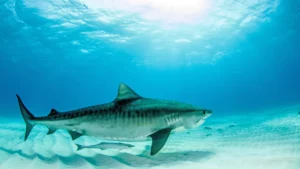
The grey sharpnose shark (Rhizoprionodon oligolinx) is a small requiem shark of the Indo-West Pacific that grows to about 70 cm (28 in) and lives in shallow coastal water from the Gulf of Oman to Indonesia and southern China. It is plain bronze-grey above and pale below, with a long pointed snout, large eyes and no ridge between the dorsal fins.
It hunts small bony fish, prawns and squid on the bottom, and females carry 3 to 5 pups on a placental cord for about a year. It is far too small to threaten a swimmer and has never bitten anyone. Because gillnet fleets across southern Asia land it in enormous numbers, the IUCN lists it as Near Threatened.
- Maximum lengthAbout 70 cm (28 in); most adults 50–60 cm
- WeightNo published maximum; adults weigh only a few kilograms
- LifespanNot measured; close relatives reach 7–12 years
- Depth rangeSurface to about 36 m (120 ft)
- DietSmall bony fish, prawns, shrimps and squid
- IUCN statusNear Threatened
- Kingdom
- Animalia
- Phylum
- Chordata
- Class
- Chondrichthyes
- Order
- Carcharhiniformes
- Family
- Carcharhinidae
- Genus
- Rhizoprionodon
- Species
- Rhizoprionodon oligolinx
- Family (common)
- Requiem sharks
- Also known as
- Gray sharpnose shark
On this page
- How to recognise a grey sharpnose shark
- How big does a grey sharpnose shark get?
- Where grey sharpnose sharks live
- What grey sharpnose sharks eat
- Behaviour and daily life
- Reproduction and lifespan
- Are grey sharpnose sharks dangerous?
- Conservation status
- Similar species and close relatives
- Frequently asked questions
- References
How to recognise a grey sharpnose shark
Picture a miniature requiem shark with a nose drawn out into a point, and you have the genus Rhizoprionodon. The body is slim and round in cross-section, the snout is long and narrowly parabolic, and the eyes are unusually large for a shark of this family, each with a working nictitating eyelid. The back of the mouth carries short labial furrows at the corners, and the teeth are the same in both jaws: single oblique cusps with smooth or faintly serrated edges, built to grip rather than to saw.
The fin arrangement is the most useful field mark. There is no ridge of skin between the two dorsal fins, and the second dorsal is small and set well back, its origin roughly over the middle of the anal fin base. That small, rearward second dorsal separates the sharpnose sharks at a glance from juvenile blacktip reef sharks and other young Carcharhinus that share the same shallow bays.
Colour gives nothing away: bronze to grey above, dull white below, with dusky rims on the pectoral and dorsal fins and no spots, bars or white tips. Telling it apart from the milk shark, which lives alongside it in almost every market in the region, needs a count rather than a glance, and the story of that count is in the section on relatives below.
How big does a grey sharpnose shark get?
Few sharks anywhere are smaller. The largest reliably recorded individuals are about 70 cm (28 in) in total length, and most adults landed by inshore fleets measure 50 to 60 cm. A grown grey sharpnose therefore fits comfortably along a forearm, and a fish market crate will hold a dozen of them.
Pups are born at roughly 21 to 26 cm, already perfect copies of the adult, and they grow quickly in their first year in warm, food-rich estuaries. Males mature at around 33 to 36 cm and females a little later, at about 35 to 38 cm, which means this species is breeding at half its maximum length. Early maturity is the one biological advantage it has against heavy fishing pressure, and it is why the grey sharpnose has held on in seas where larger sharks have vanished.
Weight is rarely published for the species, because it is landed and sold by the basket rather than weighed by the fish. A 60 cm individual is a slender animal of a couple of kilograms at most. There is no evidence of the exaggerated maximum lengths sometimes quoted for it; nothing approaching a metre has been verified. The graphic below puts that verified 70 cm beside a 1.8 m diver.
Where grey sharpnose sharks live
The species belongs to the warm continental shelves of the Indo-West Pacific, roughly between 30°N and 18°S. Its core range runs from the Gulf of Oman and the eastern Persian Gulf along the coasts of Iran, Oman and Pakistan, around the Indian subcontinent, through the Bay of Bengal and the Andaman Sea to Malaysia, Indonesia, Vietnam and southern China. Records from the Gulf of Carpentaria in northern Australia and from Palau mark the ragged eastern edge of the range, and several of them need confirmation because of the confusion with related species.
Within that band it is a creature of shallow, turbid, productive water: sandy and muddy bottoms, the mouths of estuaries, tidal creeks and the shoals off river deltas. The depth records run from the surf zone down to about 36 m, and the great majority of catches come from well inside 30 m. It does not descend the continental slope and it is not an oceanic wanderer.
It is one of the most frequently landed sharks in the region for exactly that reason: it lives where the small-boat gillnet fleets of India, Bangladesh and Singapore work every day of the year. The map below shows the shelf waters where it is regularly recorded.

- Bahrainlisted
- Cambodialisted
- Hong Konglisted
- Indialisted
- Iranlisted
- Malaysialisted
- Omanlisted
- Pakistanlisted
- Qatarlisted
- Singaporelisted
10 countries list the grey sharpnose shark in their species guide; the count is the number of incidents attributed to it there in the SharkSider database. Browse every guide on sharks around the world and sharks in the US.
What grey sharpnose sharks eat
Stomach contents from Indian and Pakistani landings give a consistent picture: small bony fish first, then crustaceans, then cephalopods. Anchovies, sardines, silverbellies, croakers, gobies and the young of larger food fishes make up the bulk. Penaeid prawns and other shrimps are eaten in quantity, especially in estuarine water, and small squid and cuttlefish appear regularly in the samples.
Everything about the animal is built for that menu. The narrow oblique teeth in both jaws form an interlocking cage that holds a slippery fish or a shrimp rather than cutting it, and the shark then swallows the prey whole. There is no head shaking, no sawing and no cooperative hunting of the sort seen in larger requiem sharks; a grey sharpnose is a solitary forager working the bottom metre of a murky bay.
Its senses are tuned to that world. Visibility in the water it lives in can be less than a metre, so the electroreceptive ampullae of Lorenzini across the long snout and the lateral line along the flank do most of the work, picking up the muscle twitches of a buried shrimp. The large eyes are useful at dawn and dusk, when much of the feeding appears to happen. Like all requiem sharks it replaces its teeth continuously, which matters for an animal whose food is armoured in shell.
Behaviour and daily life
Very little of this shark's behaviour has been watched directly. It has never been a target for divers, it does not survive well in aquaria, and almost every specimen science has examined arrived dead in a net. What can be reconstructed comes from catch data, and catch data describe patterns rather than individuals.
Those patterns suggest a shark that moves inshore and offshore with the seasons rather than migrating along a coast. In the northern Indian Ocean, catches shift with the monsoon: fish concentrate in the shallows and creeks when river outflow is high and the water is rich, and spread onto the open shelf when it drops. Gillnetters frequently take several individuals in one set, so the species is at least loosely aggregated, and catches are often sorted by size and sex, which hints at the same kind of segregation seen in better-studied sharpnose sharks.
Activity seems to peak at night and in the low light of dawn and dusk, when its prey species are least able to see a predator coming. As a small requiem shark it must keep swimming to push water across the gills, so it has no resting period on the bottom in the way that a bamboo shark or a wobbegong does. It is, in short, a fast-living, short-lived, constantly moving little fish, and it behaves like one.
Reproduction and lifespan
The grey sharpnose is viviparous in the full mammalian sense: after the yolk supply is used up, the empty yolk sac fuses with the wall of the uterus to form a placental connection through which the mother feeds each embryo for the rest of the pregnancy. Requiem sharks are the group in which this arrangement is most developed, and it is one of the reasons their pups are born so well formed.
Litters are small. Three to five pups is the usual count, occasionally six, and each is around 21 to 26 cm at birth. Gestation is estimated at close to twelve months, so a mature female produces at most one litter a year and, in some populations, appears to breed on a slightly longer cycle. Pupping is concentrated in shallow inshore water, and the smallest free-swimming individuals turn up in estuaries and creek mouths, which serve as nurseries in the same way as they do for the Atlantic sharpnose shark on the other side of the world.
No ageing study has been published for this species, so any figure given for its lifespan is borrowed. Vertebral ageing of the better-known sharpnose sharks gives maximum ages of roughly seven to twelve years with maturity in the second year, and there is no reason to expect anything very different here. Compared with the decades reported for larger species on our how long sharks live page, this is a sprinter's life history.
Are grey sharpnose sharks dangerous?
No. A fully grown grey sharpnose is shorter than a human forearm and its jaws are built around prawns and anchovies. It has no recorded incident of any kind, provoked or unprovoked, and none is plausible: the worst a handler can expect is a scratch from a thrashing fish being taken out of a net. Our database returns nothing for the species, as the note below confirms, and the International Shark Attack File has never attributed a case to it either.
The interaction runs entirely the other way. This is one of the most heavily caught sharks in the northern Indian Ocean, and for many coastal families in the region it is food rather than a threat: the meat is eaten fresh, dried or salted across South and Southeast Asia, and the fins go into the trade even though they are tiny. Anyone snorkelling over a shallow Indian or Malaysian sandflat has far more to fear from the sun and the boat traffic than from a shark of this kind, and if you want the general rules for the few species that do matter, they are on our shark encounter guide and in the list of the least dangerous sharks.
The SharkSider database has no incident attributed to this species. The database draws on the International Shark Attack File, the Global Shark Attack File and verified local reports, and is updated weekly.
Conservation status
The IUCN Red List assesses the grey sharpnose shark as Near Threatened. That may look mild for a species landed in the millions, and it reflects a genuine tension in the data: the fishing pressure across its range is among the most intense anywhere in the world, but the shark matures at around a third of a metre and can produce a litter every year, so its populations rebuild faster than those of any large coastal shark.
The pressure itself is not in doubt. Inshore gillnet, trawl and hook fleets from the Persian Gulf to the Java Sea take this shark as both target and bycatch, and in many landing sites it is among the commonest sharks on the quay. It is rarely reported to species level in national statistics, which are usually filed as "small sharks", so the true catch is unknown and almost certainly larger than the recorded one. Habitat matters too: the mangrove creeks and estuaries where its pups grow up are being cleared, dredged and polluted along much of the Asian coast.
Since November 2023 the whole family Carcharhinidae has been listed on Appendix II of CITES, so international trade in the fins and meat of this species now requires permits and a finding that the trade is sustainable. Enforcing that on a shark this small and this common is the real challenge, and it is a good example of the wider problem set out on our page about why sharks are endangered.
Similar species and close relatives
The grey sharpnose belongs to a genus of seven small, plain, pointy-nosed requiem sharks spread across the warm seas of the world. Its Indo-Pacific neighbour is the Australian sharpnose shark, while the Atlantic holds the Atlantic sharpnose, the Caribbean sharpnose and the Brazilian sharpnose, and the eastern Pacific the Pacific sharpnose. All of them look so alike that identification usually depends on where the fish was caught.
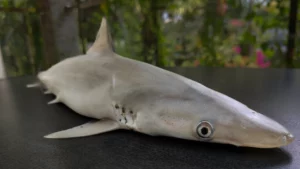
The one that causes real trouble is the milk shark, Rhizoprionodon acutus, which shares almost the whole range. The two are separated on vertebral counts, the grey sharpnose having markedly fewer, and on a slightly shorter snout and different proportions of the labial furrows. In practice this means that regional landing statistics mix the two freely, and some older distribution records for either species are unreliable.
Beyond the genus, small Carcharhinus in the same bays are the usual source of confusion. Young blacktip reef sharks and other small requiem sharks overlap in size but carry an interdorsal ridge or obvious fin markings, and both have a much larger second dorsal set further forward. If you want to see how these small requiem sharks sit within the wider group, start from our overview of the types of sharks.
- Australian Sharpnose Sharkspecies profile
 Atlantic Sharpnose Sharkspecies profile
- Caribbean Sharpnose Sharkspecies profile
- Brazilian Sharpnose Sharkspecies profile
- Pacific Sharpnose Sharkspecies profile
 Milk Sharkspecies profile
Frequently asked questions
How big do grey sharpnose sharks get?
They reach about 70 cm (28 inches) in total length, and most adults caught by inshore fisheries are 50 to 60 cm. Pups are born at roughly 21 to 26 cm. This makes the grey sharpnose one of the smallest members of the requiem shark family, and a fully grown adult is no longer than a human forearm.
Where do grey sharpnose sharks live?
In shallow coastal water of the Indo-West Pacific, from the Gulf of Oman and the eastern Persian Gulf around India and the Bay of Bengal to Thailand, Malaysia, Indonesia, Vietnam and southern China. There are also records from the Gulf of Carpentaria and Palau. They stay on the continental shelf, usually inside 30 metres of water.
What do grey sharpnose sharks eat?
Mostly small bony fish such as anchovies, sardines, silverbellies and gobies, together with prawns and other shrimps and small squid and cuttlefish. Their narrow, oblique teeth are shaped for gripping slippery prey whole rather than cutting it, and they forage alone near the bottom of turbid bays and estuaries.
Are grey sharpnose sharks dangerous to humans?
No. The species has never been implicated in a bite anywhere in the world, and at 70 cm long with jaws built for shrimp it poses no realistic risk to a swimmer or a diver. The only injuries associated with it are minor cuts to fishermen handling live animals as they are removed from gillnets.
How do grey sharpnose sharks reproduce?
They are placental viviparous, like most requiem sharks. The embryo uses its yolk first, then the empty yolk sac attaches to the uterine wall and the mother nourishes it directly. Litters are small, usually three to five pups, gestation lasts close to a year, and the pups are born at 21 to 26 cm in shallow inshore nurseries.
How long do grey sharpnose sharks live?
No ageing study has been published for this species, so there is no reliable measured figure. Better-studied sharpnose sharks in the same genus live seven to twelve years and mature in their second year, and the grey sharpnose is expected to be similar. It is a fast-growing, short-lived shark rather than a slow one.
Is the grey sharpnose shark endangered?
It is listed as Near Threatened by the IUCN. Fishing pressure across its range is extreme, but early maturity and an annual litter let its populations replace themselves faster than those of large coastal sharks. Since November 2023 the whole requiem shark family has been on CITES Appendix II, so its fins and meat need trade permits.
What is the difference between a grey sharpnose shark and a milk shark?
They look almost identical and share most of their range. The reliable difference is internal: the grey sharpnose has markedly fewer vertebrae. It also has a slightly shorter snout and different labial furrow proportions. Because the two are sold together in Asian markets, catch statistics for both species are mixed and often unreliable.
Can you eat grey sharpnose shark?
Yes, and across South and Southeast Asia it is an everyday food fish, sold fresh or dried and salted. It is small, so it carries far less accumulated mercury than large predatory sharks. Its tiny fins still enter the fin trade, and since 2023 international trade in the species requires CITES documentation.
How deep do grey sharpnose sharks go?
They are shelf animals. Records run from the surf zone down to about 36 metres, and the great majority of catches come from inside 30 metres. They do not descend the continental slope and are not found in open ocean, which is why they meet inshore gillnet and trawl fleets so constantly.
References

A small team focused on researching sharks and making marine biology easy to understand. Every page is reviewed against current species records and the SharkSider attack database, and updated when new incidents or research appear.
Published October 18, 2022 · Last updated September 22, 2026 · No incident attributed to this species in the SharkSider attack database, which is updated weekly.