The Australian sharpnose shark (Rhizoprionodon taylori) is a small requiem shark of the northern Australian and southern Papuan shelf that grows to about 69 cm (2.3 ft) and lives from the surface to roughly 110 m. It is bronze above and white below, with a long pointed snout, big eyes and dark-edged dorsal and tail fins.
It eats small fishes, prawns and squid in turbid coastal water. Females bear one to ten pups through a placenta after an eleven to twelve month cycle, most of it spent in suspended development. Maturity comes at about a year and the maximum age is seven. The IUCN lists it as Least Concern, and it is too small to threaten anyone.
- Maximum length69 cm (2.3 ft); adults usually 45–60 cm
- WeightUnder 2 kg (4.4 lb); no published maximum
- Lifespan7 years, the shortest known for any shark
- Depth rangeSurface to about 110 m (360 ft)
- DietSmall bony fishes, prawns, squid
- IUCN statusLeast Concern (assessed 2018)
- Kingdom
- Animalia
- Phylum
- Chordata
- Class
- Chondrichthyes
- Order
- Carcharhiniformes
- Family
- Carcharhinidae
- Genus
- Rhizoprionodon
- Species
- Rhizoprionodon taylori
- Family (common)
- Requiem sharks
- Also known as
- Taylor's sharpnose shark
On this page
- How to recognise an Australian sharpnose shark
- How big do Australian sharpnose sharks get?
- Where Australian sharpnose sharks live
- What Australian sharpnose sharks eat
- Behaviour and living fast
- Reproduction, diapause and lifespan
- Is the Australian sharpnose shark dangerous to people?
- Conservation status
- Similar species and close relatives
- Frequently asked questions
- References
How to recognise an Australian sharpnose shark
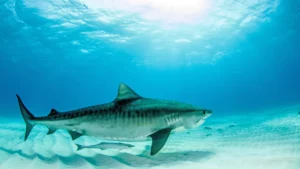
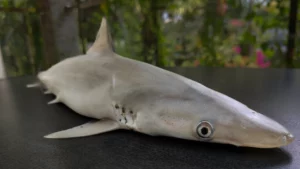
Size does most of the work. Anything under 70 cm with the classic requiem shark outline, a slim body, a long snout and a tall first dorsal fin, caught in shallow water off northern Australia, is likely to be this species or one of two or three companions. The snout is the genus character: long, narrow and bluntly pointed, noticeably more than a third of the head, with long grooves at the corners of the mouth, the labial furrows, running forward along both lips.
The colour scheme is quiet. Bronze to grey-brown on the back, chalk white underneath, with the countershading meeting along a soft line rather than a sharp one. The tips and trailing edges of the first dorsal and the caudal fin are dusky to dark, while the pectoral, pelvic and second dorsal fins are pale-edged rather than dark-tipped, which is the opposite of the pattern in the black-finned Carcharhinus sharks of the same coast. There are no spots and no flank stripe.
Fin placement separates it from its relatives. The second dorsal is small and starts over or behind the middle of the anal fin base, and there is no ridge of skin between the dorsal fins. The teeth are small, oblique triangles with finely serrated edges, alike in both jaws, and there are around 24 to 26 rows in each. Eyes are large for the head, an adaptation to the murky inshore water this shark works in.
How big do Australian sharpnose sharks get?
This is one of the smallest requiem sharks. The largest measured specimen was 69 cm (2.3 ft) in total length, and ordinary adults run between about 45 and 60 cm, which is to say a well-grown individual would fit comfortably in a kitchen sink. Females average slightly larger than males, as in almost every shark.
Pups are born at about 25 cm, more than a third of adult length, and then grow with genuine speed. Both sexes are mature at roughly a year old and about 42 to 47 cm, which is among the fastest maturation rates measured in any shark; most species take five years or more, and large coastal sharks take a decade. Growth slows sharply after maturity, so the difference between a two-year-old and a six-year-old is a matter of centimetres.
No published weight series exists. A 60 cm shark of this build weighs under two kilograms, and quoting a precise maximum would be inventing one. Scale matters for understanding the animal: at this size an Australian sharpnose is prey for almost everything larger on the same ground, from Australian blacktip sharks to large groupers, and its entire life strategy is built around that fact. The bar below sets the 69 cm maximum against a 1.8 m diver.
Where Australian sharpnose sharks live
The range is small and tidy. The species occupies the tropical continental shelf of northern Australia, from the Pilbara coast of Western Australia across the Northern Territory and the Gulf of Carpentaria to Queensland and the northern edge of New South Wales, and extends north across Torres Strait into the coastal waters of southern Papua New Guinea. Published limits run from about 8°S to 28°S; accounts that place the northern limit at 8°N are misprints, since the shark has never been recorded in the northern hemisphere.
Habitat is shallow, warm and turbid. These sharks live over soft bottoms in bays, gulfs and open coastal water, from the surf zone out across the inner shelf, and are commonest in the top few tens of metres. Verified records extend to about 110 m, and they are only occasionally taken deeper. Water temperatures across that range sit between roughly 24 and 30 °C year-round.
Within that habitat they are genuinely abundant. The Australian sharpnose is one of the most frequently caught sharks in northern Australian inshore gillnet and prawn trawl operations, and surveys of the Gulf of Carpentaria routinely record it in large numbers. Being common and being safe are different things for a shark, but in this case they happen to coincide, for reasons that come down to how fast the species breeds.

What Australian sharpnose sharks eat
Small prey, taken close to the bottom. Stomach contents are dominated by small bony fishes, with prawns and other crustaceans an important second component and squid appearing regularly. The prawns matter: this shark shares its habitat with Australia's northern prawn grounds, and it feeds on the same animals the trawlers are after, which is why it turns up so often in their nets.
The teeth suit that menu exactly. Small serrated triangles set in both jaws form a fine cutting edge that will shear through a prawn's shell or a sardine's body without needing the heavy crushing plates of a bottom-feeding bullhead shark or the saw teeth of a large predator. Nothing here is built for prey bigger than the shark's own head.
Hunting is done in water where you often cannot see your hand. Turbid tropical bays rule out vision as a primary sense, so the animal works on smell, on the lateral line, and above all on the electroreceptive ampullae of Lorenzini clustered across the long snout, which pick up the muscle and heart activity of a buried prawn or a flatfish at close range. The unusually large eye suggests vision still contributes in the clearer water offshore and at dusk, when feeding activity appears to peak.
Behaviour and living fast
Everything about this shark makes sense once you accept that it is a small animal in a dangerous neighbourhood. It is an inshore species surrounded by predators several times its size, it has no defensive armament worth mentioning, and it compensates by growing quickly, breeding early and often, and dying young. Ecologists call this a fast life history, and among sharks, which are famous for the opposite, the Australian sharpnose is close to the extreme end.
Practically, that means loose aggregations rather than tight schools, sorted roughly by size and sex, moving with the tide across shallow bottoms. Individuals do not appear to travel far; the species occupies the same coastal band all year, with some movement into shallower water in the warm months when pups are born. There is no long-distance migration on record.
Senses and swimming are unremarkable for a requiem shark, which in this family means quite good: a strong sense of smell that works over tens to hundreds of metres down-current rather than the miles of popular myth, nictitating eyelids that close over the eye during a bite, and a cruising gait that costs little energy. What is remarkable is the turnover. A population of these sharks replaces itself in a handful of years, so a fishery can remove a great many of them and still find plenty the following season, which is the key to the conservation picture and an instructive contrast with the slow-breeding species discussed under how long sharks live.
Reproduction, diapause and lifespan
The Australian sharpnose is viviparous with a yolk-sac placenta: once the embryo has used its yolk, the spent sac attaches to the uterine wall and the mother supplies it directly until birth. Litters run from one to ten pups, with four or five typical, and the newborns measure about 25 cm.
The pregnancy itself is the strangest thing about the species. The whole cycle takes eleven to twelve months, which sounds ordinary, but most of it is spent doing nothing: after fertilisation the embryos enter a period of arrested development, an embryonic diapause, lasting roughly seven and a half months, and only then does active growth begin and run for the remaining four or five. The effect is to fix the timing of birth in the warm season without forcing the female to carry rapidly growing young for a whole year. Diapause of this kind is well known in seals and some deer but rare and poorly understood in sharks.
Maturity at about one year and reproduction every year thereafter give this shark a productivity almost no other elasmobranch matches. The price is a short life: the maximum reported age is seven years, the lowest figure recorded for any shark species, with most individuals dying well before that. There are no nursery grounds in the strict sense, because the entire range is shallow coastal water and a 25 cm pup is already living where its parents live. For the contrast with a species at the other extreme, see the blacktip reef shark and the requiem family overview at requiem sharks.
Is the Australian sharpnose shark dangerous to people?
It cannot be. A fully grown Australian sharpnose is 60 centimetres long with a mouth a few centimetres across and teeth built for prawns. The SharkSider database holds no incident attributed to the species, and there is no plausible mechanism by which one could occur beyond a nipped finger during handling.
The species does share its water with people, which makes the absence of records meaningful rather than merely a consequence of remoteness. Northern Australian beaches, estuaries and prawn grounds are worked and swum in by plenty of people, and this small shark is among the most abundant animals there. It simply has no interest in anything that size. Where the same coastline does produce serious incidents, the sharks involved are bull sharks in the rivers and larger whalers offshore, and the record is set out on the Australian shark attack page. Handling a live one from a net calls for care only on the shark's behalf.
The SharkSider database has no incident attributed to this species. The database draws on the International Shark Attack File, the Global Shark Attack File and verified local reports, and is updated weekly.
Conservation status
The IUCN Red List assessed Rhizoprionodon taylori in 2018 as Least Concern, and unusually for a heavily caught shark the assessment records a stable population. Very large numbers are taken as bycatch in the northern Australian inshore gillnet fisheries and in the Northern Prawn Fishery, and are mostly discarded because the animal is too small to be worth landing.
What protects it is arithmetic. A species that matures at one year, breeds annually and produces up to ten pups can rebuild a depleted population within a few years, and modelling of northern Australian shark stocks consistently finds this one among the most resilient. That resilience is not unlimited, and it depends on the coastal habitats it uses remaining intact; mangrove clearance, port development and declining water quality in Queensland bays are the pressures most likely to matter in the long run.
Since November 2023 the species has also carried an international listing: the whole requiem shark family was added to Appendix II of CITES at that point, so trade in the fins or meat of any Rhizoprionodon now requires permits. For a shark that is almost never traded the practical effect is small, but it closes a loophole, since small requiem shark fins are difficult to tell apart once dried. The wider argument sits under why sharks are endangered, and the species' role as prey is part of what eats sharks.
Similar species and close relatives
The genus Rhizoprionodon contains seven small sharpnose sharks spread through the world's warm shelves, and they are separated mainly by geography and by fin proportions. The nearest neighbour here is the milk shark (R. acutus), which shares the northern Australian coast, grows to about 1.1 m and has an even longer snout; anything over 70 cm on that coast with this outline is a milk shark rather than this species.
The Atlantic members of the genus show how little the body plan has changed: the Atlantic sharpnose shark of the United States seaboard, the Caribbean sharpnose shark and the Brazilian sharpnose shark are all small, bronze, long-snouted animals of coastal shallows. The Pacific sharpnose shark does the same job on the American west coast, and the grey sharpnose shark in the Indian Ocean.
On its own grounds the confusion is with juveniles of larger species rather than with adults. A half-grown Australian blacktip or creek whaler is the same length as an adult sharpnose but has a shorter snout and a deeper body, and the blackspot shark, another small inshore Carcharhinus, carries a conspicuous dark blotch on the second dorsal fin that this species never has. A broader tour of the small coastal sharks begins at types of sharks.
 Milk Sharkspecies profile
 Atlantic Sharpnose Sharkspecies profile
- Caribbean Sharpnose Sharkspecies profile
- Brazilian Sharpnose Sharkspecies profile
- Pacific Sharpnose Sharkspecies profile
- Grey Sharpnose Sharkspecies profile
Frequently asked questions
How big does an Australian sharpnose shark get?
The largest recorded specimen was 69 centimetres, about 2.3 feet, in total length. Most adults measure 45 to 60 centimetres and weigh under two kilograms, with females slightly larger than males. Pups are born at around 25 centimetres and reach maturity at 42 to 47 centimetres when they are roughly one year old.
Where do Australian sharpnose sharks live?
On the tropical inshore shelf of northern Australia, from Western Australia across the Northern Territory and the Gulf of Carpentaria to Queensland and northern New South Wales, plus the coastal waters of southern Papua New Guinea. They live in shallow turbid water from the surf zone down to about 110 metres.
How long do Australian sharpnose sharks live?
Seven years at most, which is the shortest maximum age recorded for any shark. Most individuals die earlier. The species compensates with extraordinary speed at the other end of life: maturity at about twelve months and a litter every year afterwards, a pattern ecologists call a fast life history.
What do Australian sharpnose sharks eat?
Small bony fishes make up most of the diet, with prawns and other crustaceans an important second component and squid appearing regularly. They feed near the bottom in murky coastal water, locating prey mainly by smell and by the electroreceptive pores on the snout rather than by sight.
Are Australian sharpnose sharks dangerous to humans?
No. A full-grown adult is about 60 centimetres long with a mouth a few centimetres wide and teeth suited to prawns. No incident has ever been attributed to the species, despite it being one of the most abundant sharks on beaches and prawn grounds where people work and swim every day.
What is embryonic diapause in this shark?
It is a pause in development. After fertilisation the embryos of this species stop growing for roughly seven and a half months before resuming and completing development in the final four or five, within an overall cycle of eleven to twelve months. The effect is to fix birth in the warm season. Diapause is common in mammals but rare in sharks.
How many pups does an Australian sharpnose shark have?
One to ten, with four or five typical, born at about 25 centimetres. The young are nourished through a yolk-sac placenta after their yolk supply is used up, so they are born fully formed. Females breed every year, which is unusually frequent for a shark of any size.
Is the Australian sharpnose shark endangered?
No. The IUCN assessed it as Least Concern in 2018 with a stable population, despite very heavy bycatch in northern Australian gillnet and prawn trawl fisheries. Its fast breeding rate lets the population rebuild quickly. Since November 2023 it has been listed on CITES Appendix II with all other requiem sharks.
How do you tell it apart from a milk shark?
Mainly by size. Both are small bronze sharpnose sharks sharing the northern Australian coast, but the milk shark grows to about 1.1 metres against 69 centimetres, and has a proportionally longer snout. On that coastline, an adult-looking sharpnose shark over 70 centimetres is a milk shark.
Why is it called a sharpnose shark?
Because of the long, narrow, bluntly pointed snout that gives the whole genus its English name, taking up well over a third of the head. The scientific name Rhizoprionodon refers to the root-like saw teeth, and taylori honours Taylor, after whom the species is also called Taylor's sharpnose shark.
References

A small team focused on researching sharks and making marine biology easy to understand. Every page is reviewed against current species records and the SharkSider attack database, and updated when new incidents or research appear.
Published October 10, 2022 · Last updated September 22, 2026 · No incident attributed to this species in the SharkSider attack database, which is updated weekly.