Yes, there are sharks in Norway: at least 16 species with solid records, none of them a threat to swimmers. The common ones are the spiny dogfish (the pigghå of Norwegian fishermen), the velvet belly lanternshark and blackmouth catshark of the deep fjords, the small-spotted catshark of the south coast, the porbeagle of the open North Sea, the basking shark that surfaces off the west coast in summer, and the Greenland shark in the cold, dark water of the northern fjords.
Safety is the easiest part of this page to write. SharkSider's database holds two entries for Norway: a probable drowning at Herøy in 1818 in which a shark was never confirmed, and a provoked, injury-free bite on a diver's wetsuit sleeve in the Oslofjord in 2007 by a small-spotted catshark less than a metre long. No person has ever been confirmed killed or seriously injured by a shark in Norwegian waters.
- Shark species recorded16 with solid records
- ProtectionBasking shark protected since 2006; porbeagle since 2007; spurdog under quota
- Most seen from the shoreSpiny dogfish (spurdog) and small-spotted catshark
- Signature encounterBasking sharks off the west coast in summer; Greenland sharks in the northern fjords
- Incidents in the database2 entries (1818 unconfirmed, 2007 provoked), 0 injuries
- Water temperature4–8 °C in winter, 12–18 °C in summer at the surface

On this page
- Where sharks live in Norwegian waters
- List of the different types of sharks in Norway
- Where to see sharks in Norway
- Best time of year to see sharks in Norway
- Shark attacks in Norway: what the record actually shows
- Is it safe to swim and snorkel in Norway?
- Shark conservation in Norway
- Sharks in neighbouring waters
- Frequently asked questions
- References
Where sharks live in Norwegian waters
Two things make Norway unusual among cold countries. The first is the North Atlantic Current, the tail end of the Gulf Stream, which runs up the whole coast and keeps the sea between 4 and 8 °C even in January as far north as Tromsø. That is cold, but it is not Arctic, and it is warm enough for the same sharks that live off Scotland and the Faroes to follow the current north. The second is depth. Norway's fjords are drowned glacial valleys: the Sognefjord reaches 1,308 m, the Hardangerfjord more than 800 m, and even the Oslofjord has a 200-metre trench a short boat ride from the capital. Deep, dark, cold water a few hundred metres from land is exactly what the country's most numerous sharks, the velvet belly lanternshark and the blackmouth catshark, need, and Norwegian marine biology students routinely trawl both from research vessels within sight of Bergen.
The coast divides into three shark regions. The Skagerrak and the south coast, from the Swedish border to Lindesnes, is the warmest and most varied: this is where the small-spotted catshark, the tope and the occasional thresher, blue shark and shortfin mako turn up, and where the Norwegian Trench, a 700-metre-deep channel that hugs the coast, brings deep-water species close inshore. The west coast and the North Sea, from Stavanger to Ålesund, is porbeagle and basking shark country, with the spurdog everywhere over the banks. The north, from Lofoten to the Russian border, is the domain of the Greenland shark, which lives in the cold deep water of the fjords and the Barents Sea shelf and has been caught by longliners off Andenes, Tromsø and the Varanger peninsula for centuries.
What Norway does not have is any warm-water shark. The surface never climbs much above 18 °C, and only briefly in the Oslofjord in a hot August, so the requiem sharks, hammerheads and reef sharks of the tropics are absent, and the great white has never been recorded. Norwegian sharks are cold-water fish eaters, plankton feeders and deep-sea scavengers, which is the main reason the incident record is empty.
List of the different types of sharks in Norway
The table covers every shark with a reliable record from Norwegian waters, based on fisheries landings, the Institute of Marine Research surveys and confirmed sightings. Sizes are realistic adult lengths. The risk column concerns a swimmer or bather at a Norwegian beach, which for every species here is close to zero; the only real hazard on this list is the spurdog's dorsal spines when a fisherman unhooks one. Norwegians call the spurdog pigghå, the porbeagle håbrann, the basking shark brugde and the Greenland shark håkjerring, and all four have been fished commercially at some point.
| Species | Adult size | Risk to swimmers | Where in Norway & notes |
|---|---|---|---|
| Spiny Dogfish (Spurdog)Squalus acanthias | 0.8–1.2 m (2.5–4 ft) | Low | Everywhere over the shelf and in the fjords, in large schoolsNorway's commonest shark, the pigghå. Closed to fishing in 2011 and reopened under quota in 2023 after the stock recovered. Venomous dorsal spines. |
Porbeagle SharkLamna nasus | 1.5–2.5 m (5–8 ft) | Low | Open North Sea and Norwegian Sea banks; Lofoten cod groundsThe håbrann, a warm-blooded relative of the white shark that Norway once fished harder than anyone. Directed fishing banned since 2007. |
Basking SharkCetorhinus maximus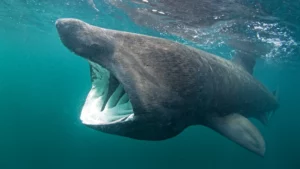 | 6–9 m (20–30 ft) | Low | Surface waters off the west coast, June–AugustThe brugde. Harmless plankton feeder, hunted by Norwegian harpoon boats until 2006, now protected. |
Greenland SharkSomniosus microcephalus | 2.5–5 m (8–16 ft) | Low | Deep, cold water of the northern fjords and the Barents Sea shelfThe håkjerring, the longest-lived vertebrate known. Sluggish, near-blind, never a danger; landed for liver oil for centuries. |
Small-spotted CatsharkScyliorhinus canicula | 0.6–0.9 m (2–3 ft) | Low | Sandy and muddy bottoms of the Oslofjord and the south coastThe shark divers actually meet, and the one in the 2007 Oslofjord incident. Rests on the bottom by day; harmless. |
Blackmouth CatsharkGaleus melastomus | 0.5–0.7 m (1.6–2.3 ft) | Low | Deep fjord basins and the Norwegian Trench, 200–1,000 mAbundant in research trawls from Bergen to Trondheim. Never near the surface. |
Velvet Belly LanternsharkEtmopterus spinax | 0.35–0.45 m (1.1–1.5 ft) | Low | Deep fjords, 100–500 m; very common around BergenA bioluminescent dwarf shark that glows blue along its belly. Probably the most numerous shark in Norway. |
Tope (School Shark)Galeorhinus galeus | 1.2–1.8 m (4–6 ft) | Low | South coast and Skagerrak in summer; occasionalA slim, fast hound shark at the northern edge of its range. Critically endangered globally; rarely landed in Norway. |
Bluntnose Sixgill SharkHexanchus griseus | 3–4.5 m (10–15 ft) | Low | Deep water of the Norwegian Trench and the western fjordsA primitive deep-sea shark that occasionally rises at night. Recorded off Norway but rarely; harmless to people. |
Common Thresher SharkAlopias vulpinus | 3–5 m (10–16 ft) incl. tail | Low | Rare summer visitor to the Skagerrak and southern North SeaRecognised by the enormous upper tail lobe. A handful of Norwegian records, all in warm summers. |
Shortfin Mako SharkIsurus oxyrinchus | 2–3 m (7–10 ft) | Moderate | Very rare stray to the Skagerrak and southern North Sea in summerThe fastest shark, a warm-blooded fish eater that occasionally follows mackerel north. No Norwegian incident has ever involved one. |
Blue SharkPrionace glauca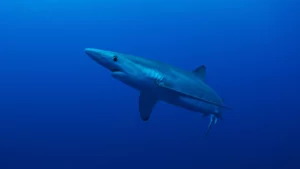 | 2–3 m (7–10 ft) | Low | Offshore, western and southern Norway, late summerAn open-ocean wanderer that reaches Norway in warm years. Landed occasionally by longliners; never seen from the shore. |
Frilled SharkChlamydoselachus anguineus | 1.2–2 m (4–6.5 ft) | Low | Deep slopes off the west and north coasts, 500–1,000 mAn eel-like living fossil with 300 needle teeth. A few Norwegian specimens exist in museum collections; never seen alive by divers. |
Portuguese DogfishCentroscymnus coelolepis | 0.9–1.2 m (3–4 ft) | Low | Continental slope off western Norway, below 400 mOne of the deepest-living sharks, recorded to 3,700 m elsewhere. Taken occasionally in deep-water trawls. |
Leafscale Gulper SharkCentrophorus squamosus | 1–1.5 m (3–5 ft) | Low | Continental slope off the west coast and the Norwegian SeaA deep-water gulper shark once targeted for liver oil across the Northeast Atlantic. Endangered; landings are now prohibited. |
Black DogfishCentroscyllium fabricii | 0.6–0.9 m (2–3 ft) | Low | Cold deep water off northern Norway and the Barents Sea slopeA jet-black Arctic lanternshark relative, abundant in deep trawls off Finnmark. Entirely harmless. |
Great White SharkCarcharodon carcharias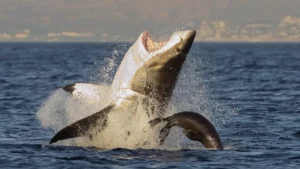 | 4–6 m (13–20 ft) | n/a | Not recorded in NorwayListed here purely because readers keep asking. No Norwegian record exists; the water is too cold even in summer. |
The species people ask about most is the great white shark, and the answer is that it has never been recorded in Norway. White sharks favour water of 12–24 °C; the Norwegian coast only touches the bottom of that range for a few weeks in late summer, and there is no food base of seals and tuna in the right places to hold one. The nearest confirmed records are in the Bay of Biscay and, historically, the western Mediterranean. Bull sharks, tiger sharks and hammerheads are equally absent. The old version of this page listed the shortfin mako as “highly aggressive”; the mako is a genuine but rare summer visitor to the Skagerrak and southern North Sea, and it has never approached a person in Norwegian water. The other correction worth making is size: the bluntnose sixgill was given as 15–20 feet, which is the extreme, not the adult norm of 3–4.5 m.
Where to see sharks in Norway
Nobody runs shark dives in Norway, but sharks are part of the scenery on the coast if you know where to look. These are the places with the most reliable records, from the Oslofjord to the Barents Sea.
- Oslofjord (Drøbak, Sjøstrand, Hvaler)The warmest, most sheltered water in the country. Small-spotted catsharks rest on the bottom in 10–40 m and are a regular sight for divers at Drøbak and Sjøstrand, the site of the 2007 catshark incident. Spurdogs are caught from the piers in autumn.
- Skagerrak coast and the Norwegian Trench (Kristiansand, Arendal)The deep channel that runs along the south coast brings blackmouth catsharks, velvet belly lanternsharks and the occasional bluntnose sixgill within a few kilometres of shore. Blue sharks, threshers and makos are landed here in warm summers.
- Bergen fjords (Byfjorden, Raunefjorden)The University of Bergen's research trawls in the fjords around the city bring up velvet belly lanternsharks by the hundred, glowing faintly on deck. Divers at night in the Hjeltefjord occasionally see them in shallow water.
- Sognefjord and HardangerfjordNorway's deepest fjords hold lanternsharks, blackmouth catsharks and Greenland sharks in their 800–1,300 m basins. Sport anglers fishing deep with big baits from Sogndal and Rosendal have hooked Greenland sharks of well over 3 m.
- Møre coast (Ålesund, Herøy, Runde)The heart of the old basking shark and porbeagle fisheries. Basking sharks still surface here in June and July, often spotted from the bird cliffs at Runde and by fishing boats working the banks. The 1818 database entry comes from Herøy.
- Lofoten and Vesterålen (Andenes, Bleik)The continental shelf edge lies only a few kilometres off Andenes, and whale-watching boats heading for the sperm whale grounds pass water where Greenland sharks and porbeagles are caught. Longliners here have landed Greenland sharks for generations.
- Saltstraumen, BodøThe strongest tidal current in the world pushes nutrient-rich water through a 150-metre strait four times a day. Famous for giant coalfish and wolffish, it also produces regular spurdog sightings for divers and the odd porbeagle following the fish.
- Tromsø, Kvænangen and the Varanger fjordThe far north. Greenland sharks are caught on longlines and occasionally filmed by divers in winter, when the water is at its clearest. Kvænangen's winter herring run draws humpbacks and orcas, and porbeagles follow the same fish.
For a realistic chance of seeing a shark yourself, dive the Oslofjord or the south coast in late summer and look on sandy bottoms for catsharks, or take a whale-watching or fishing trip off the west coast in June and July when basking sharks are at the surface. Greenland sharks are a matter of luck and very deep bait; the Norwegian Institute of Marine Research tags them on the Barents Sea longliners, and sport anglers hook one a few times a year.
Best time of year to see sharks in Norway
Norwegian shark sightings follow the sun and the fish, and there is a clear season.
- June to September: the surface warms to 12–18 °C along the whole coast. Basking sharks appear off Møre and the west coast in June and July, feeding on the plankton bloom at the surface, sometimes in small groups. Porbeagles move over the North Sea banks after mackerel and herring, blue sharks and the rare mako push into the Skagerrak from the Atlantic, and this is the only period when a thresher has ever been seen. Spurdogs move into shallower water and are caught from piers on the south coast.
- October to November: the water is still relatively warm and the visibility improves as the plankton dies back. The best months for divers hoping to see small-spotted catsharks in the Oslofjord and the south coast. Porbeagles are still on the banks.
- December to March: surface temperatures fall to 4–8 °C, and in the inner fjords to near zero. The pelagic visitors are gone, but this is the clearest water of the year and the season when Greenland sharks are caught most often on longlines in the north and when divers at Tromsø have filmed them. The Lofoten cod season, from January to April, brings porbeagles and spurdogs to the fishing grounds.
- April and May: the spring bloom turns the sea green and visibility drops. Basking sharks are on their way north; the first are usually reported off Rogaland and Hordaland in late May.
Winter surface temperatures in the north are what keep the Greenland shark here year-round, and summer temperatures in the south are what keep the great white out. Norwegian water has never been recorded above about 20 °C, and then only in the innermost Oslofjord.
Shark attacks in Norway: what the record actually shows
Norway has the kind of shark attack record that only a cold country can have. SharkSider tracks every reported case in its own database, published on the shark attacks in Norway page. It holds two entries for the country: one dated record from the modern era, listed below, and one from 1818 at Herøy on the Møre coast, a probable drowning in which the involvement of a shark was never confirmed. The summary line counts only the dated modern record (both entries are on the attacks page, which is refreshed weekly):
- 2007 · Sjøstrand, Oslo FjordScuba diving — Provoked incident no injury. diver touched 'dead' shark; shark bit his equipment-covered armSpecies: 3' small spotted catshark, Scyliorhinus canicula · not fatal
The 2007 case is worth describing because it shows how small Norway's shark risk really is. A scuba diver at Sjøstrand in the Oslofjord found a small-spotted catshark lying on the bottom, assumed it was dead and picked it up. The fish, about 90 cm long, clamped onto his wetsuit sleeve. No injury, no medical treatment, and the shark was released. The International Shark Attack File lists it as a provoked incident, and it stands as the only time a shark has bitten anyone in Norwegian water in the two centuries the databases cover. The 1818 Herøy entry is a drowning that a shark may have been near, recorded in an era when any body found at sea with marks on it was blamed on sharks.
The pattern is easy to explain. The sharks a Norwegian swimmer could meet, spurdogs and catsharks, are under a metre long and eat small fish and crustaceans. The larger species, porbeagles, basking sharks and Greenland sharks, live offshore or at depth and have no history of biting people anywhere in the North Atlantic. What kills swimmers in Norway is cold water: cold shock and hypothermia claim lives every year in fjords that are 8 °C a metre below a 16 °C surface. The standard shark safety advice is worth reading before a holiday in warmer seas; at home, the advice is a wetsuit.
Is it safe to swim and snorkel in Norway?
As far as sharks are concerned, completely. Norway has thousands of bathing spots, from the city beaches of Oslo and Bergen to the white-sand coves of Lofoten, and none of them has ever had a shark problem. The animals a snorkeller might realistically see are a small-spotted catshark lying on the sand in the Oslofjord, which will swim off if approached, or a spurdog passing in a school in autumn. Both are harmless. Divers who deliberately go looking for lanternsharks at night in the Bergen fjords are dealing with a 40-centimetre animal that glows faintly blue; the risk runs entirely the other way.
The real hazards in Norwegian water are physical. The surface can be a comfortable 17 °C in August while the water at ten metres is below 10 °C, and swimmers who jump from rocks into a fjord can go into cold shock. Currents in straits such as Saltstraumen and the Moskstraumen off Lofoten are dangerous to boats, let alone swimmers. Jellyfish, particularly the lion's mane in late summer, sting more Norwegians every year than any shark ever has. Anglers should handle spurdogs carefully: the spine in front of each dorsal fin carries a mild venom and a jab to the hand is painful for hours.
Snorkelling with basking sharks is possible off the west coast in a good summer, though there is no organised industry as there is in Scotland or Ireland. The rules are the same as for swimming with whale sharks: enter the water quietly from a stationary boat, keep several metres from the body and well clear of the tail, and never touch or block the animal. A basking shark is a plankton feeder with no interest in people, but it weighs several tonnes and its tail can knock a swimmer senseless.
Shark conservation in Norway
Norway's relationship with sharks was, for most of the twentieth century, a commercial one. The porbeagle fishery, which began in the 1920s, made Norway the largest porbeagle fishing nation in the world, with landings that peaked at several thousand tonnes a year in the North Sea before the stock collapsed in the 1960s and again, after a shift to the Northwest Atlantic, in the 1970s. The basking shark fishery was bigger still: Norwegian harpoon boats took thousands of basking sharks a year for their liver oil between the 1950s and the 1980s, and Norway remained the last country in the North Atlantic to hunt them. The spurdog was landed by the tens of thousands of tonnes, mostly for the British fish-and-chip trade, until that stock too fell to a fraction of its size.
The turn came in the 2000s. Norway closed the basking shark fishery in 2006, banned directed fishing for porbeagle in 2007 and for spurdog in 2011, and now requires live basking sharks and porbeagles taken as bycatch to be released. Both species are listed on the Convention on Migratory Species and the porbeagle is on CITES Appendix II, which Norway enforces. The spurdog story has a twist: after a decade of protection, the Institute of Marine Research found the Northeast Atlantic stock recovering, and in 2023 Norway reopened a limited, quota-managed spurdog fishery, one of the few shark stocks in the world to have been closed, rebuilt and reopened on scientific advice. The Greenland shark, the country's longest-lived animal at up to 400 years or more, has no specific protection but is no longer targeted, and the Institute now tags the ones caught on Barents Sea longlines to learn where they go. For the global picture behind these decisions, read why sharks are endangered.
Sharks in neighbouring waters
Norway sits at the top of a shared North Atlantic and North Sea shark fauna. Sweden gets the same spurdogs, catsharks and occasional porbeagles in the Skagerrak and Kattegat, thinning out as the water freshens toward the Baltic, and Denmark lands the same species at Skagen and Hirtshals from the North Sea. Finland, deep in the brackish Baltic, has almost nothing. Iceland shares the Greenland shark, basking shark and porbeagle and still eats fermented Greenland shark as hákarl; Russia's Barents Sea coast is the eastern edge of the Greenland shark's range, and the Netherlands sits at the shallow southern end of the same North Sea. For the cold-water species in general, see our page on sharks of the Arctic, and for every coast we cover, sharks around the world.
Frequently asked questions
Are there sharks in Norway?
Yes. At least 16 species have solid records in Norwegian waters. The common ones are the spiny dogfish or spurdog, the velvet belly lanternshark and blackmouth catshark of the deep fjords, the small-spotted catshark of the Oslofjord and south coast, the porbeagle of the North Sea, the basking shark off the west coast in summer and the Greenland shark in the north.
Have there been shark attacks in Norway?
Effectively no. SharkSider's database holds two entries: a probable drowning at Herøy in 1818 in which a shark was never confirmed, and a 2007 case in the Oslofjord where a diver picked up a small-spotted catshark he thought was dead and it bit his wetsuit sleeve. Nobody has ever been confirmed injured by a shark in Norway.
Are there great white sharks in Norway?
No. There is no confirmed record of a great white shark in Norwegian waters. The species favours water between 12 and 24 degrees, and the Norwegian coast only reaches the bottom of that range for a few weeks in late summer. The nearest confirmed white shark records in Europe are in the Bay of Biscay and the Mediterranean.
Is it safe to swim in the sea in Norway?
Yes, as far as sharks go. No Norwegian beach has ever had a shark problem, and the only species a swimmer might meet, catsharks and spurdogs, are under a metre long and harmless. The genuine dangers are cold water below the warm surface layer, tidal currents in the straits and lion's mane jellyfish in late summer.
Can you see basking sharks in Norway?
Yes, in summer. Basking sharks surface off the west coast, especially around Møre and Runde, in June and July when plankton is thickest, and are spotted from fishing boats, ferries and bird cliffs. Norway hunted them for liver oil until 2006; they have been protected since, and sightings are slowly increasing.
Are there Greenland sharks in Norway?
Yes. The Greenland shark, known locally as the hakjerring, lives in the cold deep water of the northern fjords and the Barents Sea shelf and is caught on longlines off Andenes, Tromso and Finnmark. Sport anglers occasionally hook one in the deep fjords further south, and divers at Tromso have filmed them in winter.
What is the most common shark in Norway?
The spiny dogfish, or spurdog, which lives in schools across the whole shelf and in the fjords and is the shark most often caught by anglers. By sheer numbers the velvet belly lanternshark, a 40-centimetre glowing deep-water species, may be even more abundant, but it lives far below where anyone sees it.
When is the best time to see sharks in Norway?
June to September for basking sharks at the surface and porbeagles on the banks, October and November for divers hoping to find catsharks in the clearer water of the Oslofjord, and midwinter for Greenland sharks, which are caught most often in the north between December and March.
Is shark fishing legal in Norway?
Partly. Fishing for basking sharks has been banned since 2006 and for porbeagles since 2007, and both must be released alive if caught by accident. The spurdog fishery was closed in 2011 and reopened under a strict quota in 2023 after the stock recovered. Greenland sharks and the small deep-water species have no specific protection but are not targeted.
Are there sharks in the Oslofjord?
Yes. The Oslofjord is the best place in Norway to see a shark, because small-spotted catsharks rest on its sandy bottoms in 10 to 40 metres and are a regular sight for divers at Drobak and Sjostrand. Spurdogs move into the fjord in autumn, and blackmouth catsharks and lanternsharks live in its deep central trench.
References

A small team focused on researching sharks and making marine biology easy to understand. Every page is reviewed against current species records and the SharkSider attack database, and updated when new incidents or research appear.
Published December 13, 2022 · Last updated September 21, 2026 · Incident data from the SharkSider attack database (1 records for Norway, 0 fatal).


