
Yes, there are sharks in Chile, around 22 species with solid records, but very few of them live where people swim. The common inshore species are the Chilean catshark, the speckled smooth-hound, the spiny dogfish and the broadnose sevengill shark; offshore the blue shark and shortfin mako dominate the longline catch; and around Easter Island and the Desventuradas the Galapagos shark is the everyday sighting.
The risk to swimmers is very low. SharkSider's database holds 9 records for Chile between 1934 and 2026, 4 of them fatal, and every case with a species named involved a great white shark, nearly all off the Coquimbo region and nearly all on divers or spearfishermen. The last unprovoked bite was in 1994, 300 miles east of Easter Island; the only later entries are a 2012 fisherman injured while handling a shark and a fishing crew member bitten on the arm far offshore west of Tocopilla in August 2026.
- Shark species recorded22 with solid records
- ProtectionFinning banned since 2011; great white, basking and whale sharks protected; vast marine parks around the oceanic islands
- Most seen from the shoreChilean catshark (pintarroja) in the kelp
- Signature encounterGalapagos sharks at Motu Nui, Easter Island
- Incidents in the database9 (1934–2026), 4 fatal; all named species great white
- Water temperature12–16 °C central coast; 18–22 °C far north; 20–26 °C Easter Island

On this page
- Where sharks live in Chile
- List of the different types of sharks in Chile
- Where to see sharks in Chile
- Best time of year to see sharks in Chile
- Shark attacks in Chile: what the record actually shows
- Is it safe to swim and dive with sharks in Chile?
- Shark conservation in Chile
- Sharks in neighbouring waters
- Frequently asked questions
- References
Where sharks live in Chile
Chile's sea is dominated by the Humboldt Current, a river of cold water that flows north from the Southern Ocean and, with the help of the trade winds, pulls even colder, nutrient-loaded water up from the deep along the entire coast. The result is one of the most productive fisheries on Earth, but also water that is uncomfortably cold for most sharks: 12–16 °C off Valparaíso in any season, and rarely above 20 °C even at Antofagasta in summer. The species that thrive here are the ones built for it, the small bottom-living catsharks and smooth-hounds, the spiny dogfish, the cold-tolerant sevengill and, further out, the lamnid sharks whose warm-blooded muscles let them hunt in cool water: the shortfin mako, the porbeagle and the great white.
Three other Chiles add to the list. The far north around Arica and Iquique warms to 18–22 °C in summer and during El Niño years, which is when hammerheads, threshers, copper sharks and the occasional whale shark push south from Peru. Patagonia, from Chiloé to Cape Horn, is a maze of fjords and channels at 6–12 °C where the narrowmouthed catshark, dogfish and deep-water sleeper sharks live under some of the least-explored water in the Americas. And the oceanic islands, Rapa Nui (Easter Island), the Salas y Gómez ridge, the Desventuradas and the Juan Fernández archipelago, sit in warm subtropical water 700 to 3,700 km offshore, with a completely different fauna led by the Galapagos shark. Chile has placed enormous marine parks around all of them, and they are now among the largest fully protected ocean areas in the world.
List of the different types of sharks in Chile
The table lists the species with dependable records from Chilean waters, mainland and islands together, drawn from the artisanal fishery landings, the swordfish longline observer programme and the survey work around the oceanic islands. Sizes are typical adults. The risk column is about swimmers and spearfishermen on the coast rather than divers who seek a species out, and for most of these sharks it is “low” simply because they are small, deep-living or both. Local names help: pintarroja is the Chilean catshark, tollo covers the smooth-hounds and dogfish, marrajo is the mako and azulejo the blue shark.
| Species | Adult size | Risk to swimmers | Where in Chile & notes |
|---|---|---|---|
| Chilean Catshark (Pintarroja)Schroederichthys chilensis | 0.5–0.65 m (1.6–2.1 ft) | Low | Kelp forests and rocky reefs from Peru to Chiloé; Quintay, ValparaísoThe most common shark on the Chilean coast and the one shore divers find under every ledge. Lays egg cases on the kelp. |
| Narrowmouthed CatsharkSchroederichthys bivius | 0.6–0.7 m (2–2.3 ft) | Low | Patagonian channels and fjords, Chiloé to the Strait of MagellanThe southern counterpart of the pintarroja. Harmless bottom-dweller. |
| Speckled Smooth-hound (Tollo)Mustelus mento | 0.9–1.3 m (3–4 ft) | Low | Sandy and rocky bottoms of the central and northern coastThe main tollo of the artisanal fishery. Eats crabs; no teeth to speak of. |
| Humpback Smooth-houndMustelus whitneyi | 0.8–1 m (2.6–3.3 ft) | Low | Northern Chile and Peru, over sandHeavily fished across its small range; listed as endangered. |
| Spiny Dogfish (Tollo de cachos)Squalus acanthias | 0.8–1.2 m (2.6–4 ft) | Low | Cold water of the south and the Patagonian fjordsVenomous dorsal spines are its only defence; harmless unless handled. |
| Chilean AngelsharkSquatina armata | 1–1.3 m (3.3–4.3 ft) | Low | Sandy bottoms of the far north, Arica to CoquimboA flattened ambush hunter now endangered by gill nets. May snap if stepped on. |
Broadnose Sevengill SharkNotorynchus cepedianus | 2.2–3 m (7–10 ft) | Moderate | Coastal bays from Coquimbo to Patagonia, near sea lion coloniesThe largest shark most Chilean divers will meet inshore. Bold, but no Chilean incident on record. |
Bluntnose Sixgill SharkHexanchus griseus | 3.5–4.8 m (11–16 ft) | Low | Deep slopes along the whole coastOccasionally landed by deep-water fisheries; never near swimmers. |
Tope Shark (Cazón)Galeorhinus galeus | 1.3–1.8 m (4–6 ft) | Low | Coastal shelf waters of central and southern ChileA slender, migratory houndshark fished for meat. Inoffensive. |
Blue Shark (Azulejo)Prionace glauca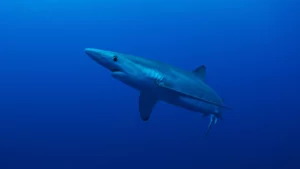 | 2–3 m (7–10 ft) | Low | Offshore along the entire coastThe most caught shark in the swordfish longline fishery. Rarely inshore. |
Shortfin Mako Shark (Marrajo)Isurus oxyrinchus | 2.5–3.5 m (8–11 ft) | Moderate | Offshore, especially the north and around the islandsWarm-blooded, fast and endangered. Second in the longline catch after the blue shark. |
Porbeagle SharkLamna nasus | 2–2.5 m (7–8 ft) | Low | Cold offshore water of southern Chile and the Southern Ocean edgeA mako relative built for the cold. Known from fishery bycatch. |
Great White SharkCarcharodon carcharias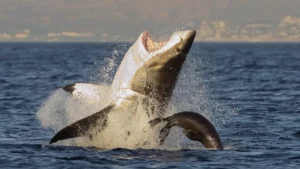 | 4–6 m (13–20 ft) | High | Coquimbo to Valparaíso near sea lion colonies; oceanic records near Easter IslandRare but genuinely present, and the species in every named Chilean incident. Coquimbo's fossil beds were a white shark nursery millions of years ago. |
Common Thresher SharkAlopias vulpinus | 3–4.5 m (10–15 ft) incl. tail | Low | Offshore, northern and central ChileStuns anchovy schools with its tail. Harmless to people. |
Bigeye Thresher SharkAlopias superciliosus | 3–4 m (10–13 ft) incl. tail | Low | Deep oceanic water, longline bycatchRecorded by observers on the swordfish fleet. |
Pelagic Thresher SharkAlopias pelagicus | 2.5–3.3 m (8–11 ft) incl. tail | Low | Warm offshore water of the far northReaches Chile from Peru in warm years. |
Smooth Hammerhead SharkSphyrna zygaena | 2.5–4 m (8–13 ft) | Low | Northern Chile, Arica to Antofagasta, and offshoreThe only hammerhead that tolerates Chilean temperatures. Seen by sport fishers, rarely by divers. |
Copper Shark (Bronze Whaler)Carcharhinus brachyurus | 2.5–3.3 m (8–11 ft) | Moderate | Coastal waters of the far north in summerA temperate requiem shark with a bite record in Australia and Africa, but none in Chile. |
Galapagos SharkCarcharhinus galapagensis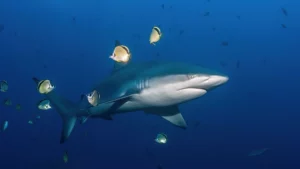 | 2.5–3 m (8–10 ft) | Moderate | Rapa Nui, Salas y Gómez, the Desventuradas and Juan FernándezThe signature shark of Chile's oceanic islands. Curious and confident around divers; no island incident on record. |
Basking SharkCetorhinus maximus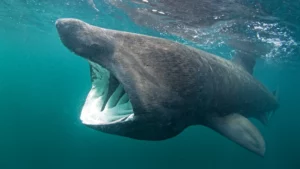 | 6–9 m (20–30 ft) | Low | Occasional spring sightings along the central and southern coastA plankton feeder that follows the Humboldt bloom. Protected in Chile. |
Whale SharkRhincodon typus | 5–10 m (16–33 ft) | Low | Rare visitor to the far north, Arica and Iquique, in warm yearsAt the cold southern edge of its Pacific range. Protected. |
| Southern Sleeper SharkSomniosus antarcticus | 3–4.5 m (10–15 ft) | Low | Deep, cold water off PatagoniaA sluggish giant of the deep, known from trawl and longline records. Never seen by divers. |
Several sharks that visitors ask about do not occur here. There are no bull sharks, no tiger sharks on the mainland coast and no reef sharks of the tropical Pacific kind; the water is far too cold and the coast has no coral. Scalloped and great hammerheads belong to Peru and further north, with the smooth hammerhead the only member of the family that reaches Chile. Nurse sharks, lemon sharks and blacktips are absent altogether. Even at Easter Island, the warmest Chilean water, the fauna is a short list built around the Galapagos shark rather than the crowded reef-shark scene of Polynesia further west.
Where to see sharks in Chile
Chile is not a shark-diving destination in the usual sense, and no operator runs baited shark dives. What it offers instead is cold-water diving in kelp forests where small sharks are genuinely common, expedition trips to islands where big sharks are, and one of the world's most remote island dive scenes.
- Motu Nui and the Hanga Roa coast, Rapa Nui (Easter Island)Visibility of 50 m and Galapagos sharks cruising the volcanic drop-offs around the islets off the south-west tip. The island's dive centres see them on most dives from November to April, occasionally with a passing hammerhead or mako.
- Nazca-Desventuradas Marine Park (San Félix and San Ambrosio)A 300,000 km² no-take park around two uninhabited islands 850 km offshore. Expedition surveys found Galapagos sharks in remarkable numbers and healthy pelagic fish; reachable only by research or private vessel.
- Juan Fernández archipelago (Robinson Crusoe Island)Endemic fish, a recovering fur seal colony and, in the deep water beyond the islands, makos, blue sharks and the occasional Galapagos shark. A destination for divers who want the unusual.
- Quintay and the Valparaíso kelp forestsCold shore dives among giant kelp where the Chilean catshark rests on the rock by day and where speckled smooth-hounds and, at times, a broadnose sevengill pass through. The easiest shark sighting in mainland Chile.
- Coquimbo, Totoralillo and Punta de ChorosSea lion colonies, Humboldt penguins and the historical centre of Chile's great white records. Sevengill sharks hunt the seals in the bays, and this stretch is where four of the nine database incidents occurred.
- Chiloé and the Comau fjord, northern PatagoniaCold, dark, plankton-rich fjord diving with deep-water corals in shallow reach. Narrowmouthed catsharks and spiny dogfish are the common sharks; sevengills appear near the salmon farms.
- Arica and Iquique offshoreThe warm far north. Sport-fishing boats meet smooth hammerheads, threshers, copper sharks and makos, and whale sharks are recorded in warm years; the Chilean angelshark lives on the sandy bottom below.
For a first Chilean shark, do the kelp at Quintay and look under the ledges for a pintarroja. For big animals, Rapa Nui is the only practical option; the Desventuradas and Juan Fernández are expedition territory.
Best time of year to see sharks in Chile
The country spans 38 degrees of latitude, so the calendar depends entirely on where you are.
- Central coast (Valparaíso to Coquimbo): the water is 12–16 °C all year. Autumn, March to May, brings the calmest seas and clearest water in the kelp; spring upwelling from September to November turns the sea green with plankton. Catsharks and smooth-hounds are present in every month.
- Far north (Antofagasta to Arica): summer, December to March, when surface water reaches 18–22 °C and the warm-water sharks push south. El Niño years extend the season and bring the rarities.
- Rapa Nui: diving is year-round, but November to April gives the warmest water, 22–26 °C, and the most Galapagos shark activity; winter swells from May to September close some sites.
- Patagonia: summer only, December to March, when the fjords are at 10–12 °C and the weather allows boats out.
- Great whites: the Chilean records cluster from December to March, matching the sea lion pupping season on the Coquimbo coast, though sightings are rare enough that no one plans a trip around them.
Shark attacks in Chile: what the record actually shows
Chile's record is small but unusually specific: almost every entry names the same species and the same stretch of coast. SharkSider's database holds nine entries between 1934 and 2026; the six most recent are listed below, and the full set is kept up to date on our shark attacks in Chile page.
- 2026 · 200 nautical miles west of Tocopilla aboard the vessel Naelita, Antofagasta RegionFishing — Bite to right arm severe bleedingSpecies not identified · not fatal
- 2012 · Antofagasta, Antofagasta ProvinceFishing (illegally) — Hand injured provoked incidentSpecies not identified · not fatal
- 1994 · 300 miles east of Easter IslandSwimming alongside NOAA research vessel Discoverer — Leg severed mid-thighSpecies: 3.6 m [11'9"] white shark · not fatal
- 1994 · 300 miles East of Easter IslandSwimming alongside NOAA research vessel Discoverer — Thigh bittenSpecies: 3.6 m [11'9"] white shark · not fatal
- 1988 · Valpariso, Valpariso ProvinceSkindiving — FatalSpecies: 16' white shark · fatal
- 1981 · Bahia Totoralillo, 80 km north of Coquimbo, CoquimboFree diving Spearfishing — Foot & ankle bittenSpecies: White shark · not fatal
Four of the nine were fatal, and they all happened on the coast between Coquimbo and Valparaíso: a man who fell into the water at Coquimbo in 1934, a spearfisherman taken by a 4 m great white at El Panul, south of Coquimbo, in 1963, a hookah diver killed by a white shark at Punta Negra near Pichidangui in 1980, and a skin diver killed by a white shark estimated at 16 feet off Valparaíso in December 1988. A fifth diver survived a bite to the foot and ankle from a white shark at Bahía Totoralillo, north of Coquimbo, in 1981. The pattern is the same as in South Australia or California: cold water, sea lion colonies, and people in wetsuits on the surface or on the bottom near seals, in a region where great whites hunt. A palaeontological discovery from 2020 fits the picture, though it lies outside the incident list: fossil beds at Bahía Inglesa and around Coquimbo have been identified as ancient great white nurseries from a time when the water here was warmer.
The two 1994 records describe a single event. Two crew members of the NOAA research vessel Discoverer were swimming beside the ship about 300 miles east of Easter Island when a 3.6 m white shark bit both of them, severing one man's leg at the thigh; both survived. Open-ocean swimming from a stopped ship, far from any coast, is a risk in any sea. The only later entries are a March 2012 fisherman at Antofagasta injured on the hand while handling a shark caught illegally, a provoked incident, and a crew member on the fishing vessel Naelita bitten on the right arm about 200 nautical miles west of Tocopilla in August 2026; neither says anything about swimmers. So for the ordinary beach-goer at Viña del Mar or La Serena the honest summary is: no unprovoked bite in more than thirty years, no incident ever involving a swimmer at a beach, and a great white risk that is confined to divers around seal colonies. Our guide to surviving a shark attack is worth reading before any dive near the Coquimbo sea lion haul-outs.
Is it safe to swim and dive with sharks in Chile?
For swimmers, the cold is a bigger problem than the sharks. Chilean beaches on the central coast are 13–16 °C even in January, which keeps most people in the shallows for a few minutes at a time, and none of the coastal sharks has any interest in them: the Chilean catshark is barely the length of your forearm, smooth-hounds and dogfish eat crabs and small fish, and the angelshark lies buried in sand waiting for flatfish. The broadnose sevengill is the one inshore species big enough to matter, and although it has bitten people elsewhere, usually after being provoked, there is no Chilean record against it.
Divers and spearfishermen are the group with a real, if small, exposure. Great whites in Chile hunt South American sea lions and fur seals, and the incidents at El Panul, Totoralillo, Pichidangui and Valparaíso all involved people diving or spearfishing near the coast where those colonies sit. The sensible rules follow directly: avoid diving right beside seal haul-outs, especially at dawn and dusk and in the December to March pupping season; keep speared fish on a float line rather than on your body; dive in pairs; and leave the water calmly if a large shark shows interest. At Rapa Nui the Galapagos sharks are curious and will come close, but the island's dive centres have never recorded a bite; keep still, keep your hands in and let them look.
If a whale shark turns up off Arica in a warm year, the animal is harmless, and basking sharks passing the central coast in spring are equally so; give both the tail room they need and enjoy the sight.
Shark conservation in Chile
Chile has moved from being a significant shark-fishing nation to one of the biggest protectors of ocean space in the world within about fifteen years. The turning points were the 2007 National Plan of Action for sharks, which forced the fishery to start counting what it caught, and the 2011 finning law, which requires every shark landed to arrive with its fins naturally attached, closing the loophole that had allowed fins to be cut at sea and bodies dumped. The great white, the basking shark and the whale shark have been protected from capture since the early 2010s, and Chile has signed the shark memorandum under the Convention on Migratory Species. Then came the marine parks: Motu Motiro Hiva around Salas y Gómez in 2010, Nazca-Desventuradas in 2016, the Rapa Nui and Juan Fernández parks in 2018 and the Diego Ramírez reserve at the tip of the continent the same year. Together they put well over 40 percent of Chile's exclusive economic zone under protection, most of it fully closed to fishing.
The gaps are on the mainland and in the deep. The swordfish longline fleet still takes blue sharks and shortfin makos in large numbers, and the mako is now endangered across the Pacific. Artisanal boats land smooth-hounds, dogfish and catsharks as tollo for the domestic market with little monitoring of stock size, and the Chilean angelshark, once common in the north, is now listed as endangered after decades of gill-netting. Salmon farming has spread through the Patagonian fjords, altering the water the catsharks and sevengills depend on. None of this has yet been matched by the kind of coastal protection the oceanic islands enjoy, which is where the next decade of Chilean shark conservation will be decided. Slow-growing species like the mako and the angelshark cannot wait, as our explainer on why sharks are endangered makes clear.
Sharks in neighbouring waters
Chile's shark fauna is shared along the Humboldt Current with Peru, where the same species meet a warmer, richer tropical fauna in the north, and with Ecuador, whose Galápagos Islands gave the Galapagos shark its name. Across the Andes, Argentina and Uruguay have the Atlantic versions of the same cold-water story, sevengills, smooth-hounds and porbeagles included, while Brazil to the north-east runs from temperate to fully tropical. Westward across the Pacific, French Polynesia shows what a warm-water island shark fauna looks like when it is fully protected. The full set of country guides is on our sharks around the world index.
Frequently asked questions
Are there sharks in Chile?
Yes, around 22 species with confirmed records. The cold Humboldt coast is home to small sharks such as the Chilean catshark, smooth-hounds and spiny dogfish, plus the broadnose sevengill; blue sharks and makos live offshore; Galapagos sharks ring Easter Island and the Desventuradas; and a small great white population hunts sea lions near Coquimbo.
Have there been shark attacks in Chile?
A few. SharkSider's database lists 9 records from 1934 to 2026, 4 of them fatal, and every case with a species identified involved a great white shark, mostly on divers or spearfishermen between Coquimbo and Valparaíso. The last unprovoked bite was in 1994 near Easter Island; the later entries are a 2012 fisherman injured handling a shark and a 2026 fishing crew member bitten far offshore west of Tocopilla.
Are there great white sharks in Chile?
Yes, though they are rare. Great whites are recorded along the central coast, especially around the sea lion colonies of the Coquimbo region, and one bit two swimmers 300 miles east of Easter Island in 1994. Fossil beds at Bahía Inglesa and near Coquimbo have also been identified as ancient great white nurseries.
Is it safe to swim at Chilean beaches?
Yes. No swimmer at a Chilean beach has ever been recorded bitten by a shark; the coastal species are small and harmless, and the great white incidents all involved divers or spearfishermen near seal colonies. The cold water, 13–16 °C on the central coast even in summer, is the real limit on how long you stay in.
Can you dive with sharks in Chile?
Yes, in two very different ways. Cold-water shore dives in the kelp at Quintay near Valparaíso reliably turn up Chilean catsharks and smooth-hounds, with sevengills possible. For big sharks, Rapa Nui's Motu Nui dive sites have Galapagos sharks on most dives in 50 m visibility. No baited shark dives are run in Chile.
What sharks live around Easter Island?
The Galapagos shark is the everyday species, patrolling the volcanic drop-offs around Motu Nui and the Hanga Roa coast. Makos, blue sharks and the occasional smooth hammerhead pass through the surrounding blue water, and the great white is known from the open ocean to the east. Tropical reef sharks are absent this far from the western Pacific.
What is the most common shark in Chile?
The Chilean catshark, called pintarroja, a half-metre spotted shark that lives in the kelp forests and rocky reefs from Peru to Chiloé and lays its egg cases on the seaweed. Divers at Quintay and other central-coast sites find it under ledges on almost every dive, and it turns up in the artisanal fishery too.
When is the best time to see sharks in Chile?
It depends on the region. Autumn, March to May, gives the clearest kelp diving on the central coast; December to March is the season for warm-water sharks in the far north and for fjord diving in Patagonia; and November to April is the warm, calm window at Easter Island when Galapagos sharks are most active.
Are there bull sharks or tiger sharks in Chile?
No. Bull sharks need warm estuaries and tiger sharks need tropical or warm-temperate water, and the Humboldt Current keeps mainland Chile at 12–20 °C. Neither species has a record on the Chilean coast. The large requiem sharks here are the copper shark in the warm north and the Galapagos shark at the oceanic islands.
Is shark finning legal in Chile?
No. A 2011 law requires every shark landed in Chile to arrive with its fins naturally attached, which ended finning at sea. The great white, basking shark and whale shark are protected from capture, and marine parks around Easter Island, the Desventuradas, Juan Fernández and Diego Ramírez put more than 40 percent of Chile's waters off limits to fishing.
References

A small team focused on researching sharks and making marine biology easy to understand. Every page is reviewed against current species records and the SharkSider attack database, and updated when new incidents or research appear.
Published January 3, 2023 · Last updated September 28, 2026 · Incident data from the SharkSider attack database (9 records for Chile, 4 fatal).


