
Yes, there are sharks in Cambodia, but they are small and shy. Sixteen species are recorded on the coast and around the islands. The common ones are the brownbanded bamboo shark, the coral catshark, the whitespotted bamboo shark, the blacktip reef shark and the small requiem sharks landed at Sihanoukville, such as the spot-tail and milk shark; whale sharks pass the outer islands of Koh Tang and Koh Prins in the dry season.
The safety record is blank. SharkSider's database contains no shark attack for Cambodia in any year, and the neighbouring Thai coast of the same gulf averages well under one minor bite a year. The bull shark, the only genuinely dangerous species on the list, is rare on the coast and better known from old records far up the Mekong than from any beach.
- Shark species recorded16 with solid records
- ProtectionKoh Rong marine area 2016; Kep and Koh Sdach areas; CITES member; no shark-specific law
- Most seen from the beachBrownbanded bamboo shark
- Signature encounterNight dives with bamboo sharks and coral catsharks at Koh Rong Sanloem
- Incidents in the databaseNone recorded
- Water temperature27–30 °C year-round

On this page
- Where sharks live in Cambodian waters
- List of the different types of sharks in Cambodia
- Where to see sharks in Cambodia
- Best time of year to see sharks in Cambodia
- Shark attacks in Cambodia: what the record actually shows
- Is it safe to swim and snorkel in Cambodia?
- Shark conservation in Cambodia
- Sharks in neighbouring waters
- Frequently asked questions
- References
Where sharks live in Cambodian waters
Cambodia's sea is the north-eastern corner of the Gulf of Thailand, and the gulf sets the terms. It is a shallow shelf sea, rarely deeper than 60 m, fed by the Mekong's plume from the east and by dozens of smaller rivers along the Cambodian coast, so the water is warm, green and full of nutrients rather than blue and clear. That suits a particular kind of shark: bottom-living carpetsharks and catsharks that hunt crabs and small fish among the coral by night, and small, fast requiem sharks that follow the sardine and anchovy schools over the sand. The big oceanic species have no deep water to work with, and the reef-shark communities of the Andaman Sea on Thailand's other coast are largely absent.
The coast itself runs from the Thai border at Koh Kong, through the port city of Sihanoukville, to the quiet provinces of Kampot and Kep near the Vietnamese frontier. The mainland shore is mostly mangrove, mudflat and river mouth, especially the huge Peam Krasop mangroves of Koh Kong and the Ream peninsula south of Sihanoukville, and these are the nurseries where young bamboo sharks and juvenile requiem sharks grow up. The reefs are around the islands: the Koh Rong archipelago just off Sihanoukville, the Koh Sdach group to the north-west, and, five hours out by boat, the isolated outer islands of Koh Tang, Koh Prins and Koh Poulo Wai, which have the clearest water in the country and the only Cambodian sites where a diver has a real chance of a blacktip reef shark or a passing whale shark.
There is also a freshwater story. The Mekong is one of the few rivers in the world with a documented history of bull sharks far upstream, and old records place them well into Cambodia. That population, if it still exists, is a shadow of what it was: dams, sand mining and fishing pressure have changed the river, and no confirmed bull shark has been reported from the Cambodian Mekong in many years. On the coast the species is an occasional visitor to the estuaries rather than a resident.
List of the different types of sharks in Cambodia
Cambodian shark records are thinner than for any of its neighbours, so this table is deliberately conservative. It lists the species with a solid record from Cambodian waters, whether from dive-site surveys around Koh Rong and the outer islands, landings at the Sihanoukville, Kampot and Kep fish markets, or fisheries surveys of the north-eastern Gulf of Thailand. Sizes are typical adults. The risk column concerns a swimmer or snorkeller at a Cambodian beach, and for nearly every species it is negligible. Khmer fishermen use one word, chhlam, for almost all of them. The old version of this page listed the Californian leopard shark, which has never occurred within ten thousand kilometres of Cambodia; the animal divers here call a leopard shark is the zebra shark, and it appears under that name below.
| Species | Adult size | Risk to swimmers | Where in Cambodia & notes |
|---|---|---|---|
Brownbanded Bamboo SharkChiloscyllium punctatum | 0.8–1.2 m (2.5–4 ft) | Low | Under coral heads and in seagrass around Koh Rong; night divesThe shark of Cambodia. Slender, sluggish by day, out hunting crabs after dark. Juveniles are banded, adults plain brown. |
Whitespotted Bamboo SharkChiloscyllium plagiosum | 0.7–0.95 m (2.5–3 ft) | Low | Rocky reefs at Koh Sdach and the outer islandsDark bands with white spots. Egg-laying; its cases are found in the coral. Harmless. |
Grey Bamboo SharkChiloscyllium griseum | 0.6–0.8 m (2–2.5 ft) | Low | Muddy inshore bottoms and estuary mouthsThe plainest of the three bamboo sharks, taken in trawls and traps along the mainland coast. |
Coral CatsharkAtelomycterus marmoratus | 0.5–0.7 m (1.5–2.5 ft) | Low | Wedged in coral crevices at Koh Rong Sanloem, seen at nightA slim, marbled catshark barely thicker than a wrist. The second most common shark on Cambodian night dives. |
Blacktip Reef SharkCarcharhinus melanopterus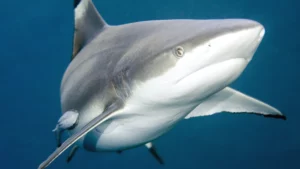 | 1.2–1.6 m (4–5 ft) | Low | Outer islands: Koh Tang, Koh Prins, Koh Poulo WaiRare near the mainland, regular at the clear-water outer islands. Shy; circles once and leaves. |
Zebra SharkStegostoma tigrinum | 2–2.5 m (7–8 ft) | Low | Sand beside the outer-island reefsThe animal the old list called a leopard shark. Spotted adults rest on the bottom by day; completely docile. |
Whale SharkRhincodon typus | 5–10 m (16–33 ft) | Low | Occasional at Koh Tang and Koh Prins, December–AprilA few sightings a season, not a reliable aggregation. Filter feeder; harmless. |
Bull SharkCarcharhinus leucas | 2.2–3.2 m (7–10 ft) | High | Estuaries and, historically, far up the MekongGenuinely recorded but rare; the old claim that it is commonly seen was wrong. No Cambodian incident on record. |
Blacktip SharkCarcharhinus limbatus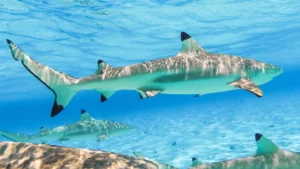 | 1.5–2 m (5–6.5 ft) | Moderate | Open water over the shelf, following sardine schoolsLanded at Sihanoukville. The source of most minor surf bites on the Thai side of the gulf; none here. |
| Spot-tail SharkCarcharhinus sorrah | 1.2–1.6 m (4–5 ft) | Low | Reefs and sandbanks along the whole coastThe most common mid-sized shark in the market catch. Black tip on the lower tail lobe. |
Spinner SharkCarcharhinus brevipinna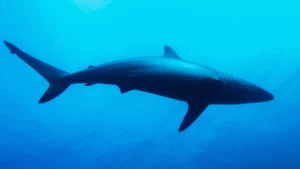 | 1.8–2.5 m (6–8 ft) | Moderate | Offshore around the outer islandsLeaps and spins through baitfish. Occasional in longline and gillnet catches. |
Milk SharkRhizoprionodon acutus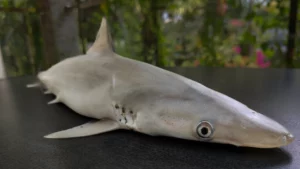 | 0.8–1.1 m (2.5–3.5 ft) | Low | Shallow inshore water, river mouths and mangrove edgesSmall, abundant and harmless; the bulk of the small-shark catch at Kampot and Kep. |
Grey Sharpnose SharkRhizoprionodon oligolinx | 0.6–0.8 m (2–2.5 ft) | Low | Sandy bays and estuariesLooks like a half-size milk shark and is landed alongside it. |
Spadenose SharkScoliodon laticaudus | 0.5–0.7 m (1.5–2.5 ft) | Low | Muddy river mouths and the Mekong plumeA tiny, flat-snouted shark that tolerates brackish water. Sold by the basket at the markets. |
Sicklefin Weasel SharkHemigaleus microstoma | 0.8–1 m (2.5–3 ft) | Low | Shelf bottoms in 10–60 mA small octopus-eating shark of the gulf's trawl grounds. Harmless. |
Scalloped Hammerhead SharkSphyrna lewini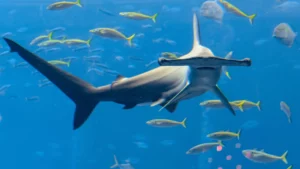 | 2.5–3.5 m (8–12 ft) | Low | Deeper central gulf; juveniles landed at SihanoukvilleKnown here mainly from fisheries landings, mostly young animals. Critically endangered. |
Great White SharkCarcharodon carcharias | 4–6 m (13–20 ft) | n/a | Not found in the Gulf of ThailandIncluded only because it is asked about. A temperate species with no record in these warm, shallow waters. |
Several sharks that visitors expect are missing for good reason. The great white is a cool-water species that never enters the Gulf of Thailand; the nearest records are from southern Australia and, rarely, the East China Sea. The tiger shark is recorded on the deeper Andaman coast of Thailand and in the South China Sea, but has no confirmed Cambodian record in these shallow waters. Grey reef sharks, whitetip reef sharks and silvertips, the classic Indo-Pacific reef trio, need the clear, current-swept drop-offs that the gulf simply does not have, and none has been documented at the Cambodian islands. The bull shark stays in the table because its Mekong history is real, but the original page's claim that it is “commonly seen” is not: it is one of the rarest sharks on the coast today.
Where to see sharks in Cambodia
Cambodia's dive industry is small and honest about what it offers: this is a place for macro life, seahorses, nudibranchs and, if you dive at night, the small sharks that hide by day. These are the sites where the records are most consistent.
- Koh Rong Sanloem: Corner Bar, Koh Koun and the house reefsThe most reliable shark sightings in Cambodia. Brownbanded bamboo sharks and coral catsharks come out from under the coral heads after dark and can be found on almost every night dive from the M'Pai Bay and Saracen Bay dive shops, in 5–15 m of water.
- Koh Rong, the main islandFringing reefs on the north and west coasts and the seagrass beds at Long Set Beach, inside the Koh Rong Marine Fisheries Management Area. Juvenile bamboo sharks on the reef flats; small requiem sharks over the sand at dawn.
- Koh Tang and Koh Prins, the outer islandsFive hours from Sihanoukville, with 20–30 m visibility in the dry season. The only Cambodian sites with regular blacktip reef shark sightings, a chance of a zebra shark on the sand, and occasional whale sharks between December and April. Liveaboard or long day trip only.
- Koh Poulo Wai and Condor ReefRemote reefs south-west of Koh Tang near the sea border with Thailand and Vietnam. Bamboo sharks in the coral, spinner and blacktip sharks in the blue, and the best odds in the country of a whale shark.
- Koh Sdach archipelago, Koh Kong provinceA cluster of a dozen islands in the north-west with a fishing community and a managed marine area. Coral catsharks and whitespotted bamboo sharks on the reefs; a quieter alternative to Koh Rong.
- Kep and the Koh Tonsay reefsMarine Conservation Cambodia's base in the far south-east, where artificial reef blocks were laid to keep trawlers out. Bamboo sharks have moved into the structures, and the programme's surveys are the best shark data on the mainland coast.
- Sihanoukville and Kampot fish marketsThe place to see the requiem sharks nobody meets underwater: spot-tail sharks, milk sharks, spadenose sharks, weasel sharks and the occasional scalloped hammerhead, landed by the trawl and gillnet fleet and sold at dawn.
If you want a shark on your own terms, book a night dive at Koh Rong Sanloem between November and April; the bamboo sharks are close to guaranteed. For anything larger, only the outer islands will do, and only in the dry season when the boats can make the crossing.
Best time of year to see sharks in Cambodia
The Gulf of Thailand is warm all year, so season here is about wind and visibility rather than temperature.
- November to April, the dry season: north-east winds, flat seas on the Cambodian side, water of 27–29 °C and the year's best visibility, up to 30 m at the outer islands. Every dive site is open, the crossing to Koh Tang is possible, and whale shark sightings, when they happen, fall between December and April. The peak months are January to March.
- May to October, the south-west monsoon: rain, wind and swell from the sea. Visibility inshore drops to a few metres as the rivers flood the coast with sediment, the outer-island trips stop, and only the sheltered eastern sides of Koh Rong and Koh Rong Sanloem are dived. Bamboo sharks are still there on the night dives, but you will see less of everything else.
- Water temperature: 27–30 °C in every month, with a slight dip in January and the warmest water in May. There is no cold season and no seasonal shark migration to speak of.
- Pupping: the small requiem sharks drop their young in the mangrove creeks and estuaries in the early rainy season, and juvenile bamboo sharks are most obvious on the reef flats from June onwards.
Visibility is the deciding factor for anything but night dives. On a bad day in the wet season the Koh Rong house reefs are a green soup; on a good day in February the outer islands look like a different country.
Shark attacks in Cambodia: what the record actually shows
Cambodia has no recorded shark attack. SharkSider's database, which collects every documented case worldwide, contains no entry for Cambodia in any year, and the summary below is generated directly from it.
No incidents are recorded in the SharkSider database for this country.
This is what you would expect from the fauna. The sharks of the Cambodian coast are bottom-dwelling carpetsharks with tiny mouths and small requiem sharks under 1.5 m that eat sardines and shrimp. The one species with real potential to hurt a person, the bull shark, is rare on the coast and the region's bull shark history belongs to the rivers, not the beaches. The wider gulf confirms the picture: Thailand, with far more swimmers on the same body of water, records only a handful of minor bites a decade, most of them from small blacktip sharks in the surf. Cambodia's reporting is weak, and a fisherman nipped by a bamboo shark while emptying a trap would never enter any database, so the blank record means “no documented case” rather than “impossible”. Practically, the risks at Otres, Sokha or Koh Rong are jellyfish, sea urchins, boat traffic and rip currents in the monsoon, and the usual shark-safety habits, no swimming at dusk, near fishing boats or where fish are being cleaned, are more than enough.
Is it safe to swim and snorkel in Cambodia?
From a shark point of view, absolutely. The bamboo sharks and coral catsharks you may find on a snorkel over the Koh Rong reefs are 60–100 cm long, hide under coral by day and are so placid that the main risk is to them, from people who grab them for a photograph. Leave them alone; a bamboo shark pulled from its hole can be injured, and a startled one can give a pinching bite that breaks the skin. Blacktip reef sharks at the outer islands are shy and will circle once before leaving; stand still and enjoy it. Zebra sharks lying on the sand are harmless and should not be touched or ridden. If you are lucky enough to meet a whale shark off Koh Tang, it cannot hurt you, but keep 3 m from the body, more from the tail, and enter the water quietly rather than jumping in on top of it.
Divers have a small extra list. Night dives are where the sharks are, and a good torch discipline matters more than shark awareness: keep the beam off the animal's eyes, stay off the reef, and do not chase a catshark into the coral. Bull sharks are an estuary and river animal here, so the one sensible precaution on the mainland coast is to avoid swimming in murky river mouths and creek channels, particularly after heavy rain and at night.
Shark conservation in Cambodia
Cambodia has no law that protects sharks specifically. The 2006 Fisheries Law bans destructive gear such as push nets and trawling in shallow water, Cambodia is a party to CITES, which regulates trade in whale sharks, hammerheads and several requiem species, and the country has begun building a network of marine protected areas: the Koh Rong Marine Fisheries Management Area in 2016, the first large one in the country at over 400 km², followed by managed areas around Kep and the Koh Sdach archipelago. Those areas were designed with the Fisheries Administration and conservation groups, and they include no-take zones and seagrass and reef refuges that directly shelter bamboo sharks and juvenile requiem sharks.
The pressures are severe. Illegal trawling and electric fishing by boats from all three countries around the gulf strip the shallow bottom where the carpetsharks live; the shark fin trade passes through Cambodian ports on its way to regional markets; and the mangroves of Koh Kong and Ream have been cut for shrimp ponds, sand dredging and resort construction, removing the nurseries. Coastal development at Sihanoukville, transformed by a building boom in the late 2010s, has sent sediment over the nearest reefs. Small programmes in Kep and Koh Rong, which lay artificial reef blocks to physically stop trawlers and survey the sharks that return, have shown the reefs can recover quickly when the nets stop. Our guide to why sharks are endangered covers why shallow, heavily fished seas like this one are where sharks disappear first.
Sharks in neighbouring waters
Cambodia shares its sharks with the whole Gulf of Thailand and the seas beyond it. Thailand, next door, has the same bamboo sharks and blacktips on its gulf coast plus the whale sharks, leopard sharks and reef sharks of the Andaman Sea on the other side of the peninsula. Vietnam holds the eastern shore of the gulf and the Mekong delta, where the bull shark story continues. Further south, Malaysia and Singapore sit at the mouth of the South China Sea with the same small requiem and carpetshark fauna, while Indonesia and the Philippines offer the whale sharks, threshers and reef sharks that Cambodia's shallow gulf cannot. See our sharks around the world overview for the complete list of countries.
Frequently asked questions
Are there sharks in Cambodia?
Yes, sixteen species with solid records, but they are small and easy to miss. Brownbanded bamboo sharks and coral catsharks are common on the reefs around Koh Rong, small requiem sharks such as the spot-tail and milk shark are landed daily at Sihanoukville, and blacktip reef sharks, zebra sharks and the occasional whale shark are seen at the outer islands of Koh Tang and Koh Prins.
Have there been shark attacks in Cambodia?
No. Not a single Cambodian shark incident appears in the SharkSider database, in any year. The species on the Cambodian coast are bottom-dwelling carpetsharks and small requiem sharks, and the neighbouring Thai coast of the same gulf, with far more swimmers, records only a handful of minor bites per decade.
Can you dive with sharks in Cambodia?
Yes, on night dives. Dive shops at Koh Rong Sanloem find brownbanded bamboo sharks and coral catsharks on almost every night dive from November to April, in shallow water suitable for beginners. For blacktip reef sharks, zebra sharks or a chance of a whale shark you need a long trip to the outer islands of Koh Tang and Koh Prins in the dry season.
Are there bull sharks in Cambodia?
Rarely. Bull sharks have a genuine history in the Mekong, with old records well upstream into Cambodia, and they occasionally enter coastal estuaries. Today they are among the rarest sharks on the coast, no confirmed sighting has come from the Cambodian Mekong in many years, and the earlier claim that they are commonly seen was wrong.
Are there great white sharks in Cambodia?
No. The great white is a cool-water shark and has never been recorded in the Gulf of Thailand, which is warm, shallow and enclosed. Tiger sharks, grey reef sharks and whitetip reef sharks are also absent from Cambodian records; they belong to the deeper, clearer seas on the far side of the Thai peninsula.
Are there whale sharks in Cambodia?
Occasionally. Whale sharks pass the outer islands of Koh Tang, Koh Prins and Koh Poulo Wai between December and April, and a few sightings are reported each dry season by the liveaboards and long day trips out of Sihanoukville. There is no reliable aggregation as there is in Thailand, the Philippines or the Maldives.
Is it safe to swim in the sea in Cambodia?
Yes, with sharks the least of your worries. No shark incident has ever been documented in Cambodia, and the sharks near the beaches are harmless bamboo sharks and small fish-eaters. The real hazards are jellyfish, sea urchins, boat traffic at busy beaches and rip currents during the May to October monsoon. Avoid swimming in murky river mouths at night.
When is the best time to see sharks in Cambodia?
November to April, the dry season, when the seas are calm, visibility reaches 20–30 m at the outer islands and the boats can cross to Koh Tang. Bamboo sharks are seen on night dives all year, but the whale shark sightings and the blacktip reef sharks are a dry-season affair. Water is 27–30 °C in every month.
What is the most common shark in Cambodia?
The brownbanded bamboo shark. It lives under coral heads and in seagrass around Koh Rong and Koh Rong Sanloem, comes out at night to hunt crabs, and is found on most night dives. In the fish markets the most common sharks are the spot-tail shark and the milk shark, landed by the trawl and gillnet fleet.
Is shark fishing legal in Cambodia?
There is no shark-specific ban. Sharks are landed and sold legally as part of the general catch, and fins pass through Cambodian ports to regional markets. Protection comes indirectly: the 2006 Fisheries Law bans trawling in shallow water, Cambodia is a party to CITES, and the Koh Rong, Kep and Koh Sdach marine management areas include no-take zones that shelter reef sharks.
References

A small team focused on researching sharks and making marine biology easy to understand. Every page is reviewed against current species records and the SharkSider attack database, and updated when new incidents or research appear.
Published January 19, 2023 · Last updated September 21, 2026 · Incident data from the SharkSider attack database (0 records for Cambodia, 0 fatal).


