
Yes, there are sharks in New York, and there are more of them near the beaches than at any time in living memory. Sixteen species have a solid record in state waters, and the bull shark is listed as an unconfirmed straggler. Along the Long Island surf the ones that matter are the sand tiger, sandbar and dusky shark, with smooth and spiny dogfish everywhere; offshore live blue sharks, makos, threshers, basking sharks and a nursery of young great whites in the New York Bight.
The safety picture is unusual: many small bites, no deaths. The SharkSider database holds 50 New York records from 1642 to 2026, 32 of them since 1900, and not one fatality since 1878. Twenty of those records date from 2000 onwards and 15 from the 2020s alone, six in 2022 and six in 2023, nearly all along the Suffolk County beaches. Every modern injury was a single bite to a foot, leg or hand, usually blamed on a sand tiger shark of 1–1.5 m feeding on bunker in the surf.
- Shark species in this list16 recorded (+ bull shark, unconfirmed)
- ProtectionSand tiger, white & dusky prohibited; drone beach patrols since 2023
- Most seen from the beachSand tiger shark
- Signature encounterSand tiger nursery in Great South Bay
- Incidents in the database50 (1642–2026), none fatal since 1878
- Water temperature3–6 °C in Feb, 20–24 °C in Aug

On this page
- Why New York has more sharks than it used to
- List of the different types of sharks in New York
- Where to see sharks in New York
- Best time of year to see sharks in New York
- Shark attacks in New York: what the record shows
- Is it safe to swim at Long Island and New York City beaches?
- Shark conservation in New York
- Sharks in nearby states
- Frequently asked questions
- References
Why New York has more sharks than it used to
New York's coast is short but strategically placed. Long Island's south shore is a 190 km wall of barrier beach facing the open Atlantic, and behind it lie shallow lagoons, Great South Bay, Moriches Bay and Shinnecock Bay, that warm up fast in summer and are stuffed with silversides, bunker and crabs. To the north, Long Island Sound is a deep, tidal arm of the sea that shelters spiny dogfish and sandbar sharks. And 150 km to the south-east the shelf ends at the Hudson Canyon, the largest submarine canyon on the East Coast, where the Gulf Stream's eddies bring blue sharks, makos and threshers within a day's run of Montauk. Montauk's charter captains knew that long before science did: Frank Mundus was hauling giant whites and makos into the harbour in the 1960s, and one of his customers wrote a book about it.
What changed in the last decade is the food. Atlantic menhaden, the oily baitfish New Yorkers call bunker, were netted almost to nothing in the state's waters by industrial reduction fishing. A 2019 state law barred purse seining for menhaden inside New York waters, and the schools came back with startling speed: by 2021 miles-long bunker slicks were sitting off Rockaway and Jones Beach every summer. Sharks followed. Sand tigers, sandbar sharks and duskies now feed in the surf zone where the bunker press against the beach, and that is exactly where the bites of 2022 and 2023 happened. Add cleaner water in the Hudson estuary and the warmest ocean summers on record, and the pattern is easy to read.
The great white story runs alongside. In 2016 OCEARCH and New York biologists tagged juvenile white sharks a few kilometres off Montauk and showed that the New York Bight is a nursery: pups born nearby spend their first summers in the warm, prey-rich water off Long Island before moving offshore in autumn. Adult whites pass through on their way between Cape Cod and the Carolinas. None of this is new in a biological sense, but it is new to a public that had assumed sharks were something Florida had.
Management is federal for the migratory species (sand tiger, white and dusky sharks must be released; shortfin mako retention has been banned since 2022) and state for the beaches. After the 2022 cluster the governor's office put shark-spotting drones, jet-ski patrols and helicopter sweeps on the state park beaches, and lifeguards now close the water for an hour whenever a shark is sighted inside the bars. New York City did the same at Rockaway in 2023.
List of the different types of sharks in New York
The table includes every species with a reliable record in New York waters, from Long Island Sound to the shelf edge. Sizes are typical adults, not the Montauk record board. The risk column judges the threat to a bather on a Long Island beach in the state's own conditions, which is why the shortfin mako, called “highly aggressive” on the original version of this page, is rated low: it is a blue-water fish that lives 50 km and more offshore and has never been involved in a New York beach incident. Two dogfish species are included because they are the sharks New Yorkers most often catch and the most numerous by far.
| Species | Adult size | Risk to swimmers | Where in New York & notes |
|---|---|---|---|
Sand Tiger SharkCarcharias taurus | 2–3.2 m (6.5–10.5 ft) | Moderate | Great South Bay nursery and the south-shore surf, June to OctoberThe species behind almost every recent Long Island bite, all minor, and the one you are most likely to see from the beach. Protected since 1997. |
Sandbar SharkCarcharhinus plumbeus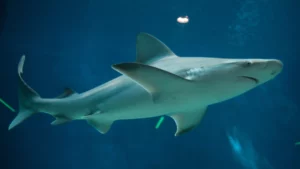 | 1.8–2.4 m (6–8 ft) | Low | Bays, inlets and Long Island Sound in summerThe commonest large coastal shark inshore. Shy; must be released if caught. |
Dusky SharkCarcharhinus obscurus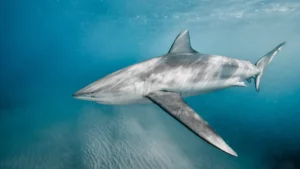 | 3–3.6 m (10–12 ft) | Low | Passes the beaches in summer; juveniles feed on bunker inshoreProhibited since 2000 and still rebuilding. Seen in the surf with the sand tigers. |
| Smooth DogfishMustelus canis | 0.9–1.5 m (3–5 ft) | Low | Every bay and pier from May to OctoberThe shark most New Yorkers actually catch. Flat crushing teeth; cannot break skin. |
| Spiny DogfishSqualus acanthias | 0.8–1.2 m (2.5–4 ft) | Low | Long Island Sound and the shelf, mainly in the cold monthsAbundant in vast schools. Two dorsal spines are the only hazard, to anglers. |
Blue SharkPrionace glauca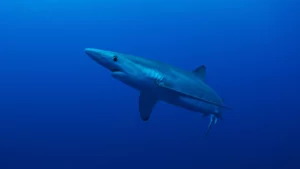 | 2–3 m (7–10 ft) | Low | Offshore from Montauk, June to OctoberThe mainstay of the charter fleet. One state record names it, from a boat, not a beach. |
Shortfin Mako SharkIsurus oxyrinchus | 2.5–3.5 m (8–11 ft) | Low | Blue water 30–150 km offshore, summerNot the beach menace the old table implied; never involved in a New York bathing incident. Catch-and-release only since 2022. |
Common Thresher SharkAlopias vulpinus | 3–5.5 m (10–18 ft) incl. tail | Low | Outside the inlets and along the shelf in summerSometimes seen slapping bunker with its tail within sight of the Hamptons beaches. |
Basking SharkCetorhinus maximus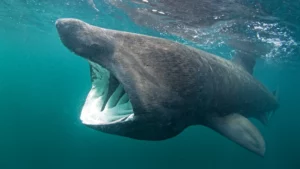 | 6–9 m (20–30 ft) | Low | Shelf edge and occasionally nearshore in May and JuneThe biggest fish in New York waters and a filter feeder. Harmless; mistaken for a great white every spring. |
Great White SharkCarcharodon carcharias | 4–6 m (13–20 ft); juveniles here 1.5–2.5 m | Moderate | Juvenile nursery off Montauk and the Hamptons in summer; adults offshore on migrationThe New York Bight nursery was confirmed by tagging in 2016. No New York bite is attributed to a white shark. |
Porbeagle SharkLamna nasus | 2–2.5 m (7–8 ft) | Low | Cold shelf water in winter and springA cold-water cousin of the mako; caught on the shelf in the cold months. |
Smooth Hammerhead SharkSphyrna zygaena | 2.5–4 m (8–13 ft) | Low | Offshore in late summerThe only hammerhead regular this far north. Shy of boats and people. |
Scalloped Hammerhead SharkSphyrna lewini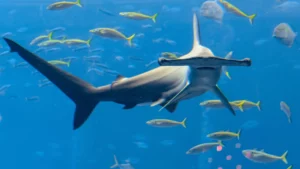 | 2.5–3.5 m (8–12 ft) | Low | Occasional summer visitor off Montauk in warm yearsThreatened; must be released. A sign of warming water when it appears. |
Tiger SharkGaleocerdo cuvier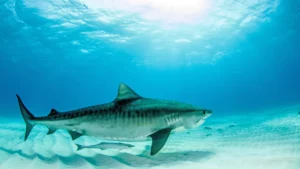 | 3–4.5 m (10–15 ft) | Low | Rare offshore visitor in August and SeptemberHooked off Montauk in the warmest weeks of some years. Never recorded near a New York beach. |
Blacktip SharkCarcharhinus limbatus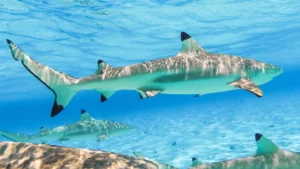 | 1.5–2.5 m (5–8 ft) | Low | Increasingly caught off the south shore in late summerA southern species at the northern edge of its range; still uncommon here. |
Chain CatsharkScyliorhinus retifer | 40–50 cm (1.5 ft) | Low | Deep water on the outer shelf and Hudson CanyonA small, chain-patterned bottom shark that glows under blue light. Trawl bycatch, never seen from shore. |
Bull SharkCarcharhinus leucas | 2.1–3.4 m (7–11 ft) | n/a | Rare straggler off Long Island; no confirmed Hudson River recordListed because it is asked about constantly. The viral 2020 Hudson sighting was never confirmed as a bull shark. |
Species that are asked about but do not belong here: reef sharks of any kind, nurse sharks, lemon sharks and hammerheads of the tropical kind are Florida animals and do not reach New York except as summer stragglers. Bull sharks are the most persistent rumour. They are recorded off Long Island only rarely, and despite a 2020 sighting near the Hudson-Athens lighthouse that went viral, there is no confirmed bull shark from the Hudson River, which is too cold for the species most of the year. Sand tigers, which have a similar heavy-bodied look from a boat, explain most of the reports. Whale sharks have been photographed off Montauk in warm-water years but are a once-a-decade event.
Where to see sharks in New York
New York's inshore water is green and cool, so most sightings happen from a boat, a drone feed or through glass. These are the places that reliably produce sharks.
- Montauk Point and the Montauk charter fleetThe shark fishing capital of the north-east since the 1950s. Charters run 15–60 km out from June to October for blue sharks, shortfin makos (now catch-and-release only) and threshers, and the odd tiger or hammerhead in the warmest weeks. Juvenile great whites are tagged in the same water each summer.
- Great South Bay and Fire Island (Robert Moses to Smith Point)Since 2015 biologists have been catching and tagging juvenile sand tiger sharks inside Great South Bay every summer: the bay is a nursery. On the ocean side, Robert Moses, Kismet, Ocean Beach and Smith Point produced most of the 2022–2023 bites. Watch the bunker slicks from the beach and you will see fins.
- Jones Beach State Park and WantaghThe busiest state beach and the site of the two most recent records, a 2025 bite at Wantagh and a small bite from a young sand tiger in July 2026. The drone patrols close the water several times a summer when sharks are spotted inside the sandbar.
- Rockaway Beach, QueensNew York City's own surf beach, where a wader was bitten on the thigh in August 2023 and lifeguards routinely spot sharks feeding in the bunker schools off Beach 59th to 90th Street. The city added drones in 2023.
- Shinnecock Inlet and the Hamptons ocean beachesStrong tides pull bait through the inlet and sandbar, dusky and thresher sharks feed just outside it in summer. Surfcasters hook sandbar and sand tiger sharks from Southampton to Westhampton on August nights.
- Hudson Canyon and the shelf edgeThe offshore ground, 150 km out. Blue sharks in hundreds, makos, threshers, basking sharks in spring and the occasional whale shark in late summer. Long-range charters leave from Montauk, Freeport and Captree.
- New York Aquarium, Coney IslandThe Ocean Wonders: Sharks! building on the boardwalk holds sand tiger, sandbar and nurse sharks with rays and local species in a 57,500 square foot exhibit that also explains the Hudson Canyon and the New York Bight. The Wildlife Conservation Society runs the Great South Bay sand tiger research from here.
- Long Island Aquarium, RiverheadThe only place in the state to cage dive: a caged descent into a 450,000 litre tank of sand tiger, nurse and sandbar sharks, no certification required. Real ocean cage diving does not exist in New York.
For a wild shark with no boat, stand on the Fire Island beaches at dawn in August and look for the dark bunker slicks: sand tigers and sandbar sharks feed on the surface edge of them. For the big offshore species it is a Montauk charter between July and September, and for a guaranteed close look, Coney Island.
Best time of year to see sharks in New York
New York's sharks are almost all summer visitors. The ocean off Long Island falls to 3–6 °C in February, colder than most shark species will tolerate, and climbs to 20–24 °C by August. The calendar follows the thermometer.
- December to April: the beach is empty of sharks. Spiny dogfish and porbeagles remain on the shelf in the cold water, and a small winter porbeagle fishery works the shelf. Great whites pass through on migration but stay far offshore.
- May and June: the arrival. Basking sharks surface-feed along the shelf edge in May, sand tigers and sandbar sharks move into the bays as they pass 15 °C, and the first blue sharks and makos appear off Montauk in early June.
- July and August: peak season for everything and the months in which nearly every beach incident in the state's modern record has occurred. Bunker schools press against the south shore, juvenile white sharks feed off Montauk and the Hamptons, and threshers work the bait offshore.
- September and October: the water is still 18–20 °C and the fishing is at its best as fish fatten before leaving. Sand tigers and duskies migrate south past the beaches; by early November they are gone.
If you want to see a shark from the sand, go to Fire Island or Jones Beach on a calm August morning. If you want to catch one, book Montauk for July.
Shark attacks in New York: what the record shows
New York's list is the oldest on the site, opening with a swimmer between Manhattan and the Bronx in 1642, and it is dominated by the nineteenth century, when sharks followed the slaughterhouse waste into the East River and bathers went in anyway. The SharkSider database holds 50 records for the state, 32 of them from 1900 onwards. Four were fatal, the earliest in 1642 and the rest in the 1800s; the last deaths were in Brooklyn and the East River in August 1878. The full list is on the shark attacks in New York page, updated weekly. These are the six most recent records:
- 2026 · Jones Beach State Park Long IslandSwimming — Small bite right footBaby Sand Tiger shark
- 2025 · WantaghSwimming — Lacerations to lower left foot and legSand Tiger shark
- 2023 · RockawayWading — Laceration to left posterior thighSpecies not identified
- 2023 · Cherry Grove, Suffolk CountyStanding — Puncture wounds to thigh4' shark
- 2023 · Fire Island Pines, Suffolk CountySwimming — Injury to right hand3' shark
- 2023 · Quogue Village Beach, Suffolk CountySwimming — Laceration to right kneeSpecies not identified
The modern record is a story of the last five summers. Between 1900 and 2019 the state logged 17 records, fewer than one a decade in most decades. Then came one in 2021, six in 2022, six in 2023, and one each in 2025 and 2026. Suffolk County, which is Fire Island, Robert Moses, Smith Point and the Hamptons, holds 11 of the recent records, Nassau County two, and Rockaway in Queens three across the whole record. Swimmers and waders account for 26 records overall, surfers and boarders for 8. Two of the 2022 cases involved lifeguards on training exercises at Smith Point and Ocean Beach, bitten during the exercises.
What bites people here is small. Where a species was identified it was a sand tiger shark in five cases (one logged as a “baby”), a blue shark once, and an unidentified “sand” shark once; the estimated sizes run from 1 to 2 m. The injuries match: puncture wounds to a foot, a cut to a heel, a laceration to a hand or knee, all treated and released the same day. There is no case in the state's modern record of a bite from a great white, a tiger or a bull shark, and none of the recent cases came close to being life-threatening. Our guide on how to survive a shark attack covers the first aid that matters for this kind of bite.
Is it safe to swim at Long Island and New York City beaches?
Yes. The species biting people on Long Island is a fish-eater with a mouth built for gripping bunker, and every recent injury was the result of a swimmer being inside a feeding school in turbid water. The rules that follow are the same ones the state park lifeguards use. Do not enter the water at dawn or dusk, when sand tigers move into the surf to feed. Stay out of and away from bunker schools; a dark, oily slick on the surface with birds over it is a dinner table, not a swimming spot. Swim in front of a lifeguard stand, because those beaches have drone cover and will clear the water if a shark is seen inside the bar. Avoid swimming near surfcasters at night and keep dogs out of the surf when fish are being cleaned.
Sand tigers themselves are not aggressive animals. Divers on the New Jersey and Long Island wrecks spend whole dives beside them, and the aquarium in Riverhead puts untrained visitors in a cage with them every day. The bites happen because a surf zone full of bunker and swimmers is a confusing place for an animal that hunts by feel and smell. Sandbar and dusky sharks, the other two beach species, are shyer still.
The offshore sharks are a different world. Blue sharks and makos will approach a boat and a hooked fish with confidence, and anyone who goes into the water on a Montauk charter, to free a line or take a photograph, is doing something the captains discourage for good reason. Basking sharks, the largest animals in New York waters, are filter feeders and will let a boat drift beside them without concern.
Shark conservation in New York
New York's sharks are recovering, and the reasons are specific. The 2019 menhaden purse-seine ban rebuilt the food supply along the whole south shore. Federal rules that took sand tiger and white sharks off the table in 1997, dusky sharks in 2000 and shortfin makos in 2022 removed the fishing pressure on the species most often seen from the beach. The Clean Water Act decades earlier turned the Hudson estuary from an open sewer back into a nursery for the striped bass and bunker the sharks follow. The result is that a sand tiger nursery inside Great South Bay, unknown to science until 2015, now yields tagged juveniles every summer, and a white shark nursery sits within sight of Montauk lighthouse.
Not every trend runs the right way. The shelf-edge longline and gillnet fisheries still take blue sharks, threshers and porbeagles, some as bycatch; the shark tournaments that made Montauk famous have moved largely to catch-and-release but still land big makos and threshers for the scales. Warming water is pushing southern species north and compressing the season for cold-water animals such as the porbeagle and the spiny dogfish. If you fish, release sand tigers, duskies and makos in the water without lifting them, and report tagged sharks. If you swim, the drones and closures are on your side: they protect the sharks from panicked reactions as much as they protect people. Our page on why sharks are endangered explains the wider picture.
Sharks in nearby states
Long Island's sharks belong to the whole New York Bight. New Jersey shares the same sand tiger, sandbar and dogfish populations and adds the wreck-diving grounds where divers meet them face to face. Across the Sound, Connecticut and Rhode Island have the same species in cooler water, and Massachusetts is where Long Island's juvenile great whites go as adults, to hunt seals off Cape Cod. To the south, Delaware and Maryland host the Delaware Bay sandbar nursery and the Ocean City mako fleet. The white sharks tagged off Montauk have been tracked to Canada's Nova Scotia coast and back. For the rest of the map, start with sharks around the world.
Frequently asked questions
Are there sharks in New York?
Yes. Sixteen species have a solid record in New York waters, plus the bull shark as a rare, unconfirmed straggler. Sand tiger, sandbar and dusky sharks feed along the Long Island beaches in summer, smooth and spiny dogfish are everywhere, and blue sharks, makos, threshers and basking sharks live offshore. Juvenile great whites use the water off Montauk as a nursery.
How many shark attacks have there been in New York?
The SharkSider database holds 50 records for New York from 1642 to 2026, 32 of them since 1900. Four were fatal, all before 1900; nobody has died from a shark bite in the state since 1878. Fifteen of the records come from the 2020s, six each in 2022 and 2023, and every one was a minor bite to a foot, leg or hand.
Why are there suddenly shark bites on Long Island?
Because the food came back. A 2019 state ban on purse seining for menhaden let the bunker schools rebuild along the south shore, and sand tiger and sandbar sharks now feed in the surf where the bait presses against the beach. Warmer summers and record beach crowds put swimmers in the same water. The bites are small and none has been serious.
Are there great white sharks in New York?
Yes. The New York Bight off Montauk and the Hamptons is a nursery for juvenile great whites, confirmed when biologists tagged pups there in 2016. Adults pass through on migration between Cape Cod and the Carolinas. No New York bite has ever been attributed to a great white; the animals near the beaches are 1.5–2.5 m juveniles feeding on fish.
Are there bull sharks in New York or the Hudson River?
Only as a rare straggler off Long Island. There is no confirmed bull shark from the Hudson River; the 2020 sighting near the Hudson-Athens lighthouse was never identified, and the river is too cold for the species for most of the year. Most reports of bull sharks in New York turn out to be sand tiger or sandbar sharks.
Is it safe to swim at Jones Beach, Robert Moses and Rockaway?
Yes. The state park and city beaches have drone and jet-ski patrols and lifeguards clear the water when a shark is seen inside the sandbar. Avoid dawn and dusk, stay out of bunker schools and away from surfcasters, and swim in front of a lifeguard stand. Every recent bite was minor and treated the same day.
Does the New York Aquarium have sharks?
Yes. The Ocean Wonders: Sharks! building on the Coney Island boardwalk houses sand tiger, sandbar and nurse sharks with rays and local fish in a 57,500 square foot exhibit built around the New York Bight and Hudson Canyon. The Long Island Aquarium in Riverhead also offers a cage dive in its shark tank.
What is the most common shark in New York?
By numbers it is the dogfish: smooth dogfish in the bays in summer and spiny dogfish in the Sound and on the shelf in winter, both harmless. Among the larger sharks the sand tiger is the one most often seen and caught from the south-shore beaches, followed by the sandbar shark.
When is the best time to see sharks in New York?
July and August, when the ocean reaches 20–24 °C and sand tigers, sandbar sharks and duskies feed on bunker along the south shore. Offshore the Montauk charter season for blue sharks, makos and threshers runs from June to October, and basking sharks surface along the shelf in May and June.
Can you go shark fishing from Montauk?
Yes. Montauk has been the shark-fishing capital of the north-east since the 1950s and charters run from June to October for blue sharks, threshers and makos. Shortfin makos have been catch-and-release only since 2022, and sand tiger, white and dusky sharks must always be released. Most tournaments now score by tag and release.
References

A small team focused on researching sharks and making marine biology easy to understand. Every page is reviewed against current species records and the SharkSider attack database, and updated when new incidents or research appear.
Published November 30, 2022 · Last updated September 22, 2026 · Incident data from the SharkSider attack database (32 records for New York, 0 fatal).


