
Yes, there are sharks in New Hampshire, though nearly all of them live well offshore in the Gulf of Maine. Eleven species have a reliable record. Off the beaches the only sharks a swimmer might share the water with are the spiny dogfish and the smooth dogfish; blue sharks, porbeagles, shortfin makos, threshers and basking sharks live on the shelf around Jeffreys Ledge and the Isles of Shoals, and white sharks are detected off Hampton and Rye in most summers.
The safety record could not be shorter. The SharkSider database holds no shark incident of any kind for New Hampshire, and the International Shark Attack File has never logged one either: not a bite, not a death, not a bump in the state's history. Water of 15–19 °C in August keeps the tropical species away and keeps most bathers close to shore; the nearest real incidents are in neighbouring Maine and Massachusetts.
- Shark species in this list11 recorded
- ProtectionWhite, basking, sand tiger & dusky prohibited; federal fin ban 2022
- Most seen from the beachSpiny dogfish
- Signature encounterBasking sharks over Jeffreys Ledge, June–September
- Incidents in the database0 (none ever recorded)
- Water temperature2–4 °C in Feb, 15–19 °C in Aug

On this page
- Why New Hampshire's sharks stay offshore
- List of the different types of sharks in New Hampshire
- Where to see sharks in New Hampshire
- Best time of year to see sharks in New Hampshire
- Shark attacks in New Hampshire: what the record shows
- Is it safe to swim at New Hampshire beaches?
- Shark conservation in New Hampshire
- Sharks in nearby states
- Frequently asked questions
- References
Why New Hampshire's sharks stay offshore
Everything about New Hampshire's sharks follows from the Gulf of Maine. The Gulf is a semi-enclosed sea walled off from the warm Atlantic by Georges Bank and fed from the north by the cold Labrador Current, so its water is colder than the latitude suggests: 2–4 °C off Hampton Beach in February and only 15–19 °C at the height of August, when Rhode Island's beaches are at 23 °C. That rules out the warm-water coastal sharks of the states to the south. Sandbar sharks, duskies, hammerheads and the sand tigers that bite bathers on Long Island are either absent or rare stragglers here. What the Gulf has instead is food: enormous tides, deep basins and shallow ledges that force nutrients to the surface and feed herring, mackerel, sand lance and the plankton blooms of early summer. The sharks that thrive on that menu are the cold-tolerant ones, and they are mostly animals of the open shelf.
The state's small piece of that shelf is well organised. Six miles out lie the Isles of Shoals, nine rocky islands shared with Maine, with a harbour seal haul-out on Duck Island and the Shoals Marine Laboratory on Appledore. Twenty miles out is Jeffreys Ledge, a 33-mile glacial ridge rising to within 50 m of the surface, where herring and krill concentrate and the whale-watch boats from Rye Harbor find humpbacks, finbacks, basking sharks and blue sharks on the same trip. Inshore, the coast is short and mostly sand and rock, from Seabrook and Hampton Beach in the south past Rye and the Isles to Portsmouth Harbor and the fast tidal Piscataqua River, which drains Great Bay, a large inland estuary that spiny dogfish enter but no other shark uses.
The change of the last decade is the white shark. Grey and harbour seal numbers have grown all along northern New England, and the white sharks that hunt them off Cape Cod have extended their summer range north. Acoustic receivers maintained off Hampton, Rye and Seabrook by the state's Fish and Game Department with the Atlantic White Shark Conservancy now log tagged white sharks passing the beaches in most summers, and the July 2020 death of a swimmer at Bailey Island in Maine, the first fatal shark attack ever recorded in that state, made New Hampshire's lifeguards take the detections seriously. The animals are still few, still mostly passing through, and still a long way from the record of Cape Cod, but they are no longer a curiosity.
List of the different types of sharks in New Hampshire
Eleven species have a solid record in New Hampshire's waters, counting the Gulf of Maine shelf out to Jeffreys Ledge. Sizes are typical adults rather than record fish, and the risk column is about swimmers on the beaches, where in practice only the two dogfish are ever present. A note on names: the dogfish New Hampshire fishermen curse is the spiny dogfish, the mackerel shark of old Gulf of Maine accounts is the porbeagle, and the sleeper shark hauled up now and then from the deep basins is the Greenland shark.
| Species | Adult size | Risk to swimmers | Where in New Hampshire & notes |
|---|---|---|---|
| Spiny DogfishSqualus acanthias | 0.8–1.1 m (2.5–3.5 ft) | Low | Everywhere from the beaches to Jeffreys Ledge, May–OctoberBy far the most abundant shark in New Hampshire and the Gulf of Maine, in schools of thousands. Its venomous dorsal spines are an angler's problem, not a swimmer's. |
| Smooth DogfishMustelus canis | 0.9–1.3 m (3–4 ft) | Low | Inshore in the warmest weeks, Hampton Harbor to PortsmouthA summer visitor at the northern edge of its range; a crab-eater with flat teeth. |
Blue SharkPrionace glauca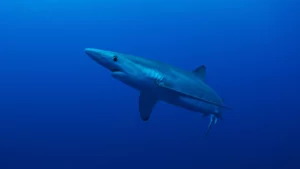 | 2–3 m (7–10 ft) | Low | Offshore, Jeffreys Ledge and beyond, June–OctoberThe standard catch of the Rye Harbor and Hampton charters; tagged in numbers and almost always released. |
Shortfin Mako SharkIsurus oxyrinchus | 2–3 m (7–10 ft) | Low | Warm shelf water in late summer, well offshorePresent in warm years on the outer edge of its range; no-retention in the Atlantic since 2022. |
Porbeagle SharkLamna nasus | 1.5–2.5 m (5–8 ft) | Low | Cold shelf water in every season; the Gulf of Maine is its strongholdNew Hampshire's signature shark: a warm-bodied mackerel shark that thrives at 8–15 °C. Fished down twice, now slowly recovering. |
Common Thresher SharkAlopias vulpinus | 3–4.5 m (10–15 ft) including the tail | Low | Jeffreys Ledge and the Isles of Shoals on herring and mackerel, summerOccasionally seen leaping from the whale-watch boats. Harmless. |
Basking SharkCetorhinus maximus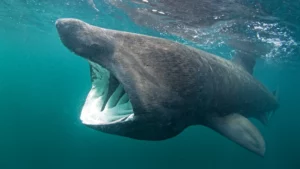 | 6–8 m (20–26 ft) | Low | Jeffreys Ledge and around the Shoals, June–SeptemberA plankton-feeding giant and the most reliable big shark sighting off the state. Endangered globally, protected here. |
Great White SharkCarcharodon carcharias | 3.5–5 m (11–16 ft) adults; many detections are 2.5–3.5 m | Moderate | Isles of Shoals seal haul-outs; detected off Hampton, Rye and Seabrook in summerTagged animals from Cape Cod and Nova Scotia pass through, and sightings are rising with seal numbers. No New Hampshire incident, ever. |
Sand Tiger SharkCarcharias taurus | 2–3 m (7–10 ft) | Low | Rare summer straggler inshore, warm years onlyCommon south of Cape Cod, with a juvenile nursery in Plymouth Bay; only occasional records this far north. Prohibited species. |
Sandbar SharkCarcharhinus plumbeus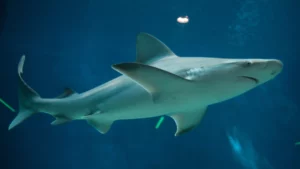 | 1.5–2.2 m (5–7 ft) | Low | Rare, warm-year visitor to inshore watersAt the far northern edge of its range; New Hampshire records are exceptional, and there are none from any lake. |
Greenland SharkSomniosus microcephalus | 3–5 m (10–16 ft) | Low | Deep, cold basins of the Gulf of Maine, 200 m and moreThe Arctic sleeper shark, hauled up occasionally by Gulf of Maine trawlers and longliners. Never near a beach. |
Longfin Mako SharkIsurus paucus | 2.5–4 m (8–13 ft) | n/a | Not confirmed off New HampshireListed on the old page; a slow, deep-water tropical species with no verified Gulf of Maine record off this state. |
The original version of this page needs three corrections. It claimed that Lake Winnipesaukee, the state's largest lake, holds sandbar, tiger and basking sharks. It holds none: Winnipesaukee is a freshwater lake 500 ft above sea level with no connection to the ocean that a fish could use, and no shark of any species has ever lived in it. The only sharks in New Hampshire fresh water are in aquarium tanks. The tiger shark is not recorded off New Hampshire at all; it is a warm-water species that rarely passes Cape Cod. And the longfin mako, listed at 12–14 ft and “highly aggressive”, is a slow, deep-water tropical shark with no verified record off this state, so it sits in the table as unconfirmed. The bull shark, the species most often asked about, has never been recorded in the Gulf of Maine's cold water either.
Where to see sharks in New Hampshire
With a coast this short, New Hampshire's shark watching happens from boats, and the whale-watch and charter fleets at Rye Harbor and Hampton Harbor do most of it. These are the places where the state's sharks are actually found.
- Jeffreys LedgeThe state's offshore ground, 20 miles out. Whale-watch boats from Rye Harbor see basking sharks feeding at the surface from June to September, and blue sharks follow the same herring and krill. Charter boats fish blue sharks and porbeagles here all summer.
- Isles of ShoalsNine islands six miles off Rye, half in Maine. Duck Island's harbour seal colony is the reason white sharks are detected around the Shoals, and the Shoals Marine Laboratory on Appledore runs summer courses that survey the sharks and seals.
- Hampton Beach State ParkNew Hampshire's biggest and busiest beach, at the mouth of Hampton Harbor. Spiny dogfish are caught from the jetty and the surf, and the acoustic receiver off the beach logs tagged white sharks passing in summer. Swimmers see neither.
- Rye Harbor and Jenness State BeachThe departure point for whale-watch and shark-fishing trips, with a small state beach next door. Blue shark charters leave from here from late June; the harbour's receiver has logged white sharks on their way north.
- Wallis Sands State Beach, RyeA sheltered family beach facing the Isles of Shoals. Dogfish in the summer surf, seals on the rocks in the cooler months, and a clear view of the water where most of the state's white shark detections have been made.
- Seabrook Beach and Hampton HarborThe state's southern corner, one beach from Massachusetts. Hampton Harbor's party boats target dogfish and groundfish; white shark detections off Seabrook have been reported in recent summers.
- Seacoast Science Center, Odiorne Point State Park, RyeThe state's marine centre, with Gulf of Maine touch tanks and exhibits and a reporting line for seal and shark sightings. The best place to learn the local species before a boat trip; no large sharks on display.
If you want to see a shark in New Hampshire, book a whale-watch or a blue shark charter from Rye Harbor between late June and early September: basking sharks and blue sharks are seen on a good share of trips to Jeffreys Ledge, and the whales come free. From the beach, the realistic shark is a spiny dogfish on a fishing line.
Best time of year to see sharks in New Hampshire
The Gulf of Maine's shark season is short. The water off the beaches is 2–4 °C in February, does not reach 10 °C until late May and peaks at 15–19 °C in August; sharks arrive with the warmth and leave with it.
- May to June: spiny dogfish move inshore in vast schools as the water passes 8 °C, and the first basking sharks appear over Jeffreys Ledge as the spring bloom builds. Porbeagles are on the shelf in the cool water.
- July to August: the peak. Blue sharks are reliable on the Ledge and charters run daily in good weather, basking sharks feed at the surface, threshers and the occasional shortfin mako ride the warmest water offshore, and white sharks are logged on the beach receivers as they move between Cape Cod and Maine.
- September to October: the water is at its warmest in early September and the blue sharks and whites linger; by mid-October the dogfish are heading offshore and the season is over.
- November to April: effectively shark-free inshore. Porbeagles and Greenland sharks remain in the cold, deep basins of the Gulf all winter.
Offshore visibility over the Ledge is a clean 10–15 m on calm summer days; inshore it is a green 3–5 m, and there is no shark diving of any kind in the state.
Shark attacks in New Hampshire: what the record shows
New Hampshire is one of the few coastal states with no shark incident in the record at all. The SharkSider database, which tracks every reported case worldwide and is updated weekly, holds nothing for the state, and the International Shark Attack File at the Florida Museum has never logged a New Hampshire case either. The national list is on the shark attacks in the USA page.
No incidents are recorded in the SharkSider database for this country.
There is no mystery about why. The state has 18 miles of coast, a swimming season of about ten weeks, water that rarely passes 19 °C, and a shark fauna in which the only species that comes within reach of a bather is the dogfish. The sharks that bite people elsewhere in New England, small sand tigers in the surf off Long Island and Rhode Island, and white sharks around the seals of Cape Cod and Maine, are either rare stragglers here or animals that pass the beaches without stopping. The cold does the rest: swimmers at Hampton Beach spend minutes in the water, not hours, and the surf zone is shallow sand with no seal rookeries on it.
The neighbouring record shows what the risk would look like if it ever arrived. In September 2018 a bodyboarder was killed by a white shark at Newcomb Hollow Beach in Wellfleet on Cape Cod, the first fatal attack in Massachusetts since 1936, and in July 2020 a swimmer was killed by a white shark off Bailey Island in Harpswell, the first fatal attack ever recorded in Maine. Both happened near seal haul-outs in water New Hampshire shares, and both involved a species now detected off the state's own beaches. That is why New Hampshire lifeguards clear the water on a confirmed sighting and why the state asks beachgoers to report seals and sharks to the Seacoast Science Center. Our guide on how to survive a shark attack explains what a white shark bite involves and why stopping the bleeding in the first minutes matters more than anything else.
Is it safe to swim at New Hampshire beaches?
Yes, and the sharks are the least of the hazards. No one has ever been bitten by a shark in New Hampshire, the only sharks in the surf are dogfish, and a spiny dogfish's two mildly venomous dorsal spines are a problem for the angler unhooking it, not for a swimmer. Rip currents at Hampton Beach and the cold itself, which can take an unprepared swimmer's breath away even in August, cause far more rescues every summer than sharks ever have. Smooth dogfish, present in the warmest weeks, have flat teeth for crushing crabs and cannot wound a person.
The white shark detections change the advice only slightly. Stay out of the water at dawn and dusk; keep well away from seals, and get out if one is swimming near you, because a white shark hunting a seal cannot tell a person on a board from its prey; avoid swimming off the rocky points and around the Isles of Shoals where the seals haul out; and if lifeguards close the beach after a sighting, wait the hour. Kayakers and paddleboarders heading to the Shoals are the group most exposed and should stay in company and away from the seal rocks. Snorkelling in New Hampshire is a cold-water pastime in 3–5 m of visibility, best in a wetsuit around Odiorne Point and the Rye ledges, and it will show you lobsters, cunner and kelp rather than sharks. There is no shark diving in the state; the nearest is the blue shark cage trips out of Point Judith in Rhode Island.
Shark conservation in New Hampshire
New Hampshire's Fish and Game Department manages its marine fisheries under the Atlantic States Marine Fisheries Commission's coastal shark plan and NOAA's highly migratory species rules, and since 2011 every saltwater angler has needed the state's recreational saltwater licence. White, basking, sand tiger, dusky, bigeye thresher and the other listed species are prohibited and must be released; shortfin makos have been no-retention in the Atlantic since July 2022; and blue sharks, threshers and porbeagles may be kept only within the federal limits, with fins attached, by anglers holding the free federal HMS permit. The state never had a fin-trade law of its own, but the federal Shark Fin Sales Elimination Act of December 2022 closed that gap for every state.
The Gulf of Maine's sharks have been through two collapses and one recovery. Porbeagles were fished down by Norwegian longliners in the 1960s within a few years of the fishery opening, recovered partly, and were fished down again in the 1990s; the north-west Atlantic stock is now under a rebuilding plan measured in decades. Spiny dogfish crashed in the late 1990s under a directed fishery and were rebuilt by 2010 under strict quotas, which is why they are abundant again and why fishermen complain about them. The basking shark, listed as Endangered by the IUCN, is protected in US waters and its Jeffreys Ledge aggregations are among the most reliable in the western Atlantic. The larger worry now is the Gulf itself, which has warmed faster than almost any other patch of ocean over the past two decades; the herring and the cold-water plankton that feed porbeagles and basking sharks are shifting north, and southern species are moving in behind them. Our page on why sharks are endangered explains why slow-breeding sharks such as the porbeagle, which does not mature until it is eight to thirteen years old, take so long to come back.
Sharks in nearby states
New Hampshire's sharks belong to the whole Gulf of Maine. Maine, with 3,500 miles of coast against New Hampshire's 18, has the same species in far greater numbers plus the 2020 Bailey Island fatality, and Massachusetts holds Cape Cod, the white shark capital of the Atlantic seaboard and the source of most of the animals detected off Hampton and Rye. South of the Cape the water warms and the list changes: Rhode Island and Connecticut have sand tigers and sandbar sharks inshore, and New York's Long Island beaches record the small sand tiger bites that the Gulf of Maine never sees. The porbeagles and blue sharks tagged off Jeffreys Ledge range north to Nova Scotia and the Gulf of St Lawrence, which is why Canada's shark page reads so much like this one. Every other coast we cover is listed in sharks around the world.
Frequently asked questions
Are there sharks in New Hampshire?
Yes, eleven species are recorded, but almost all of them live offshore in the Gulf of Maine. Spiny and smooth dogfish are the only sharks near the beaches; blue sharks, porbeagles, basking sharks, threshers and the occasional mako are found around Jeffreys Ledge and the Isles of Shoals, and white sharks pass the coast in summer.
Has there been a shark attack in New Hampshire?
No. The SharkSider database and the International Shark Attack File both hold zero incidents for New Hampshire, with no bite, injury or death in the state's history. The nearest cases are the 2018 fatality at Wellfleet on Cape Cod and the 2020 fatality at Bailey Island in Maine, both involving white sharks near seal colonies.
Are there great white sharks in New Hampshire?
Yes, in small numbers. Acoustic receivers off Hampton, Rye and Seabrook log tagged white sharks passing the coast in most summers, drawn by the seal haul-outs at the Isles of Shoals and along the Maine border. They are animals tagged off Cape Cod and Nova Scotia moving between the two, and none has ever bitten anyone in New Hampshire.
Are there sharks in Lake Winnipesaukee?
No. Lake Winnipesaukee is a freshwater lake about 500 ft above sea level with no navigable link to the ocean, and no shark has ever lived in it. Claims that it holds sandbar, tiger or basking sharks are false; none of those species enters fresh water anywhere, and the tiger shark is not recorded off New Hampshire at all.
Is it safe to swim at Hampton Beach?
Yes. No shark has ever bitten anyone in New Hampshire, and the only sharks in the surf are harmless dogfish. Rip currents and cold water are the real hazards at Hampton Beach. If a white shark is confirmed nearby, lifeguards clear the water for an hour; stay away from seals and avoid swimming at dawn and dusk.
What is the most common shark in New Hampshire?
The spiny dogfish, a metre-long shark that moves inshore in schools of thousands from May to October and is caught from every jetty and party boat in the state. Offshore, the blue shark is the everyday species of the charter fleet, and the basking shark is the big one seen from the whale-watch boats over Jeffreys Ledge.
When is the best time to see sharks in New Hampshire?
July to early September. Blue sharks are reliable on Jeffreys Ledge, basking sharks feed at the surface, and white sharks are logged on the beach receivers. Late May and June are good for basking sharks and porbeagles in the cool water. From November to April the inshore waters are effectively shark-free.
Where can I see sharks in New Hampshire?
From a boat. Whale-watch and shark-fishing trips out of Rye Harbor and Hampton Harbor reach Jeffreys Ledge, where basking sharks and blue sharks are seen on many summer trips. The Isles of Shoals are the white shark area. On land, the Seacoast Science Center at Odiorne Point has Gulf of Maine exhibits but no large sharks.
Can you fish for sharks in New Hampshire?
Yes, with a state saltwater licence and, for offshore trips, the free federal HMS permit. Blue sharks, threshers and porbeagles may be kept within federal limits with fins attached. White, basking, sand tiger and dusky sharks are prohibited and must be released, and shortfin makos have been no-retention in the Atlantic since 2022.
Are there bull sharks or tiger sharks in New Hampshire?
No. Both are warm-water species and neither has a confirmed record in the Gulf of Maine, where summer water rarely passes 19 °C. The old version of this page listed tiger sharks in Lake Winnipesaukee, which is impossible. The warmest-water sharks that genuinely reach New Hampshire are the occasional shortfin mako and sandbar shark in a hot August.
References

A small team focused on researching sharks and making marine biology easy to understand. Every page is reviewed against current species records and the SharkSider attack database, and updated when new incidents or research appear.
Published November 30, 2022 · Last updated September 22, 2026 · Incident data from the SharkSider attack database (0 records for New Hampshire, 0 fatal).


