
Yes, there are sharks in Maine: about 12 species have a solid record in the Gulf of Maine. The ones you are most likely to encounter are the spiny dogfish, the porbeagle, the blue shark, the basking shark and, increasingly, the white shark, with shortfin makos and threshers on the offshore banks in summer.
The record is very short and very recent. The SharkSider database holds 2 incidents for Maine, both since 2010, one of them fatal: a scuba diver whose camera was bitten by a porbeagle near Eastport in 2010, and the swimmer killed by a white shark at Bailey Island on 27 July 2020. Against tens of millions of beach visits, that is one of the lowest rates on the Atlantic coast, but the 2020 death is the reason Maine now takes its sharks seriously.
- Shark species in this guide12 confirmed
- White shark protected since1997 (federal Atlantic waters)
- Most seen from the beachBasking shark (fins, Jun–Sep)
- Signature encounterPorbeagles and blues on Jeffreys Ledge
- Incidents in the database2 (2010–2020), 1 fatal
- Water temperature3–20 °C (37–68 °F)

On this page
- Where Maine's sharks live: the Gulf of Maine and its seals
- List of the different types of sharks in Maine
- Where to see sharks in Maine
- Best time of year to see sharks in Maine
- Shark attacks in Maine: what the record actually shows
- Is it safe to swim in Maine?
- Shark conservation in Maine
- Sharks in nearby states
- Frequently asked questions
- References
Where Maine's sharks live: the Gulf of Maine and its seals
Maine's 3,500 miles of tidal shoreline all face one body of water, the Gulf of Maine, a semi-enclosed sea walled off from the open Atlantic by Georges Bank and Browns Bank. Cold water from the Scotian Shelf flows in around Nova Scotia, the Bay of Fundy's tides stir it, and the result has always been a cold, rich, foggy sea full of herring, mackerel, sand lance and the groundfish that built the state's fishing towns. That richness is why the Gulf holds a large share of the western Atlantic's porbeagles, a summer influx of blue sharks and makos along the shelf edge, basking sharks filtering the plankton off Monhegan, and more spiny dogfish than any other fish of their size. The Gulf's temperature, from about 3 °C in March to 18–20 °C at the beaches in August, sets the calendar: the warm-water sharks arrive in June and leave in October, and only the porbeagle, the dogfish and the deep-water species stay all year.
The newest arrival is really a return. Grey seals, hunted to near-absence from New England by bounty programmes, have recolonised Maine's outer islands since the Marine Mammal Protection Act of 1972, and harbour seals now haul out on ledges in every bay from Kittery to Eastport. White sharks follow seals, and since the 2010s the growing Cape Cod population has been detected further and further up the coast each summer. Maine's Department of Marine Resources began deploying acoustic receivers in 2020 and has since logged tagged white sharks from Wells and Old Orchard Beach to Casco Bay, Penobscot Bay and beyond, most of them subadults and adults passing through between June and October. They are not common, they are not resident, and they are not new; what has changed is that the state can now see them.
List of the different types of sharks in Maine
The table lists every species with a dependable record in Maine waters, from the dogfish that every lobsterman curses to the deep-water sharks that only the offshore fleet meets. Sizes are typical adults rather than record fish. The risk column is about swimmers at Maine's beaches; anglers and divers who handle a shark are a different matter. Two naming notes: the “smooth dogfish” of southern Maine is the dusky smoothhound, Mustelus canis, a toothless crab-eater, and the porbeagle is sometimes called a “mackerel shark” on the docks.
| Species | Adult size | Risk to swimmers | Where in Maine & notes |
|---|---|---|---|
| Spiny DogfishSqualus acanthias | 0.8–1.2 m (2.5–4 ft) | Low | Everywhere in the Gulf of Maine, inshore from May to NovemberThe most abundant shark in Maine and the bane of every bait bag. Harmless in the water; a mildly venomous spine on each dorsal fin catches anglers' hands. |
Porbeagle SharkLamna nasus | 2–2.5 m (6.5–8 ft) | Low | All year; inshore Downeast and on the offshore banks, most in summerMaine's cold-water resident, a warm-bodied cousin of the white shark that pups in the Gulf of Maine. One record: a camera bitten near Eastport in 2010. |
Blue SharkPrionace glauca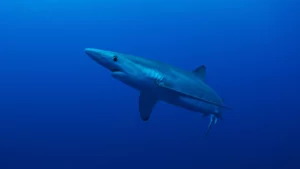 | 2–3 m (7–10 ft) | Low | Jeffreys Ledge and Platts Bank, Jul–SepThe shark charter boats find in numbers. Slender, curious and unrecorded in any Maine incident. |
Great White SharkCarcharodon carcharias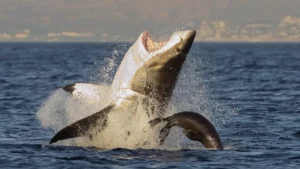 | 4–5.5 m (13–18 ft) | High | Along the whole coast near seal ledges, Jun–Oct; detected yearly since 2020Responsible for the state's only fatal attack, at Bailey Island in July 2020. A seasonal visitor from the Cape Cod population, protected in US Atlantic waters since 1997. |
Basking SharkCetorhinus maximus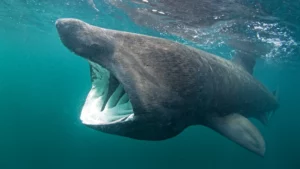 | 6–8 m (20–26 ft) | Low | Surface waters off Monhegan, Casco Bay and Mount Desert, Jun–SepThe second-largest fish in the sea, a plankton feeder and the source of most 'great white' reports from Maine beaches. |
Shortfin Mako SharkIsurus oxyrinchus | 2.5–3.5 m (8–11 ft) | Low | Warm offshore water on the banks, Jul–SepThe fastest shark, and no longer a legal catch: retention has been banned in US Atlantic fisheries since 2022. The old label of highly aggressive has no Maine basis. |
Common Thresher SharkAlopias vulpinus | 3–5 m (10–16 ft) including the tail | Low | Offshore and occasionally in the outer bays, Jul–OctWhips schooling herring and mackerel with its tail. Sometimes seen leaping off Casco Bay in late summer. Harmless. |
Sand Tiger SharkCarcharias taurus | 2–3 m (7–10 ft) | Low | Rare summer visitor to the bays of southern MaineFierce-looking, sluggish and protected since 1997. Gentle because of its temperament, not the size of its mouth. |
| Smooth Dogfish (Dusky Smoothhound)Mustelus canis | 0.9–1.2 m (3–4 ft) | Low | Southern Maine bays in the warmest weeks of summerA crab-eating houndshark with flat pavement teeth. Cannot hurt a person. |
Smooth Hammerhead SharkSphyrna zygaena | 2.5–3.5 m (8–12 ft) | Low | Rare late-summer stray to the outer coast in warm yearsThe one hammerhead that tolerates cool water; a handful of Gulf of Maine records, none near a beach. |
Greenland SharkSomniosus microcephalus | 3–5 m (10–16 ft) | Low | Deep, cold basins of the Gulf of Maine, all yearThe Arctic's slow giant at the southern end of its range, caught occasionally by the groundfish fleet. Lives for centuries. |
Chain CatsharkScyliorhinus retifer | 0.4–0.6 m (1.3–2 ft) | Low | Deep water of the outer Gulf and Georges BankA small, chain-patterned egg-layer that glows under blue light. Brought up by trawlers, never seen from shore. |
One species from the earlier version of this page has to go: the bonnethead is a small, warm-water hammerhead of the Carolinas and the Gulf of Mexico, and there is no record of one in Maine. The earlier table also rated the shortfin mako as highly aggressive, which it is toward a hooked tuna and not toward anyone in the water off Maine, and explained the sand tiger's gentleness by its small mouth, which is neither true nor the reason. The sharks people ask about and will not find here are bull sharks and tiger sharks; both are warm-water animals whose northern limit is well south of Cape Cod. Whale sharks, nurse sharks and blacktips are likewise absent from the Gulf of Maine.
Where to see sharks in Maine
Maine has no cage-diving and little in the way of shark tourism, but the sharks are more visible than they used to be. These are the places where a sighting, a fin or a hooked porbeagle is a realistic hope.
- Jeffreys Ledge and Platts BankThe offshore banks 15 to 30 miles out of Portland and Kennebunkport are the state's shark fishing grounds. From July to September charter boats chumming for blue sharks routinely raise several in a day, with porbeagles, threshers and the occasional mako in the slick. Catch-and-release is the norm and makos must now be released by law.
- Bailey Island, Harpswell and Casco BayThe site of the 2020 fatality and a stretch of coast where white sharks are now detected every summer around the seal ledges of the outer bay. In 2022 a family filmed a juvenile white shark eating a harbour porpoise off Cliff Island. Kayakers see harbour seals everywhere here, which is the reason the sharks come.
- Popham Beach and Reid State ParkTwo of the busiest state park beaches, at the mouth of the Kennebec, and the beaches most often closed to swimming under the purple shark flag since 2021 after fins were seen close to shore. Most sightings turn out to be basking sharks or sunfish; some have been confirmed white sharks.
- Old Orchard Beach and Saco BayMaine's biggest beach resort sits on a shallow bay where acoustic receivers have recorded tagged white sharks passing in summer. Swimmers here are in waist-deep water on a sandy bottom, and the lifeguards now stage sightings the way Cape Cod does.
- Monhegan Island and Muscongus BayThe mid-coast island where basking sharks are most reliably seen from the ferry and from the cliffs in June and July, feeding on the surface in calm weather. Porbeagles are caught by the island's few fishermen, and whale-watching boats out of Boothbay Harbor cross the same water.
- Eastport, Cobscook Bay and Passamaquoddy BayThe far Downeast corner, with the largest tides in the country and cold water even in August. This is porbeagle country: the 2010 incident, a porbeagle biting a diver's video camera at Burnt Cove, happened here, and divers occasionally meet them in the channels.
- Bar Harbor and Mount Desert RockWhale-watching boats out of Bar Harbor heading for Mount Desert Rock's seal and whale grounds record basking sharks, porbeagles and blue sharks through the summer, and the rock's grey seal colony is one of the places white sharks are expected to turn up.
- Maine State Aquarium, West Boothbay HarborThe small aquarium run by the Department of Marine Resources shows Gulf of Maine fish and has touch tanks with skates and, in some seasons, small sharks. It is also the base for the state's shark monitoring work, so the staff know exactly where the summer's detections have been.
For a guaranteed shark, book a blue shark charter out of Portland in August; four or five in a day is normal. For the sight of a lifetime with no boat, stand on the Monhegan cliffs on a windless June morning and look for a basking shark's tail and dorsal fin cutting the surface together.
Best time of year to see sharks in Maine
Maine's shark year is short, warm-water-driven and almost entirely a summer affair.
- June and July: the arrivals. Basking sharks appear first, feeding on the spring plankton bloom off Monhegan and Casco Bay; porbeagles move onto the inshore grounds; the first white sharks are detected off the southern beaches as the water passes 12 °C.
- August and September: the peak. Blue sharks, makos and threshers are on Jeffreys Ledge and Platts Bank, white shark detections along the coast are at their highest, sand tigers and smooth dogfish reach the bays of southern Maine, and the beaches are at their warmest and busiest. Both of the state's recorded incidents fell just either side of this window: late July for Bailey Island and late October for Eastport.
- October and November: the departures. The warm-water sharks head south as the Gulf cools below 12 °C; porbeagles and dogfish remain, and the last white sharks are logged in early November in warm years.
- December to May: the quiet season. Only porbeagles, dogfish, Greenland sharks and the deep-water catsharks are in the Gulf, all of them well away from any beach.
Sea surface temperature runs from around 3 °C (37 °F) in March to 15–20 °C (59–68 °F) at the southern beaches in August, and stays several degrees colder Downeast. The Gulf of Maine has warmed faster than almost any other patch of ocean over the last twenty years, and the longer, warmer summers are the single biggest reason the state's shark season is lengthening.
Shark attacks in Maine: what the record actually shows
Maine's list is two entries long, but one of them is among the most significant in New England's history. The SharkSider database holds 2 incidents for Maine, in 2010 and 2020, one fatal; the full record, updated weekly, is on our shark attacks in Maine page. Both recorded incidents are listed here:
- 2020 · Bailey Island, Cumberland CountySwimming — FatalWhite shark, 11'? · fatal
- 2010 · Burnt Cove near Eastport, Washington CountyScuba diving — No injury to diver, shark bit his video cameraPorbeagle shark, 8'
The two cases could hardly be more different. On 23 October 2010 a scuba diver at Burnt Cove near Eastport, in Washington County, was approached by a porbeagle of about eight feet that bit his video camera and left him untouched; it remains the only known porbeagle encounter of its kind in US waters and is best read as curiosity, not aggression. On 27 July 2020 a 63-year-old woman swimming a short way off Bailey Island in Cumberland County was killed by a white shark estimated at around 11 feet, the first fatal shark attack ever recorded in Maine. State biologists later confirmed the species from a tooth fragment. She was swimming in a wetsuit near a shoreline where seals haul out, in the month and the water temperature at which white sharks are now most often detected, which is precisely the profile of the Cape Cod incidents of 2018.
What the record does not show is a trend. There has been no incident in the five summers since, despite far more eyes on the water, and the acoustic data suggest that white sharks pass along the Maine coast for days at a time without any human noticing. The lesson the state drew is the sensible one: the risk is tiny but no longer zero, it concentrates around seal ledges and river mouths from July to September, and swimmers who stay in shallow water, avoid seals and get out when a fin is reported are as safe as they ever were. Our guide on surviving a shark attack covers what to do in the rare case that advice is not enough.
Is it safe to swim in Maine?
Yes, and it is important to say so plainly. One death in a state that records tens of millions of beach visits a decade is an exceptionally low rate, and Maine's cold water keeps most swimmers in the surf zone where sharks almost never come. The sensible precautions are the ones the state now posts at its beaches: do not swim near seals, do not swim at dawn or dusk, stay close to shore and in groups, avoid murky water near river mouths, and leave the water calmly if a purple flag goes up or a fin is called. Wetsuits and dark fins make a swimmer look more like a seal from below, which is why the 2020 case has changed how open-water swimmers along Casco Bay plan their routes.
Divers and snorkellers have almost nothing to fear. Maine's dive sites are cold, dark and full of dogfish, which will swim through a group of divers without a glance, and the porbeagles that occasionally appear Downeast are inquisitive rather than dangerous, as the 2010 camera incident shows. Basking sharks, which snorkellers sometimes meet off Monhegan and Bar Harbor, are plankton feeders with no teeth worth the name; the only risk is a slap from the tail if you crowd one, so keep a few metres off and never grab a fin.
Anglers are the group that actually gets bitten in Maine, by the sharks they land. A porbeagle or a blue shark on deck has a mouthful of narrow, hooked teeth and a long memory of being pulled through the water; dogfish have a mildly venomous spine in front of each dorsal fin that goes through a rubber glove. Cut the leader on a shark you are releasing, and handle dogfish by the tail with the spines pointed away.
Shark conservation in Maine
Nearly all of the rules that protect Maine's sharks are federal, because most of the Gulf's sharks spend most of their time beyond the three-mile line. White sharks have been a prohibited species in US Atlantic waters since 1997, so no vessel may target or keep one; sand tigers, dusky sharks and basking sharks are on the same list. The porbeagle, which was hammered by Norwegian and Faroese longliners in the 1960s and again in the 1990s, has been managed under a small quota since 2008 and is slowly rebuilding in the Gulf of Maine, one of its most important nurseries in the whole Atlantic. In 2022 the United States prohibited any retention of shortfin makos in Atlantic fisheries after an international stock assessment found the species in steep decline, so a mako caught on Jeffreys Ledge now goes back in the water alive. The federal ban on the sale of shark fins, in force since 2023, closed the last legal market for fins from any of these animals.
Maine's own contribution is monitoring rather than regulation. Since 2020 the Department of Marine Resources has run a coast-wide array of acoustic receivers, shared with the Atlantic White Shark Conservancy and Massachusetts, that logs every tagged white shark passing the state's beaches, and it feeds sightings and detections to lifeguards and the public in near real time. State park beaches adopted the purple shark flag in 2021, and the state now urges anglers to report shark catches and beachgoers to report fins. The pressures that remain are the familiar ones: spiny dogfish are still a commercial target and mature at 12 years or more, blue sharks die on longlines far outside US waters, and the warming of the Gulf of Maine is rearranging the food web faster than any species can adapt. Seals, whose recovery brought the white sharks back, are protected and increasing, and the state has no plans to change that. Our page on why sharks are endangered explains why species that give birth to a handful of pups every two years need this kind of patience.
Sharks in nearby states
The Gulf of Maine's sharks do not stop at state lines. New Hampshire shares the same 18 miles of coast and the same Jeffreys Ledge, and Massachusetts is where the white sharks that reach Maine spend most of their summer, around the grey seal colonies of Cape Cod. Further south, Rhode Island, Connecticut, New York and New Jersey add the warm-water sand tigers, sandbar sharks and smooth dogfish that only stray into Maine in August. To the north and east, Canada's Bay of Fundy and Nova Scotia hold the other half of the porbeagle's nursery and the grey seal colonies on Sable Island that white sharks visit each autumn. The full list of state pages is on Sharks in the US, and our guide to sharks around the world covers every country beyond it.
Frequently asked questions
Are there sharks in Maine?
Yes. Around 12 species have a solid record in the Gulf of Maine. Spiny dogfish are everywhere, porbeagles live here all year, blue sharks, makos and threshers work the offshore banks in summer, basking sharks feed on the surface off the mid-coast islands, and white sharks are detected along the coast every summer following the seals.
Are there great white sharks in Maine?
Yes, as seasonal visitors. Tagged white sharks from the Cape Cod population are picked up by Maine's acoustic receivers from June to October each year, from Wells and Old Orchard Beach up to Casco and Penobscot bays. They follow the recovering grey and harbour seal colonies. There is no resident population, and most pass through without being seen.
Has there ever been a shark attack in Maine?
Two incidents are on record, one fatal. In October 2010 a porbeagle bit a scuba diver's video camera near Eastport without hurting him. On 27 July 2020 a 63-year-old woman swimming off Bailey Island in Harpswell was killed by a white shark, the first and only fatal shark attack in Maine's history. Nothing has been recorded since.
Is it safe to swim in the ocean in Maine?
Yes. One death against tens of millions of beach visits is among the lowest rates on the Atlantic coast. The precautions Maine now posts are simple: stay away from seals, avoid dawn and dusk, keep close to shore in a group, skip murky water at river mouths, and leave the water when a purple shark flag is raised. Cold water and rip currents remain the real hazards.
What does the purple flag mean on Maine beaches?
Since 2021 Maine's state park beaches such as Popham and Reid fly a purple flag when a dangerous marine animal, in practice a shark, has been reported nearby. Lifeguards clear the water, usually for an hour or two, and reopen it when nothing further is seen. Many sightings turn out to be basking sharks or ocean sunfish.
What is the most common shark in Maine?
The spiny dogfish, by an enormous margin. Schools of these one-metre sharks fill the Gulf of Maine from May to November, strip bait from lobster traps and fill anglers' lines. Among the large sharks, the porbeagle is the true resident and the blue shark is the one charter boats find most easily offshore in summer.
Are there bull sharks or tiger sharks in Maine?
No. Both are warm-water sharks whose northern limit lies well south of Cape Cod, and neither has a confirmed Maine record. The bonnethead listed on older pages does not occur here either. The Gulf of Maine's dangerous-looking sharks are the porbeagle, the mako and the white shark, and only the last has ever injured anyone in the state.
When is the best time to see sharks in Maine?
July to September. Blue sharks, makos, threshers and porbeagles are on Jeffreys Ledge and Platts Bank, basking sharks feed at the surface off Monhegan and Bar Harbor, and white shark detections along the coast peak in August. By November the warm-water species have left and only porbeagles, dogfish and the deep-water sharks remain.
Can you go shark fishing in Maine?
Yes, with a federal highly migratory species permit. Charter boats out of Portland, Kennebunkport and Boothbay Harbor chum for blue sharks and porbeagles on the offshore banks from July to September, mostly catch-and-release. White sharks, sand tigers and basking sharks may not be targeted or kept, and since 2022 shortfin makos must be released too.
Are there sharks in Casco Bay and Portland?
Yes. Casco Bay's seal ledges are where white sharks have been detected and seen most often since 2020, including the Bailey Island fatality and a juvenile filmed eating a porpoise off Cliff Island in 2022. Dogfish, basking sharks and the occasional thresher also use the bay in summer. Swimmers at the city beaches remain far more at risk from cold than from sharks.
References

A small team focused on researching sharks and making marine biology easy to understand. Every page is reviewed against current species records and the SharkSider attack database, and updated when new incidents or research appear.
Published November 30, 2022 · Last updated September 22, 2026 · Incident data from the SharkSider attack database (2 records for Maine, 1 fatal).


