Yes, Georgia's coast has plenty of sharks, at least 19 species with a confirmed record. The Atlantic sharpnose is by far the most common, followed by the bonnethead, the blacktip, the finetooth and the sandbar shark, all of which use the sounds and creeks behind the barrier islands as summer nurseries. Bull sharks push well up the tidal rivers, and white sharks visit offshore between December and March.
The bite record is short for a state with beaches this busy: 18 incidents in the SharkSider database from 1876 to 2026, three of them fatal, and none fatal since 1974. Seven have happened since 2000, all survived, mostly minor bites on feet and legs at Tybee, St. Simons and Jekyll islands. The most recent, in July 2026, involved an angler near Ossabaw Island rather than a swimmer.
- Shark species in this list19 recorded
- Protected speciesWhite & sand tiger (1997), dusky (2000)
- Most seen from the beachAtlantic sharpnose & bonnethead
- Signature encounterWhale sharks at Georgia Aquarium, Atlanta
- Incidents in the database18 (1876–2026), 3 fatal
- Water temperature11–13 °C in Jan, 28–29 °C in Aug

On this page
- Why Georgia's short coast has so many sharks
- List of the different types of sharks in Georgia
- Where to see sharks in Georgia
- Best time of year to see sharks in Georgia
- Shark attacks in Georgia: what the record shows
- Is it safe to swim in Georgia with sharks around?
- Shark conservation in Georgia
- Sharks in nearby states
- Frequently asked questions
- References
Why Georgia's short coast has so many sharks
Look at a map and Georgia's coast sits at the innermost point of a huge curve called the Georgia Bight, the concave stretch of shoreline between Cape Hatteras and Cape Canaveral. That shape matters. Longshore currents slow down as they round the bight, sediment drops out, and the result is a wide, shallow, mud-and-sand shelf that stays warm and turbid through the summer. Add the highest tides on the East Coast south of Maine, two to almost three metres twice a day, and you get an enormous volume of water flushing in and out of the sounds behind the islands. Every tide drags shrimp, mullet, menhaden and crabs out of the marsh and into the creeks, which is exactly the food supply that small coastal sharks and their pups need.
Behind the fourteen barrier islands lies roughly a third of all the salt marsh on the Atlantic coast of the United States, protected since the Coastal Marshlands Protection Act of 1970. The five big river systems that feed it, the Savannah, Ogeechee, Altamaha, Satilla and St. Marys, create a gradient from fresh to fully salt water that suits different sharks at different life stages. Atlantic sharpnose, bonnethead and finetooth sharks feed in the sounds; sandbar and scalloped hammerhead females drop their pups in Wassaw, Ossabaw and St. Andrew sounds in late spring; bull sharks run miles up the tidal rivers past Savannah and Darien. Georgia's Department of Natural Resources has been netting and tagging these nurseries every summer since the early 2000s as part of the federal COASTSPAN survey, and the catch is dominated year after year by the same handful of small species.
Offshore the picture changes. The shelf runs out for more than 100 kilometres before it reaches the Gulf Stream, and scattered across it are limestone ledges such as Gray's Reef National Marine Sanctuary, 19 miles east of Sapelo Island, where sandbar, nurse and blacknose sharks patrol the live-bottom ledges in 18 to 21 metres of water. Beyond the shelf edge the Gulf Stream brings makos, threshers and silky sharks, and in winter the same warm-water corridor is a highway for white sharks moving between Nova Scotia and Florida.
List of the different types of sharks in Georgia
Every species below has a solid record in Georgia waters, from the tidal creeks to the shelf edge. Lengths are typical adults, not record fish, and the risk column refers to swimmers and waders at the beach rather than anglers handling a hooked shark, which is how a surprising share of Georgia's bite injuries actually happen. A few corrections to what is often repeated online: nurse sharks top out at about 3 metres (10 ft), not the 18 to 32 feet sometimes quoted; great hammerheads are usually 3.5 to 4.5 metres, with 6 metres an extreme maximum; and the sand tiger's placid reputation has nothing to do with a small mouth, its jaws are large and lined with the protruding teeth that make it look so fierce in aquariums.
| Species | Adult size | Risk to swimmers | Where in Georgia & notes |
|---|---|---|---|
Atlantic Sharpnose SharkRhizoprionodon terraenovae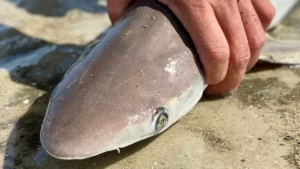 | 0.8–1.1 m (2.5–3.5 ft) | Low | Every sound, creek and surf zone, May to OctoberThe most abundant shark in Georgia by a wide margin and the one most often caught from piers. Small, shrimp-eating and harmless. |
Bonnethead SharkSphyrna tiburo | 0.9–1.2 m (3–4 ft) | Low | Shallow marsh creeks and grass flats; Gould's Inlet, JekyllA small hammerhead with a shovel-shaped head that hunts blue crabs in water a kayak can float in. Timid. |
Blacktip SharkCarcharhinus limbatus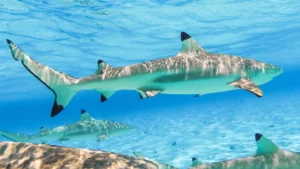 | 1.5–1.8 m (5–6 ft) | Moderate | Surf zone and inlets during the mullet runNamed in two Georgia bite records, including the 2021 Tybee surfing case. Chases baitfish through the breakers and occasionally mistakes a foot. |
Spinner SharkCarcharhinus brevipinna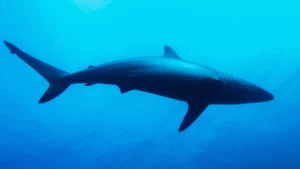 | 1.8–2.2 m (6–7 ft) | Moderate | Beaches and nearshore shelf, late summer and autumnThe shark that leaps and spins out of the water off St. Simons. Often confused with the blacktip; same feeding habits, same small bite risk. |
Finetooth SharkCarcharhinus isodon | 1.2–1.6 m (4–5 ft) | Low | Sounds and river mouths, especially the Altamaha deltaOne of the commonest species in the state nursery survey yet almost unknown to the public. Feeds on menhaden; no bite record. |
Blacknose SharkCarcharhinus acronotus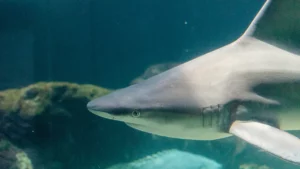 | 1.1–1.4 m (3.5–4.5 ft) | Low | Nearshore shelf and around Gray's ReefA slender shark with a dusky smudge on the snout tip. Common on the ledges offshore; rarely in the surf. |
Sandbar SharkCarcharhinus plumbeus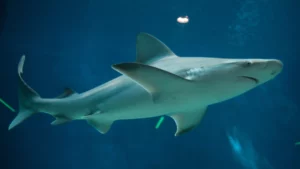 | 1.8–2.4 m (6–8 ft) | Low | Pups in Wassaw, Ossabaw and St. Andrew sounds; adults at Gray's ReefGeorgia's sounds are a recognised sandbar nursery. High-finned, heavy-bodied and not implicated in any state bite. |
Bull SharkCarcharhinus leucas | 2.2–3.2 m (7–10.5 ft) | High | Tidal rivers and sounds: Savannah, Ogeechee, Altamaha, Back River at TybeeTolerates fresh water and hunts in zero visibility. Identified in the 2019 Wilmington River bite; the species to keep in mind around river mouths. |
Lemon SharkNegaprion brevirostris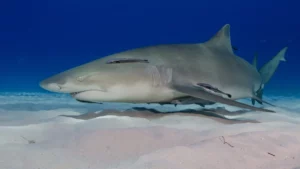 | 2.4–3 m (8–10 ft) | Low | Shallow sounds and creek mouths in summer; juveniles in the estuariesMore common in Florida, but juveniles turn up in Georgia's nursery nets and adults are caught from the beaches. Sluggish and rarely a problem. |
Tiger SharkGaleocerdo cuvier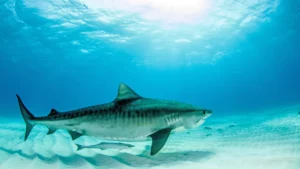 | 3–4.5 m (10–15 ft) | High | Offshore shelf and shelf edge in summer; occasionally the inletsSatellite-tagged tigers pass through the Georgia Bight every summer. Dangerous in theory, almost never close to a Georgia swimmer in practice. |
Sand Tiger SharkCarcharias taurus | 2.2–3 m (7–10 ft) | Low | Wrecks and ledges offshore; young fish in the soundsFierce-looking, slow-moving and protected since 1997. The "sand shark" in old Georgia bite reports usually means a small shark of unknown species. |
Scalloped Hammerhead SharkSphyrna lewini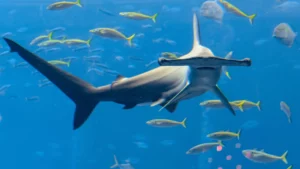 | 2.5–3.5 m (8–12 ft) | Low | Pups in the sounds in early summer; adults offshoreGeorgia's estuaries are a primary nursery for this critically endangered species. Newborns 45 cm long are netted every June. |
Great Hammerhead SharkSphyrna mokarran | 3.5–4.5 m (11–15 ft) | Moderate | Nearshore in summer chasing rays; occasionally hooked from the beachThe largest hammerhead, usually well under the 6 m maximum. Eats stingrays and tarpon; no Georgia bite on record. |
Smooth Hammerhead SharkSphyrna zygaena | 2.5–3.5 m (8–12 ft) | Low | Cooler shelf water in winter and springA temperate hammerhead that reaches Georgia when the water is cold. Uncommon and offshore. |
Dusky SharkCarcharhinus obscurus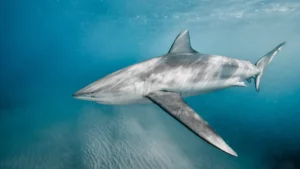 | 2.8–3.6 m (9–12 ft) | Low | Outer shelf during spring and autumn migrationsProhibited to land since 2000 and still recovering. Big but placid; stays well offshore. |
Nurse SharkGinglymostoma cirratum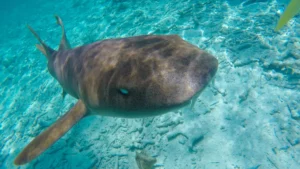 | 2.2–3 m (7–10 ft) | Low | Ledges at Gray's Reef and nearshore live-bottom in summerAdults reach about 3 m, not the 18 to 32 feet sometimes claimed. Lies under ledges by day; bites only when grabbed. |
Great White SharkCarcharodon carcharias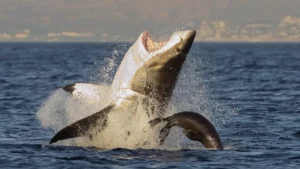 | 4–5.5 m (13–18 ft) | Moderate | Offshore in the Georgia Bight, December to March onlyTagged sharks including Breton (over 4 m) and Cabot have been tracked off Tybee and the Golden Isles in winter. Absent in beach season. |
Common Thresher SharkAlopias vulpinus | 3–5 m (10–16 ft) incl. tail | Low | Shelf edge and Gulf Stream, mainly in cooler monthsHalf of that length is tail. Feeds on schooling fish far from shore; harmless to people. |
Shortfin Mako SharkIsurus oxyrinchus | 2.5–3.5 m (8–11 ft) | Low | Gulf Stream edge, 60 miles or more offshoreCaught by Georgia's offshore charter fleet in winter and spring. Never near the beaches; landing is now restricted under Atlantic rules. |
People searching for Georgia sharks usually want to know about two species in particular. The great white shark is real here but strictly seasonal: satellite-tagged animals such as Cabot and Breton, both tagged off Nova Scotia by OCEARCH, have pinged repeatedly off Tybee Island and the Golden Isles between December and March, when the water is 12 to 16 °C and nobody is swimming. They are not on the beaches in summer. The other is the whale shark, which does not occur naturally off Georgia at all; it is here only because Georgia Aquarium in Atlanta keeps them, the only aquarium in the Western Hemisphere that does. Caribbean reef sharks, blacktip reef sharks and oceanic whitetips, all sometimes listed for the state, have no Georgia record either.
Where to see sharks in Georgia
Georgia's water is brown, not blue, so most sightings happen from a pier, a boat or a kayak rather than with a mask on. These are the places where sharks are a reliable part of the scenery.
- Tybee Island pier and Back RiverSavannah's beach. Atlantic sharpnose and bonnetheads are caught from the pier all summer, and the Back River at the south end is a well-known bull shark and blacktip spot on a falling tide. It is also the site of most of Georgia's recorded bites.
- Jekyll Island (Driftwood Beach, St. Andrews Sound)The sound at the south end is a documented sandbar shark and scalloped hammerhead nursery. Juvenile sharks are netted here every summer by state biologists, and small sharks are a common sight from the fishing pier at Clam Creek.
- St. Simons Island pier and Gould's InletBlacktips and spinners feed on mullet schools off the pier in late summer; kayakers in Gould's Inlet regularly see bonnetheads in a few feet of water. Two of the state's recent minor bites happened on the St. Simons beach.
- Cumberland Island National SeashoreEighteen miles of undeveloped beach reached by ferry from St. Marys. Sharpnose and blacktip sharks work the surf zone at dawn, and the St. Marys inlet at the south end holds bull sharks. Georgia's first recorded bite was here in 1876.
- Gray's Reef National Marine SanctuaryThe state's one genuine dive site, 19 miles off Sapelo Island in 18–21 m of water. Sandbar sharks, nurse sharks and the occasional scalloped hammerhead cruise the ledges from May to October, with visibility of 10–20 m on a good day.
- Wassaw and Ossabaw soundsReached by boat from Savannah or Skidaway Island. The shark-fishing charters out of Thunderbolt and Isle of Hope target blacktips, sharpnose and bull sharks in the sounds and creeks from May onward, usually on catch-and-release.
- Sapelo Island and the Altamaha deltaThe University of Georgia's marine institute is here, and the Altamaha, the largest undammed river on the East Coast, pours into a maze of creeks full of finetooth, sharpnose and bonnethead sharks. Access is by ferry or private boat.
- Georgia Aquarium, AtlantaFour hours from the coast but the easiest big-shark encounter in the state: whale sharks, manta rays and a predator gallery with sand tiger, silky and hammerhead sharks. Certified divers and snorkellers can book a supervised swim in the whale shark tank.
For a first sighting, the Tybee pier at dusk in July is hard to beat, and it costs nothing. Divers should book Gray's Reef through a charter out of Savannah or Brunswick and check the forecast carefully, because the sanctuary is a long, exposed run offshore.
Best time of year to see sharks in Georgia
Georgia's inshore sharks are almost entirely seasonal, and water temperature drives the calendar.
- December to March: nearshore water falls to 11–13 °C and the small coastal species leave for Florida or the shelf edge. This is white shark season offshore; tagged animals are tracked in the Bight most winters, but they stay in deeper water and are rarely seen.
- April to May: the sounds warm past 20 °C and the sharpnose, bonnethead and blacktip sharks pour back in. Pregnant sandbar and scalloped hammerhead females arrive to pup in the sounds from late May.
- June to September: peak season. Water of 27–29 °C, the most sharks in the creeks and surf, the best pier fishing and, not coincidentally, almost every recorded bite. Gray's Reef is at its calmest and clearest in these months.
- October to November: mullet run along the beaches and blacktips and spinners feed hard before heading south. Cooling water around 20 °C by mid-November empties the nurseries.
Offshore water over the shelf edge stays a few degrees warmer in winter thanks to the Gulf Stream, which is why makos, threshers and white sharks can be there when the beach is empty.
Shark attacks in Georgia: what the record shows
SharkSider's database holds 18 incidents for Georgia going back to a bather bitten on the leg at Cumberland Island in 1876. Seventeen of those are dated 1900 or later, and the full list is kept up to date on the shark attacks in Georgia page. The six most recent are listed below.
- 2026 · Near Ossabaw Island Liberty CountyFishing — Severe bite to thigh1.5-2m shark unknown species
- 2022 · Île de Saint Simon, Glynn CountyFishing — Thumb bitten by hooked shark provoked incidentAtlantic blacktip shark
- 2021 · Tybee Island, Chatham CountySurfing — Lower left leg bittensmall blacktip shark
- 2019 · Wilmington River, Chatham CountySwimming — Arc of lacerations to bicepBull shark, 4' to 5'
- 2018 · St. Simon Island, Glynn CountyStanding — Minor injury to left thighSpecies not identified
- 2014 · Tybee Island, Chatham CountySurfing — Puncture wounds to right thighShark involvement not confirmed
Three deaths are recorded, none of them recent. A swimmer died at Tybee Island in August 1912, another in the Back River at Savannah Beach in July 1974, the state's last fatality, and the 1908 case was a crew member lost when the British steamer Caribbee foundered off the coast, a shipwreck rather than a beach incident. Everything since 1974 has been survivable, and most of it minor: a 2-inch cut on a foot at Jekyll in 2001, puncture wounds to a surfer's thigh at Tybee in 2014 that were never confirmed as a shark, a minor thigh injury to someone standing in the surf at St. Simons in 2018.
The pattern is easy to read. Chatham County, which is Tybee and the Savannah rivers, accounts for eight of the 18 records and both of the beach deaths; Glynn County, with St. Simons and Jekyll, has six, none fatal. Swimming and wading explain nine incidents, surfing two, and fishing three, including the thumb bitten by a hooked blacktip at St. Simons in May 2022 and the July 2026 case near Ossabaw Island, in which an angler took a severe bite to the thigh from a 1.5 to 2 metre shark. Only three records name a species with any confidence: a small blacktip that bit a surfing instructor's leg at Tybee in July 2021, a 4 to 5 foot bull shark that raked a swimmer's bicep in the Wilmington River in June 2019, and a "sand shark" at Tybee in 1995. That mix, murky water, small sharks feeding on baitfish in the surf, people in ankle-to-waist-deep water, is the classic mistaken-identity bite, and it is why almost every Georgia injury is to a foot, ankle or lower leg.
Is it safe to swim in Georgia with sharks around?
By any sensible measure, yes. Georgia records a bite roughly once every three or four years against millions of beach visits, and no swimmer has died in more than fifty years. The sharks in the surf at Tybee or Jekyll in July are overwhelmingly Atlantic sharpnose and bonnetheads under a metre long, animals that eat shrimp and small fish and flee from people. Blacktips and spinners are bigger and faster, and they are the species most likely to nip a foot when they are chasing mullet through the breakers in poor visibility.
The two species that deserve real respect are the bull shark and the tiger shark. Bull sharks live in Georgia's tidal rivers and sounds all summer, in water where you cannot see your own feet, and they are the most likely candidate for the 2019 Wilmington River bite. Tiger sharks are offshore animals here and rarely come within reach of a swimmer. The practical rules follow from the record: stay out of the creeks and river mouths, especially on a falling tide at dusk; do not swim near anyone fishing or near a bait school you can see boiling on the surface; leave the water if you see birds diving on baitfish close in; and if you land a shark on the pier, keep your hands well away from the front end. Our guide to what to do in a shark attack covers the rest. Water clarity is the biggest difference between Georgia and, say, the Bahamas: you will almost never see the shark that is near you, which cuts both ways, since it will usually not see you clearly either.
Shark conservation in Georgia
Georgia's sharks are managed under a three-layer system. Federal rules in the Atlantic prohibit landing white sharks and sand tigers (since 1997) and dusky sharks (since 2000), and the Atlantic States Marine Fisheries Commission's coastal shark plan sets the framework the state follows. Georgia's own saltwater regulations then add a one-shark daily limit for anglers, a 54-inch fork-length minimum for the large coastal species and a shorter minimum for bonnetheads and Atlantic sharpnose, plus a list of prohibited species that mirrors the federal one. There is no significant commercial shark fishery in the state, although sharks are still caught and released, and sometimes killed, as bycatch in the shrimp trawl fleet.
The bigger conservation story is habitat. Because Georgia's marshes were protected in 1970, before most of the coast was developed, the nurseries that sandbar sharks, hammerheads and bull sharks depend on are largely intact, which is unusual on the East Coast. Gray's Reef has been a national marine sanctuary since 1981, with a research area closed to fishing since 2011, and the state's COASTSPAN nursery surveys give managers twenty years of data on which species are pupping where. The threats that remain are the familiar ones: sandbar and dusky sharks are still recovering from overfishing in the 1980s and 1990s, scalloped hammerheads are critically endangered globally, and warming water is already shifting the timing of the spring arrival. Our explainer on why sharks are endangered gives the wider context.
Sharks in nearby states
The same sharks that fill Georgia's sounds in summer are shared with its neighbours. South Carolina, just across the Savannah River, has the same nursery estuaries and a longer bite record; Florida, south of the St. Marys, is where most of Georgia's sharks spend the winter and where the bull shark risk climbs sharply. North Carolina and Virginia mark the northern end of the same migration, while Alabama and Mississippi show what the Gulf side of the South looks like. Across the water, the Bahamas are where Georgia's winter white sharks and summer tiger sharks are often tracked next. Our map of sharks around the world covers every state and country on the site.
Frequently asked questions
Are there sharks in Georgia?
Yes. At least 19 species have a confirmed record on the Georgia coast, and the sounds behind the barrier islands are among the most important shark nurseries on the US Atlantic coast. Atlantic sharpnose, bonnethead, blacktip, finetooth and sandbar sharks are the common ones from May to October; bull sharks use the tidal rivers.
Are there great white sharks in Georgia?
Only in winter and only offshore. OCEARCH-tagged white sharks such as Cabot (tagged off Nova Scotia in 2018 at 9 ft 8 in and 533 lb) and Breton (over 13 ft) have been tracked off Tybee Island and the Golden Isles between December and March. Neither was tagged in Georgia, and none are present in beach season.
Have there been shark attacks in Georgia?
Eighteen incidents are in the SharkSider database from 1876 to 2026, three fatal and none fatal since 1974. Seven have occurred since 2000, all survived, most of them minor bites to feet and legs at Tybee, St. Simons and Jekyll. The latest, in July 2026, was an angler bitten on the thigh near Ossabaw Island.
Is it safe to swim at Tybee Island?
Yes, with ordinary care. Tybee has the most recorded bites in the state, four, because it is the busiest beach, but all since 1974 were survivable and mostly minor. Avoid the Back River and the inlet ends at dusk, stay away from people fishing, and get out if baitfish are being chased near shore.
Are there whale sharks in Georgia?
Not in the ocean. Whale sharks are tropical open-water animals and do not occur off the Georgia coast. Georgia Aquarium in Atlanta is the only aquarium in the Western Hemisphere that keeps them, and it offers supervised swims and dives in its Ocean Voyager tank for visitors who book ahead.
Are there bull sharks in Georgia's rivers?
Yes. Bull sharks tolerate fresh water and are regularly caught in the Savannah, Ogeechee, Altamaha and Satilla river systems in summer, sometimes far above the salt line. A 4 to 5 ft bull shark was identified in a 2019 bite in the Wilmington River near Savannah, the only river bite in the state record.
What is the most common shark in Georgia?
The Atlantic sharpnose shark. It makes up the bulk of the catch in the state's annual nursery surveys and is the shark most often landed from the Tybee, St. Simons and Jekyll piers. Bonnetheads are the second most common, followed by blacktips and finetooth sharks.
When is the best time to see sharks in Georgia?
June to September, when the water is 27 to 29 °C and the sounds and surf are full of sharpnose, bonnethead and blacktip sharks. Sandbar and hammerhead pups appear in late May and June. White sharks are present only in winter, offshore, and are tracked rather than seen.
Can you dive with sharks in Georgia?
The one real option is Gray's Reef National Marine Sanctuary, 19 miles off Sapelo Island, where sandbar and nurse sharks patrol limestone ledges in 18 to 21 m of water from May to October. Charters run from Savannah and Brunswick. Georgia Aquarium also offers a supervised dive with its whale sharks.
Is shark fishing legal in Georgia?
Yes, with limits. Anglers may keep one shark per day, large coastal species must be at least 54 inches fork length, and bonnetheads and Atlantic sharpnose have a shorter minimum. White sharks, sand tigers, dusky sharks and other listed species must be released. Most charter captains release every shark.
References

A small team focused on researching sharks and making marine biology easy to understand. Every page is reviewed against current species records and the SharkSider attack database, and updated when new incidents or research appear.
Published November 30, 2022 · Last updated September 22, 2026 · Incident data from the SharkSider attack database (17 records for Georgia, 3 fatal).


