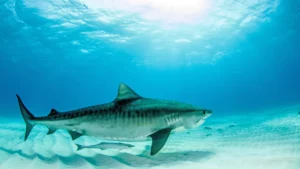
The scoophead shark (Sphyrna media) is a small hammerhead of shallow tropical coasts from the Gulf of California to Ecuador and from Panama to southern Brazil, reaching about 1.5 m (5 ft), with a broad, mallet-shaped head roughly a quarter to a third as wide as the shark is long. It lives over mud and sand in estuaries and bays.
It eats small fish, shrimps, crabs, octopus and squid. It bears live young of about 34 cm, though litter size and gestation are not reliably known. The IUCN listed it as Critically Endangered in 2020 after declines of more than 80 percent from inshore fishing. It has never been recorded biting a person.
- Maximum length1.5 m (5 ft); males mature at about 90 cm
- WeightNot recorded; probably under 10 kg (22 lb)
- LifespanUnknown (no ageing study published)
- Depth rangeShallow inshore water, mostly under 30 m (100 ft)
- DietSmall fish, shrimps, crabs, octopus and squid
- IUCN statusCritically Endangered (assessed 2020)
- Kingdom
- Animalia
- Phylum
- Chordata
- Class
- Chondrichthyes
- Order
- Carcharhiniformes
- Family
- Sphyrnidae
- Genus
- Sphyrna
- Species
- Sphyrna media
- Family (common)
- Hammerhead sharks
- Also known as
- Scoophead hammerhead, Cornuda (Latin America), Cação-rodela (Brazil)
On this page
- How to recognise a scoophead shark
- How big is a scoophead shark?
- Where scoophead sharks live
- What scoophead sharks eat
- Behaviour and senses
- Reproduction and lifespan
- Are scoophead sharks dangerous?
- Conservation status: why the scoophead is Critically Endangered
- Similar species and close relatives
- Frequently asked questions
- References
How to recognise a scoophead shark
The scoophead is a hammerhead in miniature, and the shape of the hammer is the key. Its head is a broad mallet, 22 to 33 percent of the total length from tip to tip, with a front edge that curves in a wide arc and is cut by a single shallow notch at the midline. Compare that with the bonnethead, whose head is a smooth, rounded shovel with no notch and a narrower span, and with the smalleye hammerhead of the same Atlantic coast, whose head is more deeply notched and whose body is tinged gold. In the eastern Pacific the scalloped bonnethead, smaller and with a scalloped head margin, is the other candidate.
Behind the head the body is slender and the fins give the second clue. The first dorsal fin is moderately tall and starts above the rear of the pectoral fin bases; the second dorsal is small and low; and the anal fin is noticeably longer than the second dorsal, with a deep notch in its trailing edge. Colour is plain grey to grey-brown above and white or cream below, without markings, and the fin tips are not dark.
The mouth is small and arched, set well behind the front of the head, with about 15 or 16 rows of teeth on each side of each jaw. The upper teeth have narrow, oblique, smooth-edged cusps; the lower teeth are more upright.
How big is a scoophead shark?
Small, by any shark's standard. The largest scoopheads on record are about 1.5 m (5 ft) long, and most adults are well under that. Males mature at roughly 90 cm (3 ft); females are the larger sex and mature somewhere between 1 m and 1.3 m. The old figure of 59 inches for the maximum is the same 1.5 m expressed differently, and it is one of the few numbers on the previous version of this page that stands up.
Pups are born at about 34 cm (13 in), and because the head is already fully formed at birth, a newborn scoophead looks exactly like a scaled-down adult. No weights have been published for the species; a shark of this build at 1.5 m would weigh somewhere under 10 kg (22 lb), and a typical adult far less. No growth curve, no age-at-maturity and no maximum age have been worked out either, because nobody has had enough specimens of known age to study. That gap matters for conservation, as the sections below explain.
The size bar sets the largest recorded scoophead beside a 1.8 m diver. It is a shark you could lift with one hand, which is part of the reason it disappears so easily into a gillnet.
Where scoophead sharks live
The scoophead has two separate ranges, one on each side of the Isthmus of Panama, a pattern shared with several inshore fishes that were one population before the isthmus closed. On the Pacific side it occurs from the Gulf of California in Mexico south along Costa Rica and Panama to Ecuador, where the Gulf of Guayaquil has historically been one of its strongholds. On the Atlantic side it runs from Panama and the Caribbean coast of Colombia and Venezuela along the Guianas and the whole coast of Brazil as far south as Paraná and Santa Catarina.
Everywhere in that range it is a shark of the shallows. It lives over mud and sand on the inner continental shelf, in bays, estuaries, river mouths and the channels between mangroves, in turbid, warm water usually less than 30 m (100 ft) deep; the exact lower limit of its depth range has never been established. It does not occur around offshore islands or in clear reef water, and it is never seen from a dive boat, which is why it has so few photographs.
That habitat choice has become its undoing. The muddy inshore strip of tropical America is exactly where small-scale gillnet and shrimp-trawl fleets work hardest, and a species that never leaves it has nowhere to hide. The range list below shows the country pages on which it is recorded.

4 countries list the scoophead shark in their species guide; the count is the number of incidents attributed to it there in the SharkSider database. Browse every guide on sharks around the world and sharks in the US.
What scoophead sharks eat
Stomach contents from fishery catches show a diet of small animals that live on or just above the muddy bottom: small schooling bony fish such as anchovies, sardines and croakers, penaeid shrimps, swimming crabs, and cephalopods, including octopus and squid. Nothing large, nothing armoured, nothing that fights back. The narrow, smooth-edged teeth grip rather than cut, and the small mouth limits prey to what can be swallowed whole.
The hammer is the hunting tool. Like every member of the family, the scoophead carries its ampullae of Lorenzini, the jelly-filled pores that sense electric fields, spread across the whole underside of the wide head, so it sweeps a broad strip of bottom with each pass and can find a shrimp buried in mud by the faint field of its muscles. The widely spaced nostrils at the outer corners of the head let it compare scent between left and right and track odour to its source in water where it cannot see more than an arm's length, and the wide-set eyes give it a near-complete view of the bottom below.
It hunts on the move, probably mostly at night, cruising a metre or two above the substrate and dropping to pin prey that the electrosense reveals. No one has watched a scoophead feed in the wild; the account above is reconstructed from its anatomy, its stomachs and the well-studied behaviour of the bonnethead, its closest ecological equivalent.
Behaviour and senses
Almost nothing about the scoophead's behaviour has been observed directly. What can be said comes from catch data and from the biology of the family. It is a small, active swimmer that must keep moving to breathe, since hammerheads cannot pump water over the gills while stationary, and catch records suggest it lives in loose groups rather than alone, with several animals often coming up in the same net.
The wide head does more than carry sensors. In hammerheads it works as a hydrofoil, giving lift at the front of the body and letting the shark turn far more tightly than a conventional shark of the same size, an advantage when chasing shrimps and small fish in a confined estuary channel.
Seasonal movements are likely but undocumented. On the Pacific coast of Central America small hammerheads move into estuaries in the wet season, when river flow brings nutrients and prey, and the scoophead probably does the same, with pregnant females entering the shallowest water to give birth. Whether it makes any longer migration is unknown. Our hammerhead shark overview covers what is known about the family's senses and social behaviour in more detail.
Reproduction and lifespan
Like all hammerheads the scoophead is viviparous with a yolk-sac placenta: once the embryo has used up its yolk, the empty yolk sac attaches to the wall of the uterus and the mother feeds it for the rest of the pregnancy. Pups are born at about 34 cm (13 in), fully formed and independent, in the shallow, turbid water of estuaries and bays that serves as a nursery.
That is nearly the whole of what is reliably known. Litter size is often given as anywhere from one to eight pups, but that range rests on very few examined females and should be treated as a rough indication rather than a measurement; the related bonnethead carries 4 to 16. Gestation has not been determined, though in similar small hammerheads it is about ten to eleven months, and pupping on the Pacific coast appears to fall in the late dry season and the start of the rains.
Age is a blank. No vertebral ageing study exists for this species, so nobody can say how old a 90 cm male or a 1.3 m female is, or how long the animals live; a small hammerhead of this size might reach 15 to 20 years, but that is inference from relatives, not data (see how long sharks live). Without an age at maturity nobody can calculate how fast the population might recover from fishing.
Are scoophead sharks dangerous?
No. The SharkSider database contains no incident of any kind attributed to the scoophead shark, and none appears in any national record within its range. The reasons are obvious once you have seen one: a mouth a few centimetres wide, teeth built for gripping shrimps, and a body that rarely passes 1.3 m. The shark bites reported from Brazil, Mexico and Panama on our Brazil, Mexico and Panama pages belong to bull, tiger and the large hammerheads, never to this one.
The danger runs entirely the other way. Fishers in artisanal gillnet fleets handle scoopheads by the hundred, and the only injury on record is the occasional scrape from a thrashing animal being cleared from a net. A swimmer or wader in a Central American estuary is in no more danger from a scoophead than from the mullet it is chasing. If it were seen more often it would head every list of harmless sharks.
The SharkSider database has no incident attributed to this species. The database draws on the International Shark Attack File, the Global Shark Attack File and verified local reports, and is updated weekly.
Conservation status: why the scoophead is Critically Endangered
In 2020 the IUCN Red List moved the scoophead from Data Deficient to Critically Endangered, one step from extinct in the wild. The assessors concluded that the species had declined by more than 80 percent over three generations and was still falling, based on the collapse of small-shark landings in inshore fisheries across its range and its disappearance from surveys in areas where it was once common.
The cause is unglamorous and relentless: bycatch. The scoophead lives its whole life in the shallow, muddy strip that artisanal gillnetters and shrimp trawlers fish every day from Mexico to Brazil. It is not a target, but it is caught constantly, and being small it is kept, sold cheaply as food or ground into fishmeal, and almost never recorded under its own name. Pregnant females and newborns in estuary nurseries are the most exposed. Mangrove loss and pollution degrade the same nurseries.
Protection is recent and patchy. Since November 2023 all hammerheads, the scoophead included, have been on CITES Appendix II, which regulates international trade in fins and meat but does nothing about local fishing. Brazil lists the species as nationally threatened, with capture and sale prohibited on paper. Elsewhere it falls under general shark rules or none. Without species-level reporting, gear restrictions in nursery estuaries and a proper study of its biology, it will stay on our list of the sharks most at risk.
Similar species and close relatives
The scoophead belongs to the small end of the hammerhead family. Its closest relatives are the other little Sphyrna species of the Americas: the bonnethead of the western Atlantic and eastern Pacific, with its rounded, unnotched head; the scalloped bonnethead of the eastern Pacific, the smallest hammerhead of all; and the smalleye hammerhead of the Atlantic coast of South America, golden-tinged and Critically Endangered for the same reasons. All four live inshore over mud and sand, all eat shrimps and small fish, and all are caught in the same nets; the newly described Carolina hammerhead shows how easily a species can hide inside the family.
The big hammerheads are different animals. The scalloped hammerhead, smooth hammerhead and great hammerhead grow to 3 to 6 m, range across open ocean and reef, and have heads that are wide, flat blades rather than mallets; a juvenile scalloped hammerhead in an estuary is the one that can be confused with a scoophead, and the scalloped front edge of its head is the way to tell them apart. Across the Indo-Pacific the winghead shark takes the hammer to its extreme, with a head half as wide as its body is long.
 Bonnethead Sharkspecies profile
- Scalloped Bonnetheadspecies profile
- Smalleye Hammerheadspecies profile
 Scalloped Hammerhead Sharkspecies profile
 Smooth Hammerheadspecies profile
 Great Hammerhead Sharkspecies profile
Frequently asked questions
How big does a scoophead shark get?
The scoophead reaches about 1.5 m (5 ft), which makes it one of the smallest hammerheads. Males mature at around 90 cm and females at roughly 1 to 1.3 m. Pups are born at about 34 cm. No weights have been published for the species; a full-grown adult probably weighs less than 10 kg (22 lb).
Where do scoophead sharks live?
In shallow tropical water on both coasts of the Americas: from the Gulf of California to Ecuador on the Pacific side, and from Panama and the Caribbean coast of Colombia along Brazil to Santa Catarina on the Atlantic side. They stay close inshore over mud and sand, in estuaries, bays and river mouths, usually shallower than 30 m.
What do scoophead sharks eat?
Small bottom-living prey: schooling fish such as anchovies and croakers, penaeid shrimps, swimming crabs, and octopus and squid. The wide head carries electroreceptors that detect prey buried in mud, and the small mouth and narrow gripping teeth limit the shark to animals it can swallow whole. It has never been watched feeding in the wild.
Is the scoophead shark dangerous to humans?
No. There is no recorded bite by a scoophead anywhere in its range and none in the SharkSider database. It is a small shark with a tiny mouth and teeth designed for holding shrimps and small fish. The only people who handle it are fishers clearing gillnets, and the risk there is a scrape, not a bite.
Why is the scoophead shark Critically Endangered?
Because it lives its whole life in the shallow, muddy coastal strip that artisanal gillnet and shrimp-trawl fisheries work every day from Mexico to Brazil. It is caught constantly as bycatch, kept for food or fishmeal and rarely recorded. The IUCN estimated a decline of more than 80 percent over three generations when it listed the species in 2020.
How do scoophead sharks reproduce?
They give birth to live young, nourished during pregnancy through a yolk-sac placenta, in shallow estuary nurseries. Pups are about 34 cm at birth. Litter size is usually quoted as one to eight but rests on very few examined females, and gestation has not been measured; in similar small hammerheads it is around ten to eleven months.
How long do scoophead sharks live?
Nobody knows. No ageing study has been done on the species, so there is no age at maturity and no maximum age on record. Small hammerheads of similar size, such as the bonnethead, live around 15 to 20 years, and the scoophead is likely to be comparable, but that is inference from relatives rather than a measurement.
What is the difference between a scoophead and a bonnethead?
Both are small inshore hammerheads of the Americas, but the scoophead has a broader, mallet-shaped head with a shallow notch at the front and a relatively larger anal fin, while the bonnethead has a narrower, smoothly rounded, shovel-shaped head with no notch. The bonnethead is far more common and is often seen by anglers; the scoophead is rarely encountered.
Is the scoophead shark protected?
Partly. All hammerheads, including the scoophead, were added to CITES Appendix II at the 2022 conference, in force since November 2023, which controls international trade in their fins and meat. Brazil lists it as nationally threatened and bans its capture and sale. In most of the rest of its range there is no species-specific protection, and it continues to be taken as bycatch in inshore fisheries.
References

A small team focused on researching sharks and making marine biology easy to understand. Every page is reviewed against current species records and the SharkSider attack database, and updated when new incidents or research appear.
Published September 9, 2022 · Last updated September 22, 2026 · No incident attributed to this species in the SharkSider attack database, which is updated weekly.