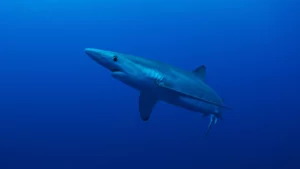
The sand tiger shark (Carcharias taurus) is a stout, humpbacked lamniform shark of warm-temperate coasts that reaches about 3.2 m (10.5 ft) and 159 kg and lives in shallow water near reefs, wrecks and gutters on every coast except the eastern Pacific. Its protruding teeth and rusty-spotted back make it easy to name, and it is the only shark that swallows air to hover.
It hunts fish, small sharks, rays and squid at night, sometimes herding schools together. Females carry just two pups, one per uterus, after the strongest embryo has eaten its siblings, and breed every second year. The IUCN lists it as Critically Endangered. It rarely bites people, and almost only when hooked or provoked.
- Maximum length3.2 m (10.5 ft); most adults 2–3 m
- WeightUp to 159 kg (350 lb); typically 90–130 kg
- LifespanUp to about 40 years (females), 34 (males)
- Depth rangeSurf zone to 191 m (627 ft), usually under 25 m
- DietBony fish, small sharks and rays, squid, crustaceans
- IUCN statusCritically Endangered (assessed 2020)

- Kingdom
- Animalia
- Phylum
- Chordata
- Class
- Chondrichthyes
- Order
- Lamniformes
- Family
- Odontaspididae
- Genus
- Carcharias
- Species
- Carcharias taurus
- Family (common)
- Sand tiger sharks
- Also known as
- Grey nurse shark (Australia), Ragged-tooth shark / raggie (South Africa), Spotted ragged-tooth shark, Sand shark (USA)
On this page
- How to identify a sand tiger shark
- How big do sand tiger sharks get?
- Where sand tiger sharks live
- What sand tiger sharks eat and how they hunt
- Behaviour: the only shark that gulps air
- Reproduction and lifespan: cannibals in the womb
- Are sand tiger sharks dangerous to people?
- Conservation status: Critically Endangered
- Similar species and close relatives
- Frequently asked questions
- References
How to identify a sand tiger shark
The teeth give it away before anything else. A sand tiger's mouth is lined with long, narrow, awl-shaped teeth that jut outwards and stay visible when the jaws are shut; each has a slender cusp with one or two tiny cusplets at the base, and none is serrated. There are 44 to 48 tooth rows in the upper jaw and 41 to 46 in the lower. They grasp slippery fish rather than cut, which is why the animal's reputation has always run ahead of its record.
The body is heavy and slightly humpbacked, with a flattened, cone-shaped snout, small eyes with no nictitating membrane and five long gill slits ahead of the pectoral fins. The best structural clue is the fins: the first dorsal sits far back, closer to the pelvic fins than to the pectorals, and the second dorsal and anal fins are almost as large as the first. No other big coastal shark is built that way. The tail has a long upper lobe with a notch near the tip above a short lower lobe, and there is no keel on the tail stalk, which separates the sand tiger from the great white and the shortfin mako at a glance.
Colour runs from grey-brown to bronze above and off-white below. Juveniles and many adults carry scattered reddish-brown spots on the rear half of the body and tail; they fade with age but rarely vanish, and in South Africa they earned the name spotted ragged-tooth.

How big do sand tiger sharks get?
The largest sand tigers with a trustworthy measurement are a little over 3.2 m (10.5 ft) long and about 159 kg (350 lb). Claims of 4.3 m sharks in older books have never been confirmed with a tape and a scale. A typical adult you meet on a wreck is 2 to 3 m and weighs 90 to 130 kg, and the animal is deep-bodied, so it looks heavier than a requiem shark of the same length.
Pups are enormous at birth for a shark of this size: about 1 m (95 to 105 cm), because only two are born and each has spent months eating everything else in its uterus. Males mature at roughly 1.9 to 2.0 m and six to seven years; females at about 2.2 to 2.3 m and nine to ten years. Growth after maturity is slow, perhaps a few centimetres a year, so a 3 m female is an old animal. The bar below sets the record length against a 1.8 m diver.
Where sand tiger sharks live
Sand tigers are sharks of warm-temperate and subtropical coasts, generally in water above about 16 °C, and they are absent from the entire eastern Pacific and from the central Pacific islands. In the western Atlantic they range from the Gulf of Maine to Florida, the Gulf of Mexico, the Bahamas and Bermuda, and separately from southern Brazil to Argentina. In the eastern Atlantic they were once common in the Mediterranean and off West Africa, and they still occur from Namibia around South Africa to Mozambique. Farther east they live off Japan, Korea and China and along both coasts of Australia, where the east and west coast populations are genetically separate.
The habitat is shallow and structured: surf gutters, rocky reefs, sandy bays, caves and wrecks from the surf zone to 191 m, though most animals stay above 25 m. In summer dozens gather over the wrecks off North Carolina and in the gutters of Fish Rock in New South Wales; in winter they crowd Aliwal Shoal and Protea Banks.
Migrations run along a coast, not across oceans: US sharks move north to Delaware Bay, Long Island and Massachusetts in summer and back to the Carolinas and Florida in winter; in South Africa the adults mate off KwaZulu-Natal in winter and the females give birth in the cooler Eastern Cape the following summer.

- South Africa43 records
- New York3 records
- China1 record
- Massachusetts1 record
- Argentinalisted
- Brazillisted
- Connecticutlisted
- Croatialisted
- Delawarelisted
- Egyptlisted
- Floridalisted
- Francelisted
Show all 38 places
- Georgialisted
- Ghanalisted
- Greecelisted
- Israellisted
- Italylisted
- Japanlisted
- Mainelisted
- Maltalisted
- Marylandlisted
- Moroccolisted
- New Hampshirelisted
- New Jerseylisted
- Nigerialisted
- North Carolinalisted
- Rhode Islandlisted
- Saudi Arabialisted
- Senegallisted
- South Carolinalisted
- South Korealisted
- Spainlisted
- Texaslisted
- The Gambialisted
- Tunisialisted
- Turkeylisted
- Uruguaylisted
- Virginialisted
23 countries and 15 US states list the sand tiger sharks in their species guide; the count is the number of incidents attributed to it there in the SharkSider database. Browse every guide on sharks around the world and sharks in the US.
What sand tiger sharks eat and how they hunt
The menu is mostly bony fish that school near the bottom or around structure: bluefish, menhaden, mackerel, herring, sea bass, flatfish, mullet and porgies, plus squid, crabs and lobsters. Larger sharks add small sharks and rays, including smooth-hounds, dogfish and skates. The teeth pierce and hold, so prey is grabbed and swallowed whole or in large pieces rather than sawn apart.
Sand tigers hunt mainly at night. By day they hang almost motionless in caves and gutters or over a wreck; after dusk they spread out over the sand. Divers in Australia and observers in aquaria have watched groups working together: several sharks circle a school of baitfish, tightening the ring until the fish are packed against the surface or a reef wall, then take turns cutting through it. Whether they coordinate or simply exploit the same panic is still argued.
The hovering trick described below is part of the hunting kit. A shark that hangs in mid-water without beating its tail makes no pressure wave, and schooling fish will drift to within a body length of it before the lunge. Adults seem to eat every few days rather than daily, and captive animals are fed only two or three times a week.
Behaviour: the only shark that gulps air
Sharks lack a swim bladder and most must keep swimming or sink. The sand tiger solved the problem in a way no other shark has: it rises to the surface, takes a mouthful of air and holds it in its stomach. With the right volume swallowed it becomes neutrally buoyant and can hover in a cave or gutter, tilted slightly nose-up, with barely a flick of the tail. To descend it belches the air back out. Any big aquarium shows the routine several times a day.
It is a slow, deliberate swimmer with a heavy side-to-side sculling motion, and in the wild it is strongly social. Aggregations of twenty to over a hundred form at the same reefs and wrecks year after year, often sorted by sex and size. In the mating season the males patrol the edge of the group and bite the females' flanks and fins before copulation; the scars are a normal sight on adult females in late spring.
Its senses are the usual lamniform set: a good lateral line, the electroreceptive ampullae of Lorenzini on the snout, and small eyes that work well in dim light, as a night hunter needs. It is also the shark most people have actually seen, because it tolerates captivity better than any other large species and has anchored public aquaria since the 1950s.

Reproduction and lifespan: cannibals in the womb
The sand tiger has the lowest reproductive output of any shark studied. It is ovoviviparous: eggs hatch inside the two uteri and the embryos grow without a placenta. Early in the pregnancy each uterus may hold a dozen embryos, but the first to reach about 10 cm and grow working teeth eats the others, then lives on the unfertilised eggs the mother keeps producing. The habit came to light in 1948 when the biologist Stewart Springer put his hand into the uterus of a freshly caught female and was bitten by the embryo. The result is a litter of exactly two pups, one per uterus, each about 1 m long.
Gestation lasts eight to twelve months. Mating takes place in spring and early summer in the United States, in winter off KwaZulu-Natal and in autumn on Australia's east coast, and the females then move to cooler water to give birth. A female needs a year to recover, so she breeds every second year at best. Known nurseries include Delaware Bay, Great South Bay on Long Island and Plymouth Bay in Massachusetts.
Age was long guessed at 15 to 20 years. In 2014 radiocarbon dating of vertebrae from western North Atlantic sharks pushed the maximum to about 40 years for females and 34 for males, with maturity at six to seven years for males and nine to ten for females (see how long sharks live). A female may therefore produce fewer than twenty pups in her life.
Are sand tiger sharks dangerous to people?
Much less than the teeth suggest. The SharkSider database attributes 88 records to the sand tiger under its various names, and only one was fatal: a swimmer in New South Wales sometime before 1906, in a report that names a grey nurse but admits the identification is doubtful. Since 2000 there have been 26 records and no deaths. The busiest decade was the 1960s, when spearfishing and culling in Australia and South Africa put people and sharks in the same gutters. South Africa (43 records) and Australia (40) account for almost everything; the United States has three.
The activities tell the real story. Fishing and boating (23) and diving or spearfishing (23) make up more than half the file: a hooked shark beside a boat, a spearfisher with a bleeding fish in a cave full of raggies, a diver who grabbed a tail. Swimmers account for 18 records and surfers for 13. On Long Island, young sand tigers chasing baitfish through the surf have nipped swimmers' feet and legs at Robert Moses State Park (2023), Wantagh (2025) and Jones Beach (2026), leaving puncture wounds rather than serious injury. The country files are on the South Africa, Australia and New York pages.
The rules follow from that list: do not spearfish inside an aggregation or carry speared fish on your belt, never grab or ride one for a photograph, and release a hooked shark without bringing it aboard. With that minimum of respect it is one of the safest big sharks to share water with; our guide to shark encounters covers the rest.
Sand Tiger Sharks incidents in the SharkSider database
- Records attributed89
- Fatal1 (1%)
- Years covered1906–2026
- Since 200027 incidents, 0 fatal
- Most common activityFishing & boats
- Most recordsSouth Africa (43)
The six most recent records attributed to the sand tiger sharks
- 31 August 2026 · Norton Point South Beach Edgartown Marthas Vineyard, Massachusetts, USASwimming — Lacerations to lower leg consistent with a shark biteRecorded as: Not stated sandbar or sand tiger shark suspected · not fatal
- 3 July 2026 · Jones Beach State Park Long Island, New York, USASwimming — Small bite right footRecorded as: Baby Sand Tiger shark · not fatal
- 25 June 2025 · Wantagh, Long Island NY, USASwimming — Lacerations to lower left foot and legRecorded as: Sand Tiger shark · not fatal
- 5 January 2024 · Papiesfontein, Eastern Cape Province, South AfricaFishing — Provoked incident. lacerations and puncture wounds to hand and calf from hooked sharkRecorded as: Raggedtooth shark · not fatal
- 3 July 2023 · Beach 3, Robert Moses State Park, Suffolk County, New York, USASwimming — 3 small puncture wounds to left legRecorded as: Sand tiger shark · not fatal
- 27 April 2019 · Tomaree, New South Wales, AustraliaSpearfishing — 3 puncture marks to left forearmRecorded as: Grey nurse shark, 3 m female · not fatal
Records are matched on the shark named in each report (“sand tiger”, “grey nurse”, “gray nurse”, “raggedtooth”, “ragged tooth”, “ragged-tooth”), so they include incidents where the species was reported rather than confirmed. Full records by country on the shark attacks pages.
Conservation status: Critically Endangered
The IUCN Red List moved the sand tiger to Critically Endangered in its 2020 assessment. The species has declined steeply across most of its range and its biology leaves almost no room for recovery: two pups every two years, maturity near ten years for females, and a habit of gathering at the same shallow reefs, where a few boats with lines can strip a population. The Mediterranean population has all but disappeared, eastern Australia's was cut to a few hundred animals by the 1980s, and the stock off Brazil and Argentina has collapsed under longlines and gillnets.
It was the first shark in the world to receive legal protection, in New South Wales in 1984, and Australia now lists the east coast population as critically endangered and the west coast population as vulnerable under federal law. The United States banned landings in Atlantic waters in 1997 and Brazil protects the species. Elsewhere it still dies on commercial and recreational lines, in the bather-protection nets of KwaZulu-Natal, New South Wales and Queensland, and as trawl bycatch. There is no CITES listing.
Aquarium collection, once a real pressure on the US population, is now minor, and the aquaria that keep sand tigers now supply data on growth, mating and reproduction. The species heads our list of sharks running out of time.
Similar species and close relatives
The family Odontaspididae has only three living species. The smalltooth sand tiger (Odontaspis ferox) is bigger, bulkier and greyer, lives on deep reefs and seamounts below 100 m, has larger eyes and teeth with two or three cusplets a side. The bigeye sand tiger (Odontaspis noronhai) is a dark deep-water animal almost nobody has seen alive. Both share the fin layout and protruding teeth, so depth and eye size are the quickest separators.
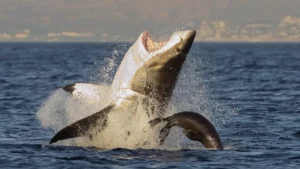
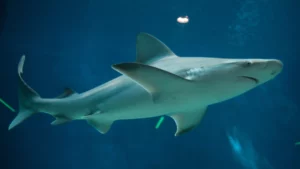
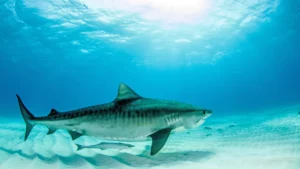
The names cause more trouble than the biology. In Australia the sand tiger is the grey nurse, but it is unrelated to the nurse shark of the Atlantic, a sluggish bottom-feeder with barbels and tiny teeth. In the United States it is often just the sand shark, a name also hung on the sandbar shark, a requiem shark with a tall first dorsal fin and serrated teeth. The word tiger has nothing to do with the tiger shark; it refers to the spots. A big sand tiger with its mouth open is regularly reported as a great white, but the white's serrated triangular teeth, crescent tail and keeled tail stalk are all missing here.
 Smalltooth Sand Tiger Sharkspecies profile
 Great White Sharkspecies profile
 Shortfin Mako Sharkspecies profile
 Nurse Sharkspecies profile
 Sandbar Sharkspecies profile
 Tiger Sharkspecies profile
Frequently asked questions
How big do sand tiger sharks get?
The largest reliably measured sand tigers are a little over 3.2 m (10.5 ft) long and weigh about 159 kg (350 lb). Most adults are 2 to 3 m. Pups are unusually large at birth, around 1 m, because only two are born per litter after eating their siblings in the womb.
Why are sand tiger sharks called grey nurse or ragged-tooth sharks?
The same species has different names by region. Australians call it the grey nurse shark, South Africans the ragged-tooth or raggie because of its jutting, uneven teeth, and Americans the sand tiger or sand shark for its habit of cruising sandy bottoms. It is not related to the nurse shark or the tiger shark.
Are sand tiger sharks dangerous to humans?
Rarely. The SharkSider database holds 88 records attributed to the species and a single fatal case, from New South Wales before 1906, with a doubtful identification. Since 2000 there have been 26 records and no deaths, most involving hooked sharks, spearfishers or divers who provoked the animal, and small nips on swimmers' feet.
Why do sand tiger sharks gulp air?
To hover. Sharks lack a swim bladder, so the sand tiger swims to the surface, swallows air and stores it in its stomach until it is neutrally buoyant. It can then hang motionless in a cave or over a wreck, which saves energy and lets schooling fish approach. To sink it simply burps the air out.
What do sand tiger sharks eat?
Mostly bony fish that school near the bottom: bluefish, menhaden, mackerel, herring, sea bass, flatfish and mullet, plus squid, crabs and lobsters. Larger adults also take small sharks, dogfish and rays. They hunt mainly at night, and groups have been watched herding schools of fish together before feeding.
How do sand tiger sharks reproduce?
They are ovoviviparous with intrauterine cannibalism. Eggs hatch inside the two uteri, and in each the first embryo to reach about 10 cm eats its siblings, then feeds on unfertilised eggs. After 8 to 12 months the female gives birth to exactly two pups of about 1 m, and breeds only every second year.
Where do sand tiger sharks live?
In shallow warm-temperate and subtropical coastal water of the Atlantic, Indian and western Pacific oceans: the US east coast, Brazil and Argentina, West and southern Africa, the Red Sea, Japan and Australia. They favour reefs, gutters, caves and wrecks from the surf zone to 191 m, and are absent from the eastern Pacific.
How long do sand tiger sharks live?
Radiocarbon dating of vertebrae from the western North Atlantic gives maximum ages of about 40 years for females and 34 for males, well above the older estimate of 15 to 20 years. Males mature at six to seven years and females at nine to ten, which is why the population recovers so slowly.
Are sand tiger sharks endangered?
Yes. The IUCN Red List classed the species as Critically Endangered in 2020 after steep declines in the Mediterranean, the south-west Atlantic and eastern Australia. It has been protected in New South Wales since 1984, the first shark anywhere to get legal protection, and in US Atlantic waters since 1997.
Can sand tiger sharks be kept in aquariums?
Yes, better than any other large shark. Sand tigers have been displayed in public aquaria since the 1950s, tolerate tanks well, live for decades in captivity and have bred there. Their calm hovering and toothy appearance make them the classic aquarium shark; captive collection is now strictly limited in the United States.
References

A small team focused on researching sharks and making marine biology easy to understand. Every page is reviewed against current species records and the SharkSider attack database, and updated when new incidents or research appear.
Published July 9, 2016 · Last updated September 28, 2026 · 89 incidents attributed to the sand tiger sharks in the SharkSider attack database (1 fatal), updated weekly.