
The Iceland catshark, or the Icelandic catshark, is a species that sporadically appears throughout the Atlantic Ocean. Naturalist Bjarni Sæmundsson gave it its scientific name. He honored his friend Gísli Lárusson for supporting the study of fish living in Iceland.
Iceland Catshark Scientific Classification |
|
| Kingdom | Animalia |
| Phylum | Chordata |
| Class | Chondrichthyes |
| Order | Carcharhiniformes |
| Family | Scyliorhinidae |
| Genus | Apristurus |
| Scientific Name | A. laurussonii |
Description
Iceland catsharks are slender-bodied, tapering off towards the head. On average, these sharks are 1.64-1.96 ft long, with the record held by a specimen 2.2 ft long. Its snout is broad, long, and shaped like a snout. This shark’s short mouth extends all the way to its eyes.
These sharks are dark brown with no discernable markings.
Where do they live
Map Of The Iceland Catshark’s Habitat
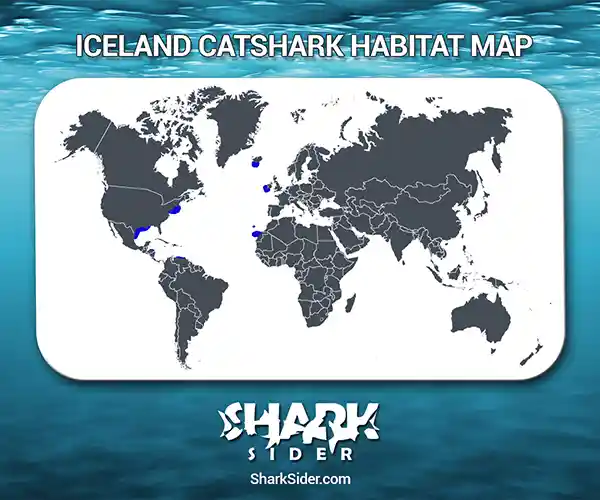
Iceland catsharks live in the Atlantic, with sightings in the Canary Islands, Delaware, Iceland, Madeira, Massachusetts, the northern Gulf of Mexico, Honduras, South Africa, southwestern Ireland, and Venezuela between 67 and 11°N.
Its depth range is 1804-4757 ft at or close to the bottom of the upper continental slopes.
Behavior
Feeding
These sharks consume bony fish, crustaceans, marine worms, and squids.
Reproductive
Iceland sharks are oviparous, laying a pair of eggs at a time.
Interactions with humans
While this shark is sometimes caught as a bycatch in the Gulf of Mexico, its population appears to be stable and is not declining. Hence, the IUCN lists the Iceland shark as “Least Concern” or “LC”.