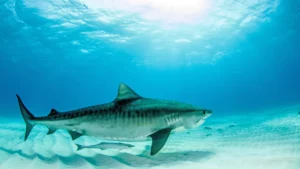
The gulf wobbegong (Orectolobus halei) is a large carpet shark of temperate southern Australia, growing to a measured 2.56 m and reportedly 2.9 m (9.5 ft), that lies flat on rocky and coral reefs from southern Queensland around to central Western Australia. Its wide head is fringed with skin lobes and its back patterned in dark saddles.
It ambushes reef fish, octopus, crustaceans and smaller sharks from a resting position with a sudden gape and fang-like teeth. Females bear litters of roughly 12 to 47 live pups after a 10 to 11 month pregnancy. The IUCN lists it as Least Concern. Wobbegongs account for dozens of minor bites in Australia, none fatal.
- Maximum lengthReported to 2.9 m (9.5 ft); 2.56 m measured
- WeightNo reliable published maximum
- LifespanUnknown; probably 25+ years
- Depth rangeShore to 195 m (640 ft)
- DietReef fish, octopus, cuttlefish, crustaceans, small sharks and rays
- IUCN statusLeast Concern (assessed 2015)
- Kingdom
- Animalia
- Phylum
- Chordata
- Class
- Chondrichthyes
- Order
- Orectolobiformes
- Family
- Orectolobidae
- Genus
- Orectolobus
- Species
- Orectolobus halei
- Family (common)
- Wobbegongs
- Also known as
- Banded wobbegong, Hale's wobbegong
On this page
- How to recognise a gulf wobbegong
- How big do gulf wobbegongs get?
- Where gulf wobbegongs live
- What gulf wobbegongs eat and how they hunt
- Behaviour, senses and camouflage
- Reproduction and lifespan
- How dangerous are gulf wobbegongs to people?
- Conservation status
- Similar species and close relatives
- Frequently asked questions
- References
How to recognise a gulf wobbegong
All wobbegongs share a plan no other shark has: a body flattened from above, a very wide head with the mouth at the front, a fringe of fleshy lobes along the sides of the head, nasal barbels, and a skin pattern that mimics weed-covered rock. The gulf wobbegong is the largest of the group, and it was only separated from the ornate wobbegong in 2006 and the two still share the name banded wobbegong in older books.
The reliable differences are these. The gulf wobbegong grows far bigger: an ornate wobbegong is mature at 80 cm and rarely passes 1.2 m. Its head is broader, and the skin lobes below and in front of the eyes are fewer and simpler, where the ornate wobbegong carries a bushier fringe. The pattern is a series of dark, corrugated-edged saddles over a yellowish to grey-brown back, broken by pale blotches and scattered dark spots, but without the crisp white rings of the spotted wobbegong.
Both jaws carry two or three pairs of enlarged, fang-like teeth at the front, backed by small pointed ones, on a mouth that can gape almost to the width of the head. There is an anal fin, which the angelsharks lack, and nasal barbels that the flat blind shark also carries, though without the fringe of head lobes. The cobbler wobbegong, the only other large wobbegong of the south coast, has rows of warty tubercles along its back.
How big do gulf wobbegongs get?
The gulf wobbegong is the largest wobbegong. Older references gave a maximum of 2.9 m (9.5 ft) for the banded wobbegong, and since those giants were almost certainly this species, 2.9 m is usually quoted as its maximum. The largest animal with a measurement behind it is about 2.56 m (8.4 ft); the 2006 study that separated the two species worked with sharks up to about 2.06 m, so treat the bigger figures as reported rather than verified. Most adults divers meet are 1.5 to 2 m.
No reliable maximum weight has been published; a 2 m wobbegong is a thick-bodied animal that takes two people to lift. Both sexes mature at about 1.7 to 1.8 m, and there is no marked size difference between males and females. Newborns are around 20 to 25 cm. Ages from vertebral bands have not been validated, so age at maturity and lifespan remain uncertain; a species this slow to mature probably lives a quarter of a century or more (see how long sharks live). The size bar below sets the reported maximum against a 1.8 m diver.
Where gulf wobbegongs live
The gulf wobbegong is endemic to Australia and lives along the whole temperate south: from Southport on the Gold Coast of Queensland down the New South Wales coast, through Bass Strait and the South Australian gulfs that give it its name, and west and north along the Western Australian coast to about Norwegian Bay near Ningaloo. It is absent from the tropical north, where the northern wobbegong and tasselled wobbegong take over.
It is a shark of hard bottom: rocky reefs, kelp and sponge gardens, the coral reefs at its Queensland and Western Australian extremes, and the sand patches between, resting in caves, beneath ledges and on top of large sponges by day. Recorded depths run from the intertidal to 195 m (640 ft), but most sightings are in under 30 m of water, which is why it meets swimmers and snorkellers so often.
Tagging on the New South Wales coast shows strong site fidelity: individuals return to the same reef, often the same ledge, for months or years, moving between a few favourite resting sites within a small home range.
What gulf wobbegongs eat and how they hunt
A wobbegong is a trap. It lies motionless on the bottom, its outline dissolved by the mottled skin and the fringe of lobes that breaks the line of the head, and waits, sometimes all day, for something to come within a body length. When it does, the shark throws its head up and forward, drops the floor of the mouth and gapes: the sudden expansion of the throat pulls the prey in, and the fang-like front teeth close on it. At night it cruises slowly over the reef and roots into crevices.
The menu in New South Wales stomach studies is dominated by bony fish, especially luderick, morwong, snapper, mullet and wrasses, followed by octopus and cuttlefish, crustaceans including rock lobsters and crabs, and a regular helping of other elasmobranchs: catsharks, Port Jackson sharks, stingarees and smaller wobbegongs. A gulf wobbegong will also try a fish already on a spearfisher's spear, which is how many of the bites on people start.
The gape and the loosely jointed jaws let a wobbegong swallow a fish nearly its own head width, and there are reliable reports of one holding a shark or a large fish in its mouth for hours while digestion softens it. One large meal can last a week or more.
Behaviour, senses and camouflage
The gulf wobbegong's life is organised around not moving. It can lie still on the bottom because, like the nurse sharks, it pumps water over its gills with its throat muscles instead of relying on forward motion (see how sharks breathe). Resting sharks are so confident in their camouflage that a diver can approach to within a metre, and that confidence is the source of nearly every bite: the shark does not move away from a foot coming down on it, it defends itself.
Its senses are those of a close-range predator. The eyes are small and set on top of the head, and vision is probably good enough only to register a shadow passing overhead. The barbels and skin lobes are touch and taste organs, and the ampullae of Lorenzini on the snout pick up the electrical signature of prey that has stopped in front of the jaws.
Wobbegongs are usually solitary, but several will rest together in one cave or on one ledge, and the same individuals reassemble at the same sites over the years. The winter mating season brings males and females together and produces the bite scars that females carry on their flanks and gills.
Reproduction and lifespan
The gulf wobbegong is aplacental viviparous: the eggs hatch inside the mother and the embryos live on their large yolk sacs until birth (see the ways sharks reproduce). Studies on the New South Wales coast found that it mates in winter, that pregnancy lasts 10 to 11 months, and that pups are born in spring at roughly 20 to 25 cm.
Litters are large for a shark: roughly 12 to 47 pups, the number rising with the size of the mother, and around 20 is typical. The cost is time. After giving birth a female takes a year or more to rebuild her yolk reserves and ovulate again, so the cycle from one litter to the next runs about three years. Where the pups go after birth is unknown; small wobbegongs are rarely seen by divers.
The lifespan has never been validated. Vertebral ring counts from New South Wales suggest well over a decade to mature and a life into the twenties at least. Wobbegongs have been kept in public aquariums for more than 20 years, which supports a lifespan of 25 years or longer.
How dangerous are gulf wobbegongs to people?
Wobbegongs have the strangest bite record of any Australian shark: many incidents, no deaths, and almost all of them the shark's reply to being stepped on, grabbed, speared or cornered. The SharkSider database holds 55 records attributed to wobbegongs, none fatal, from 1940 to 2023; 28 of them since 2000, again none fatal. The commonest activities are swimming and wading (20) and diving and spearfishing (18), then surfing (12), and 52 of the 55 happened in Australia, with single records from Papua New Guinea and the Solomon Islands. The six most recent cards below are typical: a snorkeller's leg at Yallingup in July 2023, feet bitten at Warriewood and Whalers Beach in January 2022, and four more foot injuries, one explicitly a shark trodden on.
One honesty note. The reports name the shark only as a wobbegong, so the record covers the whole family; no incident in the database is identified to species. The gulf wobbegong, the largest species and a common one on the reefs where most bites happen, is certainly among the culprits, with the spotted wobbegong the other main candidate. A big gulf wobbegong clamps rather than slashes, and there are documented cases of one refusing to let go of a leg until it was carried out of the water.
The practical advice is short. Look before you put a foot down on a reef flat, do not reach into ledges, get speared fish out of the water fast, and do not pull a wobbegong's tail for a photograph. Bites are painful and often need stitches, but they are not life-threatening. The full record is on the Australia attacks page, and our guide to surviving a shark encounter covers what to do if one holds on.
Gulf Wobbegong incidents in the SharkSider database
- Records attributed55
- Fatal0 (0%)
- Years covered1940–2023
- Since 200028 incidents, 0 fatal
- Most common activitySwimming & wading
- Most recordsAustralia (52)
The six most recent records attributed to the gulf wobbegong
- 22 July 2023 · Yallingup Lagoon, Western Australia, AustraliaSnorkeling — Lower left leg bittenRecorded as: Wobbegong shark · not fatal
- 24 January 2022 · Warriewood, New South Wales, AustraliaSwimming — Foot bittenRecorded as: Wobbegong shark · not fatal
- 22 January 2022 · Whalers Beach, Western Australia, AustraliaSnorkeling — Knees, ankles & feet bittenRecorded as: Wobbegong shark · not fatal
- 14 January 2019 · North Cottesloe, Western Australia, AustraliaSwimming — Minor injury to left footRecorded as: Wobbegong shark · not fatal
- 15 December 2018 · New South Wales, AustraliaActivity not stated — Bitten on foot when he stepped on the shark provoked incidentRecorded as: Wobbegong shark · not fatal
- 28 November 2018 · South Steyne, New South Wales, AustraliaSurfing — Cut to left footRecorded as: Wobbegong shark · not fatal
Records are matched on the shark named in each report (“wobbegong”), so they include incidents where the species was reported rather than confirmed. Full records by country on the shark attacks pages.
Conservation status
The IUCN Red List assessed the gulf wobbegong in 2015 and listed it as Least Concern, on the grounds of a wide, lightly fished range and a stable catch in the one fishery that matters. It is not listed on CITES or the Convention on Migratory Species and has no specific protection in Australian federal law.
The fishery that matters is in New South Wales, where wobbegongs have been taken for decades for their firm white flesh, sold as flake. Commercial landings fell by more than half through the 1990s, and the state responded with a minimum size limit, catch limits and a recreational bag limit that in effect ends recreational take. Catches have since stabilised. Elsewhere it is a minor bycatch of trap, line and gillnet fisheries.
The biology counsels caution even so. A shark that matures at 1.7 m and produces a litter only every third year recovers slowly, and its attachment to particular reefs means a local population can be fished out and stay out. Compared with the species on our list of endangered sharks, though, the gulf wobbegong is in decent shape.
Similar species and close relatives
Twelve wobbegong species are known, nearly all Australian, and the gulf wobbegong can be confused with several. Its closest relative and near-twin is the ornate wobbegong, which shares its pattern and much of its range but is a dwarf, mature at 80 cm, with bushier head lobes. The spotted wobbegong overlaps it from southern Queensland to Western Australia and grows almost as large; its white O-shaped rings on a greenish-brown back are the clue. The cobbler wobbegong of the south coast is lumpy with tubercles, and the floral banded wobbegong is small and boldly banded.
In the north, the tasselled wobbegong of the Great Barrier Reef and New Guinea wears a full beard of branched lobes around the whole head, and the northern wobbegong is a small tropical species; the Japanese wobbegong is the only member of the genus outside Australasia. Beyond the wobbegongs, the flat bottom-resting sharks most often mistaken for one are the blind shark and the epaulette shark, both small and without the fringed head, and the angelsharks, which have no anal fin and a ray-like outline. All belong to different families (see types of sharks).
 Ornate Wobbegongspecies profile
 Spotted Wobbegongspecies profile
- Cobbler Wobbegongspecies profile
- Floral Banded Wobbegongspecies profile
 Tasselled Wobbegongspecies profile
 Blind Sharkspecies profile
Frequently asked questions
How big is a gulf wobbegong?
It is the largest wobbegong. A maximum of 2.9 m (9.5 ft) is widely quoted from older records of the banded wobbegong, but the largest measured specimen is about 2.56 m. Most adults seen by divers are 1.5 to 2 m. Both sexes mature at about 1.7 to 1.8 m, and pups are born at around 20 to 25 cm.
Where do gulf wobbegongs live?
Only in Australia, along the temperate south: from Southport in southern Queensland down through New South Wales, Victoria and South Australia to Norwegian Bay on the central coast of Western Australia. They rest on rocky and coral reefs, in caves and under ledges, from the shore to 195 m, mostly in less than 30 m.
What is the difference between a gulf wobbegong and an ornate wobbegong?
Size, head and lobes. The gulf wobbegong grows past 2 m and matures at about 1.7 m; the ornate wobbegong matures at 80 cm and rarely exceeds 1.2 m. The gulf wobbegong has a broader head and fewer, simpler skin lobes around it. They were treated as one species, the banded wobbegong, until 2006.
What do gulf wobbegongs eat?
Reef and schooling fish such as luderick, morwong, snapper and mullet, plus octopus, cuttlefish, rock lobsters and crabs, and other elasmobranchs including Port Jackson sharks, catsharks, stingarees and smaller wobbegongs. They ambush prey from a resting position with a sudden gape and suction, and one large meal can last a week.
Are gulf wobbegongs dangerous to humans?
Only if provoked. The SharkSider database holds 55 records attributed to wobbegongs, none fatal, almost all in Australia and almost all caused by someone stepping on, grabbing or spearing near the shark. The reports do not identify the species; the gulf wobbegong, as the largest, is among the likely culprits. Bites are painful but not life-threatening.
Why do wobbegongs bite people?
Because their camouflage works too well. A resting wobbegong does not flee when a wader steps on it or a diver reaches into its ledge; it bites in defence, and its jaws are built to clamp and hold. Spearfishers carrying bleeding fish and divers pulling a wobbegong's tail account for many records. Look before you step and keep hands out of caves.
How do gulf wobbegongs reproduce?
They are aplacental viviparous, hatching eggs internally and bearing live young. Mating takes place in winter, pregnancy lasts 10 to 11 months and pups are born in spring. Litters run from about 12 to 47 pups, typically around 20, but females need a year or more to recover, so a litter is produced only every three years.
How long do gulf wobbegongs live?
Nobody has validated an age. Vertebral ring counts from New South Wales suggest well over a decade to reach maturity and a lifespan into the twenties, and wobbegongs have lived more than 20 years in public aquariums, so 25 years or more is likely. The 16-year age at maturity in older sources comes from those unvalidated counts.
Are gulf wobbegongs endangered?
No. The IUCN listed the species as Least Concern in 2015. It has a wide southern Australian range, much of it lightly fished. Commercial wobbegong catches in New South Wales fell by more than half in the 1990s, but size and catch limits have stabilised them since. It is not on CITES and has no specific federal protection.
Can you eat gulf wobbegong?
Yes, and Australians have for decades: the firm white flesh is sold as flake in New South Wales fish-and-chip shops, and wobbegong is one of the few sharks with a directed commercial fishery in the state. Recreational take is now tightly limited, and most anglers and spearfishers release the sharks they catch.
References

A small team focused on researching sharks and making marine biology easy to understand. Every page is reviewed against current species records and the SharkSider attack database, and updated when new incidents or research appear.
Published October 10, 2022 · Last updated September 22, 2026 · 55 incidents attributed to the gulf wobbegong in the SharkSider attack database (0 fatal), updated weekly.