The Borneo shark (Carcharhinus borneensis) is a small requiem shark, reaching about 65 cm (2.1 ft), known with certainty only from the shallow coastal waters off Mukah in Sarawak, on the north-west coast of Malaysian Borneo. It is slender and grey with a long pointed snout, and a row of enlarged pores beside the corners of its mouth sets it apart from every other member of its genus.
The few stomachs examined held small bony fish. It bears live young, six in the one pregnant female recorded, each 24 to 28 cm at birth. The IUCN lists it as Critically Endangered because it survives in a tiny, heavily fished area. It is too small to harm anyone.
- Maximum lengthAbout 65 cm (2.1 ft); FishBase lists 70 cm
- WeightNo published measurement; probably under 2 kg
- LifespanUnknown; no ageing study exists
- Depth rangeShallow inshore waters; exact depths not recorded
- DietSmall bony fish (few stomachs examined)
- IUCN statusCritically Endangered (assessed 2020)
- Kingdom
- Animalia
- Phylum
- Chordata
- Class
- Chondrichthyes
- Order
- Carcharhiniformes
- Family
- Carcharhinidae
- Genus
- Carcharhinus
- Species
- Carcharhinus borneensis
- Family (common)
- Requiem sharks
On this page
How to recognise a Borneo shark
Almost nobody has seen a living Borneo shark, so identification rests on the specimens laid out on ice at the Mukah fish landing and in museum jars. What you would see is a slim, small requiem shark with a long, narrow, pointed snout, large round eyes with a nictitating membrane, and slit-like nostrils with only a small nipple of skin in front of each. The back is slate grey to grey-brown, the belly white, and there are no bold fin markings of the kind that make the blacktip reef shark so easy.
The one feature that clinches it is odd and unique in the genus Carcharhinus: a row of enlarged, obvious pores running along the upper lip beside each corner of the mouth. These are openings of the ampullae of Lorenzini, the electrical sense, and no other requiem shark carries them so large or so neatly lined up. The absence of a ridge of skin between the dorsal fins is a second check, separating it from the ridge-backed group that includes the grey reef shark.
The fins are conventional: a moderately large first dorsal starting over the rear of the pectoral bases, a much smaller second dorsal placed over the anal fin, sickle-shaped pectorals, small triangular pelvic fins and a tail with a long upper lobe. The teeth number about 25 or 26 rows in the upper jaw and 23 to 25 in the lower; the uppers are narrow, oblique and serrated, the lowers slender, upright and finely serrated.
How big does a Borneo shark get?
Small, and the numbers are firm because they come from measured specimens rather than fishermen's estimates. The largest known Borneo shark is about 65 cm (2.1 ft) in total length; FishBase carries a maximum of 70 cm. Males mature at roughly 55 to 58 cm and females at 61 to 65 cm, which means a fully grown female is barely longer than the point at which she can breed; there is very little growth left after maturity, a pattern typical of small coastal requiem sharks. Nobody has weighed an adult and published the figure; a 65 cm shark of this slim build would weigh well under 2 kg.
Birth size is also on record, from the one pregnant female that has been examined: her pups were 24 to 28 cm (9.4 to 11 in) long, more than a third of adult length, which is a large investment per pup and helps explain the small litter. The sexes appear to differ only slightly in size, females being the larger. With only a few dozen specimens ever measured the maximum could creep up a little, but a metre-long Borneo shark would be a surprise. The size bar below compares the 65 cm maximum with a 1.8 m diver.
Where Borneo sharks live
The honest answer is: a small piece of the coast of Sarawak, and possibly nowhere else. Every confirmed specimen collected since the rediscovery has come from the inshore waters off Mukah, a fishing town in central Sarawak on the north-west coast of Borneo, in Malaysia. The species was described in 1858 from Borneo material, and a handful of old museum specimens carry labels from Borneo, from Java in Indonesia and from the coast of China. Those Chinese and Javanese records have never been repeated, and most researchers treat them as mislabelled or as a different species. For practical purposes the Borneo shark is a Sarawak endemic.
Its habitat, as far as it can be reconstructed from where the fishermen catch it, is shallow coastal water over soft bottom: the muddy, river-influenced shelf off Mukah, where inshore gillnets and small trawls work within a few kilometres of the shore. No depth has been recorded for a live capture, no tag has ever been attached to one, and nothing is known of seasonal movement. The waters here are warm all year, about 28 to 30 °C, and heavily used by artisanal boats, which is both why the species was found again and why it is in danger.

1 country list the borneo shark in their species guide; the count is the number of incidents attributed to it there in the SharkSider database. Browse every guide on sharks around the world and sharks in the US.
What Borneo sharks eat
The only direct evidence is the contents of the few stomachs that were opened when fresh specimens were examined, and they held small bony fish. That is consistent with the animal's build. A long pointed snout, big eyes, a mouth full of narrow oblique cutting teeth above and slender gripping teeth below, and a slim body are the standard kit of a small requiem shark that chases little schooling fish over open bottom: anchovies, small croakers, ponyfish and the like, which are exactly what the Mukah inshore fishery catches alongside it.
The enlarged pores beside the mouth hint at something more. Electroreception works only at very close range, and a dense line of receptors along the lip is what a shark needs to pin down prey it cannot see, in turbid water or in soft sediment. Off a river-fed coast the water is often brown with silt, and an animal that hunts there by electric sense as much as by sight would be well served by exactly this arrangement. Whether the Borneo shark also takes shrimps and crabs from the mud, as the similar-sized smalltail shark of the Americas does, is unknown; nobody has looked at enough stomachs to say.
What can be ruled out is anything large. A 60 cm shark with a small mouth eats small things, and it is itself on the menu of the bigger sharks and rays that share the coast.
Behaviour and adaptations
No scientist has watched a Borneo shark behave. There are no underwater observations, no tagging data and no aquarium records, so this section has to reason from anatomy and from what related sharks do, and say so.
Two adaptations are visible in the specimens. The first is the nictitating membrane, the third eyelid that requiem sharks draw across the eye when feeding or when the eye is threatened; in a fish that lives over mud in silty water it presumably also keeps sediment off the cornea. The second is the row of enlarged lip pores discussed above, which suggests a shark that relies heavily on electroreception at close quarters, as you would expect where visibility is often a metre or less. Large eyes point the other way, towards good vision when the water clears, and the two together fit a coastal animal that copes with whatever the river delivers.
Beyond that, the small size, slim body and inshore habitat all argue for a shark that lives fast and close to the bottom, probably in loose groups as small requiem sharks often do, and that never travels far. The whole known population appears to occupy tens of kilometres of coastline, and no other locality has produced a specimen in decades of Southeast Asian shark surveys, which itself says something about how sedentary the animal must be. Any page that gives you figures for its senses, social life or speed is inventing them.
Reproduction and lifespan
Like every other Carcharhinus, the Borneo shark is viviparous with a yolk-sac placenta: embryos begin on the yolk and, once it is used up, the yolk sac fuses to the wall of the uterus and feeds them from the mother's bloodstream until birth (the other modes of shark reproduction are explained on our facts page). This much is established from a single pregnant female examined among the Mukah specimens, and it is the source of the only two reproductive numbers the species has: a litter of six, and pups of 24 to 28 cm.
Everything else is inferred. The gestation period has not been measured; for small requiem sharks of similar size it is usually nine to twelve months, and a litter every year is plausible but unproven. There is no information on a birth season, on where the pups are dropped, or on whether the shallow muddy shelf off Mukah serves as a nursery, although the presence of a pregnant female and of small specimens in the same landings suggests the whole life cycle plays out close to shore.
Maturity comes at 55 to 58 cm in males and 61 to 65 cm in females. No ageing study has ever been done, so the age at maturity and the lifespan are unknown; comparable small coastal sharks mature at two to four years and live perhaps ten to fifteen (see how long sharks live). Six pups a year from a female that takes years to mature is slow enough that a fishery removing most adults each season can push the species down quickly.
Are Borneo sharks dangerous to people?
No, and the database confirms it: the SharkSider records hold no incident of any kind attributed to the Borneo shark, and the International Shark Attack File has never logged one either. It could hardly be otherwise. This is a shark the length of a forearm with a mouth a few centimetres wide, built to catch anchovies, and one that has been encountered by people almost exclusively as a dead fish in a net. Nobody has been in the water with a live one long enough to be bitten.
The danger runs entirely the other way. Every Borneo shark that meets a person meets a fisherman, and the encounter ends on a market slab. If you are a diver or a scientist in Sarawak and you think you have seen one alive, the right response is a photograph and a report to the Sarawak fisheries authorities or a university, because a documented sighting would be the first. Our general guide to shark encounters is written for very different species.
The SharkSider database has no incident attributed to this species. The database draws on the International Shark Attack File, the Global Shark Attack File and verified local reports, and is updated weekly.
Conservation status
The Borneo shark is assessed as Critically Endangered on the IUCN Red List (assessed 2020), the highest threat category short of extinction, and it appears on lists of the world's "lost" sharks: species that went unrecorded for decades. It was described in 1858, known from a handful of museum specimens, and then not seen at all for most of the twentieth century until researchers found fresh individuals in the landings at Mukah in 2004. The rediscovery allowed a proper redescription, but it also confirmed the worst: the whole known range is one heavily fished stretch of coast.
The threat is simple and hard to remove. The shallow shelf off Mukah is worked intensively by inshore gillnets and trawls that take everything, and small sharks are landed and sold for local consumption whether they are the target or not. There is no closed season, no size limit and no species-specific protection in Malaysia. Since 25 November 2023 the entire requiem shark family has been listed on CITES Appendix II, so international trade in Borneo shark products would in theory need permits, but the species is not traded internationally in any meaningful way, and it is not on the CMS appendices.
What would help is local: a survey to find out whether the population extends beyond Mukah, protection of any nursery ground identified, and a landing ban that fishermen can actually recognise, given the lip pores. Until then it belongs on any list of why sharks are endangered, and it is a reminder that among the 500-odd shark species some could vanish before they have been photographed alive.
Similar species and close relatives
Genetic work places the Borneo shark among the small, slender members of Carcharhinus rather than with the big reef and oceanic species, and its nearest neighbours in Southeast Asian waters are the hardnose shark, a similar-sized species with a heavily calcified snout, and the whitecheek shark, which has a dark blotch on the second dorsal fin and no lip pores. Both are far more common and both turn up in the same markets, which is why the Borneo shark went unrecognised for so long.
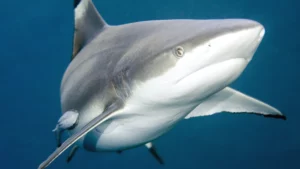
The species it is most often mentioned alongside is the Pondicherry shark, another Critically Endangered "lost" requiem shark of the Indo-West Pacific that was rediscovered from market specimens and river records; the Pondicherry shark is larger and has black-tipped fins. Across the Pacific, the smalltail shark of the tropical Americas and the blacknose shark of the western Atlantic are the ecological equivalents: small, slim, inshore requiem sharks that feed on little fish over soft bottoms. The blacktip reef shark shares the coast but is larger, boldly marked and a reef animal. A full list of the family is on our types of sharks page.
- Hardnose Sharkspecies profile
- Whitecheek Sharkspecies profile
- Pondicherry Sharkspecies profile
- Smalltail Sharkspecies profile
 Blacknose Sharkspecies profile
 Blacktip Reef Sharkspecies profile
Frequently asked questions
How big is a Borneo shark?
Small. The largest measured specimen is about 65 cm (2.1 ft) long. Males mature at 55 to 58 cm and females at 61 to 65 cm, so adults are barely bigger than the size at maturity. Newborns are 24 to 28 cm. No adult has been weighed and published; an animal this slim would be under 2 kg.
Where does the Borneo shark live?
With certainty, only in the shallow inshore waters off Mukah on the north-west coast of Sarawak, Malaysian Borneo, where every modern specimen has been landed. Nineteenth-century museum labels mention China and Java, but those records have never been repeated and are probably errors. It is effectively a Sarawak endemic.
Why is the Borneo shark so rare?
It appears to have a tiny natural range on one heavily fished stretch of coast, and small inshore sharks there are taken by gillnets and trawls regardless of species. Between the 1930s and 2004 no specimen was recorded at all. Whether it was always this scarce or has been fished down is not known.
How do you identify a Borneo shark?
Look at the mouth. A row of enlarged pores runs along the upper lip beside each corner of the mouth, a feature no other Carcharhinus shark has. Add a long pointed snout, large eyes, plain grey colouring without fin markings, no ridge between the dorsal fins, and a length under 65 cm.
What do Borneo sharks eat?
Small bony fish, based on the few stomachs that have been examined. The narrow cutting teeth, pointed snout and slim body fit a shark that chases small schooling fish such as anchovies over soft bottom. Whether it also takes shrimps and crabs, as similar sharks do, has not been studied.
How do Borneo sharks reproduce?
They are viviparous with a yolk-sac placenta, like all requiem sharks. The one pregnant female examined carried six pups of 24 to 28 cm. Gestation has not been measured; nine to twelve months is typical for sharks of this size. Birth season, nursery areas and breeding frequency are unknown.
How long do Borneo sharks live?
Nobody knows. No ageing study has been done because so few specimens exist. Small coastal requiem sharks of similar size generally mature at two to four years and live around ten to fifteen, which is the best available guess, but any exact figure for this species is an invention.
Are Borneo sharks dangerous to humans?
No. There is no incident attributed to the species in the SharkSider database or the International Shark Attack File, and a 65 cm shark with a mouth built for anchovies could not seriously injure a person. Almost every human encounter with the species has been with a dead fish at a market.
Is the Borneo shark endangered?
Yes, it is Critically Endangered on the IUCN Red List, the last category before extinction. Its known range is a single fished coastline, it has no legal protection in Malaysia, and it was unrecorded for about 70 years before 2004. All requiem sharks were added to CITES Appendix II in November 2023.
When was the Borneo shark rediscovered?
In 2004, when researchers surveying fish landings at Mukah in Sarawak found fresh specimens among the inshore catch. Until then the species was known only from a few old museum specimens, the last collected in the 1930s, and some scientists suspected it might already be extinct. The new material allowed a full redescription.
References

A small team focused on researching sharks and making marine biology easy to understand. Every page is reviewed against current species records and the SharkSider attack database, and updated when new incidents or research appear.
Published September 9, 2022 · Last updated September 22, 2026 · No incident attributed to this species in the SharkSider attack database, which is updated weekly.