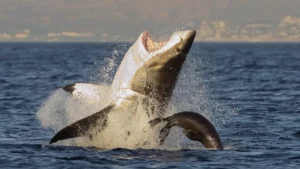
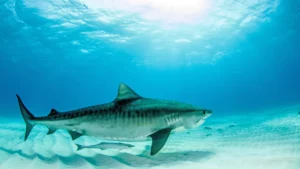
The blacktip shark (Carcharhinus limbatus) is a medium-sized requiem shark of warm coastal seas worldwide, usually 1.5 m (5 ft) long and reaching about 2.5 m (8 ft) and 120 kg. It has a long pointed snout, a tall first dorsal fin, no interdorsal ridge and black fin tips, and it is known for spinning leaps while feeding.
It hunts schooling fish such as sardines, menhaden and mullet, plus small sharks, rays and squid. Females bear 1–10 live pups every second year after a 10–12 month pregnancy, and the species lives about 12–15 years. The IUCN lists it as Vulnerable. It causes dozens of minor bites on Florida surfers and waders, but no confirmed death.
- Maximum lengthAbout 2.5 m (8 ft); most adults 1.4–1.6 m
- Weight18–40 kg typical (40–90 lb); record 122.8 kg (271 lb)
- Lifespan12–15 years
- Depth rangeSurface to 140 m (460 ft), usually under 30 m
- DietSchooling fish, small sharks, rays, squid
- IUCN statusVulnerable (assessed 2020)

- Kingdom
- Animalia
- Phylum
- Chordata
- Class
- Chondrichthyes
- Order
- Carcharhiniformes
- Family
- Carcharhinidae
- Genus
- Carcharhinus
- Species
- Carcharhinus limbatus
- Family (common)
- Requiem sharks
- Also known as
- Blacktip shark, Atlantic blacktip shark, Blacktip whaler (Australia), Small blacktip shark
On this page
- How to tell a blacktip shark from its look-alikes
- How big do blacktip sharks get?
- Where blacktip sharks live
- What blacktip sharks eat and how they hunt
- Behaviour, senses and migration
- Reproduction and lifespan
- How dangerous are blacktip sharks?
- Conservation status and fisheries
- Similar species and close relatives
- Frequently asked questions
- References
How to tell a blacktip shark from its look-alikes
Blacktips are the classic grey requiem shark, so identification comes down to fin detail. The snout is long and pointed, the eyes round and moderately large, and the tall first dorsal fin starts above or just behind the base of the pectoral fins. There is no ridge of skin between the two dorsal fins, a quick way to rule out the sandbar and dusky sharks, which have one.
The back is grey to bronze-grey and the belly white, with a clean white wedge running forward along the flank. The pectoral, pelvic and second dorsal fins and the lower tail lobe carry black tips, and the first dorsal is usually dark-edged too. The one fin that normally stays plain is the anal fin, and that matters: in an adult spinner shark the anal fin is black-tipped as well, the snout is longer, the eye smaller and the first dorsal begins further back, behind the free rear tip of the pectoral. The two are confused so often that many bite reports simply say "blacktip or spinner".
The teeth are erect, narrow and finely serrated in both jaws, about 15 on each side of the upper jaw and 15 on each side of the lower. In the Arabian Sea the smoothtooth blacktip has smooth-edged teeth, and in northern Australia the near-identical Australian blacktip can only be told apart reliably by vertebral counts or genetics. The blacktip reef shark is a different animal: short blunt snout, a bold black brush on the first dorsal fin, and a life spent on coral flats.

How big do blacktip sharks get?
The blacktip is a mid-sized shark, and most of the animals that swim past Florida bathers are 1.2 to 1.6 m (4 to 5 ft) long and weigh 18 to 40 kg (40 to 90 lb). Fully grown females are larger than males and can reach about 2.5 m (8 ft); a length of 2.8 m has been claimed but never confirmed with a measured specimen. The all-tackle angling record, a 122.8 kg (271 lb) fish taken off Kenya in 1995, shows what an exceptional old female can weigh.
Pups measure 38 to 72 cm at birth, most of them 55 to 65 cm, and grow quickly in their first year. Along the US Atlantic coast males mature at about 1.3 to 1.45 m and four to five years of age, females at roughly 1.5 to 1.55 m and six to seven years; in the Gulf of Mexico both sexes mature slightly smaller and younger. Growth then slows, so a 2 m female is a survivor of well over a decade. The size bar below sets the maximum against a 1.8 m diver: this is a shark you could lift with two people, not a monster.
Where blacktip sharks live
Blacktips are found in tropical and warm-temperate seas on every continent. In the western Atlantic they range from Massachusetts (in the warmest weeks) through North Carolina, Florida, the whole Gulf of Mexico and the Caribbean to southern Brazil. In the eastern Atlantic they occur from Senegal to Congo and, rarely, in the Mediterranean. The Indo-Pacific population runs from South Africa and the Red Sea through the Persian Gulf, India, Indonesia and the Philippines to southern China, northern Australia and, uncommonly, Hawaii; a further population lives in the eastern Pacific from Baja California to Peru. Genetic work shows the Atlantic and Indo-Pacific lineages have long been separate and may one day be split into two species.
It lives in surf zones, bays, estuaries and river mouths, usually in less than 30 m of water and only occasionally down to 140 m. It tolerates the reduced salinity of estuaries but does not enter fresh water the way the bull shark does. Water warmer than about 20 °C is the rule, which drives the seasonal migration up the US east coast to the Carolinas and Virginia in summer and back south in autumn. Each winter tens of thousands gather within a few hundred metres of the beach off Palm Beach County, Florida, where aerial surveys by Florida Atlantic University have counted more than ten thousand animals in a single flight.

- Florida62 records
- South Carolina11 records
- South Africa9 records
- Bahamas5 records
- Texas3 records
- Georgia2 records
- North Carolina2 records
- Alabama1 record
- Guam1 record
- Louisiana1 record
- Maryland1 record
- Mississippi1 record
Show all 82 places
- Virginia1 record
- Algerialisted
- Anguillalisted
- Arubalisted
- Bahrainlisted
- Barbadoslisted
- Belizelisted
- Brazillisted
- Cambodialisted
- Chinalisted
- Colombialisted
- Costa Ricalisted
- Cubalisted
- Curaçaolisted
- Delawarelisted
- Dominicalisted
- Dominican Republiclisted
- Ecuadorlisted
- Egyptlisted
- El Salvadorlisted
- Fijilisted
- Ghanalisted
- Greecelisted
- Grenadalisted
- Guatemalalisted
- Haitilisted
- Honduraslisted
- Hong Konglisted
- Indialisted
- Indonesialisted
- Iranlisted
- Israellisted
- Italylisted
- Jamaicalisted
- Japanlisted
- Kenyalisted
- Malaysialisted
- Maltalisted
- Mexicolisted
- Moroccolisted
- New Jerseylisted
- New Yorklisted
- Nicaragualisted
- Nigerialisted
- Omanlisted
- Pakistanlisted
- Panamalisted
- Papua New Guinealisted
- Perulisted
- Puerto Ricolisted
- Qatarlisted
- Saint Lucialisted
- Samoalisted
- Saudi Arabialisted
- Senegallisted
- Singaporelisted
- Somalialisted
- Sri Lankalisted
- Thailandlisted
- The British Virgin Islandslisted
- The Cayman Islandslisted
- The Gambialisted
- The Maldiveslisted
- The Philippineslisted
- The U.S. Virgin Islandslisted
- Trinidad and Tobagolisted
- Tunisialisted
- Turkeylisted
- Venezuelalisted
- Vietnamlisted
69 countries and 13 US states list the black tip sharks in their species guide; the count is the number of incidents attributed to it there in the SharkSider database. Browse every guide on sharks around the world and sharks in the US.
What blacktip sharks eat and how they hunt
Blacktips are fish-eaters first and last. Stomach studies from the Gulf of Mexico and the US south-east are dominated by schooling fish: menhaden, sardines, herrings, anchovies, mullet, croakers, jacks, Spanish mackerel and sea catfish. The rest of the diet is small sharks such as the Atlantic sharpnose, stingrays and skates, squid, cuttlefish, crabs and, now and then, a lobster. Marine mammals and turtles are absent; the narrow teeth are the wrong tools.
The hunting method is speed. A blacktip charges up through a bait school from below, snapping as it goes, and its momentum often carries it clear of the surface, where it spins on its long axis two or three times before crashing back. The spinner shark does the same thing more consistently, but blacktips are the sharks most beachgoers see breaching off Florida piers. During the autumn mullet run on the Florida Atlantic coast dozens may feed together in a few feet of water, which puts surfers and sharks in the same surf line and explains much of the bite record below.
Feeding peaks at dawn and dusk, and a shark that has been tracking a bait ball in murky water will strike at almost any flash of pale movement, which is how a hand or a foot gets bitten once and then released.

Behaviour, senses and migration
Blacktips are among the most social of the requiem sharks. They travel in schools that are usually sorted by size and sex, with mature females and males meeting only for the spring mating season. There is no evidence of a strict pecking order within a school. Around divers they are nervous unless bait is in the water.
The best-documented behaviour is the annual migration along the US Atlantic coast. The same individuals return to the Palm Beach winter grounds year after year, and tagging shows the run north in April and May, a summer spread from Georgia to the Carolinas and beyond, and the return in October and November. A quieter finding is philopatry: genetic sampling of pups in Gulf and Atlantic nurseries showed that females return to the bay where they were born to give birth, so each nursery holds a partly separate stock.
The senses are those of a generalist hunter. A good lateral line and the ampullae of Lorenzini guide the final strike in cloudy water. Smell works over tens to hundreds of metres down-current, not the miles of folklore. Unlike makos and white sharks, a blacktip is fully cold-blooded, which is why it leaves cooling northern waters each autumn.
Reproduction and lifespan
The blacktip is viviparous with a yolk-sac placenta: once the yolk is used up, the empty sac attaches to the uterine wall and feeds the embryo. Mating takes place in late spring and early summer, gestation lasts 10 to 12 months, and the pups are born the following May or June in shallow nurseries such as Bulls Bay in South Carolina, Terra Ceia Bay in Florida and the bays of Texas and Louisiana. Litters hold 1 to 10 pups, typically 4 to 6, and the female breeds only every second year.
Newborns stay inside the nursery for their first summer, and leave for deeper water with the first cold fronts of autumn. Age at maturity is four to five years for males and six to seven for females on the US Atlantic coast. Growth-band counts give a lifespan of at least 12 years, perhaps 15 for the largest females, short by shark standards (see how long sharks live).
The species also supplied one of the first proven cases of a "virgin birth" in a shark. In 2007 a female that had lived without a male at the Virginia Aquarium was found to be carrying a pup, and DNA analysis showed it had no father: the egg had been fertilised by one of the female's own cells, a process called automictic parthenogenesis. It is a fallback, not a strategy, and such pups rarely survive.
How dangerous are blacktip sharks?
Honestly: the blacktip bites more people than almost any other shark, and hurts them less. The SharkSider database holds 111 incidents attributed to the species, from 1944 to 2024, and none of them was fatal. Seventy-eight of the records date from 2000 onward, 86 are from the United States, and most of those come from Florida's Volusia County, where baitfish, surfers and blacktips crowd the inlet at New Smyrna Beach. South Africa (9), the Bahamas (5) and French Polynesia (4) follow. Surfers and boarders account for 51 of the cases, swimmers and waders for 23, divers and spearfishers for 14.
The pattern is consistent: a single quick bite to a foot, calf or hand in murky, waist-deep water, often during the mullet run or near a pier where people are fishing, followed by the shark letting go and leaving. That is a fish-hunter mistaking a pale, splashing limb for prey, not a predator sizing up a person. Injuries usually mean stitches rather than surgery, and many Florida bites are logged as "blacktip or spinner" because no one saw the fin.
We rate the species Moderate: no single encounter is likely to be serious, but so many people share its surf zones that a bite somewhere is an annual certainty. Avoid dawn, dusk and bait schools, stay out of the water when people are fishing from the beach, and read what to do if a shark approaches. The full record for South Africa is on the South Africa page.
Black Tip Sharks incidents in the SharkSider database
- Records attributed111
- Fatal0 (0%)
- Years covered1944–2024
- Since 200078 incidents, 0 fatal
- Most common activitySurfing & boards
- Most recordsUSA (86)
The six most recent records attributed to the black tip sharks
- 8 July 2024 · Ponce de Leon Inlet Volusia County, Florida, USADiving into water — Lower left leg injuryRecorded as: 4-5ft Blacktip shark · not fatal
- 30 December 2022 · Protea Banks, KNZ, South AfricaDiving/shark feeding — Hamd bittenRecorded as: Blacktip · not fatal
- 7 December 2022 · Texas, USASurfing — Foot bittenRecorded as: Blacktip · not fatal
- 15 August 2022 · Myrtle Beach, Horry County, South Carolina, USAStanding — Multiple llacerations to right forearmRecorded as: Blacktip shark · not fatal
- 25 July 2022 · Daytona Beach, Volusia County, Florida, USAWading — Minor bite to left footRecorded as: Blacktip shark? · not fatal
- 3 May 2022 · Île de Saint Simon, Glynn County, Georgia, USAFishing — Thumb bitten by hooked shark provoked incidentRecorded as: Atlantic blacktip shark · not fatal
Records are matched on the shark named in each report (“blacktip”, “black tip”), so they include incidents where the species was reported rather than confirmed. Full records by country on the shark attacks pages.
Conservation status and fisheries
The IUCN Red List assessed the blacktip shark as Vulnerable in 2020, with the population decreasing globally, after decades in the Near Threatened category. The downgrade reflects steep declines in the Indian Ocean and parts of Asia rather than in the well-managed US stocks. Since November 2023 every member of the family Carcharhinidae has been listed on CITES Appendix II, so exported fins and meat now need permits. The species is not listed under the Convention on Migratory Species.
In the United States the blacktip is the most valuable shark in the commercial fishery, sold fresh under its own name, and it is fished under the federal Atlantic highly migratory species plan with quotas, gear rules and a recreational size limit. Stock assessments have found the Gulf of Mexico population healthy and not overfished, while the Atlantic stock is managed more cautiously because its status is less certain. Elsewhere blacktips are taken in huge numbers by gillnets and longlines off India, Pakistan, Indonesia, Mexico and West Africa, where landings are rarely limited, and their fins are common in the Hong Kong trade. Shark nets off KwaZulu-Natal catch them every year.
Because the species breeds in the shallowest, most developed coastal water, the loss of estuarine nurseries to dredging, pollution and harbour building is a threat no quota can fix. Our page on why sharks are endangered sets the blacktip's situation against the wider picture.
Similar species and close relatives
The blacktip belongs to the largest shark genus, Carcharhinus, and several of its relatives wear the same fin tips. The spinner shark is its constant companion on the US south-east coast and the species it is most often confused with; look for the black-tipped anal fin, smaller eye and further-back dorsal fin of an adult spinner. The Australian blacktip replaces it in the tropical north of Australia and hybridises with it where they overlap, while the smoothtooth blacktip of the Arabian Sea was known from a single museum specimen until 2008. The finetooth shark shares the same nurseries and bait schools but has plain fins and long gill slits, and the blacknose shark is a smaller, browner animal with a dark smudge on the snout tip.
The blacktip reef shark is the species most tourists mean when they say "blacktip", but it is a short-nosed reef dweller of the Indo-Pacific with a far bolder dorsal marking, and it does not occur in the Atlantic. Larger grey sharks with an interdorsal ridge, the sandbar and dusky, are sometimes reported as blacktips; the ridge settles it. For an overview of how this family fits together, see our guide to the requiem sharks.
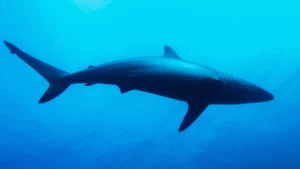 Spinner Sharkspecies profile
- Australian Blacktip Sharkspecies profile
- Smoothtooth Blacktip Sharkspecies profile
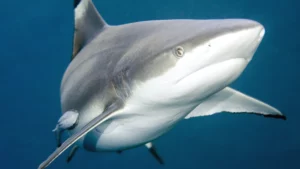 Blacktip Reef Sharkspecies profile
- Finetooth Sharkspecies profile
 Blacknose Sharkspecies profile
Frequently asked questions
How big is a blacktip shark?
Most blacktip sharks are 1.2 to 1.6 m (4 to 5 ft) long and weigh 18 to 40 kg. Large females reach about 2.5 m (8 ft), and the angling record is a 122.8 kg fish caught off Kenya in 1995. Newborn pups measure 38 to 72 cm, usually around 60 cm, at birth.
How long do blacktip sharks live?
Growth-band counts give a lifespan of at least 12 years, with the largest females probably reaching 15 or slightly more. That is short for a shark. Males mature at four to five years and females at six to seven on the US Atlantic coast, so an individual may breed only four or five times in its life.
Where do blacktip sharks live?
In warm coastal water worldwide: the US Atlantic and Gulf coasts, the Caribbean and Brazil, West Africa, the Red Sea and Persian Gulf, India, South-East Asia, northern Australia and the Pacific coast from Mexico to Peru. They stay mostly in less than 30 m of water, in surf zones, bays, estuaries and river mouths, and migrate seasonally with temperature.
What do blacktip sharks eat?
Mostly schooling fish such as menhaden, sardines, herring, anchovies, mullet, croakers and jacks, along with small sharks like the Atlantic sharpnose, stingrays, squid and crabs. They hunt by charging up through bait schools, and the momentum often carries them out of the water in a spinning leap.
Why do blacktip sharks jump out of the water?
The leaps are a by-product of feeding. A blacktip rushes vertically through a school of fish, snapping as it rises, and its speed carries it clear of the surface, where it spins two or three times before falling back. Spinner sharks do the same thing even more often, which is why the two are confused.
Are blacktip sharks dangerous to humans?
They bite people more often than almost any other species but rarely cause serious injury. The SharkSider database holds 111 incidents attributed to blacktips since 1944, none fatal, with 86 of them in the United States and most involving surfers or waders in murky Florida surf. Typical injuries are a single bite to a foot or hand.
How do you tell a blacktip shark from a spinner shark?
Check the anal fin: it is plain in a blacktip and black-tipped in an adult spinner. Spinners also have a longer snout, smaller eyes and a first dorsal fin that starts behind the pectoral fin's rear tip rather than above it. Both leap and spin while feeding, so behaviour alone does not separate them.
Are blacktip sharks endangered?
The IUCN lists the blacktip shark as Vulnerable, assessed in 2020, with numbers falling in the Indian Ocean and much of Asia. Trade has been controlled under CITES Appendix II since November 2023. US stocks are managed with quotas and the Gulf of Mexico population is considered healthy, but fishing elsewhere is largely unregulated.
Can blacktip sharks reproduce without a mate?
Yes, in rare cases. In 2007 a female at the Virginia Aquarium that had never been housed with a male was found to be pregnant, and DNA tests confirmed the pup had no father. This automictic parthenogenesis is a rare fallback, and pups produced this way have reduced genetic diversity and seldom survive long.
Is the blacktip shark the same as the blacktip reef shark?
No. The blacktip reef shark is a separate species, Carcharhinus melanopterus, with a short blunt snout and a conspicuous black brush on its first dorsal fin, found only on Indo-Pacific reefs. The blacktip shark has a long pointed snout, grows larger, ranges into the Atlantic and Mediterranean, and prefers open surf and bays.
References

A small team focused on researching sharks and making marine biology easy to understand. Every page is reviewed against current species records and the SharkSider attack database, and updated when new incidents or research appear.
Published November 29, 2016 · Last updated September 22, 2026 · 111 incidents attributed to the black tip sharks in the SharkSider attack database (0 fatal), updated weekly.