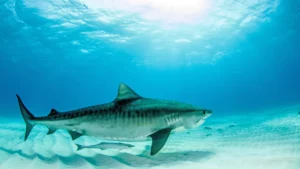
The birdbeak dogfish (Deania calcea) is a deep-water gulper shark of the Atlantic and Pacific that grows to about 122 cm (4 ft) and lives on continental slopes between roughly 70 and 1,490 m, most often between 400 and 900 m. It is instantly recognisable by its extremely long flattened snout, its two spined dorsal fins and the pitchfork-shaped denticles that make its skin feel like coarse velvet.
It feeds mainly on lanternfish, squid and prawns. Females carry 6 to 12 pups on yolk alone, mature at around 20 years and live at least 35, so populations rebuild very slowly. Harmless to people, it is listed by the IUCN as Near Threatened after heavy fishing for its squalene-rich liver.
- Maximum lengthAbout 122 cm (4 ft), females larger
- WeightNo reliable published maximum
- LifespanAt least 35 years
- Depth rangeAbout 70–1,490 m (230–4,900 ft)
- DietLanternfish, small bony fish, squid, prawns
- IUCN statusNear Threatened

- Kingdom
- Animalia
- Phylum
- Chordata
- Class
- Chondrichthyes
- Order
- Squaliformes
- Family
- Centrophoridae
- Genus
- Deania
- Species
- Deania calcea
- Family (common)
- Gulper sharks
- Also known as
- Birdbeak dogfish, Shovelnose spiny dogfish, Brier shark
On this page
How to recognise a birdbeak dogfish
Nothing else in the deep Atlantic has that snout. It is very long, flattened from above and drawn out to a narrow tip, occupying close to half the length of the head, and the mouth sits far back beneath it. Seen from the side, the profile really does suggest a wading bird, which is where both the English name and the older name shovelnose spiny dogfish come from.
The rest of the shark follows the squaliform pattern. There is no anal fin, and both dorsal fins carry grooved spines: the first spine is short and the first fin long and low, while the second fin is taller with a much longer spine. The pectoral fins are small and squared off, the eyes are large and green, and the body is slender, dark grey-brown above and only slightly paler below, with no spots or bands.
Run a hand along the flank and the identification is confirmed. The dermal denticles of Deania are unique among sharks: each one is raised on a stalk and ends in three prongs, so the skin has the texture of coarse velvet rather than sandpaper. Gulper sharks in the genus Centrophorus, which share the same slopes and the same spined fins, have flat overlapping block-shaped denticles and a far shorter snout, so the skin alone settles the question.

How big does a birdbeak dogfish get?
The birdbeak dogfish reaches about 122 cm (4 ft) in total length, which makes it one of the larger sharks of the deep slope, though still a small shark by the standards of coastal water. Most individuals landed by deepwater fleets measure 80 to 105 cm. Females grow larger than males and dominate the top of the size range, as they do in almost every squaliform shark.
Pups are born at roughly 30 to 35 cm, already a quarter of adult length, and they carry functioning dorsal spines from birth. Growth after that is exceptionally slow. Males mature at about 75 to 85 cm and females at about 95 to 110 cm, and ageing studies based on the dorsal spines put female maturity at somewhere around twenty years and the oldest individuals examined at thirty-five. In other words this shark spends more than half its life as a juvenile.
Weights are rarely published and not very meaningful. Much of the body mass of a gulper shark is liver, which can approach a quarter of total weight and is loaded with low-density oil, and specimens arrive on deck distorted by the pressure change. In the scale below, the verified 122 cm is measured off against a 1.8 m diver.
Where birdbeak dogfish live
This is one of the few deep-sea sharks with a genuinely global distribution, though a patchy one. In the eastern Atlantic it runs from Iceland and the Faroe Channel south along the slopes of Ireland, the Bay of Biscay, Portugal, Spain and the Canary Islands to Namibia and the Cape of Good Hope. In the Pacific it is known from Japan, southern Australia, New Zealand and Chile. Whether all of these are one species or a complex of closely similar ones is still being worked out.
What links every one of those places is the shape of the seabed. The birdbeak dogfish is a shark of the continental and island slope, found from about 70 m down to nearly 1,500 m but concentrated in the band between 400 and 900 m, where the slope is steep and the water sits at 5 to 10 °C. It is usually caught on or just above the bottom, over soft sediment, and around seamounts and canyon walls where currents concentrate food.
Catches are strongly sorted by size and sex, with mature females taken in different places, and often at different depths, from males and juveniles. That segregation is one reason a slope fishery can remove a disproportionate share of the breeding females in a very short time. The map below shows the slopes where the species is regularly recorded.

4 countries list the birdbeak dogfish shark in their species guide; the count is the number of incidents attributed to it there in the SharkSider database. Browse every guide on sharks around the world and sharks in the US.
What birdbeak dogfish eat
Stomach analyses from the north-eastern Atlantic and from New Zealand agree closely. Small midwater bony fish dominate, with lanternfish the single most important group, followed by other slope-associated fish including small hakes and rattails. Squid are eaten regularly, and prawns and other crustaceans make up the remainder. This is a predator of the deep scattering layer as much as of the seabed itself.
The teeth match that diet and differ sharply between the jaws. The upper teeth are narrow and lance-like, arranged for grip, while the lower teeth are broad, blade-shaped and interlock into one continuous cutting edge. Prey is held by the upper jaw and sheared by the lower, so the shark can handle fish that are too large to be swallowed whole.
The long snout is not a digging tool. It is packed with electroreceptive ampullae of Lorenzini, and spreading them across a long, flat blade gives a wider sensory sweep as the shark swims, in the same way that a hammerhead's head does in shallow water. In permanent darkness that matters more than eyesight, although the large green eyes are certainly used to pick up the bioluminescence of lanternfish and squid. Most feeding appears to happen in the hours when the scattering layer rises towards the surface and the shark can meet it higher in the water column.
Behaviour and adaptations
Nobody has watched a birdbeak dogfish behave in its own environment for any length of time, so the picture is assembled from anatomy, catch composition and a handful of submersible observations of similar slope sharks. It describes an animal built for economy rather than speed.
Buoyancy is the clearest adaptation. Sharks have no swim bladder, and a deep-sea species cannot afford to swim constantly just to keep its depth, so the birdbeak dogfish carries an enormous liver filled with squalene, a hydrocarbon lighter than seawater. The liver can make up around a quarter of the body and brings the shark close to neutral buoyancy, letting it hang in the water and glide with very little effort. That same oil is the reason the species was hunted, which is a hard irony.
The rest follows: pale, poorly vascularised muscle, a lightly calcified skeleton, a low metabolic rate and long gaps between meals. Trawl hauls often contain many individuals at once, and those hauls are usually dominated by one sex or one size class, which points to loose schooling and to segregation by sex and maturity. Vertical movement with the scattering layer is likely, as it is in other slope dogfish. There is no evidence of long horizontal migration; a population on one stretch of slope appears to stay there, which is precisely what makes local depletion so easy and recovery so slow.
Reproduction and lifespan
Reproduction is yolk-sac viviparous: eggs are fertilised internally and retained, each embryo develops on the yolk it began with, with no placental connection, and the pups are born fully formed at about 30 to 35 cm. Litters run from roughly 6 to 12 pups, and the number rises with the size of the mother. No egg case is ever laid.
The timing is the important part. Males mature at about 75 to 85 cm and females at 95 to 110 cm, and spine-based ageing in New Zealand waters puts female maturity at around twenty years of age, with the oldest individuals examined at about thirty-five. Gestation has not been measured directly but is thought to last well over a year, and there is no evidence of a fixed breeding season, so females probably reproduce every second or third year at best. Over a whole lifetime a female may produce only a few dozen pups.
That arithmetic explains everything about the species' conservation position. A shark that waits two decades to breed and then produces fewer than ten young at a time has an intrinsic rate of increase close to zero, and a fishery removing a few per cent of the adults each year is enough to drive the population down. It is the classic deep-sea life history described on our how long sharks live page, and it leaves no margin at all.
Are birdbeak dogfish dangerous?
No. This shark lives on slopes hundreds of metres below the reach of any diver, it does not come into coastal water, and it does not survive the journey to the surface. Our database returns no incident attributed to the species, as the note below records, and no shark attack file anywhere lists one. At 122 cm it is large enough to be taken seriously as an animal, but it has no interest in and no access to people.
Where it does need careful handling is on deck. The second dorsal spine in particular is long, sharp and quite capable of going through a glove, and the pitchfork-shaped denticles will take the skin off a bare forearm as the shark twists. Crews sorting deepwater catches handle gulper sharks by the tail, well clear of the fins. The bite is a different matter: the interlocking lower teeth form a real cutting edge and a live specimen should not be picked up by the head, though no serious injury from one has been reported. For perspective on the species that actually matter to swimmers, see our list of the least dangerous sharks.
The SharkSider database has no incident attributed to this species. The database draws on the International Shark Attack File, the Global Shark Attack File and verified local reports, and is updated weekly.
Conservation status
The IUCN Red List assesses the birdbeak dogfish as Near Threatened globally, and the situation in the north-eastern Atlantic has been considerably worse than that global figure suggests. Deep-water fisheries there expanded rapidly in the 1990s, targeting gulper sharks and their relatives for liver oil, and survey indices for deep-sea sharks on the European slope fell steeply within about a decade.
The driver was squalene. The oil in a gulper shark's liver is used in cosmetics, in some pharmaceutical products and formerly in machinery lubricants, and it commanded a high enough price to make a fishery worthwhile on its own; the carcass was usually reduced to fishmeal or discarded. Because the sharks segregate by sex and size, fleets working a particular depth band could strip out the mature females first. The species is also taken as bycatch in trawl fisheries for hake, orange roughy and other deep-water species off New Zealand, Australia and South Africa.
Management has caught up only partly. The European Union set catch limits for deep-sea sharks in the north-east Atlantic from 2010 that amount in practice to a prohibition on targeting them, and several regional fisheries bodies now ban deep-set gillnets below 600 m. The species is not listed on CITES or the Convention on Migratory Species, and outside European waters there is little specific protection. With maturity at twenty years, recovery where it happens at all will take decades, the pattern set out on our page about why sharks are endangered.
Similar species and close relatives
The genus Deania holds four species, all with the same exaggerated snout and pitchfork denticles. The arrowhead dogfish is the smallest and has a shorter, broader snout and a subcaudal keel, while the longsnout dogfish of the southern hemisphere is the nearest thing to a twin and is separated mainly by fin proportions and denticle detail. Where two of them occur on the same slope, identification usually comes down to measurements rather than to a glance.
The family Centrophoridae also contains the true gulper sharks of the genus Centrophorus, which share the slopes, the two spined dorsal fins and the oily liver but have short blunt snouts and flat, tile-like denticles. The gulper shark itself, the leafscale gulper shark and the little gulper shark have all suffered the same liver-oil fisheries, and the four species are routinely landed together and reported as one category.
Deeper still, the Portuguese dogfish of the family Somniosidae overlaps in range and was caught in the same nets; it is stouter, darker and has no dorsal spines worth the name. The lanternsharks such as the velvet belly are much smaller and glow. For a wider view of where these families sit, start from our guide to the types of sharks.
- Arrowhead Dogfishspecies profile
- Longsnout Dogfishspecies profile
- Gulper Sharkspecies profile
- Leafscale Gulper Sharkspecies profile
- Little Gulper Sharkspecies profile
- Portuguese Dogfishspecies profile
Frequently asked questions
How big do birdbeak dogfish get?
They reach about 122 cm, or 4 feet, in total length, and females grow larger than males. Most individuals caught by deepwater fleets measure 80 to 105 cm. Pups are born at roughly 30 to 35 cm. Males mature at about 75 to 85 cm and females at 95 to 110 cm.
Why is it called a birdbeak dogfish?
Because of its snout, which is very long, flattened from above and drawn out to a narrow tip, taking up close to half the length of the head. In profile it resembles the bill of a wading bird. The same feature gives the species its other name, shovelnose spiny dogfish.
Where do birdbeak dogfish live?
On continental and island slopes in both hemispheres. In the eastern Atlantic they range from Iceland and the Faroe Channel south past Ireland, Portugal and Spain to Namibia and South Africa. In the Pacific they are known from Japan, southern Australia, New Zealand and Chile. They are concentrated between 400 and 900 metres deep.
What do birdbeak dogfish eat?
Mainly small midwater fish, with lanternfish the most important single group, plus small hakes, rattails, squid and prawns. Narrow gripping teeth in the upper jaw hold prey while the interlocking blade-like lower teeth shear it, so the shark can eat fish too large to swallow whole.
How long do birdbeak dogfish live?
At least 35 years, based on ageing studies that count growth bands in the dorsal fin spines of New Zealand specimens. Females do not mature until around twenty years of age, so more than half the lifespan is spent as a juvenile. This makes the species one of the slower-growing sharks on the continental slope.
How do birdbeak dogfish reproduce?
They are yolk-sac viviparous. Eggs are fertilised and retained inside the mother, each embryo living on its own yolk with no placental connection, and no egg case is laid. Litters run from about 6 to 12 pups, larger females carrying more, and the young are born fully formed at 30 to 35 cm.
Are birdbeak dogfish dangerous to humans?
No. They live hundreds of metres down on deep slopes, never enter shallow coastal water and do not survive being brought to the surface. Not one incident anywhere has ever been put down to this shark. The only hazard is on deck, where the long second dorsal spine and the rough skin can injure a bare hand.
Why were birdbeak dogfish fished?
For the oil in their livers. A gulper shark's liver can approach a quarter of its body weight and is rich in squalene, used in cosmetics and some pharmaceutical products and formerly as a lubricant. The oil was valuable enough to support a targeted fishery on its own, with the rest of the body turned into fishmeal or discarded.
Is the birdbeak dogfish endangered?
The IUCN lists it as Near Threatened globally, and north-east Atlantic populations declined steeply during the deep-water fisheries of the 1990s. The European Union has effectively prohibited targeting deep-sea sharks since 2010 and deep-set gillnets are banned below 600 metres in several regions, but recovery will take decades.
What makes birdbeak dogfish skin different?
Its dermal denticles. In the genus Deania each denticle is raised on a stalk and ends in three prongs, like a tiny pitchfork, so the skin feels like coarse velvet rather than sandpaper. No other sharks have that arrangement, and it is the quickest way to separate a Deania from a true gulper shark.
References

A small team focused on researching sharks and making marine biology easy to understand. Every page is reviewed against current species records and the SharkSider attack database, and updated when new incidents or research appear.
Published September 14, 2022 · Last updated September 22, 2026 · No incident attributed to this species in the SharkSider attack database, which is updated weekly.