No, sharks are not mammals. They are fish, belonging to the class Chondrichthyes, the cartilaginous fishes, which they share with rays, skates and chimaeras.
Sharks breathe through gills rather than lungs, have skeletons of cartilage, are covered in tooth-like scales instead of hair, and produce no milk. Most are cold-blooded. The confusion comes from features that look mammal-like from the outside: many sharks give birth to live young, some nourish embryos through a placenta, and the largest species is named after a whale.
- ClassChondrichthyes (cartilaginous fishes)
- Breathes withGills, not lungs
- Feeds young milkNever
On this page
Where sharks sit on the tree of life
Sharks are vertebrates, like mammals, birds and reptiles, but they belong to a very different branch. Zoologists place them in the class Chondrichthyes, the cartilaginous fishes, and within it in the subclass Elasmobranchii together with the rays and skates. The ratfishes or chimaeras make up the other, much smaller branch of the class. More than 500 shark species have been described, and the basic plan is set out in what is a shark.
The defining feature of the group is the skeleton. Sharks build it from cartilage, often stiffened with calcium salts in the jaws and vertebrae, and never from true bone, as explained in do sharks have bones. Bony fishes, which include almost every fish people eat, form a separate lineage. The closest relatives of sharks are rays, and the way the two groups divide is covered in our guide to cartilaginous fish.
The timeline makes the point too. Shark-like scales appear in rocks more than 400 million years old, and recognisable sharks were established in the seas long before land animals evolved into anything resembling a mammal. The earliest mammals came roughly 200 million years later. Sharks did not branch off from mammals or towards them; the two lineages split from a common ancestor long before either existed in a recognisable form.
Five differences that settle the question
Breathing. Every mammal breathes air with lungs, including whales and dolphins, which must surface to do it. Sharks have no lungs. They take oxygen from water passing over their gills, through five to seven pairs of gill slits on the side or underside of the head. The sand tiger shark does gulp air at the surface, but it holds it in the stomach to adjust buoyancy, not to breathe.
Milk. The word mammal comes from the mammary glands, and every mammal mother feeds her young on milk. No shark has mammary glands. Pups are on their own from the moment they hatch or are born, with no parental care at all.
Skin covering. Mammals have hair at some stage of life, even if only a few whiskers at birth as in some whales. Sharks are covered in placoid scales, tiny tooth-like denticles with a dentine core and an enameloid cap.
Skeleton and jaw. A mammal's lower jaw is a single bone on each side, and its ear contains three tiny bones. Sharks have cartilage jaws hung loosely from the skull, and no bones at all.
Heart and blood. Mammals have four-chambered hearts and double circulation. A shark's heart sends blood once around a single loop through the gills, described in how many hearts a shark has.
Live birth, placentas and the source of the confusion
The strongest reason people suspect sharks are mammals is reproduction. All sharks fertilise internally, the male using a pair of claspers on his pelvic fins, and the majority of species give birth to live, fully formed young rather than laying eggs.
They do it in several ways. Some sharks are oviparous and lay tough egg cases, the familiar mermaid's purses of catsharks and the spiral cases of horn sharks. Many are ovoviviparous: eggs hatch inside the mother and the embryos live on yolk, and in some species on unfertilised eggs or even on their siblings, before birth. A pregnant whale shark landed off Taiwan in 1995 carried about 300 embryos at different stages of development.
A smaller group is placental viviparous. In hammerheads, bull sharks, blue sharks and lemon sharks, the yolk sac of each embryo fuses with the wall of the uterus once the yolk runs low and becomes a placenta that passes nutrients from the mother. It works like a mammal's placenta but evolved independently from different tissue. Some rays go further and feed embryos a rich uterine secretion often called uterine milk. It is produced inside the uterus, not by mammary glands.
The whole range is laid out in do sharks lay eggs.

Are any sharks warm-blooded?
Mammals hold a steady body temperature from their own metabolism wherever they are. Most sharks do not: their body temperature tracks the water, and a shark in 15 °C water is close to 15 °C itself.
A handful of species break that rule in part. The mackerel sharks of the family Lamnidae, the great white, the shortfin and longfin makos, the porbeagle and the salmon shark, keep their swimming muscles, eyes and brain warmer than the surrounding sea. They do it with networks of tightly packed arteries and veins called retia mirabilia, which pass heat from outgoing blood to incoming blood so it is not lost at the gills. The common thresher shark has a similar arrangement in its swimming muscle. The salmon shark goes furthest and has been measured more than 10 °C above the water temperature in the cold North Pacific.
Biologists call this regional endothermy. It is not the same as a mammal's whole-body temperature control, since the warmth depends on the shark swimming and is concentrated in particular tissues. It evolved separately in sharks and in tunas, and it gives the sharks that have it faster muscles and a wider range of cold-water hunting grounds. The details are in are sharks cold-blooded.
Sharks, whales and dolphins side by side
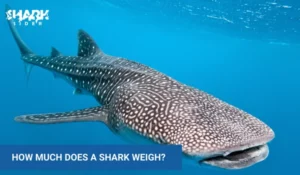
The whale shark got its name for its size and for feeding on plankton like a baleen whale, not because it is related to whales. It is a fish in every respect, with gills, cartilage and denticles. The overlaps and differences are set out in whale sharks and whales compared.
Dolphins and sharks are the other classic mix-up, because both have a pointed snout, a dorsal fin and a torpedo-shaped body. That shape is convergent evolution: the same physics of fast swimming produced similar outlines in a fish and a mammal. The quickest way to tell them apart in the water is the tail. A shark's tail fin is vertical and sweeps side to side. A dolphin's flukes are horizontal and beat up and down, because the mammal's spine evolved to flex in that direction on land long before its ancestors returned to the sea. A dolphin also has a blowhole on top of its head, and a shark has a row of gill slits on each side.
The two groups interact often. Large sharks such as the great white and tiger shark eat dolphins and seals, while orcas, which are dolphins, hunt great whites in parts of South Africa and California. More on that predator relationship is in do sharks eat dolphins.
Frequently asked questions
Is a shark a fish or a mammal?
A fish. Sharks belong to the class Chondrichthyes, the cartilaginous fishes, alongside rays, skates and chimaeras. They breathe through gills, have skeletons of cartilage and are covered in tooth-like scales. They have no lungs, no hair and no mammary glands, the features that define mammals.
Why do people think sharks are mammals?
Mostly because many sharks give birth to live young, and some species even nourish their embryos through a placenta, which people associate with mammals. The whale shark's name adds to it, as does the shark's resemblance to dolphins. None of those features makes a shark a mammal, since it still breathes with gills and produces no milk.
Do sharks give birth or lay eggs?
Both, depending on the species. Most sharks give birth to live young, either after the eggs hatch inside the mother or through a placental connection. A sizeable minority, including catsharks, horn sharks and many bamboo sharks, lay leathery egg cases that hatch outside the body months later.
Do sharks feed their babies milk?
No. Sharks have no mammary glands and give no care after birth. Embryos are nourished inside the mother by yolk, by unfertilised eggs, or through a placenta, depending on the species. Some rays feed embryos a nutrient-rich uterine fluid sometimes called uterine milk, but it is made in the uterus, not by mammary glands.
Is a whale shark a whale or a shark?
A shark, and therefore a fish. It has gills, a cartilage skeleton and placoid scales, and it gives birth through eggs that hatch inside the mother. It was named for its enormous size and for filter-feeding on plankton in a way that resembles baleen whales, which are mammals.
Are sharks warm-blooded like mammals?
Most are not. Their body temperature follows the water around them. A few mackerel sharks, including the great white, makos, porbeagle and salmon shark, keep some tissues warmer than the sea using heat-exchanging blood vessels, and the common thresher does something similar. That regional warmth is different from a mammal's steady whole-body temperature.
Do sharks breathe air like dolphins?
No. Dolphins must surface to breathe through a blowhole into their lungs. Sharks have no lungs and take oxygen from water flowing over their gills. The sand tiger shark gulps air at the surface, but it stores it in the stomach to help it float at a chosen depth, not to breathe.
References

A small team focused on researching sharks and making marine biology easy to understand. Every page is reviewed against current species records and the SharkSider attack database, and updated when new incidents or research appear.
Published October 25, 2026 · Last updated October 25, 2026 · Filed under FAQ.