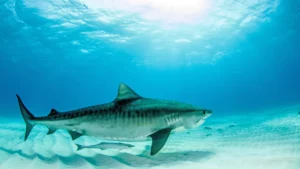
The whitefin topeshark (Hemitriakis leucoperiptera) is a small houndshark endemic to the Philippines, reaching about 96 cm (3.1 ft), that lives in shallow shelf water to at least 48 m and is known from only a few specimens collected since 1923. It is grey above and white below, with a white rear edge on every fin.
Its diet has never been studied but is presumably small fish, crustaceans and squid. It bears live young, with one litter of twelve on record and pups born at about 20 to 22 cm. The IUCN listed it as Critically Endangered in 2020 because of intense, unmanaged inshore fishing across its tiny range. It is harmless to people and has no bite record.
- Maximum length96 cm (3.1 ft), the largest measured female
- WeightNot recorded; a few kilograms at most
- LifespanUnknown; no ageing study exists
- Depth rangeInshore shelf water to at least 48 m (160 ft)
- DietNot studied; presumably small fish, crustaceans and squid
- IUCN statusCritically Endangered (assessed 2020)
- Kingdom
- Animalia
- Phylum
- Chordata
- Class
- Chondrichthyes
- Order
- Carcharhiniformes
- Family
- Triakidae
- Genus
- Hemitriakis
- Species
- Hemitriakis leucoperiptera
- Family (common)
- Houndsharks
- Also known as
- Whitefin tope, Philippine topeshark
On this page
- How to recognise a whitefin topeshark
- How big does the whitefin topeshark get?
- Where the whitefin topeshark lives
- What the whitefin topeshark probably eats
- Behaviour and senses
- Reproduction and lifespan
- Is the whitefin topeshark dangerous to people?
- Conservation status
- Similar species and close relatives
- Frequently asked questions
- References
How to recognise a whitefin topeshark
Picture a slim grey shark about the length of an arm, with the long, oval, cat-like eyes and the third eyelid of the houndshark family, and then add the feature that gives it its name: a clean white band along the rear edge of every fin, brightest on the two dorsal fins and the tail. That white trailing edge, set against a plain grey to grey-brown back and a white belly, is the mark of the species. Juveniles carry a second clue, a series of dark bars across the caudal fin that fade with age; the rest of the body is unmarked at any size.
The snout is moderately long and rounded, with broad nasal flaps in front of the nostrils, and the mouth is a wide arch lined with small, blade-like teeth whose cusps lean towards the corners of the jaw. In Hemitriakis the second dorsal fin is unusually large, nearly the size of the first, and the first dorsal sits roughly midway between the pectoral and pelvic fins; the tail has the low upper lobe and small lower lobe typical of the family. Unlike the Japanese topeshark of the western Pacific, there is no dusky bar on the underside of the snout.
Nothing else in Philippine waters combines the white fin margins with the houndshark eye. Confusion is most likely with young requiem sharks in a fish market, which have round eyes without a nictitating membrane, or with the blacktip tope, whose fin tips are dark.
How big does the whitefin topeshark get?
The honest answer is that only a few animals have ever been measured. The largest, an adult female, was 96 cm (3.1 ft) in total length, and that figure is the maximum quoted by FishBase and the IUCN. Males have been recorded adult at about 83 cm, so this is a shark that matures at three-quarters of its known maximum, as most houndsharks do. The old page's "3.1 ft from the sole captured specimen" was close to right, though it is based on a small series rather than a single fish.
Pups are born at roughly 20 to 22 cm, judging from the smallest free-swimming specimens and the size of full-term embryos, which is in line with the 20 cm newborns of the Japanese topeshark. Weight has never been published; a 96 cm houndshark of this slender build would weigh perhaps 3 to 4 kg, comparable to a large mullet. Whether females grow larger than males, as in related species, cannot be confirmed from so few animals. The bar below sets the largest known specimen against a 1.8 m diver: the whole shark would fit between the diver's hip and shoulder.
Where the whitefin topeshark lives
This is an endemic species in the strictest sense: every record comes from the Philippines, and it has never been reported from Indonesia, Malaysia or anywhere else in the Coral Triangle despite fish-market surveys in all three countries. The species was described in 1923 by the American ichthyologist Albert Herre from Dumaguete on the island of Negros, and later specimens come from the same central region, the Visayas, with the mapped range spanning roughly 5° N to 20° N.
It is an inshore shark of the continental and island shelves. The only depth attached to a specimen is 48 m, so the species is known from the shallow, warm water where Philippine municipal fisheries operate with gillnets, hook-and-line and small trawls. Bottom type, water temperature preferences and seasonal movements have not been recorded; the sensible assumption, from the biology of the other Hemitriakis species, is a tropical demersal shark living on soft sediment and around reef margins in water above 25 °C. Whether the population is continuous across the Visayan Sea or split among islands is unknown, and the map below is a best estimate drawn around the confirmed localities rather than a survey result.

1 country list the whitefin topeshark in their species guide; the count is the number of incidents attributed to it there in the SharkSider database. Browse every guide on sharks around the world and sharks in the US.
What the whitefin topeshark probably eats
No stomach of a whitefin topeshark has ever been analysed and published. What can be said comes from its anatomy and from its relatives. The small, oblique-cusped teeth of Hemitriakis are cutting and gripping tools for soft prey, not crushing plates like those of the smooth-hounds, so the diet is likely to be small bony fish, shrimps, crabs and squid taken on or just above the bottom. The Japanese topeshark, the best-studied member of the genus, eats exactly that mix, with small fish dominating in adults and crustaceans in the young, and there is no reason to expect the Philippine species to differ.
Houndsharks hunt mainly at dusk and at night, cruising slowly over the sediment and relying on smell and on the electrical sense of the ampullae of Lorenzini to find buried prey, and the long eye with its reflective layer suits dim light. The wide, arched mouth is set well back and opens downward, the geometry of a shark that picks food off the bottom rather than chasing it in open water. All of this is inference, and should be read as such until someone examines a specimen.
Behaviour and senses
Nobody has watched a whitefin topeshark alive for more than the minutes it takes to land one, so its behaviour is a blank filled in by its family. Houndsharks are active swimmers that must keep moving to breathe, unlike the catsharks that rest on the bottom, and they patrol slowly along the seabed in small groups or alone. The Japanese and banded topesharks form loose schools segregated by sex and size, and the whitefin topeshark, living in the same kind of warm shelf habitat, probably does too; if so, a single gillnet set could remove much of a local group at once, which matters for a species this rare.
The eyes are large for the body and horizontally oval, with a nictitating membrane that sweeps across to protect them when the shark bites, and the underside of the snout carries the pores of the electrical sense. The white fin margins are unusual among houndsharks and may serve as a signal between individuals in murky water, but that is speculation. There is no information on home range, migration, or whether the species enters estuaries. A tagging study of even a few animals would double what is known about this shark.
Reproduction and lifespan
The whitefin topeshark bears live young. In the genus Hemitriakis the embryos live first on their yolk and later on a yolk-sac placenta that connects them to the mother's uterine wall, the mode called placental viviparity, and the old page's description of the species as egg-retaining (ovoviviparous) is a simplification. A single pregnant female has been recorded, carrying twelve embryos, so "a litter of 12 on average" is one observation rather than an average; litters in the Japanese topeshark run from 8 to 22, which suggests a range of roughly 8 to 20 for this species.
Pups are born at about 20 to 22 cm, and the dark bars on their tails are presumably camouflage in shallow nursery water. Gestation, birth season, nursery grounds and the interval between litters are all unrecorded; the Japanese topeshark carries its young for about ten months and breeds every year, which is the best available model. Males appear to mature at around 83 cm, females somewhat larger.
Age has never been read from the vertebrae of a whitefin topeshark, so lifespan is unknown. Houndsharks of this size typically live 10 to 20 years and mature at 3 to 6, figures that fit the slow reproduction implied by a dozen large pups per litter (see how long sharks live). A species that produces perhaps ten young a year cannot absorb the fishing pressure described below.
Is the whitefin topeshark dangerous to people?
No. The SharkSider database holds no incident attributed to the whitefin topeshark, and there is none in the International Shark Attack File either. The animal is under a metre long, its teeth are a few millimetres high, and it lives on the bottom in water where the only people it meets are fishermen hauling nets. Houndsharks landed alive are docile, and the risk to a person handling one is a scraped hand from the rough skin, not a bite.
The danger runs entirely the other way. This is among the sharks most likely to disappear in our lifetime, and it belongs on a list of the least dangerous sharks for every reason except that so few people will ever see one. Divers in the Visayas who photograph a small grey shark with white fin edges should report it, with the location, to the Philippine Bureau of Fisheries or a university museum; a photograph would be a genuine scientific record.
The SharkSider database has no incident attributed to this species. The database draws on the International Shark Attack File, the Global Shark Attack File and verified local reports, and is updated weekly.
Conservation status
The IUCN Red List reassessed the whitefin topeshark in 2020 as Critically Endangered, its highest category short of extinction, and the old page had that right. The reasoning is straightforward: the species occupies a small inshore range in a country with one of the most intensive and least regulated small-scale fisheries in Asia, houndsharks are caught readily by gillnets, trawls and hook-and-line, and despite market surveys across the Philippines in recent decades the species has turned up rarely or not at all. The assessors inferred a population decline of more than 80 per cent over three generations, based on the collapse of inshore fish stocks in the Visayan Sea.
There is no targeted fishery; the whitefin topeshark is bycatch that is kept and eaten or dried, and its small fins may enter the trade that feeds shark fin soup. It has no legal protection specific to the species: it is not listed by CITES or the Convention on Migratory Species, and Philippine law protects whale sharks, manta rays and a few other elasmobranchs but not this one. Habitat loss adds to the pressure, since the shallow shelf has lost seagrass and reef to sedimentation and blast fishing.
What would help is modest: protected status under the Philippine Fisheries Code, a standing request to fisheries officers to photograph small sharks with white fin margins, and a survey of the Visayan fish markets. Until then it remains one of the clearest examples on our page about why sharks are endangered and on the IUCN Red List of a species that could vanish before it is properly described.
Similar species and close relatives
The genus Hemitriakis holds six small houndsharks of the western Pacific, all slim, all with the enlarged second dorsal fin. The Japanese topeshark (Hemitriakis japanica) of Japan, Korea, China and Taiwan is the common and well-studied member and the model for most of what is assumed about the whitefin topeshark; it is larger, to 1.2 m, with a dusky bar under the snout. The whitefin topeshark's nearest neighbours geographically are the Indonesian houndshark and the sicklefin houndshark of northern Australia, neither of which shares its white-edged fins.
Further out in the family, the tope (Galeorhinus galeus) of temperate seas is the houndshark most people have heard of, a 2 m migratory species with the same eye and body plan. The banded houndshark and flapnose houndshark of East Asia and the bigeye houndshark of the Red Sea and Indian Ocean fill the same inshore, bottom-feeding niche elsewhere. All are harmless, all are heavily fished, and the whitefin topeshark is simply the one with the smallest range and the least margin for error.
- Japanese Topesharkspecies profile
- Blacktip Topespecies profile
- Flapnose Houndsharkspecies profile
- Tope Sharkspecies profile
- Banded Houndsharkspecies profile
- Bigeye Houndsharkspecies profile
Frequently asked questions
How big is a whitefin topeshark?
The largest measured specimen, a female, was 96 cm (3.1 ft) long, and males have been recorded adult at about 83 cm. Pups are born at roughly 20 to 22 cm. Weight has never been published; a slender houndshark of this length would weigh perhaps 3 to 4 kg. Only a handful of individuals have ever been measured.
Where does the whitefin topeshark live?
Only in the Philippines. It was described in 1923 from Dumaguete on Negros, and all later records come from the central islands, the Visayas, between about 5° N and 20° N. It is an inshore shark of the island shelves, recorded to a depth of 48 m, and has never been found in Indonesia, Malaysia or elsewhere.
Why is the whitefin topeshark Critically Endangered?
Because it has a tiny inshore range in one of the most intensively fished seas in Asia, is caught easily by gillnets and trawls, and has almost never been seen in recent fish-market surveys. The IUCN inferred a decline of over 80 per cent across three generations in its 2020 assessment. It has no legal protection.
What does the whitefin topeshark eat?
Nobody has examined its stomach contents. Its small, oblique-cusped teeth and its relatives' diets point to small bony fish, shrimps, crabs and squid taken near the bottom, mostly at dusk and at night. The Japanese topeshark, the best-studied member of the genus, eats exactly that, with fish dominating in adults.
How does the whitefin topeshark reproduce?
It gives birth to live young, nourished in the uterus first by yolk and then by a yolk-sac placenta, as in the rest of the genus. Only one pregnant female is on record, carrying twelve embryos. Pups are born at about 20 to 22 cm. Gestation, birth season and nursery areas are unknown; the Japanese topeshark carries its young about ten months.
Is the whitefin topeshark dangerous to humans?
No. There is no recorded bite by this species anywhere. It is under a metre long, has teeth only a few millimetres high, and lives on the bottom in fishing grounds where the only people it meets are net fishermen. Houndsharks are docile when handled; the worst a person risks is a scrape from the rough skin.
How long does a whitefin topeshark live?
Unknown. No one has aged a specimen from its vertebral growth bands. Houndsharks of similar size usually live 10 to 20 years and mature at 3 to 6 years, which is the most reasonable guess. Slow maturity and litters of around a dozen pups mean the population cannot recover quickly from heavy fishing.
Why is it called the whitefin topeshark?
Every fin has a clean white band along its rear edge, obvious against the grey body; the scientific name leucoperiptera means white-edged fin. Tope is the old English name for the common houndshark Galeorhinus galeus, and topeshark has been extended to the smaller Hemitriakis species of the western Pacific that share its shape.
Has the whitefin topeshark been seen recently?
Very rarely. Fish-market and fisheries surveys across the Philippines in the past few decades have recorded it seldom or not at all, which is a large part of why the IUCN rates it Critically Endangered. A dated, located photograph of a small grey shark with white fin edges from the Visayas would be a valuable scientific record.
References

A small team focused on researching sharks and making marine biology easy to understand. Every page is reviewed against current species records and the SharkSider attack database, and updated when new incidents or research appear.
Published November 3, 2022 · Last updated September 22, 2026 · No incident attributed to this species in the SharkSider attack database, which is updated weekly.