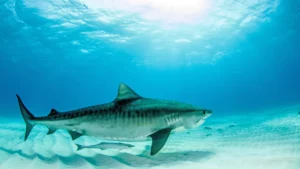
The shortnose sawshark (Pristiophorus nudipinnis) is a small bottom-living shark of the southern Australian shelf, growing to about 1.22 m (4 ft), nearly a quarter of which is a flat tooth-studded snout. It is slate grey above and cream below, with a pair of barbels under the saw, two spineless dorsal fins and no anal fin.
It eats small fish, crustaceans and worms raked off the seabed between 37 and 165 m. Females carry 7 to 14 pups on yolk alone and give birth to 25 cm young every second year. The IUCN lists it as Least Concern, and no sawshark has ever bitten a person.
- Maximum length1.22 m (4 ft), females slightly larger
- WeightNot reliably recorded; a few kilograms
- LifespanAt least 9 years in aged samples
- Depth range37–165 m (120–540 ft)
- DietSmall bottom fish, crustaceans and worms
- IUCN statusLeast Concern (assessed 2015)
- Kingdom
- Animalia
- Phylum
- Chordata
- Class
- Chondrichthyes
- Order
- Pristiophoriformes
- Family
- Pristiophoridae
- Genus
- Pristiophorus
- Species
- Pristiophorus nudipinnis
- Family (common)
- Sawsharks
- Also known as
- Southern sawshark
On this page
- How to tell a shortnose sawshark from the other one
- How big does a shortnose sawshark get?
- Where shortnose sawsharks live
- What shortnose sawsharks eat
- Behaviour, senses and adaptations
- Breeding and lifespan
- Are shortnose sawsharks dangerous?
- Conservation status
- Relatives and look-alikes
- Frequently asked questions
- References
How to tell a shortnose sawshark from the other one
Two sawsharks share the southern Australian shelf and they land in the same nets, so the useful question is never "is this a sawshark" but "which one". Colour settles it in a second. The shortnose is a flat, even slate grey to brownish grey on top and cream underneath, with no pattern whatsoever. The longnose sawshark alongside it is sandy yellow-brown and covered in dark spots, blotches and bars that run out onto the saw.
The snout is the second check, and it is what the common name refers to. In this species the rostrum takes up roughly 22 to 24 per cent of total length; in its neighbour it is noticeably longer and more slender. Along each edge sit large lateral teeth, about 13 or 14 of them in front of the paired barbels and another six to nine behind, alternating with much smaller replacement teeth that grow in from the side rather than from a conveyor of rows.
Then look at the rest of the animal. The body is flattened from top to bottom, the five gill slits open on the sides of the head, there are two dorsal fins without spines, and there is no anal fin — a combination no other Australian shark has. The barbels, two fleshy whiskers slung under the saw, sit closer to the mouth than to the snout tip, which is the classic hand-in-the-net separator from the longnose.
How big does a shortnose sawshark get?
This is a small shark by any standard. The largest reliably measured shortnose sawsharks are about 1.22 m (4 ft) in total length, saw included, and most animals brought up by the southern gillnet fleet are between 0.9 and 1.1 m. Females run slightly larger than males, the usual pattern in sharks that carry live young, but the difference is a matter of a few centimetres rather than the near-doubling seen in some larger shark families.
Because roughly a quarter of that length is snout, the body itself is short: a 1.1 m animal has a trunk you can close a hand around. No maximum weight has ever been published for the species, which tells you how little commercial interest it attracts; an adult is a matter of a few kilograms, not tens.
Pups are born at about 25 cm and reach maturity somewhere around 90 cm and above, so the species spends most of its life growing through a narrow size band. The bar below sets the maximum recorded length against a 1.8 m diver, and the comparison is the honest one: an adult shortnose sawshark is roughly two thirds the length of the person who might catch it.
Where shortnose sawsharks live
The species is endemic to Australia and to the cool southern half of it. Records run between roughly 31°S and 41°S and from about 125°E to 150°E, which puts the range from the south coast of Western Australia east across the Great Australian Bight to South Australia, Victoria and the whole of Tasmania. It does not occur in the tropical north, and it has never been recorded from New Zealand or anywhere else.
Within that band it is a shelf animal, caught between 37 and 165 m on soft bottoms of sand, mud and shell grit. Bass Strait and the shelf off Victoria and northern Tasmania hold the densest recorded concentrations, largely because that is where the gillnet fishery works hardest and therefore where anyone is looking. Water temperatures there sit in the low teens Celsius for much of the year, and the species has no tolerance for the warm water that shapes the distribution of most sharks.
It lives on the seabed rather than above it. Sawsharks are caught in bottom gillnets and demersal trawls and almost never on a line set in midwater, and divers essentially never encounter one because the shallow edge of the range still sits well below recreational depth. The map below shows the shelf strip it occupies.

What shortnose sawsharks eat
Stomach contents from southern Australian surveys are consistently unglamorous: small bottom-dwelling bony fish, shrimps and other crustaceans, and polychaete worms. Nothing in the diet is large, and nothing has to be chased down in open water. The teeth in the mouth itself are tiny, blunt and set in a small transverse slit, built for gripping soft prey rather than shearing anything — the opposite arrangement to the serrated blades of a bull shark.
The saw does the work. The rostrum is packed with ampullae of Lorenzini and lateral-line canals, and the two barbels drag lightly over the sediment as the shark cruises. A shrimp buried a couple of centimetres down still leaks a weak bioelectric field, and the electroreceptors on the underside of the saw pick it up at close range. Once a target is located, the shark swings the rostrum sideways in a short, fast slash that either stuns the animal or digs it out of the sand, then turns and takes it with the mouth set well back under the head.
That geometry explains why a sawshark's snout is so long. The mouth cannot reach prey the saw has just disturbed without a deliberate second movement, so feeding is a two-stage act: strike with the rostrum, then reposition and swallow. It is slow, economical hunting suited to an animal that spends its life within a metre of the seabed.
Behaviour, senses and adaptations
Almost everything known about how this shark behaves comes from fishery samples rather than observation, because nobody has followed one in the wild. What the anatomy shows is an animal built for a life spent close to the bottom in dim green water. The eyes are large and set on top of the head, with a bright reflective layer behind the retina, which suits the low light of 40 to 160 m without being the specialised deep-sea eye of a slope-dwelling lanternshark.
The dominant sense is electroreception. In a sawshark the sensory pores are concentrated along the flat underside of the rostrum, so the animal effectively sweeps a detector ahead of itself. Touch matters just as much: the barbels are mobile and richly innervated, and the species appears to work sediment much as a goatfish does. Smell is useful but ordinary, and the popular idea that any shark tracks blood across miles of ocean has no bearing on an animal that hunts by feel within a body length.
Sawsharks are not schooling animals, but they are regularly caught several at a time in a single net set, which suggests loose aggregations over good feeding ground rather than social structure. There is no evidence of long migration: tagging in southern Australia has shown movement of tens of kilometres, not the basin crossings made by oceanic species. The saw also works as defence, and a cornered sawshark lashes it from side to side.
Breeding and lifespan
The shortnose sawshark is ovoviviparous in the strict sense: eggs hatch inside the mother, the embryos live entirely on their own yolk, and there is no placental connection of the kind seen in requiem sharks. Litters run from about 7 to 14 pups, and the reproductive cycle appears to be biennial, so a female produces a brood roughly every second year rather than annually.
Young are born at around 25 cm total length, already carrying a complete set of rostral teeth. Those teeth lie flat and folded back against the saw during gestation and for the birth itself, a mechanical solution to an obvious problem — a litter of a dozen miniature saws would otherwise be lethal to the mother — and they erect and harden within days of birth. The same arrangement is found across the family, from the Japanese sawshark to the deep-water African dwarf sawshark.
Maturity comes at about 90 cm and upward, which for a species topping out at 1.22 m means a long juvenile phase and only a short adult one. Ageing work on animals taken in the southern gillnet fishery found none older than about nine years, and although samples of this kind almost always underestimate true longevity, there is nothing to suggest the decades reached by the long-lived sharks. Growth is quick by shark standards and the turnover of generations is fast, which is the main reason the species has weathered fifty years of net fishing.
Are shortnose sawsharks dangerous?
No. The SharkSider database holds no incident attributed to this species or to any other sawshark, and there is no plausible mechanism for one. The mouth is a small crescent under the head with blunt teeth a few millimetres long, the animal is a metre of mostly snout, and its shallow limit of 37 m already sits below almost all swimming and most recreational diving. Divers in southern Australia who want to see one have to go looking on purpose, and usually fail.
The one genuine hazard is the saw, and it is a handling hazard rather than an attack. A sawshark lifted onto a deck thrashes, and the lateral rostral teeth are sharp enough to open a forearm on a fisher who grabs the wrong end. Crews in Bass Strait handle them behind the head and keep the rostrum pointed away, and the injury when it occurs is a cut, not a bite. Treat a landed sawshark the way you would treat a landed gummy shark with a saw bolted on, and nothing happens.
For context on the species that do account for the Australian record, our page on shark attacks in Australia sets out who is actually involved, and the least dangerous sharks list puts this one in company it belongs in.
The SharkSider database has no incident attributed to this species. The database draws on the International Shark Attack File, the Global Shark Attack File and verified local reports, and is updated weekly.
Conservation status
The IUCN Red List assessed the shortnose sawshark in 2015 and placed it in Least Concern, and that verdict has held. It is not on any CITES appendix, it carries no listing under Australia's EPBC Act, and no country affords it specific protection because no assessment has found it to need any.
That is a genuinely unusual position for a shark with such a small world range. The reason is reproductive: a species that matures at about 90 cm, breeds every second year with up to fourteen pups and reaches maturity within a few years can absorb a level of fishing that would flatten a slow-breeding animal such as the dusky shark. Catch is real and continuous — the shortnose is taken as bycatch in the demersal gillnets of the Southern and Eastern Scalefish and Shark Fishery, which target gummy and school shark, and in some trawls — and the meat is landed and sold in Australia as flake. Populations have not shown the collapse that would be expected if the fishery were outrunning recruitment.
The watch items are the ordinary ones. Bycatch is not separately reported in most logbooks, so the true catch is poorly measured; the range is narrow enough that a change in the southern gillnet fleet could shift the picture quickly; and no independent survey tracks abundance. A note of caution rather than alarm, and a reminder that the sharks in trouble are usually the slow breeders.
Relatives and look-alikes
The obvious confusion is with the other Australian sawshark. The longnose sawshark shares the range, the depth and the nets; it is spotted and blotched rather than plain, its rostrum is longer, and its barbels sit further forward. Northern Australian waters hold a third species, the tropical sawshark, which is a deeper, warmer-water animal and does not overlap.
Further afield the family is scattered and mostly deep. The Japanese sawshark works the shelf of the north-western Pacific, the Bahamas sawshark and Lana's sawshark live on Caribbean slopes, and the sixgill sawshark of the western Indian Ocean is the one member of the group with six gill slits instead of five.
The mistake worth naming is not a shark at all. Sawfishes are rays, and although they carry a similar toothed rostrum they differ in every practical way: gill slits underneath the body instead of on the sides, no barbels, rostral teeth fixed in sockets rather than growing continuously, and adult lengths of up to seven metres. A sawshark on a deck is a metre long with whiskers. Flat-bodied angelsharks get confused with sawsharks in fishing reports too, but they have no saw and a huge mouth at the very front of the head.
 Longnose Sawsharkspecies profile
- Tropical Sawsharkspecies profile
- Japanese Sawsharkspecies profile
- Sixgill Sawsharkspecies profile
 Bahamas Sawsharkspecies profile
- African Dwarf Sawsharkspecies profile
Frequently asked questions
How big do shortnose sawsharks get?
The largest reliably measured individuals reach about 1.22 m (4 ft) in total length, with the saw included in that figure. Most animals caught in southern Australian nets are between 0.9 and 1.1 m. Females grow slightly larger than males. Newborn pups are around 25 cm long and already have a full set of rostral teeth.
Where do shortnose sawsharks live?
They are found only in southern Australia, from the south coast of Western Australia east through the Great Australian Bight to South Australia, Victoria and Tasmania. They live on the continental shelf between 37 and 165 m, on sand, mud and shell bottoms, and are most often recorded from Bass Strait. They occur nowhere else in the world.
What is the difference between a shortnose and a longnose sawshark?
Colour is the quickest test: the shortnose is plain slate grey with no markings, while the longnose is sandy brown with dark spots and blotches. The shortnose also has a stubbier rostrum, roughly a quarter of its total length, and its barbels sit closer to the mouth than to the tip of the saw.
Is a sawshark the same as a sawfish?
No. Sawfishes are rays, with gill slits on the underside of the body, no barbels, rostral teeth locked into sockets, and lengths of up to seven metres. Sawsharks are true sharks with gill slits on the sides of the head, a pair of barbels under the saw, and a maximum length of little more than a metre.
What do shortnose sawsharks eat?
Small bottom-living bony fish, shrimps and other crustaceans, and polychaete worms. The shark locates buried prey with electroreceptors along the underside of its rostrum and with its two barbels, then swings the saw sideways to stun or uncover the animal before taking it with its small mouth.
How long do shortnose sawsharks live?
Ageing studies on animals taken in the southern Australian gillnet fishery found none older than about nine years. That figure comes from fished populations and probably understates the true maximum, but the species is clearly short-lived and fast-growing compared with sharks that reach several decades.
Are shortnose sawsharks dangerous to humans?
No. No sawshark of any species has ever been recorded biting a person. The mouth is small with blunt teeth, and the shark lives below 37 m, deeper than most swimming and diving. The only real risk is handling a landed animal, whose thrashing saw can cut a fisher's hands or arms.
How do shortnose sawsharks reproduce?
They are ovoviviparous: eggs hatch inside the mother and the embryos live on yolk alone with no placental connection. Litters of 7 to 14 pups are born at about 25 cm, apparently every second year. The pups' rostral teeth lie folded flat against the saw until after birth so they cannot injure the mother.
Are shortnose sawsharks endangered?
No. The IUCN assessed the species as Least Concern in 2015 and it is not on any CITES appendix. It is caught as bycatch in southern Australian gillnet and trawl fisheries and sold as flake, but it matures early and breeds often enough to absorb that pressure. Poor catch reporting remains the main uncertainty.
Why do sawsharks have barbels?
The two fleshy barbels hanging under the rostrum are touch and taste organs. As the shark cruises just above the seabed they trail through sand and mud, detecting prey the eyes cannot see. Together with the electroreceptors along the saw they let the animal hunt buried shrimps and worms in near darkness.
References

A small team focused on researching sharks and making marine biology easy to understand. Every page is reviewed against current species records and the SharkSider attack database, and updated when new incidents or research appear.
Published October 25, 2022 · Last updated September 22, 2026 · No incident attributed to this species in the SharkSider attack database, which is updated weekly.