
Yes, there are sharks in Vietnam: 27 species with solid records along the coast and offshore. The ones most likely to be encountered are the blacktip reef shark, the whitetip reef shark, the whale shark, the bamboo sharks of the reef flats and, in the fish markets of the Gulf of Tonkin, the spadenose and milk sharks. Bull sharks live in the Mekong Delta and tiger sharks patrol the deep water beyond the islands.
The SharkSider database holds 15 entries for Vietnam, 14 of them from 1900 onward, and only one modern fatality: the crew of a sampan wrecked off Saigon in 1936. The other death, in 1868, was also a shipwreck. The rest of the record is dominated by ten non-fatal bites in 2009 and 2010, eight of them to swimmers at a single beach in Quy Nhon, and where a size was recorded the shark was about a metre long.
- Shark species recorded27 with solid records
- ProtectionWhale shark protected by national decree; MPAs at Nha Trang (2001), Con Dao, Phu Quoc, Cu Lao Cham
- Most seen from the beachBlacktip reef shark and bamboo sharks
- Signature encounterWhale sharks off Nha Trang and Con Dao, spring
- Incidents in the database15 (1868–2010), 2 fatal, both shipwrecks
- Water temperature19–22 °C north in winter; 27–30 °C south all year

On this page
- Where sharks live in Vietnamese waters
- List of the different types of sharks in Vietnam
- Where to see sharks in Vietnam
- Best time of year to see sharks in Vietnam
- Shark attacks in Vietnam: what the record actually shows
- Is it safe to swim and snorkel in Vietnam?
- Shark conservation in Vietnam
- Sharks in neighbouring waters
- Frequently asked questions
- References
Where sharks live in Vietnamese waters
Vietnam's coast is really three coasts. In the north, the Gulf of Tonkin is a broad, shallow, muddy shelf shared with China, fed by the Red River and cooled every winter by the north-east monsoon. Its sharks are the small coastal requiem sharks of the Asian shelf, above all the spadenose shark and the milk shark, which the fishermen of Hai Phong and Cat Ba land by the basket and sell as cá nhám. Ha Long Bay's limestone islands look like shark country but are not: the water is turbid, brackish and busy, and a reef shark is a rare sight there.
The central coast, from Da Nang down through Quy Nhon and Nha Trang to Phan Thiet, is where the shelf narrows and deep, clear water comes closest to land. Offshore islands such as Cu Lao Cham, Hon Mun and Phu Quy sit on coral, and the tuna longliners of Binh Dinh, Phu Yen and Khanh Hoa work the edge of the South China Sea basin, where they meet the oceanic sharks: silkies, blue sharks, makos, bigeye threshers, oceanic whitetips and hammerheads. Nha Trang is the country's marine science capital, home to the Institute of Oceanography founded in 1922 and to Vietnam's first marine protected area at Hon Mun, and it is the coast where whale sharks surface in spring.
The south is the Mekong. Nine river mouths pour fresh water and sediment into a shallow sea, creating the mangrove estuaries of Can Gio and the delta where bull sharks have always lived, following the salt wedge upriver as they do in every big tropical river on Earth. Beyond the delta, in the Gulf of Thailand, Phu Quoc and the An Thoi islands have coral flats with bamboo sharks and blacktip reef sharks, and 230 km out to sea the Con Dao archipelago, a national park since 1984, has the best-preserved reefs in the country. Far offshore, the disputed Paracel and Spratly reefs are the last part of Vietnamese-claimed waters where reef shark numbers still look the way the whole coast once did.
List of the different types of sharks in Vietnam
The list below is limited to species with solid Vietnamese records from landings, research collections and verified sightings. Sizes are typical adults. The risk column is about a swimmer at a Vietnamese beach, not a diver seeking a species out, and for most of these sharks it is low because they are either small, deep-living or far offshore. Vietnamese draws a line between cá mập, the big sharks, and cá nhám, the small ones on the market slab; the whale shark is cá nhám voi, the elephant shark.
| Species | Adult size | Risk to swimmers | Where in Vietnam & notes |
|---|---|---|---|
Whale SharkRhincodon typus | 6–10 m (20–33 ft) | Low | Nha Trang, Phu Quy and Con Dao in spring and early summerThe cá nhám voi, protected by national decree. Filter feeder; harmless. |
Blacktip Reef SharkCarcharhinus melanopterus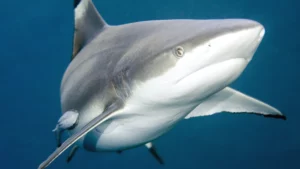 | 1.2–1.6 m (4–5 ft) | Low | Reef flats at Con Dao, Phu Quoc, Hon Mun and Cu Lao ChamThe reef shark a snorkeller is most likely to see in Vietnam. Shy; bites elsewhere are minor nips to waders' ankles. |
Whitetip Reef SharkTriaenodon obesus | 1.2–1.6 m (4–5 ft) | Low | Ledges and caves on the outer reefs of Con Dao and Nha TrangRests by day, hunts by night. Placid unless grabbed. |
Grey Reef SharkCarcharhinus amblyrhynchos | 1.5–2.5 m (5–8 ft) | Moderate | Outer walls of Con Dao and the offshore Spratly reefsScarcer in Vietnam than in the Philippines or Malaysia because of reef fishing. Territorial toward divers who crowd it. |
Bull SharkCarcharhinus leucas | 2.2–3.2 m (7–10.5 ft) | High | Mekong Delta estuaries, Can Gio mangroves and the Saigon River mouthLives in fresh and salt water. The likeliest species behind the Vung Tau ship-side bite before 1911; nobody swims where it lives today. |
Tiger SharkGaleocerdo cuvier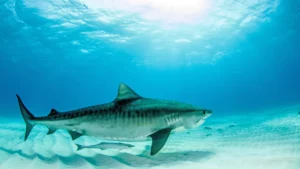 | 3–4.5 m (10–15 ft) | High | Deep water beyond Con Dao, Phu Quy and the offshore reefsLanded by longliners; not seen on the tourist reefs. No confirmed Vietnamese bite. |
Blacktip SharkCarcharhinus limbatus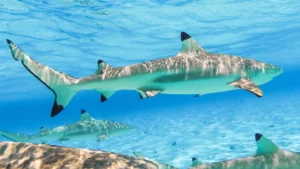 | 1.5–2.5 m (5–8 ft) | Moderate | Coastal shelf along the whole central and southern coastA fast, inshore fish-hunter that follows sardine and anchovy shoals. The kind of small requiem shark implicated at Quy Nhon. |
Spinner SharkCarcharhinus brevipinna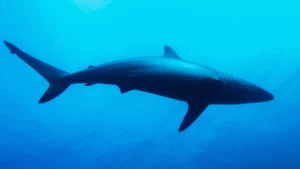 | 2–2.5 m (7–8 ft) | Moderate | Coastal waters of the central and southern shelfLeaps and spins after fish. Landed regularly at Vung Tau and Nha Trang. |
Dusky SharkCarcharhinus obscurus | 3–3.5 m (10–11.5 ft) | Moderate | Offshore shelf edge, occasionally landedA big, slow-breeding coastal-pelagic shark. Endangered globally; rare in Vietnamese landings today. |
Graceful SharkCarcharhinus amblyrhynchoides | 1.4–1.7 m (4.5–5.5 ft) | Moderate | Inshore waters of the Gulf of Thailand and the southern shelfA stocky, blacktip-like shark of the Indo-West Pacific shelf. Turns up in southern markets; easily confused with the blacktip shark. |
Silky SharkCarcharhinus falciformis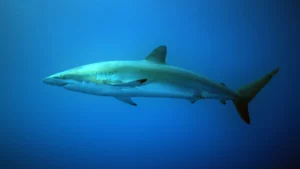 | 2–3 m (7–10 ft) | Moderate | Offshore tuna grounds of the South China SeaThe main shark bycatch of the Vietnamese tuna fleet. Listed on CITES Appendix II. |
| Oceanic Whitetip SharkCarcharhinus longimanus | 2–3 m (7–10 ft) | High | Open ocean far beyond the shelfOnce abundant across the South China Sea, now scarce after decades of longlining. A danger to shipwreck survivors, never to bathers. |
Blue SharkPrionace glauca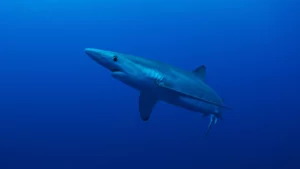 | 2–3 m (7–10 ft) | Moderate | Deep offshore water, mostly in the cooler monthsLanded by the Binh Dinh and Khanh Hoa longliners. Never seen near beaches. |
Shortfin Mako SharkIsurus oxyrinchus | 2.5–3.5 m (8–11 ft) | Moderate | Offshore tuna grounds off Phu Quy and Binh DinhFast, warm-blooded and regularly landed at Phu Quy. Endangered globally. |
Scalloped Hammerhead SharkSphyrna lewini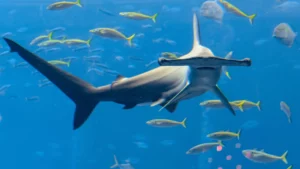 | 2.5–3.5 m (8–12 ft) | Low | Offshore; juveniles on the shelf and in landingsCritically endangered and on CITES Appendix II, yet still sold in Vietnamese markets. Timid with people. |
Great Hammerhead SharkSphyrna mokarran | 3.5–4.5 m (11–15 ft) | Moderate | Offshore reefs and shelf edge; occasional landingsThe largest hammerhead, a ray-hunter. Rarely encountered by divers in Vietnam; no bite record here. |
Bigeye Thresher SharkAlopias superciliosus | 3.5–4.5 m (11–15 ft) including tail | Low | Deep offshore water; tuna longline bycatchIts oversized eyes face upward to spot prey silhouetted against the surface at night. Harmless; landed at Phu Quy and Nha Trang. |
Pelagic Thresher SharkAlopias pelagicus | 2.5–3.5 m (8–12 ft) including tail | Low | Offshore, occasionally near deep seamountsThe smaller thresher of the tropical Pacific. Endangered; the Vietnamese longline fleet takes both threshers. |
Spadenose SharkScoliodon laticaudus | 0.5–0.7 m (1.5–2.5 ft) | Low | Gulf of Tonkin and every muddy estuary; the commonest shark in the marketsA tiny, abundant shelf shark that gives birth to well-developed pups. The cá nhám of Hai Phong's fish stalls. |
Milk SharkRhizoprionodon acutus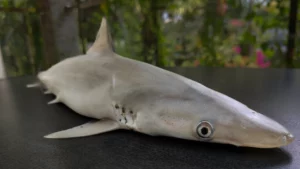 | 0.8–1.1 m (2.5–3.5 ft) | Low | Coastal waters along the whole coast, over sand and mudSlender and harmless, landed in huge numbers by inshore gillnets. |
Zebra Shark ('Leopard Shark' locally)Stegostoma tigrinum | 2–2.5 m (7–8 ft) | Low | Sand patches beside the reefs of Con Dao and Nha TrangSpotted adults rest on the bottom by day. Endangered; a good sighting for divers at Con Dao. |
Coral CatsharkAtelomycterus marmoratus | 0.5–0.7 m (1.5–2.5 ft) | Low | Crevices of coral reefs at Cu Lao Cham, Nha Trang and Con DaoA slender, marbled reef catshark seen on night dives. Harmless. |
Whitespotted Bamboo SharkChiloscyllium plagiosum | 0.7–0.95 m (2.5–3 ft) | Low | Reef flats and rock pools of Phu Quoc, Nha Trang and the Gulf of TonkinThe bamboo shark of the aquarium trade; lays eggs on the reef. Handled by children in Phu Quoc rock pools, which it does not enjoy. |
Brownbanded Bamboo SharkChiloscyllium punctatum | 0.8–1.0 m (2.5–3.5 ft) | Low | Coral flats and seagrass of Phu Quoc and Con DaoJuveniles are boldly banded, adults plain brown. Can survive hours out of water on a drying reef. |
Sharpnose Sevengill SharkHeptranchias perlo | 1–1.4 m (3–4.5 ft) | Low | Deep continental slope off the central coastA primitive seven-gilled deep-water shark, occasionally taken by bottom longlines. Never near people. |
Cookiecutter SharkIsistius brasiliensis | 0.4–0.5 m (1.5 ft) | Low | Deep oceanic water beyond the shelfBites round plugs from tuna and dolphins; its scars are seen on fish landed at Phu Quy. Rises to the surface only at night. |
| Shortnose SpurdogSqualus megalops | 0.5–0.7 m (1.5–2.5 ft) | Low | Outer shelf and slope, landed in the Gulf of TonkinA small dogfish with venomous dorsal spines; a nuisance to fishermen's hands, nothing more. |
Great White SharkCarcharodon carcharias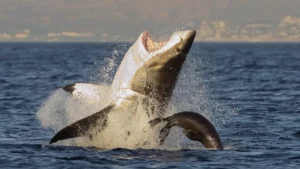 | 4–6 m (13–20 ft) | n/a | Unconfirmed in VietnamIncluded because the database's 2009 hooked-shark bite was logged as a white shark with nothing to back the identification. No specimen or photograph has ever confirmed the species here. |
Two sharks from the old version of this page have been removed. The Port Jackson shark is an Australian endemic that has never been recorded north of the equator, and its inclusion was an error. The great white shark is more complicated: it does reach the western Pacific, with confirmed records from Japan, Taiwan and the Philippines, but there is no verified Vietnamese specimen. The single “white shark” in the database, a provoked bite to a fisherman's hand from a hooked shark in June 2009, rests on the fisherman's own identification and was never examined by a scientist; a bull shark, a mako or a large requiem shark is a more likely explanation. Until a specimen or a clear photograph turns up, the great white sits in the table as unconfirmed.
Where to see sharks in Vietnam
Vietnam has no shark-feeding dives and no tiger shark sites; what it has is a few good reefs, one whale shark coast and a lot of fish markets. Here are the sites where a sighting is a realistic hope rather than a fluke.
- Nha Trang Bay and Hon Mun, Khanh HoaVietnam's first marine protected area, set up in 2001 around the island of Hon Mun. Blacktip reef sharks and bamboo sharks on the reef, and whale sharks passing along the outer bay between roughly March and June. The Institute of Oceanography in the city has a shark collection going back a century.
- Con Dao National Park, Ba Ria-Vung TauSixteen islands 230 km off the Mekong coast with the healthiest coral in Vietnam. Blacktip and whitetip reef sharks, the occasional grey reef shark, zebra sharks on the sand and whale sharks in the warm months. The park was created in 1984 and its waters have been managed since 1998.
- Phu Quoc and the An Thoi archipelago, Gulf of ThailandShallow coral flats around the southern islets where whitespotted and brownbanded bamboo sharks hide under table coral and juvenile blacktip reef sharks patrol at dusk. Easy snorkelling; the water is 28–30 °C all year.
- Cu Lao Cham, Quang NamA UNESCO biosphere reserve off Hoi An with reef sharks on the outer walls and coral catsharks in the crevices. Best from May to September, when the central coast is calm.
- Quy Nhon, Binh DinhA long city beach on a bay ringed by fish farms and fishing harbours, and the site of eight of the ten shark bites recorded in Vietnam since 2009. Scientists who investigated blamed small requiem sharks drawn into the bay; nothing has been recorded there since mid-2010.
- Phu Quy island, Binh ThuanA tuna-longlining port 100 km offshore whose boats bring in makos, silkies, hammerheads and threshers, and whose divers report whale sharks and reef sharks around the island in spring. The clearest window on Vietnam's offshore shark fauna.
- The Mekong estuaries and Can Gio, Ho Chi Minh CityBull shark country. The mangrove biosphere reserve at Can Gio and the river mouths of the delta are where bull sharks pup and hunt, and where the 1936 Saigon fatality took place. Nobody dives here; the record is fishermen's catches.
- Cat Ba and the Gulf of Tonkin marketsThe best place to see the small sharks of the northern shelf, laid out on ice at dawn: spadenose sharks, milk sharks and the occasional spurdog, landed by the trawlers of Hai Phong and Quang Ninh.
For a wild shark in the water, Con Dao is the best bet in any season and Nha Trang in spring for whale sharks. Everything else on the list is a bonus. If you would rather see a large shark in a tank, the Institute of Oceanography in Nha Trang and the Vinpearl aquarium on Hon Tre island both keep local species.
Best time of year to see sharks in Vietnam
The country stretches across 15 degrees of latitude and two monsoons, so the best season depends on which coast you are on.
- North (Ha Long, Cat Ba), May to September: the only warm, calm window. Winter brings the north-east monsoon, drizzle and water of 19–22 °C, cold enough that the reef sharks of the south are absent and the market sharks are all cool-water shelf species.
- Central coast (Nha Trang, Quy Nhon, Cu Lao Cham), February to September: dry season with the calmest, clearest water. Whale sharks appear off Nha Trang and Phu Quy from about March to June as the plankton blooms, and reef diving is at its best from May to August. October to December is typhoon season, when the central coast floods and dive centres close.
- South (Con Dao, Phu Quoc), November to April: the dry season in the Gulf of Thailand and off the delta, with 28–30 °C water and 20 m visibility. Con Dao's diving continues into the early wet season; whale sharks are reported there mostly between April and September.
Sea temperature is the simplest guide. South of Nha Trang it never falls below about 25 °C, which is why the tropical reef sharks live there all year. North of Da Nang the winter cooling is real, and the Gulf of Tonkin is a different, temperate world from December to March.
Shark attacks in Vietnam: what the record actually shows
The SharkSider database behind the global shark attacks section carries 15 entries for Vietnam: 14 from 1900 onward, including two cases logged only as “before 1911”, and one from 1868. Only two are fatal, and both were shipwrecks rather than attacks on swimmers: a junk that foundered off Cohong in January 1868 and a sampan wrecked off Saigon in September 1936. These are the six most recent records; Vietnam does not yet have its own attacks page, so the older cases are summarised in the text below:
- 2010 · Quy Nhon, Binh Dinh ProvinceSwimming — Laceration to left footSpecies: 1 m shark · not fatal
- 2010 · Quy Nhon, Binh Dinh ProvinceRescuing — Minor laceration to legSpecies: 20 to 30kg shark · not fatal
- 2010 · Quy Nhon, Binh Dinh ProvinceSwimming — Severe lacerations to left footSpecies: 20 to 30kg shark · not fatal
- 2010 · Quy Nhon, Binh Dinh Province — Minor injuriesSpecies not identified · not fatal
- 2010 · Quy Nhon, Binh Dinh Province — Right wrist bittenSpecies not identified · not fatal
- 2010 · Quy Nhon, Binh Dinh ProvinceBathing — Left arm bitten twiceSpecies not identified · not fatal
The six cards above all come from one place, and that is the whole story of modern shark bites in Vietnam. Between July 2009 and June 2010, eight people were bitten at Quy Nhon, the capital of Binh Dinh province, on a city beach that had never had a recorded incident: swimmers and bathers and, in one case, a woman who went in to help another victim. The injuries were to feet, legs, wrists and arms, some minor and two described as severe lacerations, and every one of the victims survived. Where the shark was seen it was small: the database records a 1 m animal and a fish of 20 to 30 kg. Two more bites in 2009 sit outside the cluster, one to a lower leg at an unnamed location and one to a fisherman's hand from a shark he had hooked, which is marked as provoked.
Scientists from the Institute of Oceanography in Nha Trang investigated the Quy Nhon cluster and pointed to small coastal requiem sharks, drawn into a bay crowded with cage fish farms, fishing boats and the waste both produce, biting bathers in murky water close to the harbour. The species was never confirmed from a specimen. The bites stopped as abruptly as they started, and nothing has been added to Vietnam's record since June 2010. The historical entries are thinner: a fisherman's leg amputated after a bite at Nha Trang in 1907, and two bathers bitten on the foot before 1911, one of them while swimming around an anchored ship at Vung Tau, a classic set-up for a bull shark in a river mouth. Taken together, Vietnam's record contains no confirmed fatal attack on a swimmer in its history, and the standard safety advice matters mainly in one situation: murky harbour water near fishing activity.
Is it safe to swim and snorkel in Vietnam?
Yes. Sharks are close to the bottom of the list of hazards at a Vietnamese beach, below rip currents at Da Nang and Mui Ne, jellyfish in the warm months and boat traffic in the tourist bays. The species that bite people elsewhere in the tropics, the bull and the tiger shark, are here, but the bull shark keeps to the muddy delta estuaries where nobody swims and the tiger shark to deep water beyond the islands. The reef sharks of Con Dao, Nha Trang and Phu Quoc are small, shy and gone the moment a snorkeller kicks toward them.
The Quy Nhon cluster is the exception that explains the rule. Every one of those bites happened in turbid water near fish farms and fishing harbours, the exact conditions in which a small shark feeding on scraps can mistake a foot for a fish. The practical advice for Vietnam is therefore specific: swim at the clear tourist beaches rather than beside working harbours or cage farms, stay out of river mouths in the delta, avoid swimming at dusk when the fishing fleets are gutting the day's catch, and do not swim around anchored fishing boats. Those rules would have prevented nearly everything in the country's record.
Whale sharks are harmless, and a chance encounter off Nha Trang or Con Dao is the best thing that can happen to a snorkeller in Vietnam. There is no formal code of conduct yet as there is in the Philippines or the Maldives, so apply the usual one yourself: enter quietly, hold three metres off the body and more off the tail, never touch, and ask the boat to hold off rather than chase.
Shark conservation in Vietnam
Vietnam is a shark-fishing and shark-fin-consuming country, and it does not pretend otherwise. Sharks are landed in every major port from Hai Phong to Kien Giang, mostly as bycatch of the tuna longline and gillnet fleets, and shark fin remains a wedding-banquet dish in Hanoi and Ho Chi Minh City. Vietnamese “blue boats” have been caught fishing illegally for sharks and sea cucumbers as far away as Palau, Micronesia and the Solomon Islands, which has made the country a focus of international pressure.
The legal framework has tightened over the past decade. The whale shark is listed in Vietnam's Red Data Book and on the national list of endangered, precious and rare aquatic species issued under the 2017 Fisheries Law, which makes catching or trading one illegal. Vietnam has been a CITES party since 1994, so the hammerheads, oceanic whitetip, silky shark, threshers and makos that have been added to CITES Appendix II now need export permits, and the Ministry of Agriculture has drafted a national plan of action for sharks in line with the FAO framework. The marine protected area network that began with Hon Mun in 2001 now includes Con Dao, Phu Quoc, Cu Lao Cham, Nui Chua and a dozen other sites, and reef sharks are visibly more common inside the well-run ones than outside.
The gap is enforcement. Small sharks are sold openly as cá nhám with no size or species limits, bycatch is rarely recorded, and the offshore fleets bring in hammerheads and threshers that are on paper protected by CITES. Coral loss from dynamite fishing, sedimentation and the 2016 industrial pollution disaster on the central coast has cut the habitat that reef sharks depend on. If you visit, the things that help are simple: dive with operators inside the marine parks, refuse shark fin and shark meat, and report whale shark sightings to the local park office. Our guide to why sharks are endangered shows why hammerheads and other slow breeders cannot absorb the pressure a fleet this size applies.
Sharks in neighbouring waters
Vietnam shares the South China Sea shark fauna with China to the north, whose Hainan fleets fish the same Gulf of Tonkin shelf, and with Hong Kong, the world's shark fin trading hub. Across the Gulf of Thailand, Cambodia and Thailand have the same bamboo sharks and blacktip reef sharks, and Thailand's Andaman coast adds a reliable whale shark season. To the east, the Philippines has the best reef shark and whale shark diving in the region at Malapascua, Donsol and Tubbataha, and Malaysia's Sipadan is the closest place to Vietnam where grey reef sharks and hammerheads gather in numbers. The complete country list is on sharks around the world.
Frequently asked questions
Are there sharks in Vietnam?
Yes. Twenty-seven species have solid records, from bamboo sharks and blacktip reef sharks on the coral flats of Phu Quoc and Con Dao to bull sharks in the Mekong estuaries and hammerheads, makos and threshers on the offshore tuna grounds. Whale sharks visit Nha Trang and Con Dao in spring. Most are seen in fish markets rather than underwater.
Have there been shark attacks in Vietnam?
Fifteen entries sit in the SharkSider database. The only two deaths were shipwreck victims in 1868 and 1936. The rest are non-fatal bites, ten of them between June 2009 and June 2010, eight at Quy Nhon beach in Binh Dinh, from small sharks of about a metre where a size was noted. Nothing has been recorded since.
What happened at Quy Nhon in 2009 and 2010?
Eight people, mostly swimmers and bathers, were bitten on the feet, legs and arms at the city beach over about a year, none fatally. Scientists from the Institute of Oceanography in Nha Trang blamed small coastal requiem sharks drawn into a bay full of fish farms and fishing boats. The species was never confirmed and the bites stopped in mid-2010.
Are there great white sharks in Vietnam?
Not confirmed. Great whites reach Japan, Taiwan and the Philippines, but no Vietnamese specimen or photograph exists. The single white shark in the incident record, a hooked shark that bit a fisherman's hand in 2009, was never examined by a scientist and was more likely a bull shark, mako or large requiem shark.
Is it safe to swim in Vietnam?
Yes. No swimmer has been killed by a shark in Vietnam's recorded history, and the only cluster of bites happened in murky harbour water beside fish farms at Quy Nhon. Swim at clear tourist beaches, stay out of river mouths in the delta and away from fishing boats at dusk, and sharks are not a realistic concern.
Can you see whale sharks in Vietnam?
Yes, though there is no organised industry as in the Philippines. Whale sharks pass along the outer bay of Nha Trang and around Phu Quy island from about March to June, and Con Dao reports them from April to September. Sightings are chance encounters on dive and snorkel trips rather than guaranteed tours.
Are there bull sharks in Vietnam?
Yes. Bull sharks live in the Mekong Delta's estuaries, the Can Gio mangroves and the Saigon River mouth, where they tolerate fresh water as they do in every large tropical river. They are known from fishermen's catches rather than sightings, and nobody swims in the turbid delta channels where they hunt.
Where is the best place to see sharks in Vietnam?
Con Dao National Park, 230 km off the Mekong coast, has the healthiest reefs and the most reliable blacktip, whitetip and zebra shark sightings, plus whale sharks in the warm months. Nha Trang's Hon Mun reserve is the easiest to reach, and Phu Quoc's southern islets are best for bamboo sharks in shallow water.
When is the best time to see sharks in Vietnam?
March to June on the central coast for whale sharks off Nha Trang and Phu Quy, May to September for reef diving at Cu Lao Cham and Nha Trang, and November to April in the south at Con Dao and Phu Quoc. Avoid October to December on the central coast, which is typhoon season.
Are sharks protected in Vietnam?
Partly. The whale shark is protected under the Fisheries Law and listed in the national Red Data Book, and CITES-listed species such as hammerheads, threshers, makos and silky sharks need permits to export. Small coastal sharks are fished and sold freely, and enforcement against shark fin and bycatch remains weak.
References

A small team focused on researching sharks and making marine biology easy to understand. Every page is reviewed against current species records and the SharkSider attack database, and updated when new incidents or research appear.
Published December 13, 2022 · Last updated September 21, 2026 · Incident data from the SharkSider attack database (14 records for Vietnam, 1 fatal).


