
Yes, there are sharks in Tonga, and the reefs hold a lot of them. Seventeen species have solid records in Tongan waters. The ones you are most likely to see are the blacktip reef shark, the whitetip reef shark, the grey reef shark and the tawny nurse shark; tiger sharks and the occasional bull shark patrol the deeper passes, and the offshore water beyond the reef belongs to silky sharks, oceanic whitetips and blue sharks.
The risk to people is small but not zero. The SharkSider database holds 18 records for Tonga, 16 of them dated between 1931 and 2012, with two confirmed deaths (a mail swimmer at Niuafo'ou in 1931 and a swimmer at Tu'anuku, Vava'u, killed by a tiger shark in 2006), plus two sailors lost overboard in the 1850s. Most of the injuries involved spearfishers, fishermen handling a catch, or shipwreck survivors, not tourists on a beach.
- Shark species recorded17 with solid records
- ProtectionNo national sanctuary; oceanic whitetip and silky sharks protected under Pacific tuna rules; community Special Management Areas
- Most seen from the beachBlacktip reef shark
- Signature encounterReef sharks in the Vava'u passes during the July–October whale season
- Incidents in the database18 (1852–2012), 4 fatal; 16 since 1931, 2 fatal
- Water temperature22–24 °C in August, 27–29 °C in February

On this page
- Why Tonga has so many sharks
- List of the different types of sharks in Tonga
- Where to see sharks in Tonga
- Best time of year to see sharks in Tonga
- Shark attacks in Tonga: what the record actually shows
- Is it safe to swim and snorkel with sharks in Tonga?
- Shark conservation in Tonga
- Sharks in neighbouring waters
- Frequently asked questions
- References
Why Tonga has so many sharks
Look at a bathymetric map and Tonga explains itself. The islands sit on a narrow ridge running north to south for about 800 km, and immediately east of that ridge the seabed falls into the Tonga Trench, which reaches 10,800 m at Horizon Deep. West of the ridge lies the Tofua volcanic arc, a line of active volcanoes such as Tofua, Kao and Late that rise straight out of water more than a kilometre deep. Deep, cold, nutrient-rich water is pushed up against these slopes, feeding the tuna and flying fish that the pelagic sharks follow, and the reef edge is never more than a few kilometres from that food supply. A grey reef shark at Hunga Island in Vava'u and a silky shark over the trench are separated by a short boat ride.
On top of the ridge the four island groups each offer a different habitat. Tongatapu and 'Eua in the south are raised limestone islands with fringing reef and a wide lagoon on the north side of Tongatapu. Ha'apai in the middle is a scatter of low coral islands and sandbanks on a broad shallow platform, the closest thing Tonga has to an atoll lagoon. Vava'u in the north is a drowned limestone landscape of steep-sided islands, sheltered channels and sea caves, with deep water passes at its edges. The Niuas, three volcanic islands far to the north, sit alone in open ocean. Because Tonga has no large rivers and very little run-off, the water around all of them is clear and the reefs are in good condition, which keeps the reef shark populations healthy. Add an exclusive economic zone of roughly 700,000 km² and fewer than 110,000 people, and you have a great deal of shark habitat with hardly anyone in it.
List of the different types of sharks in Tonga
The table lists the sharks with a solid record in Tongan waters, from fisheries data, tagging studies, dive logs and the incident record itself. Sizes are typical adult lengths. The risk column refers to swimmers and snorkellers, which in Tonga increasingly means people in the water on whale-swimming trips, not to divers who go looking for a species on purpose. Tongans call a shark 'anga, and the tiger shark, the one that matters most in the incident record, is 'anga tapu, a name that reflects the old belief that certain sharks were sacred and would not harm those who honoured them.
| Species | Adult size | Risk to swimmers | Where in Tonga & notes |
|---|---|---|---|
Blacktip Reef SharkCarcharhinus melanopterus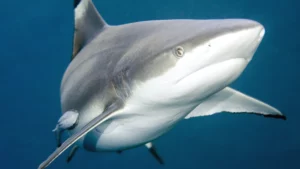 | 1.2–1.6 m (4–5 ft) | Low | Lagoon edges and reef flats in all four island groupsThe shark every visitor sees first, often in water barely deep enough to cover its back. Timid; bites are rare and minor. |
Whitetip Reef SharkTriaenodon obesus | 1.2–1.6 m (4–5 ft) | Low | Under ledges and on wrecks by day: Clan MacWilliam, Vava'u cavesSlim, placid and easy to approach. Hunts at night in the reef crevices. |
Grey Reef SharkCarcharhinus amblyrhynchos | 1.5–2.4 m (5–8 ft) | Moderate | Outer drop-offs and passes; abundant at Minerva ReefsThe shark of the Vava'u walls. Responsible for the 2000 diver bite at Minerva Reef and a 1995 fishing injury at Neiafu; respect its warning display. |
Tawny Nurse SharkNebrius ferrugineus | 2.5–3.2 m (8–10 ft) | Low | Caves and reef overhangs, resting by dayThe Pacific nurse shark. Harmless unless handled; it bites and holds when provoked. |
Silvertip SharkCarcharhinus albimarginatus | 2–2.5 m (7–8 ft) | Moderate | Deep walls off Tofua, Kao and the outer Vava'u reefsLarger and bolder than the grey reef shark, with white-edged fins. Approaches divers closely on volcanic slopes. |
Tiger SharkGaleocerdo cuvier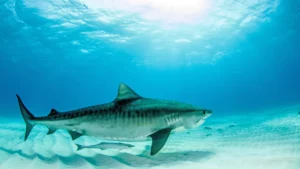 | 3–4.5 m (10–15 ft) | High | Passes and deep lagoon channels, all groupsThe only species with a confirmed fatality in Tonga (Tu'anuku, 2006) and involved in the 2002 whale-swim injury. 'Anga tapu in Tongan. |
Bull SharkCarcharhinus leucas | 2.2–3.2 m (7–11 ft) | High | Turbid lagoon channels and harbour mouths; few recordsFar less common than in Fiji because Tonga has no rivers. A 3 m bull shark was blamed for the 2012 Eueiki Island bite. |
Sicklefin Lemon SharkNegaprion acutidens | 2.5–3 m (8–10 ft) | Low | Sandy shallows and mangrove edges, Ha'apai and Vava'uThe Indo-Pacific lemon shark, yellowish and slow. Juveniles use the shallow flats as a nursery. |
Scalloped Hammerhead SharkSphyrna lewini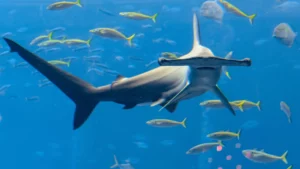 | 2.5–3.5 m (8–12 ft) | Low | Deep reef edges and seamounts, rarely near shoreCaught on longlines and occasionally seen by divers on the outer walls. Critically endangered worldwide. |
Great Hammerhead SharkSphyrna mokarran | 3.5–4.5 m (11–15 ft) | Moderate | Lagoon channels and outer reefs; occasionalA rare visitor rather than a resident. No Tongan incident has ever been attributed to a hammerhead. |
| Oceanic Whitetip SharkCarcharhinus longimanus | 2–3 m (7–10 ft) | High | Open ocean over the trench; close to 'Eua and the NiuasBold, persistent and dangerous to people adrift; the most likely species behind the shipwreck cases. Protected from retention by the tuna fleet. |
Silky SharkCarcharhinus falciformis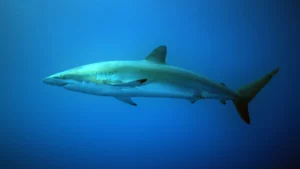 | 2–3 m (7–10 ft) | Moderate | Blue water along the trench edge, with tuna schoolsThe commonest shark in Tongan longline catches. Curious around boats and divers in open water. |
Blue SharkPrionace glauca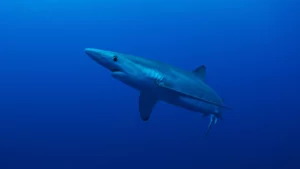 | 2–3 m (7–10 ft) | Low | Offshore, mainly in the cooler monthsSlender open-ocean shark that follows the southern water north in winter. Never on the reefs. |
Shortfin Mako SharkIsurus oxyrinchus | 2–3 m (7–10 ft) | Moderate | Deep offshore water, longline bycatchThe fastest shark in the sea and a prize for game fishers out of Nuku'alofa. Dangerous mainly to those who hook one. |
Pelagic Thresher SharkAlopias pelagicus | 2.5–3.5 m (8–12 ft) incl. tail | Low | Open ocean beyond the reef; longline recordsThe tropical thresher, recognised by its whip-like upper tail lobe. The bigeye thresher is also taken by the tuna fleet. |
Whale SharkRhincodon typus | 5–10 m (16–33 ft) | Low | Occasional, mostly Vava'u and Ha'apai in the warm monthsSeen a few times a year rather than reliably; there is no whale shark season in Tonga. Harmless filter feeder. |
Great White SharkCarcharodon carcharias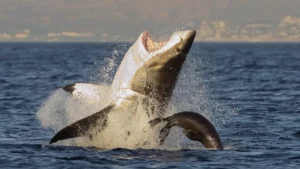 | 4–5.5 m (13–18 ft) | Moderate | Offshore and at depth, May to October; tagged from New ZealandA genuine winter visitor confirmed by satellite tags, not a resident. No Tongan incident is attributed to a white shark. |
Two corrections to the older Tongan list are worth spelling out. First, the great white shark is real here, but not in the way people imagine. Satellite tags fitted to white sharks at Stewart Island and the Chatham Islands in New Zealand have tracked the same animals to Tongan waters, the Kermadecs and Fiji during the southern winter, so a few large white sharks pass through Tonga every year, mostly offshore and at depth. There is no Tongan incident attributed to one. Second, the thresher listed on older pages as the common thresher is far more likely to be the pelagic thresher, the tropical species caught on Tongan tuna longlines; the common thresher prefers temperate water and has no confirmed Tongan record.
Where to see sharks in Tonga
Tonga sells whales, not sharks, and there are no baited shark dives in the kingdom. That is a good thing for anyone who wants to see reef sharks behaving naturally. The following places give you the best chance, and most of them are reached from the dive and whale operators based in Neiafu, Pangai and Nuku'alofa.
- Hunga Island and the western passes, Vava'uThe outer edge of the Vava'u group, where the sheltered channels open into deep water. Grey reef sharks and whitetips hold in the current on the drop-offs, and this is where the humpback boats operate from July to October, so sharks are often seen from the surface during whale swims.
- Swallows Cave and Mariner's Cave, Vava'uThe two famous sea caves on Kapa and Nuapapu islands. The caves themselves hold baitfish clouds rather than sharks, but the reef walls outside are patrolled by blacktip and whitetip reef sharks, and the swim between them is one of the best snorkels in the country.
- Clan MacWilliam wreck, Neiafu harbourA 130 m copra steamer that sank at anchor in 1927 and now lies in about 30 m inside the harbour. Whitetip reef sharks rest on the deck, and the wreck is the standard second dive for every Vava'u operator.
- Ha'ano and Uoleva, Ha'apaiLow coral islands on the Ha'apai platform with wide reef flats and channels between them. Blacktip reef sharks cruise the flats at high tide, and juvenile lemon sharks use the sandy shallows. Ha'ano is the site of a 1980s spearfishing injury in the database, a reminder that a speared fish attracts more than reef sharks.
- Tofua and Kao, Ha'apaiTwo volcanic islands west of the Ha'apai group, one of them still active, with black-sand slopes that drop into very deep water. Silvertips, grey reef sharks and pelagic species appear along the walls. Reached by charter boat only; Tofua is where the Bounty mutineers first landed in 1789.
- 'EuaThe oldest island in Tonga, with cliffs on its eastern side facing the trench and a fringing reef on the west. Whale-watching boats from 'Ohonua work water that is over a thousand metres deep within sight of shore, which brings oceanic whitetips and silky sharks unusually close to land.
- Ha'atafu Beach and the north lagoon, TongatapuThe main island's surfing and snorkelling beach on the north-west tip. Blacktip reef sharks work the lagoon edge at dusk and small whitetips rest under the reef. Day trips from Nuku'alofa also run to 'Atata and Pangaimotu islands in the lagoon.
- Minerva ReefsTwo ring reefs 400 km south-west of Tongatapu, awash at high tide, used as an anchorage by yachts sailing between Tonga and New Zealand. The lagoons are full of grey reef sharks that have never learned to fear people, and a diver was bitten on the arm here in 2000. Spectacular, remote and not for beginners.
For most visitors the practical answer is Vava'u between July and October: the whale operators put you in clear water over deep reef edges several times a day, and a grey reef or blacktip sighting during a whale swim is normal. Ha'apai gives the same species with far fewer boats; 'Eua and Tofua are for people who want the big offshore animals.
Best time of year to see sharks in Tonga
Tonga sits just inside the tropics, far enough south to have real seasons, and the sharks respond to them.
- May to October (dry season): the trade winds blow, the sea cools to 22–24 °C by August, and visibility on the outer reefs is at its best, often 30 m or more. This is humpback whale season, when the swim-with-whales boats run daily from Vava'u and Ha'apai, and it is when the reef sharks are easiest to see because the water is clearest. It is also the window in which tagged great whites from New Zealand arrive in Tongan waters.
- November to April (wet season): warmer, 27–29 °C in February, with heavier rain and the cyclone risk that peaks from January to March. Reef sharks are just as present but visibility drops after storms. Tiger sharks are recorded year-round; the 2006 fatality at Tu'anuku happened in February and the 2012 Eueiki bite in September, so there is no safe month in that sense, only quieter ones.
- Pelagic sharks: silky and oceanic whitetip sharks follow the tuna along the trench edge throughout the year, with blue sharks and makos more common in the cooler months when the southern water pushes north.
If you are choosing dates, August and September combine whales, clear water and a comfortable sea temperature, and they are the months when most Tongan dive operators are open.
Shark attacks in Tonga: what the record actually shows
Tonga's incident record is short and, read carefully, quite revealing. The whole file is on the shark attacks in Tonga page. The database holds 18 entries: 16 dated from 1931 to 2012, two of them fatal, plus two much older cases from 1852 and 1858 in which sailors went overboard off Tongatapu and Vava'u and were taken. The six latest dated cases are shown here; the attacks page has all eighteen and is kept current:
- 2012 · Eueiki Island, Vava'uSwimming — Injuries to thighs & buttocksSpecies: Possibly a 3 m bull shark · not fatal
- 2010 · Ha'apiSwimming / Whale Watching — Puncture wounds to right footSpecies not identified · not fatal
- 2006 · Tu’anuku, Vava'uSwimming — Severe bite to right leg fatalSpecies: Tiger shark · fatal
- 2004 · 30 nautical miles offshore, Nuku'alofaFive men on makeshift raft after their 10 m fishing boat capsized and sank in rough seas. Survivors rescued after 7.5 hours in the water — Bitten on feet, legs, back & abdomen but survived. survivors rescued after 7.5 hours in the waterSpecies: small sharks · not fatal
- 2004 · 30 nautical miles offshore, Nuku'alofaFive men on makeshift raft after their 10 m fishing boat capsized and sank in rough seas. Survivors rescued after 7.5 hours in the water — He was was bitten on the arm by small sharks & died, but it was not clear if he died as result of the bite or death resulted from drowingSpecies: Questionable Incident · not fatal
- 2002 · Swimming with humpback whales, Vava'uSwimming — Thigh lacerated provoked incidentSpecies: Tiger shark, 1.5 m [5']k · not fatal
The first thing the record shows is that the two modern deaths are very different events. The 1931 case at Niuafo'ou is a piece of Pacific history: the island had no harbour, so mail was swum out to passing steamers by a man carrying a sealed tin can, which is why it is still known as Tin Can Island. After a swimmer was killed by a shark that year the mail went out by canoe instead. The 2006 death at Tu'anuku in Vava'u was a straightforward tiger shark attack on a swimmer, the only one of its kind in the Tongan record. The 2004 case is listed separately: five fishermen spent seven and a half hours on a makeshift raft 30 nautical miles off Nuku'alofa after their boat sank in rough seas, and small sharks bit several of them; one man died, but the database marks it as questionable because it was never clear whether the bite or drowning killed him.
The second pattern is who gets bitten. Of the sixteen dated cases, five involved spearfishing or a fisherman holding a catch (Hunga Island in the 1950s, Ha'ano in the 1980s, Ofu in 1993 and Tapana and Neiafu in 1995), four involved shipwreck survivors in the water, one was a diver bitten by a grey reef shark at Minerva Reef, and two happened to people in the water with humpback whales, at Vava'u in 2002 and Ha'apai in 2010. The 2002 case was a provoked incident with a 1.5 m tiger shark, and the 2012 Eueiki Island injury, the most recent in the record, was attributed to a bull shark of about 3 m. That leaves ordinary swimmers with a handful of minor bites in ninety years. The standard precautions cover almost every case on the list: do not tow speared fish, do not swim from a boat that has been cleaning catch, and get out of the water if a large shark shows interest during a whale swim.
Is it safe to swim and snorkel with sharks in Tonga?
On the reefs, yes, and the sharks you will meet there are the easy ones. A blacktip reef shark in a Ha'apai lagoon will turn away the moment it notices you, and the whitetips resting under ledges at the Clan MacWilliam or outside Swallows Cave will let a calm snorkeller hang above them for minutes. Grey reef sharks deserve a little more respect, especially at Minerva Reefs and on the Vava'u drop-offs where they have never been hunted: if one begins to swim stiffly with its back arched and pectoral fins pointed down, it is telling you to back off, and you should do so slowly, keeping it in sight.
The whale swims are where Tongan safety advice really matters, because they put groups of people in deep, open water again and again. Licensed operators limit the number of swimmers per whale, keep a guide in the water and pull everyone out if a tiger shark or a large pelagic shark appears; the two whale-swim injuries in the database both came from the early years of the industry before those rules were standard. Choose a licensed boat, stay with the guide, and never linger at the surface alone after the whale has moved on. Tawny nurse sharks and lemon sharks in the shallows are harmless if left alone; a nurse shark's reputation for hanging on once it bites is the reason not to grab one by the tail, which is precisely what the Hunga Island spearfisher in the database was doing.
Shark conservation in Tonga
Tonga has not declared a shark sanctuary the way Samoa, the Cook Islands and French Polynesia have, and shark fishing is still legal in Tongan waters. What protection exists comes from three directions. The kingdom's tuna longliners operate under the Western and Central Pacific Fisheries Commission rules that forbid keeping oceanic whitetip and silky sharks, the two pelagic species most damaged by the tuna fishery; Tonga's Special Management Areas, a network of community-run coastal zones started in 2002, give villages control over their own reefs, and many have no-take sections that shelter reef sharks; and the country's most famous conservation decision, the 1978 royal decree that banned whaling, created the whale-swimming industry that now gives Vava'u a financial reason to keep its reefs and its predators intact.
The gaps are real. Shark fin has been exported from Tonga in the past, reef sharks are slow to recover once fished, and the deep-water slopes of the trench are largely unstudied. Tonga's white sharks, which arrive from New Zealand where they are fully protected, lose that protection the moment they cross into Tongan waters. If you visit, the most useful things you can do are simple: go with whale and dive operators that hold a government licence, report shark sightings and any fin trade you notice to the Ministry of Fisheries, and read our page on why sharks are endangered before you decide what to order at dinner.
Sharks in neighbouring waters
Tonga sits in the middle of a chain of South Pacific shark countries. Fiji, two hours' flight to the west, has the same reef species plus the famous bull shark dive at Beqa Lagoon; Samoa, to the north, declared its entire ocean a shark sanctuary in 2018. The Cook Islands and French Polynesia lie to the east with some of the best-protected reef shark populations on Earth, Vanuatu covers the western end of the same island arc, and the white sharks that pass through Tonga each winter come from New Zealand. The other Pacific nations, and every other coast, are collected on sharks around the world.
Frequently asked questions
Are there sharks in Tonga?
Yes. Seventeen species have solid records around the kingdom's 171 islands. Blacktip reef, whitetip reef and grey reef sharks live on the reefs of Vava'u, Ha'apai and Tongatapu, tiger sharks patrol the deeper passes, and silky, oceanic whitetip and blue sharks live in the open water above the Tonga Trench.
Have there been shark attacks in Tonga?
Yes, but few. SharkSider's database holds 18 records: 16 dated from 1931 to 2012, two of them fatal, and two sailors lost overboard in the 1850s. The most recent case was a swimmer bitten on the thigh at Eueiki Island, Vava'u, in 2012, probably by a bull shark. Most injuries involved spearfishers, fishermen or shipwreck survivors.
Is it safe to swim in Tonga?
For beach swimmers and snorkellers, yes. There have been only two shark deaths in Tonga since 1900 and no fatal attack on a swimmer since 2006. Stay out of the water at dusk, keep clear of fishing boats and speared fish, and on whale swims stay with your guide and leave the water if a large shark appears.
Are there great white sharks in Tonga?
Yes, as seasonal visitors. Satellite-tagged white sharks from Stewart Island and the Chatham Islands in New Zealand have been tracked to Tongan waters during the southern winter, usually offshore and at depth. They are rarely seen by divers and no Tongan incident has ever been blamed on one.
Are there tiger sharks in Tonga?
Yes. Tiger sharks are found in all four island groups, mainly in the deep passes and lagoon channels. They are the only species with a confirmed fatal attack in Tonga, at Tu'anuku in Vava'u in 2006, and a 1.5 m tiger shark injured a swimmer during a whale-swimming trip in 2002.
Can you swim with whale sharks in Tonga?
Not reliably. Whale sharks turn up in Tongan waters a few times a year, most often around Vava'u and Ha'apai in the warm months, but there is no aggregation site and no operator runs dedicated whale shark trips. Tonga's signature encounter is swimming with humpback whales from July to October, with reef sharks seen on the same trips.
What is the most common shark in Tonga?
The blacktip reef shark, which lives on the shallow reef flats and lagoon edges of every island group and is regularly seen from beaches and jetties. On the outer walls the grey reef shark is the most familiar species, and whitetip reef sharks rest under ledges and on the Clan MacWilliam wreck in Neiafu.
When is the best time to see sharks in Tonga?
July to October. The dry season brings the clearest water, sea temperatures of 22–24 °C and the humpback whale season, when boats from Vava'u and Ha'apai put swimmers in the water daily over deep reef edges. The warm, wet months from November to April are fine for reef sharks but visibility drops after storms and cyclones are possible.
Is shark fishing legal in Tonga?
Yes. Tonga has not declared a shark sanctuary, unlike Samoa, the Cook Islands and French Polynesia. Its tuna longliners must release oceanic whitetip and silky sharks under Western and Central Pacific Fisheries Commission rules, and community-managed Special Management Areas protect some reef habitat, but there is no national ban on catching sharks.
Are there bull sharks in Tonga?
Occasionally. Bull sharks prefer rivers and estuaries, and Tonga has neither, so they are far rarer here than in neighbouring Fiji. A bull shark of about 3 m was blamed for the 2012 bite at Eueiki Island in Vava'u, the most recent incident in the Tongan record.
References

A small team focused on researching sharks and making marine biology easy to understand. Every page is reviewed against current species records and the SharkSider attack database, and updated when new incidents or research appear.
Published January 30, 2023 · Last updated September 21, 2026 · Incident data from the SharkSider attack database (16 records for Tonga, 2 fatal).


