
Yes, there are sharks in Spain, 37 species with solid records, and the great majority are small, deep or offshore. The sharks you are most likely to meet are the blue shark (tintorera), the small-spotted catshark (pintarroja), the smooth-hounds sold as musola, the shortfin mako (marrajo) and, in the Canary Islands, the angelshark and the smooth hammerhead. The great white is a genuine but very rare visitor to the Balearics and the Strait of Gibraltar.
The SharkSider database holds 47 records for Spain, 37 of them dated 1900 or later, with only 3 deaths in that period and none since 1912; ten older entries from 1764 to 1879 add another five fatalities from the age of sail. The modern list is made of foot lacerations from angelsharks stepped on in Canarian shallows and glancing bites from small blue sharks that wander onto Mediterranean beaches in summer. No swimmer has been killed by a shark in Spain in more than a century.
- Shark species recorded37 with solid records
- ProtectionEU finning ban 2003; Spain bans hammerhead and thresher catches (2009); angelshark protected 2019
- Most seen from the beachAngelshark (Canaries), blue shark (Mediterranean, summer)
- Signature encounterAngelsharks on Canarian sand; blue sharks off Galicia and the Basque coast
- Incidents in the database47 (1764–2025), 8 fatal; last death 1912
- Water temperature12–20 °C Atlantic, 13–28 °C Mediterranean, 18–24 °C Canaries

On this page
- Where sharks live in Spanish waters
- List of the different types of sharks in Spain
- Where to see sharks in Spain
- Best time of year to see sharks in Spain
- Shark attacks in Spain: what the record actually shows
- Is it safe to swim and snorkel in Spain?
- Shark conservation in Spain
- Sharks in neighbouring waters
- Frequently asked questions
- References
Where sharks live in Spanish waters
No other European country has to think about sharks in three seas at once. The Atlantic coast, from the Basque Country round Cape Finisterre to the Portuguese border, sits on a wide continental shelf fed by the cold upwelling of the Canary Current and by the nutrient-rich Galician rías. This is the richest shark water in Spain. Blue sharks and makos follow the tuna and swordfish across the shelf edge every summer, basking sharks surface in the spring plankton, porbeagles patrol the Bay of Biscay, and the deep canyons off Galicia and the Cantabrian Sea hold gulper sharks, Portuguese dogfish and the odd frilled shark. Vigo, at the mouth of its ría, is the biggest fishing port in Europe and the place where most of the sharks caught by the Spanish surface longline fleet come ashore.
The Mediterranean coast is warmer, saltier and, after two thousand years of fishing, much poorer in large sharks. What survives is the small bottom fauna, catsharks, nursehounds, smooth-hounds and tope on the shelf between the Costa Brava and Cabo de Gata, plus a thin population of pelagic sharks, mostly blue sharks, that comes surprisingly close to the beaches of Valencia, Alicante and the Balearics in July and August. The Balearic Sea and the deep basin south of Mallorca are also where Spain's rare great white records cluster: a fatality at Cabrera in 1912 and, in June 2018, a five-metre white shark filmed off the same archipelago, the first confirmed sighting in Spanish Mediterranean waters in around three decades. The Strait of Gibraltar, at the south-western tip, is the funnel through which every Atlantic shark entering the Mediterranean must pass, which is why Tarifa produced the only modern white shark bite in the country.
Then there are the Canary Islands, 1,000 km to the south-west off the Saharan coast, with volcanic slopes that drop into two-kilometre-deep water within a few hundred metres of the beach. The islands mix subtropical Atlantic species, dusky, silky and smooth hammerhead sharks, with a shallow sandy-bay fauna that no longer exists anywhere else in Europe: the angelshark. Once common from Norway to Morocco, Squatina squatina is now critically endangered and the Canaries hold the last healthy population. Because it lies buried in sand in knee-deep water, it is also the shark Spaniards are most likely to step on, and it accounts for most of the country's recent incidents.
List of the different types of sharks in Spain
The table gathers every shark with a reliable record in Spanish waters, drawn from fisheries landings at Vigo, Algeciras and Las Palmas, research trawls and verified sightings. Sizes are typical adults, not record fish; the earlier version of this page listed maximums such as a 20-foot sixgill and a 16-foot great white, which are not what you will meet. The risk column concerns a swimmer at a Spanish beach: for the deep-water and offshore species it is theoretical, and for the small catsharks and hounds it is nil. Spanish names help when reading a market slab or a fishing report: tintorera is the blue shark, marrajo the mako, cazón the tope, pintarroja the catshark, musola the smooth-hound, mielga the spiny dogfish, angelote the angelshark and peregrino the basking shark.
| Species | Adult size | Risk to swimmers | Where in Spain & notes |
|---|---|---|---|
Blue SharkPrionace glauca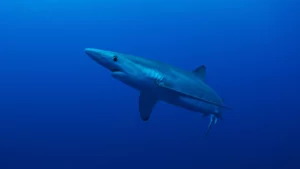 | 2–3 m (7–10 ft) | Low | Atlantic shelf edge in summer; Balearic basin; strays onto Mediterranean beachesThe tintorera, Spain's most abundant large shark and the main catch of the longline fleet. Behind most of the minor Mediterranean beach incidents since 2013. |
Shortfin Mako SharkIsurus oxyrinchus | 2–3 m (7–10 ft) | Moderate | Offshore Atlantic and Mediterranean with tuna and swordfish; the StraitThe marrajo. Endangered; the Spanish fleet was the largest taker of North Atlantic makos until the ICCAT retention ban. |
Longfin Mako SharkIsurus paucus | 2.5–3.5 m (8–11 ft) | Low | Deep oceanic water around the Canaries and off Galicia; rareKnown mostly from longline bycatch. Slower and deeper-living than the shortfin. |
Porbeagle SharkLamna nasus | 2–2.5 m (7–8 ft) | Low | Bay of Biscay and Galicia; occasionally the CanariesThe marrajo sardinero, a cool-water cousin of the mako. Bit a bodysurfer's foot on Gran Canaria in 2017; retention prohibited in EU waters. |
Great White SharkCarcharodon carcharias | 4–6 m (13–20 ft) | High | Rare visitor: Balearics (Cabrera 1912, 2018), Strait of Gibraltar (Tarifa 1986)Genuinely recorded but perhaps once a decade. The jaquetón; protected in Spain and critically endangered in the Mediterranean. |
Basking SharkCetorhinus maximus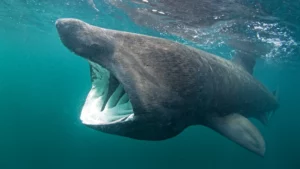 | 6–9 m (20–30 ft) | Low | Galicia and the Cantabrian coast in spring; occasional Catalan sightingsThe peregrino, a harmless plankton feeder. Protected nationally; surface sightings peak April–May. |
Common Thresher SharkAlopias vulpinus | 3–4.5 m (10–15 ft) incl. tail | Low | Atlantic and Mediterranean shelf edge; Alborán SeaThe pez zorro. Spanish vessels have been banned from catching threshers since 2009. |
Bigeye Thresher SharkAlopias superciliosus | 3–4 m (10–13 ft) incl. tail | Low | Deep oceanic water off the Canaries and GaliciaIts oversized, upward-set eyes are built for the twilight zone. Longline bycatch only; never near beaches. |
Smooth Hammerhead SharkSphyrna zygaena | 2.5–4 m (8–13 ft) | Low | Canary Islands (juveniles in sandy bays in summer); Atlantic and Mediterranean offshoreThe hammerhead you may actually see in Spain. Juvenile schools off Fuerteventura, Lanzarote and Gran Canaria; shy of swimmers. |
Scalloped Hammerhead SharkSphyrna lewini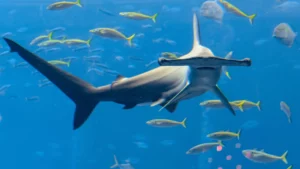 | 2.5–3.5 m (8–12 ft) | Low | Canary Islands and the Gulf of Cádiz; rareWarmer-water hammerhead at the northern edge of its range. Critically endangered; catch banned for Spanish vessels. |
Copper SharkCarcharhinus brachyurus | 2.5–3.3 m (8–11 ft) | Moderate | Canary Islands; Gulf of Cádiz; scattered Mediterranean recordsBronze whaler of the Atlantic islands. Sturdy requiem shark that follows bait schools; treated with respect by spearfishers. |
Dusky SharkCarcharhinus obscurus | 3–3.6 m (10–12 ft) | Moderate | Canary Islands offshore; occasional in the Alborán SeaOne of the largest requiem sharks, slow to mature and endangered. Seen by Canarian sport-fishing boats in deep water. |
Sandbar SharkCarcharhinus plumbeus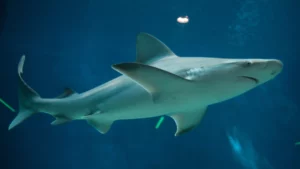 | 1.8–2.4 m (6–8 ft) | Low | Canaries and the warmer Mediterranean shelf; rareTall-finned coastal shark; an occasional catch off Valencia and the Balearics in summer. |
Silky SharkCarcharhinus falciformis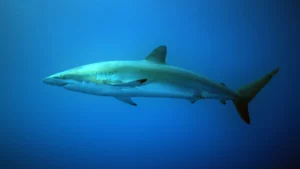 | 2–3 m (7–10 ft) | Moderate | Oceanic water around the Canary IslandsFollows tuna schools. A two-metre silky bit a swimmer's forearm at Arinaga, Gran Canaria, in December 2015. |
| Oceanic Whitetip SharkCarcharhinus longimanus | 2–3 m (7–10 ft) | High | Open ocean south and west of the Canaries; never on the mainland coastsBold pelagic shark of deep water; a risk to shipwreck survivors, not to bathers. Critically endangered. |
| AngelsharkSquatina squatina | 1.2–1.8 m (4–6 ft) | Low | Canary Islands sandy bays in 1–30 m; vanished from the mainlandThe angelote, critically endangered and now found in numbers only in the Canaries. Buried in sand by day; bites feet that step on it (four such cases since 2010). |
Sawback AngelsharkSquatina aculeata | 1.2–1.5 m (4–5 ft) | Low | Deeper Mediterranean shelf and Canaries; very rareAlmost gone from Spanish waters. Retention prohibited under EU rules. |
Angular AngelsharkSquatina oculata | 1–1.4 m (3–5 ft) | Low | Mediterranean shelf and Canary Islands; very rareThe third Mediterranean angelshark, also critically endangered. Occasional Canarian sightings. |
Small-spotted CatsharkScyliorhinus canicula | 60–80 cm (2–2.6 ft) | Low | Every shelf in Spain, 10–400 m; sold as <em>pintarroja</em>The most numerous shark in the country and the one divers see under ledges. Completely harmless. |
| NursehoundScyliorhinus stellaris | 1.2–1.5 m (4–5 ft) | Low | Rocky reefs of the Mediterranean and Galicia, caves at Cabrera and the MedesThe alitán, a large spotted catshark that rests in caves by day. Placid. |
Blackmouth CatsharkGaleus melastomus | 60–90 cm (2–3 ft) | Low | Slopes at 200–1,000 m on every coastDeep-water trawl catch, common in the Balearic and Alborán basins. Never seen by swimmers. |
Common Smooth-houndMustelus mustelus | 1–1.5 m (3–5 ft) | Low | Sandy shelf of the Mediterranean and Gulf of CádizThe musola of the fish market. Crushes crabs with flat teeth; timid. |
Starry Smooth-houndMustelus asterias | 1–1.3 m (3–4 ft) | Low | Atlantic shelf from the Basque coast to CádizWhite-spotted, Atlantic counterpart of the common smooth-hound. Harmless. |
Tope SharkGaleorhinus galeus | 1.5–1.9 m (5–6 ft) | Low | Galicia, Bay of Biscay and the Mediterranean shelfThe true cazón, though the name is applied to many sharks on menus. Critically endangered globally. |
| Spiny DogfishSqualus acanthias | 80–110 cm (2.6–3.6 ft) | Low | Cool Atlantic shelf, Galicia and the Cantabrian Sea; winter landingsThe mielga. Venomous dorsal spines for handlers, no threat to swimmers. |
Bluntnose Sixgill SharkHexanchus griseus | 3–4.5 m (10–15 ft) | Low | Deep slopes off Galicia, the Balearics and the CanariesPrimitive deep-water giant; the old table's 20 ft was a record, not a norm. Never near beaches. |
Sharpnose Sevengill SharkHeptranchias perlo | 1–1.3 m (3–4 ft) | Low | Outer shelf and slope, Mediterranean and CanariesSmall, big-eyed deep shark taken on bottom longlines. |
Frilled SharkChlamydoselachus anguineus | 1.5–2 m (5–6.5 ft) | Low | Deep canyons off Galicia and the Cantabrian Sea, 500–1,300 mEel-shaped living fossil, occasionally hauled up by Galician deep trawlers. |
Leafscale Gulper SharkCentrophorus squamosus | 1.2–1.5 m (4–5 ft) | Low | Continental slope off Galicia and the CanariesOnce targeted by Spanish deep-water longliners for liver oil; retention now banned in EU waters. |
Gulper SharkCentrophorus granulosus | 1–1.5 m (3–5 ft) | Low | Mediterranean and Atlantic slopes, 300–1,200 mThe quelvacho, one of the slowest-breeding sharks known. Endangered. |
Portuguese DogfishCentroscymnus coelolepis | 0.9–1.2 m (3–4 ft) | Low | Very deep water off Galicia and the Balearics, below 800 mOne of the deepest-living sharks in the world. Deep-water longline bycatch. |
Kitefin SharkDalatias licha | 1–1.6 m (3–5 ft) | Low | Slopes of the Canaries and the MediterraneanBioluminescent deep shark with a cookiecutter-style bite on larger prey. |
Velvet Belly LanternsharkEtmopterus spinax | 35–45 cm (1–1.5 ft) | Low | Slopes below 200 m on all coastsThe most numerous deep shark in Spanish trawls. Glows along its belly. |
Birdbeak DogfishDeania calcea | 0.9–1.2 m (3–4 ft) | Low | Cantabrian and Galician slopes; CanariesLong-snouted deep dogfish of the Atlantic slope. |
Angular RoughsharkOxynotus centrina | 60–100 cm (2–3 ft) | Low | Mediterranean shelf and slope; CanariesThe cerdo marino, a strange high-backed shark. Retention banned in the Mediterranean. |
Sand Tiger SharkCarcharias taurus | 2.2–3 m (7–10 ft) | Low | Gulf of Cádiz and Canaries; almost gone from the Spanish MediterraneanFierce-looking, placid shark, the one you will see in the Valencia and Barcelona aquariums. Critically endangered in the region. |
Whale SharkRhincodon typus | 6–10 m (20–33 ft) | Low | Rare summer visitor to the Canary Islands, especially El Hierro and La PalmaHarmless filter feeder at the northern edge of its Atlantic range. A few sightings in warm years; not annual. |
A few sharks people expect are missing for good reason. The bull shark does not occur in the Mediterranean or around the Canaries; it needs warm estuaries and there is no verified Spanish record. The tiger shark has been reported a handful of times around the Canary Islands but never on the mainland coasts, and it is far too rare to appear in the table. The blacktip reef shark and the grey reef shark are Indo-Pacific animals that do not reach the Atlantic at all. The great white, by contrast, is real: Spain sits on the western edge of the Mediterranean's small, isolated population and on the Atlantic route past Gibraltar, and confirmed records from 1912, 1986 and 2018 are all in the Balearics and the Strait. It remains a once-a-decade event, not a beach hazard.
Where to see sharks in Spain
Spain has no shark-feeding dives and only a handful of operators who target sharks at all, but it has one of the easiest wild shark encounters in Europe and several places where a patient diver or a well-chosen boat trip will find them.
- Las Teresitas, Tenerife, and Playa Chica, LanzaroteThe angelshark capital of the world. Juveniles rest buried in the sand of these sheltered bays in 1–5 m of water, and the Angel Shark Project has mapped nursery grounds here since 2014. Snorkel slowly over the sand at dawn and look for the outline of a flat, one-metre shark.
- Sardina del Norte and Arinaga, Gran CanariaShore dives on the island's north and east coasts where angelsharks lie in the shallows and, in the DB, where two of the Canaries' recorded bites happened. Smooth hammerhead juveniles school off the sandy stretches in summer.
- El Hierro, La Restinga-Mar de las Calmas marine reserveA no-take reserve since 1996 on the calm south side of the westernmost island. Deep volcanic walls bring smooth hammerheads close in summer, and whale sharks and mantas pass through in warm years.
- Galicia: Ría de Vigo, the Cíes Islands and the shelf edgeBlue sharks and makos over the shelf break from June to October, basking sharks feeding at the surface in April and May, and catsharks under every ledge inside the Islas Atlánticas national park. Vigo's fish market is the place to see what the longliners actually land.
- Basque coast: Getaria, Hondarribia and the Capbreton canyon edgeDeep water lies close to shore at the head of the Bay of Biscay. Summer charters find blue sharks, occasionally porbeagles and makos, following the anchovy and tuna along the canyon rim.
- Cabrera National Park, Balearic IslandsExpanded in 2019 to 90,000 hectares, the largest marine park in the western Mediterranean. Catsharks and nursehounds on the seagrass and rock, and the site of the country's 1912 white shark fatality and its 2018 white shark sighting.
- Tarifa and the Strait of GibraltarWhale-watching boats crossing the Strait see makos, blue sharks and sunfish on the migration corridor between the Atlantic and the Mediterranean. The 1986 windsurfer incident happened on Tarifa's beach.
- Oceanogràfic, Valencia, and L'Aquàrium, BarcelonaEurope's largest aquarium and Barcelona's harbour aquarium both keep sand tiger sharks, smooth-hounds and catsharks in walk-through tunnels: the only guaranteed sighting in the country.
If you want one wild shark on a Spanish holiday, go to the Canaries and snorkel a sandy bay at first light for angelsharks; nowhere else in Europe offers a large shark in a metre of water. For pelagic species, the Galician and Basque shelf edge in late summer is the best bet, ideally on a boat that releases what it catches.
Best time of year to see sharks in Spain
Three seas mean three calendars, and the temperature spread across the country is huge: Galician water rarely leaves the 12–20 °C band, the Mediterranean swings from 13 °C in February to 28 °C in an August heatwave, and the Canaries hold a steady 18–24 °C all year.
- April and May: the Atlantic plankton bloom. Basking sharks appear off Galicia, the Cantabrian coast and, in some years, the Catalan coast near Blanes. Porbeagles are in the Bay of Biscay and the bottom sharks of the Mediterranean are pupping on the shelf.
- June to September: the pelagic season. Blue sharks and makos follow tuna and swordfish onto the Atlantic shelf edge and along the Balearic basin, and small blue sharks stray onto Mediterranean beaches; every Mediterranean beach incident in the database since 2013 fell between June and September. Smooth hammerhead juveniles gather off the Canaries. Water on the Costa Blanca and in the Balearics reaches 25–28 °C.
- October to December: the calmest and clearest diving in the Canaries, with angelsharks moving into the bays to mate; the 2015 Arinaga silky shark bite was on Christmas Day. In the Mediterranean the water cools past 20 °C and the pelagic sharks leave the coast.
- January to March: cold and rough on the Atlantic side, 12–14 °C, when spiny dogfish and porbeagles turn up in the Galician and Basque landings and the deep-water sharks are caught on winter longlines.
The Canaries are the exception to every rule: angelsharks can be found in any month, and because the water never drops below 18 °C the subtropical species stay put.
Shark attacks in Spain: what the record actually shows
Spain has a long incident file for a country with so few dangerous sharks, and most of it is trivial. Every entry, old and new, is filed on the shark attacks in Spain page. The database holds 47 records in total: 37 dated from 1900 to 2025, three of them fatal, plus ten older entries between 1764 and 1879 that include five deaths, three of them off Algeciras and Málaga in a single summer, 1862, and one in the Guadalquivir River in 1764. The six newest dated entries appear below; the attacks page carries all 47 and is refreshed weekly:
- 2025 · Playa de Palma beach, MajorcaSwimming — Gash to legSpecies: Undetermined · not fatal
- 2023 · Rabdells Beach, ValenciaWading — Minor lacerations to right footSpecies: Blue shark · not fatal
- 2020 · Famara Beach, Lanzarote, Canary IslandsPlaying — Lacerations to both feetSpecies: Angel shark · not fatal
- 2017 · Gran Canaria, Canary IslandsBody surfing — Lacerations to right footSpecies: Porbeagle, 1.5 m · not fatal
- 2017 · Grao de Moncofa, CastellónSwimming — Lacerations to left footSpecies: Shark involvement questionable · not fatal
- 2017 · Estanys Beach, Colonia de Sant, MajorcaSwimming — Abrasion to arm from shark's rough skinSpecies: Blue shark 6' · not fatal
Three patterns explain almost the whole modern list. First, the Canary Islands and the angelshark. Gáldar in 2010, Las Teresitas in 2014 and 2016 and Famara in 2020 were all waders or children in shallow sand who trod on or grabbed a buried angelshark and received lacerated feet; the Gáldar case is logged as provoked. Add the 2017 Gran Canaria bodysurfer clipped by a 1.5 m porbeagle and the 2015 Arinaga swimmer bitten on the forearm by a two-metre silky shark, and the islands account for half of the incidents since 2010. Second, summer blue sharks on Mediterranean beaches. Arenales del Sol in 2016, Estanys on Mallorca in 2017, Rabdells near Valencia in 2023 and, most likely, Playa de Palma in July 2025 involved small blue sharks that had wandered into the shallows, usually sick or disoriented, and left minor cuts on a hand, arm or foot. Several other Mediterranean entries, Benidorm 2014 and 2015, Moncofa 2017, L'Escala 2013, are marked questionable or unconfirmed. Third, the serious cases are old and few: a windsurfer at Tarifa lost a foot to a 3.5 m white shark in 1986, a swimmer at Las Arenas in Valencia lost toes to a 1.2 m shark in 1993, and a person dangling their feet from a boat at Aigua Blava had both severed in 1962.
The three 20th-century deaths were a passenger who fell from a P&O steamer off Cape Finisterre in 1908, a bather at Ceuta in 1911 and someone who fell into the water at Isla Cabrera in 1912, blamed on a white shark. Nothing fatal has happened in the 113 years since. The usual precautions cover the real risks here: shuffle your feet on Canarian sand, leave the water if lifeguards raise the flag for a blue shark, and never grab a shark, however small, as the 2014 Motril fisherman and the 1909 San Roque man who seized one by the tail both learned.
Is it safe to swim and snorkel in Spain?
Yes, by any measure. Spain receives more than 80 million visitors a year, most of them for its beaches, and produces one or two minor shark injuries in a typical summer and none in most. Rip currents on the Atlantic coast, the levante wind at Tarifa, jellyfish blooms on the Mediterranean and weever fish buried in the sand hurt far more people. Spanish lifeguards do close beaches for a few hours when a blue shark is spotted in the shallows, as happened at Benidorm, Alicante and on the Balearics in recent summers, and that is a sensible precaution rather than a sign of danger: a blue shark that comes into a metre of water in the Mediterranean is usually ill and disoriented, and the scrapes it has inflicted came from people approaching it.
In the Canaries the rule is simple: shuffle rather than step when you wade over sand, and do not pick up anything that looks like a flat brown fish. Angelsharks are placid, but a shark pinned under a foot bites reflexively, and every Canarian incident in the database is exactly that. Snorkellers who approach one from the side and keep a metre away will watch it for as long as they like. Smooth hammerhead juveniles in the bays are shy and leave at the first splash.
Divers on the Galician and Basque shelf edge who meet a blue shark should hang in the water, keep it in view and let it circle; blue sharks are curious, not aggressive, and lose interest within minutes. Makos are another matter, fast and reactive around hooked or speared fish, so spearfishers on the Atlantic coast should get a bleeding catch out of the water rather than tow it. The great white is too rare in Spain to change anyone's plans, but the one place to respect it is the Strait: swim near the beach at Tarifa, not far offshore in deep water.
Shark conservation in Spain
Spain is the paradox of European shark conservation: the country with some of the strongest national rules and the fleet that catches the most sharks. The surface longliners based in Galicia, working the Atlantic, the Mediterranean and the Indian Ocean, land tens of thousands of tonnes of blue shark and shortfin mako every year, more than any other fleet in the EU and among the largest of any country in the world. Vigo is the hub of that trade, and the meat goes mostly to Italy and Brazil while the fins historically went to Hong Kong.
The rules have tightened steadily. The EU banned finning in 2003 and, since 2013, requires fins to be landed naturally attached to the body. Spain went further in 2009 by prohibiting its own vessels from taking any thresher shark or hammerhead. The great white, the basking shark and, since 2019, the angelshark are on the national list of species under special protection, which makes killing, keeping or selling them an offence, and the EU prohibits retaining porbeagles and the three Mediterranean angelsharks. The shortfin mako's listing on CITES in 2019 and the Atlantic retention ban agreed by ICCAT in 2021 have started to bite on the Galician fleet, which had been the biggest single taker of North Atlantic makos.
Habitat protection has grown too. Cabrera National Park was enlarged almost tenfold in 2019, El Cachucho seamount in the Cantabrian Sea became Spain's first offshore marine protected area in 2011, and the Canaries have marine reserves at La Restinga, La Graciosa and La Palma. The Angel Shark Project, run with the Canary Islands government and the Zoological Society of London, has turned the islands into the reference site for the species, with sighting maps, nursery protection and rules against handling. The gap is the same as everywhere in the Mediterranean: catsharks, smooth-hounds, dogfish and blue sharks are still landed legally in quantity, and some prohibited species still appear in markets under the catch-all name cazón. Our explainer on why sharks are endangered covers the wider picture.
Sharks in neighbouring waters
Spain's sharks do not stop at the border. Portugal shares the Iberian Atlantic shelf, the same blue shark and mako grounds, and the Azores and Madeira, which have far more pelagic shark diving than Spain. France sits across the Bay of Biscay and the Gulf of Lion, where the basking sharks of spring and the blue sharks of summer are the same animals. Gibraltar is inside the Strait itself; Morocco and Algeria hold the African side of the corridor and the Alborán Sea, and Italy is the centre of the Mediterranean great white's range. Every coast we have profiled is listed on our sharks around the world index.
Frequently asked questions
Are there sharks in Spain?
Yes. Thirty-seven species have solid records across Spain's Atlantic, Mediterranean and Canarian waters. Most are small bottom sharks such as catsharks, smooth-hounds and dogfish, or deep and offshore species such as blue sharks, makos and gulper sharks. The angelshark of the Canary Islands is the one large shark regularly found in shallow water.
Have there been shark attacks in Spain?
Yes, but almost all minor. The SharkSider database lists 47 records from 1764 to 2025, eight of them fatal and none since 1912. Recent cases are foot cuts from angelsharks stepped on in Canarian shallows and scrapes from small blue sharks on Mediterranean beaches, including incidents in 2020, 2023 and 2025. The last serious injury was a windsurfer at Tarifa in 1986.
Are there great white sharks in Spain?
Yes, but very rarely. Spain lies on the edge of the Mediterranean's small, critically endangered white shark population. Confirmed records include a fatality at Isla Cabrera in 1912, a windsurfer's foot severed at Tarifa in 1986 and a five-metre shark filmed off Cabrera in June 2018. Sightings are a once-a-decade event, not a beach hazard.
Is it safe to swim in Spain?
Yes. Spain hosts tens of millions of beachgoers each summer and records at most one or two minor shark injuries a year. Rip currents, jellyfish, weever fish and strong winds cause far more trouble. Lifeguards occasionally close a beach for a few hours when a disoriented blue shark enters the shallows; that is a precaution, not a sign of danger.
Are there sharks in the Canary Islands?
Yes, and they are the best place in Spain to see one. The Canaries hold the world's last healthy population of the critically endangered angelshark, which rests buried in sandy bays such as Las Teresitas on Tenerife and Playa Chica on Lanzarote. Juvenile smooth hammerheads school offshore in summer, and silky, dusky and blue sharks live in the deep water around the islands.
Are there sharks in Mallorca, Ibiza and the Balearic Islands?
Yes. Catsharks, nursehounds and smooth-hounds live on the shelf, blue sharks and makos in the deep Balearic basin, and the archipelago holds Spain's rare great white records, at Cabrera in 1912 and 2018. Small blue sharks occasionally reach the beaches in summer and caused minor injuries on Mallorca in 2017 and 2025 and on Ibiza in 2017.
What is the most common shark in Spain?
The small-spotted catshark, sold as pintarroja, is the most numerous on every shelf, followed by the smooth-hounds sold as musola. Offshore, the blue shark is by far the most abundant large species and the mainstay of the Spanish longline fleet. In the Canaries, the angelshark is the shark visitors most often meet.
When is the best time to see sharks in Spain?
April and May for basking sharks off Galicia and the Cantabrian coast; June to September for blue sharks and makos on the Atlantic shelf edge and hammerhead juveniles in the Canaries; October to December for calm, clear angelshark snorkelling in the Canaries. The Canaries are good in any month, since the water stays between 18 and 24 °C.
Can I dive or snorkel with sharks in Spain?
Yes, without feeding or cages. Snorkelling over sandy bays in the Canary Islands at dawn reliably finds angelsharks, and shore dives at Sardina del Norte or Las Teresitas do the same. Blue sharks are met on summer charters from Galician and Basque ports. For a guaranteed look, the Oceanogràfic in Valencia and L'Aquàrium in Barcelona keep sand tiger sharks in tunnels.
Is shark fishing legal in Spain?
Partly. Spanish vessels may not catch threshers or hammerheads, finning is banned under EU law, and the great white, basking shark, angelsharks and porbeagle are protected. Blue sharks, makos within quota, catsharks, smooth-hounds and dogfish are still landed legally, and Spain's longline fleet is the largest shark fishery in Europe.
References

A small team focused on researching sharks and making marine biology easy to understand. Every page is reviewed against current species records and the SharkSider attack database, and updated when new incidents or research appear.
Published January 4, 2023 · Last updated September 21, 2026 · Incident data from the SharkSider attack database (37 records for Spain, 3 fatal).


