Yes, there are sharks in South Korea, at least 27 species with solid records, and the common ones are small and harmless. The sharks Koreans meet most are the banded houndshark, the starspotted smooth-hound, the cloudy catshark and the Japanese bullhead shark, all sold in coastal markets; offshore the blue shark, shortfin mako and salmon shark are fished, and whale sharks, basking sharks and hammerheads visit Jeju and the south coast in summer.
The record is short but serious. The SharkSider database holds 8 incidents for South Korea between 1959 and 2010, 6 of them fatal. Five of the deaths were shell divers working on the seabed off the west coast in May and June, and great white sharks were identified in three cases. The two survivors are a diver bitten on the knee by a 3 m white shark at Gaeui Island in 2005 and a swimmer with minor leg lacerations at Jeju in 2010. No beach swimmer has been killed by a shark in South Korea in the modern record.
- Shark species recorded27 confirmed
- ProtectionWhale shark a designated marine protected species; fins-attached rules for the distant-water fleet; no general ban
- Most seen from the beachBanded houndshark
- Signature encounterSummer hammerheads and whale sharks off Jeju
- Incidents in the database8 (1959–2010), 6 fatal; last death 1996
- Water temperature3–6 °C Yellow Sea in February, 24–27 °C in August; Jeju 14–27 °C

On this page
- Where sharks live in South Korean waters
- List of the different types of sharks in South Korea
- Where to see sharks in South Korea
- Best time of year to see sharks in South Korea
- Shark attacks in South Korea: what the record actually shows
- Is it safe to swim and snorkel with sharks in South Korea?
- Shark conservation in South Korea
- Sharks in neighbouring waters
- Frequently asked questions
- References
Where sharks live in South Korean waters
Start with the west coast. The Yellow Sea between Korea and China averages only 44 m deep, has some of the largest tidal ranges in the world and is brown with sediment from the Han, Geum and Yellow rivers. In winter it chills to 3–6 °C and the sharks leave or go torpid; by June the surface is past 20 °C and the shellfish diving season is in full swing along the Chungcheong coast, from Taean down through Boryeong and Seocheon. That is exactly when and where South Korea's great white attacks have happened. White sharks follow the warming water north along the Chinese and Korean coasts in spring, arrive on the tidal flats hungry, and find divers on the bottom prising abalone and conch off the rocks in visibility of a metre or two. Five of the six deaths in the database fit this description, and every one of them happened in May or June.
The south coast and Jeju Island are the warm sector. The Tsushima Warm Current, a branch of the Kuroshio, sweeps through the Korea Strait and keeps Jeju's water between 14 and 27 °C, warm enough in summer for scalloped hammerheads, whale sharks, sand tigers and the requiem sharks. Jeju's haenyeo, the famous female free-divers, have worked these waters for centuries, and the volcanic islets off Seogwipo are the nearest thing Korea has to a shark dive. The southern archipelago from Tongyeong to Wando is smooth-hound and houndshark habitat, and Busan's Jagalchi market is where the catch ends up.
The East Sea is different again: a deep basin, more than 2,000 m in the middle, with a narrow shelf and cold water below a warm summer surface layer. Salmon sharks, spiny dogfish, sixgills and the occasional frilled shark live here, and basking sharks surface in spring. Since 2023 fishermen and beach patrols along the Gangwon coast, from Sokcho to Gangneung and Pohang, have reported an unusual number of large sharks, including great whites, makos and blue sharks, close to shore in summer. Korean scientists link it to warming surface water pulling southern species north. Whatever the cause, the result has been shark nets and drone patrols at East Sea beaches and a public that has started taking the subject seriously for the first time.
List of the different types of sharks in South Korea
The table covers the species with a solid record in South Korean waters, from the small bottom sharks that fill the markets to the seasonal visitors and the deep East Sea species. Sizes are typical adults. The risk column concerns a swimmer at a Korean beach in summer; the divers who have actually been hurt here were working on the seabed in a very different situation. Korean has its own names: sangeo is shark, baeksangeo the great white, kkachi-sangeo the banded houndshark, byeol-sangeo the starspotted smooth-hound, and dombaegi the salted shark meat that families in Gyeongsang still put on the table for ancestral rites.
| Species | Adult size | Risk to swimmers | Where in South Korea & notes |
|---|---|---|---|
Great White SharkCarcharodon carcharias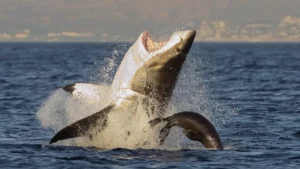 | 4–6 m (13–20 ft) | High | West coast in May–June; Jeju and the East Sea in summerBaeksangeo. Identified in the 1981 and 2005 cases and suspected in 1959; the species behind Korea's fatal record. |
Shortfin Mako SharkIsurus oxyrinchus | 2.5–3.5 m (8–12 ft) | Moderate | Korea Strait, Jeju and the East Sea in summerCheongsangari. Regular longline catch; among the sharks reported close to Gangwon beaches since 2023. |
Salmon SharkLamna ditropis | 2–2.6 m (7–8.5 ft) | Low | Cold East Sea, Ulleungdo and the Gangwon coastAksangeo. Warm-blooded cold-water shark often mistaken for a great white by fishermen. |
Basking SharkCetorhinus maximus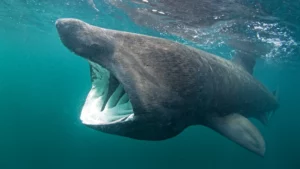 | 6–9 m (20–30 ft) | Low | East Sea and Jeju in spring plankton bloomsSecond-largest fish; caught in set-nets most years. Harmless filter feeder. |
Whale SharkRhincodon typus | 6–12 m (20–40 ft) | Low | Jeju and the south coast, June–SeptemberA designated marine protected species; net-caught animals are released. Harmless. |
Blue SharkPrionace glauca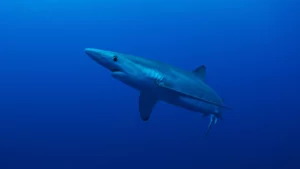 | 2–3 m (7–10 ft) | Low | Offshore in all three seasCheongsaeng-sangeo. Longline bycatch; occasionally inshore off Gangwon in summer. |
Common Thresher SharkAlopias vulpinus | 3–5 m (10–16 ft) incl. tail | Low | Korea Strait and East SeaHwansangari. Tail as long as its body; harmless. |
Bigeye Thresher SharkAlopias superciliosus | 3–4 m (10–13 ft) incl. tail | Low | Deep water south of JejuLongline record; enormous eyes for the twilight zone. |
Smooth Hammerhead SharkSphyrna zygaena | 2.5–4 m (8–13 ft) | Low | South coast and Jeju in the warm monthsGwisangeo. The temperate hammerhead; caught by set-nets and longlines. |
Scalloped Hammerhead SharkSphyrna lewini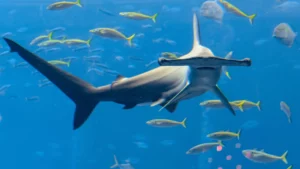 | 2.5–3.5 m (8–12 ft) | Low | Jeju's Munseom and Seopseom in late summerKorea's one reliable large shark for divers, when the Tsushima Current is warm enough. |
Sand Tiger SharkCarcharias taurus | 2.5–3.2 m (8–10 ft) | Low | Jeju and the south coast in summer; every large Korean aquariumFierce teeth, gentle nature. Critically endangered globally. |
Dusky SharkCarcharhinus obscurus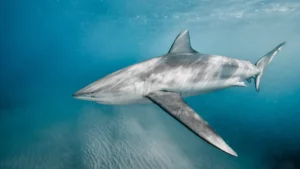 | 3–3.6 m (10–12 ft) | Moderate | Warm south coast and Jeju offshoreHyungsangeo. A large requiem shark recorded from the Korea Strait; slow-growing and heavily fished across the Pacific. |
Copper Shark (Bronze Whaler)Carcharhinus brachyurus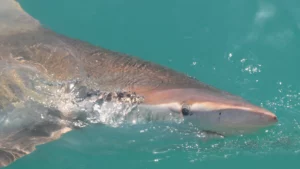 | 2.5–3.3 m (8–11 ft) | Moderate | Temperate coasts, following fish schools in summerMutae-sangeo. The temperate requiem shark of the north-west Pacific. |
Sandbar SharkCarcharhinus plumbeus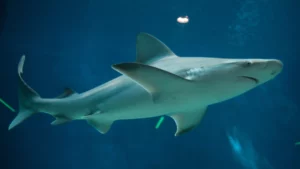 | 1.8–2.4 m (6–8 ft) | Low | South coast and JejuTall-finned, bottom-oriented; a summer visitor from the south. |
Banded HoundsharkTriakis scyllium | 1–1.5 m (3–5 ft) | Low | Yellow Sea and south coast estuaries, sandy baysKkachi-sangeo, the commonest shark in Korea and the one anglers catch from piers. |
| Starspotted Smooth-houndMustelus manazo | 0.8–1.1 m (2.6–3.6 ft) | Low | All three seas over sand and mudByeol-sangeo; the market shark of Jagalchi and the usual source of dombaegi. |
Japanese TopesharkHemitriakis japanica | 1–1.2 m (3–4 ft) | Low | South coast and Jeju shelfGae-sangeo. Slender houndshark of the East China Sea; harmless. |
Cloudy CatsharkScyliorhinus torazame | 40–50 cm (1.3–1.6 ft) | Low | Rocky bottoms in all three seasDutup-sangeo. Small egg-laying shark common in trawls and aquarium touch tanks. |
| Blackspotted CatsharkHalaelurus buergeri | 40–50 cm (1.3–1.6 ft) | Low | Yellow Sea and Korea Strait shelfBulbeom-sangeo. A speckled bottom catshark of the East China and Yellow seas. |
Japanese Bullhead SharkHeterodontus japonicus | 0.9–1.2 m (3–4 ft) | Low | Rocky shallows of the south coast and JejuGwaengi-sangeo. Shellfish-crushing teeth, spiral egg cases; harmless. |
Whitespotted Bamboo SharkChiloscyllium plagiosum | 0.7–0.95 m (2.3–3 ft) | Low | Warm south coast and JejuEolluk-sangeo. Small nocturnal reef shark at the northern edge of its range. |
Japanese WobbegongOrectolobus japonicus | 0.9–1.1 m (3–3.6 ft) | Low | Rocky reefs of the south coast and JejuSuyeom-sangeo. Camouflaged ambush hunter; bites only a hand that pokes it. |
Japanese AngelsharkSquatina japonica | 1.2–1.5 m (4–5 ft) | Low | Sandy bottoms of the Yellow Sea and East SeaJeonjari-sangeo. Flat ambush predator, heavily fished across its range. |
Japanese SawsharkPristiophorus japonicus | 1.2–1.5 m (4–5 ft) | Low | Shelf and slope of the south coast and East SeaTop-sangeo. Toothed snout for hunting in sediment; a trawl catch. |
Pacific Spiny DogfishSqualus suckleyi | 0.9–1.2 m (3–4 ft) | Low | Cold East Sea, Ulleungdo and GangwonGop-sangeo. Schooling cold-water dogfish caught for meat and liver oil. |
Bluntnose Sixgill SharkHexanchus griseus | 3.5–4.8 m (11–16 ft) | Low | Deep East Sea slope off Pohang and UljinAncient deep-water giant; a deep longline record, never near shore. |
Frilled SharkChlamydoselachus anguineus | 1.5–2 m (5–6.5 ft) | Low | Rare; deep East SeaEel-shaped living fossil; occasional deep-net records off the east coast. |
What is not here matters too. Korea's water is too cold for the tropical reef sharks, so there are no blacktip reef, whitetip reef or grey reef sharks, no nurse sharks and no zebra sharks. The bull shark has no confirmed Korean record; the tiger shark is at best an occasional stray to Jeju and is not reliably recorded. The original version of this page listed only eight species and left out the houndsharks, smooth-hounds and catsharks that are by far the commonest sharks in the country. The great white is included with a high rating not because it is common, but because it is the species behind Korea's fatal record.
Where to see sharks in South Korea
South Korea has no shark-diving industry, and most people who see a shark here see it at a market, an aquarium or from a fishing boat. These are the places where a sighting is realistic.
- Munseom and Seopseom, Seogwipo, JejuKorea's best dive sites, volcanic islets with soft coral walls in the Tsushima Current. Scalloped hammerheads pass in late summer and sand tiger sharks and whale sharks are occasionally seen by divers and fishermen.
- Jeju offshore, summerWhale sharks and basking sharks turn up in set-nets around the island most years between June and September. There is no organised encounter, but fishing charters out of Seogwipo and Moseulpo meet blue sharks and makos over deep water.
- Taean and Boryeong coast, ChungcheongThe shell-diving grounds of the west coast, and the site of most of Korea's great white cases. Not a place to see sharks deliberately; a place to understand why the divers now work with lookouts in May and June.
- Sokcho, Gangneung and the Gangwon beachesThe East Sea coast where shark sightings surged from 2023. Beaches at Sokcho and Gangneung run nets and drone patrols in July and August, and fishermen regularly report makos, blue sharks and the occasional great white.
- Ulleungdo and the deep East SeaThe volcanic island 130 km offshore sits over deep water. Salmon sharks and spiny dogfish are caught here, and the deep longliners of Pohang and Uljin bring up sixgills.
- Busan: Jagalchi market and HaeundaeJagalchi is the largest fish market in the country and the best place to see houndsharks, smooth-hounds, catsharks and the occasional mako laid out whole. Haeundae, the busiest beach in Korea, has had shark sightings but no incident.
- Aquariums: Aqua Planet Jeju, COEX Seoul, SEA LIFE BusanKorea's big aquariums keep sand tiger sharks, banded houndsharks, zebra sharks and other species, and are the only guaranteed way to see a large shark in the country.
If you want a wild shark, Jeju in August is the only serious option, and even there the odds are modest; Munseom's hammerheads are a bonus on a dive booked for the coral. Everywhere else the honest advice is a fishing charter or a morning at Jagalchi.
Best time of year to see sharks in South Korea
Korea's seas have real winters, and the shark year is compressed into the warm half.
- May to June, west coast: the Yellow Sea warms past 15–18 °C, the shellfish season opens, and this is the historical window for great white encounters with divers. Every dated fatal case in the database falls in May, and the one undated death is logged as summer.
- July to September, everywhere: peak water temperatures of 24–27 °C, the beach season, and the months when hammerheads, whale sharks and sand tigers reach Jeju and the south coast. Also the season of the recent East Sea sightings and beach nets.
- March to May, East Sea and Jeju: basking sharks appear at the surface during the spring plankton bloom and are sometimes caught in set-nets.
- October to April: the water cools to single digits in the Yellow Sea and the coastal sharks retreat to deeper water or the south. Almost nothing is seen inshore; the market species are caught offshore.
The important point for a visitor is that Korean beaches open in July and August, when the great whites of the west-coast record have moved on and the water is warm enough for the harmless southern species. The overlap between people and dangerous sharks is a few weeks in late spring, and it involves divers, not swimmers.
Shark attacks in South Korea: what the record actually shows
The SharkSider database holds eight records for South Korea, all between 1959 and 2010, six of them fatal. The full record is maintained and updated weekly on the shark attacks in South Korea page. The six newest records are shown below:
- 2010 · Jeju Island, Jeju ProvinceSwimming — Lacerations to left lower legSpecies not identified · not fatal
- 2005 · Dando/Kaeui Island, South Ch'ungch'ong ProvinceDiving — Knee bittenSpecies: 3 m [10'] white shark · not fatal
- 1996Shell Diving — FatalSpecies not identified · fatal
- 1995 · Jangkodo IslandDiving for abalone — Right leg severed fatalSpecies: 4 m shark · fatal
- 1988Shell diving — FatalSpecies not identified · fatal
- 1986Shell diving — FatalSpecies not identified · fatal
Few countries have a pattern this consistent. The six deaths: a swimmer at 36°17'N 126°31'E off South Chungcheong in the summer of 1959, possibly a white shark; a shell diver at Wae-yeon Island in Chungnam on 23 May 1981, killed by a white shark estimated at 6 m; shell divers on 15 May 1986 and 27 May 1988; an abalone diver at Jangkodo Island on 12 May 1995 whose right leg was severed by a 4 m shark; and a shell diver on 10 May 1996. Five of the six fall between 10 and 27 May and the sixth is dated only to the summer of 1959; all were on or near the west coast, and all but the first involved people working on the bottom in low visibility. The two non-fatal cases confirm the picture from both sides: a diver at Dando and Gaeui Island in South Chungcheong bitten on the knee by a 3 m white shark on 13 June 2005, and a swimmer at Jeju on 10 August 2010 with lacerations to the lower left leg from an unidentified, probably small, shark.
The explanation is ecological. Great whites in the north-west Pacific migrate north along the coasts of China and Korea as the Yellow Sea warms in spring, and the west-coast tidal flats are where they meet the shellfish divers, who are on the seabed, moving slowly, in water where a shark cannot see what it is investigating. The divers know this: since the 1990s many west-coast diving cooperatives have used lookout boats and stopped work when a large shark is reported. There has been no death since 1996, and nothing at all since 2010, which suggests the precautions work. The standard advice on surviving a shark attack applies, but for Korea the specific lesson is narrower: if you dive commercially off Chungcheong in May and June, you are the person the record is about; if you swim at Haeundae in August, you are not.
Is it safe to swim and snorkel with sharks in South Korea?
For beach swimmers, yes. Korea's beaches open for a few weeks from July into August, are heavily supervised, and since the 2023 sightings the East Sea resorts have added shark nets and drone patrols on top of the lifeguards. The sharks that live inshore in summer, houndsharks, smooth-hounds, catsharks and bullheads, are small bottom-feeders that cannot hurt a person. The 2010 Jeju case is the only recorded bite on a swimmer in the country, and it was minor.
Divers at Jeju's Munseom and Seopseom occasionally meet scalloped hammerheads and sand tiger sharks in late summer; both are placid around divers and there is no Korean incident involving either. Whale sharks and basking sharks are harmless filter feeders; if a boat finds one off Jeju, treat it as you would anywhere, keep your distance and never touch. Our page on whether whale sharks are dangerous covers the etiquette.
The one activity with a real history is commercial shellfish diving off the west coast in late spring, and that is not something a tourist does. Recreational divers who want to explore the Yellow Sea should avoid May and June, dive with a boat lookout, and get out if any large shark is reported nearby; the visibility there means you will not see it coming.
Shark conservation in South Korea
South Korea has no general protection for sharks and a long tradition of eating them. Salted shark, dombaegi, is a fixture of ancestral-rite tables in Daegu and the Gyeongsang provinces, houndsharks and smooth-hounds are sold whole at Jagalchi and the Noryangjin market in Seoul, and Korea's distant-water tuna fleet has historically been one of the larger sources of shark fins in the Pacific. What has changed is the framework around that. The whale shark is a designated marine protected species under the Ministry of Oceans and Fisheries, which makes capture, sale and possession illegal, and animals caught in set-nets around Jeju are now released rather than sold. Korea is a party to CITES and applies the trade listings for hammerheads, threshers, makos and the great white, and its distant-water fishing rules require fins to be landed attached to the carcass.
The pressure points are the ones you would expect. Small coastal sharks are taken without species-level catch limits, and the starspotted smooth-hound and banded houndshark are caught in large numbers by gill-net and trawl fisheries on both coasts. Blue sharks and makos are longline bycatch in the East Sea and Korea Strait. The warming that is bringing southern sharks north is also changing the whole ecosystem, and Korean researchers now tag and track the large sharks appearing off Gangwon to understand whether they are new residents or summer visitors. For the wider picture on why slow-breeding species such as the great white and the hammerheads are so vulnerable, our page on why sharks are endangered has the answer.
Sharks in neighbouring waters
South Korea's sharks are shared with the whole north-west Pacific. Japan, across the Korea Strait, has seen shellfish divers killed by great whites in its Seto Inland Sea too, and shares the basking and salmon sharks of the north, on a far longer species list. China shares the Yellow Sea and its white shark migration route, and Hong Kong sits at the warm end of the same coast. Russia's Primorye coast continues the cold East Sea fauna north of the peninsula. To the south, the Philippines and Vietnam are where the Kuroshio's tropical sharks come from. Every country on the site is reachable from sharks around the world.
Frequently asked questions
Are there sharks in South Korea?
Yes, at least 27 species with solid records. The common ones are small bottom sharks such as the banded houndshark, starspotted smooth-hound, cloudy catshark and Japanese bullhead. Blue sharks, makos and salmon sharks are fished offshore, and Jeju and the south coast see hammerheads, whale sharks and sand tigers in summer. Great whites visit the west coast in late spring.
Have there been shark attacks in South Korea?
Yes. The SharkSider database lists eight incidents between 1959 and 2010, six of them fatal. Five deaths were shellfish divers on the west coast in May and June, and great whites were identified in three cases. The last death was in 1996; the last incident, a swimmer with minor leg cuts at Jeju, was in 2010.
Are there great white sharks in South Korea?
Yes. Great whites move north along the Yellow Sea coast in spring and were identified in the 1981 Wae-yeon Island death and the 2005 Gaeui Island bite, both on shell divers. They are also among the sharks reported off the East Sea coast since 2023 and are caught occasionally by fishermen near Jeju and Gunsan.
Is it safe to swim at beaches in South Korea?
Yes. Beaches open in July and August, are patrolled, and East Sea resorts now add shark nets and drone surveillance. Inshore sharks in summer are small and harmless, and the only recorded bite on a swimmer, at Jeju in 2010, was minor. The serious cases involved commercial divers on the seabed in May and June, not bathers.
Why are sharks appearing on Korea's east coast?
Since 2023 fishermen and patrols along the Gangwon coast have reported unusual numbers of large sharks, including great whites, makos and blue sharks, close to shore in summer. Korean scientists link it to warming surface water in the East Sea drawing southern species north. Beaches at Sokcho and Gangneung responded with nets and drones.
Where can you see sharks in South Korea?
Jeju's Munseom and Seopseom dive sites off Seogwipo, where scalloped hammerheads and sand tigers pass in late summer, are the only realistic wild option. Fishing charters from Jeju meet blue sharks and makos. Otherwise, Busan's Jagalchi market shows the coastal species, and the large aquariums in Jeju, Seoul and Busan keep sand tiger sharks.
Can you see whale sharks in South Korea?
Occasionally. Whale sharks reach Jeju and the south coast between June and September and are caught in set-nets most years; as a designated marine protected species they are now released. There is no organised whale shark encounter in Korea, so a sighting is a matter of luck on a dive or fishing trip off Jeju.
What is the most common shark in South Korea?
The banded houndshark, known as kkachi-sangeo, which lives in sandy bays and estuaries on all three coasts and is the shark anglers catch from piers. The starspotted smooth-hound is the most common in markets, and the cloudy catshark is the small shark that turns up in almost every trawl.
Do Koreans eat shark?
Yes. Salted shark meat called dombaegi is a traditional dish for ancestral rites in Daegu and the Gyeongsang provinces, usually made from smooth-hound or houndshark. Whole small sharks are sold at Busan's Jagalchi and Seoul's Noryangjin markets. The whale shark is protected and may not be sold.
Are there bull sharks or tiger sharks in South Korea?
No confirmed bull shark record exists for Korea, and the tiger shark is at most a rare stray to Jeju rather than a resident. Korea's water is too cold for both through most of the year. The large sharks of the Korean record are great whites, with makos, salmon sharks and blue sharks offshore.
References

A small team focused on researching sharks and making marine biology easy to understand. Every page is reviewed against current species records and the SharkSider attack database, and updated when new incidents or research appear.
Published January 4, 2023 · Last updated September 21, 2026 · Incident data from the SharkSider attack database (8 records for South Korea, 6 fatal).


