
Yes, sharks are common in Saudi Arabian waters, with around 29 species confirmed across the Red Sea and the Arabian Gulf. On the Red Sea reefs the everyday species are the blacktip reef shark, the grey reef shark, the whitetip reef shark and the tawny nurse shark, with silky sharks and scalloped hammerheads in the deep water offshore; the Gulf coast is the home of the smaller milk, spot-tail and bamboo sharks, and the whale shark visits both seas.
Sharks are not a practical worry for swimmers here. SharkSider's database holds only 5 records for Saudi Arabia, with 1 fatality, and four of the five are Gulf-coast diving accidents from the 1940s and 1950 near Ras Tanura; the fifth, in 2012, was a kite-surfer crossing from Egypt who was circled but not touched. There is no confirmed shark bite on the Saudi Red Sea coast in the database at all.
- Shark species recorded29 with solid records
- ProtectionShark fishing banned by decree since 2008; Farasan Islands MPA since 1996
- Most seen from the beachBlacktip reef shark
- Signature encounterWhale sharks at Shib Habil, Al Lith, March–May
- Incidents in the database5 (1940s–2012), 1 fatal; none on the Red Sea coast
- Water temperatureRed Sea 22–32 °C; Gulf 15–35 °C

On this page
- Two seas, two very different shark faunas
- List of the different types of sharks in Saudi Arabia
- Where to see sharks in Saudi Arabia
- Best time of year to see sharks in Saudi Arabia
- Shark attacks in Saudi Arabia: what the record actually shows
- Is it safe to swim and snorkel with sharks in Saudi Arabia?
- Shark conservation in Saudi Arabia
- Sharks in neighbouring waters
- Frequently asked questions
- References
Two seas, two very different shark faunas
Saudi Arabia is unusual in having coastlines on two seas that barely resemble each other. The Red Sea is a young ocean, a rift valley that flooded and kept deepening: the central trough reaches more than 2,000 m within a few kilometres of the fringing reef, the water is saltier than almost any open sea, and it never really cools, staying above about 22 °C in the north in winter and topping 30 °C in the south in summer. The result is a reef system with the full Indo-Pacific cast of reef sharks in the shallows and true oceanic sharks, silky sharks, oceanic whitetips and hammerheads, cruising within sight of the shore. The northern coast around Tabuk, Duba and the mouth of the Gulf of Aqaba has steep walls; the central coast between Yanbu, Jeddah and Al Lith has broad reef platforms and offshore reefs; and the far south around Jizan and the Farasan Islands is shallow, turbid and plankton-rich, which is exactly what filter feeders such as whale sharks want.
The Arabian Gulf on the other side of the country is the opposite: a shallow, enclosed basin averaging around 35 m deep, with summer surface water of 35 °C and winter lows near 15 °C, plus salinity that climbs sharply in the lagoons. That is a hard place to be a shark, and the Gulf fauna is dominated by small, tough coastal species: milk sharks, spot-tail and whitecheek sharks, the Arabian carpetshark and the grey bamboo shark, with bull sharks, hammerheads and the occasional tiger shark as the large predators. Whale sharks feed on tuna spawn in the central Gulf every summer, and although the best-known aggregation sits on the Qatari side, they are recorded along the Saudi coast off Jubail and Ras Tanura too.
List of the different types of sharks in Saudi Arabia
The table keeps to species with dependable records in Saudi waters, drawn from fish-market surveys, reef monitoring around Thuwal and Jeddah, and the tagging work on whale sharks off Al Lith. Sizes are ordinary adult lengths. The risk column describes the species' behaviour toward a swimmer or snorkeller, not a diver who goes looking for it, and a low rating for a large animal like the sandbar shark simply reflects the fact that it has no history of bothering people. Several of the smaller Gulf species have never bitten anyone anywhere.
| Species | Adult size | Risk to swimmers | Where in Saudi Arabia & notes |
|---|---|---|---|
Blacktip Reef SharkCarcharhinus melanopterus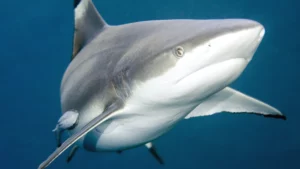 | 1.2–1.6 m (4–5 ft) | Low | Reef flats and lagoons along the whole Red Sea coast; Al Wajh, FarasanThe shark seen from the beach. Timid; the odd nip to a wader's foot is the worst on record anywhere. |
Grey Reef SharkCarcharhinus amblyrhynchos | 1.5–2.4 m (5–8 ft) | Moderate | Reef edges and passes: Yanbu, Jeddah, FarasanThe everyday shark of Saudi Red Sea dives. Territorial toward divers who push in; indifferent to snorkellers. |
Whitetip Reef SharkTriaenodon obesus | 1.2–1.6 m (4–5 ft) | Low | Under ledges and in caves on most Red Sea reefsSleeps by day, hunts at night. No threat to people. |
Tawny Nurse SharkNebrius ferrugineus | 2.5–3.2 m (8–10 ft) | Low | Coral heads and caves, Al Wajh lagoon, FarasanThe Red Sea's nurse shark. Docile until there is bait in the water. |
Silky SharkCarcharhinus falciformis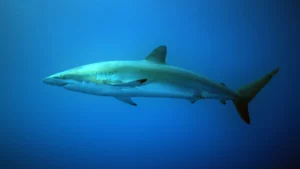 | 2–3 m (7–10 ft) | Moderate | Deep water off the reefs, Gulf of Aqaba walls, offshore JeddahThe most heavily landed shark in Jeddah's fish market surveys, mostly juveniles. Curious around swimmers in blue water. |
Silvertip SharkCarcharhinus albimarginatus | 2–2.5 m (7–8 ft) | Moderate | Deep corners of the offshore reefs, Yanbu and JeddahBold, white-edged reef shark that approaches divers closely. Rare near the surface. |
| Oceanic Whitetip SharkCarcharhinus longimanus | 2–3 m (7–10 ft) | High | Open water and offshore reefs, especially the northern Red SeaThe Red Sea's most dangerous shark to people in open water; responsible for Egypt's incidents. Never on the reef flat. |
Scalloped Hammerhead SharkSphyrna lewini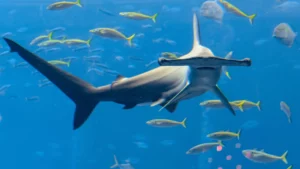 | 2.5–3.5 m (8–12 ft) | Low | Deep reefs off Yanbu and Farasan in the cooler monthsSchools at depth; critically endangered and still caught in southern Red Sea gill nets. |
Great Hammerhead SharkSphyrna mokarran | 3.5–4.5 m (11–15 ft) | Moderate | Solitary on deep reef slopes; also the GulfA stingray specialist recorded on both coasts. Rarely close to swimmers. |
Tiger SharkGaleocerdo cuvier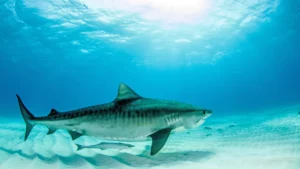 | 3–4.5 m (10–15 ft) | High | Deep slopes off Thuwal and Jeddah; occasional in the GulfTagged off the central Red Sea coast by KAUST. No Saudi incident on record, but respect it. |
Bull SharkCarcharhinus leucas | 2.2–3.4 m (7–11 ft) | High | Gulf coast harbours and outlets; uncommon in the Red SeaThe likeliest identity of the 'black-tipped shark' in the 1940s Ras Tanura diving cases. |
Sandbar SharkCarcharhinus plumbeus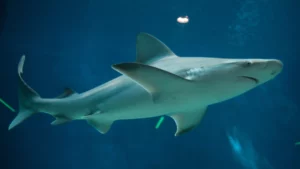 | 1.8–2.4 m (6–8 ft) | Low | Sandy slopes and reef bases on both coastsTall-finned, heavy-bodied and inoffensive. Regular in the Red Sea landings. |
Blacktip SharkCarcharhinus limbatus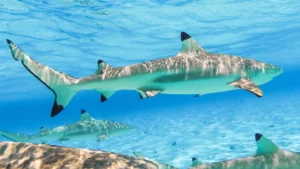 | 1.5–2.5 m (5–8 ft) | Moderate | Open coastal water on both coasts, often near bait schoolsFaster and more offshore than the reef blacktip; plain anal fin. |
Spinner SharkCarcharhinus brevipinna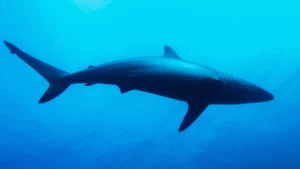 | 2–2.5 m (7–8 ft) | Moderate | Coastal water of the Red Sea and Gulf, with sardine schoolsLeaps and spins when feeding. Bites elsewhere are minor and accidental. |
Sicklefin Lemon SharkNegaprion acutidens | 2.2–3 m (7–10 ft) | Low | Sandy lagoons and mangroves: Al Wajh, Farasan, Gulf shallowsSlow, yellowish and easy to spot in a metre of water. Placid. |
Whale SharkRhincodon typus | 4–7 m here (adults to 12 m+) | Low | Shib Habil off Al Lith March–May; Gulf offshore in summerHarmless filter feeder. The Al Lith animals are juveniles that return across seasons. |
Zebra SharkStegostoma tigrinum | 2–2.5 m (7–8 ft) | Low | Resting on sand patches next to reefs, both coastsSpotted adults, striped juveniles. Entirely placid. |
Pelagic Thresher SharkAlopias pelagicus | 2.5–3.3 m (8–11 ft) incl. tail | Low | Deep water off the Red Sea reefsRecorded in landings and occasionally seen by divers on deep walls. Harmless. |
Shortfin Mako SharkIsurus oxyrinchus | 2.5–3.5 m (8–11 ft) | Moderate | Offshore Red Sea; rareKnown mainly from fishery records. Not a coastal shark here. |
Sand Tiger SharkCarcharias taurus | 2.2–3 m (7–10 ft) | Low | Rare, deep reef records in the Red SeaRagged teeth, gentle habits. Seldom seen alive by divers in Saudi water. |
Milk SharkRhizoprionodon acutus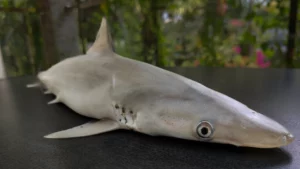 | 0.8–1.1 m (2.5–3.5 ft) | Low | Shallow coastal water on both coasts, common in the GulfOne of the most frequently landed sharks in the region. Harmless. |
| Spot-tail SharkCarcharhinus sorrah | 1.2–1.6 m (4–5 ft) | Low | Gulf coast and southern Red Sea shallowsSmall requiem shark with a black tail tip; a staple of Gulf fisheries. |
Whitecheek SharkCarcharhinus dussumieri | 0.8–1 m (2.5–3.3 ft) | Low | Gulf coast, sandy and muddy bottomsSmall and inoffensive; heavily fished across the Gulf. |
Graceful SharkCarcharhinus amblyrhynchoides | 1.4–1.7 m (4.5–5.5 ft) | Low | Coastal Gulf watersLooks like a blacktip; no incident on record anywhere. |
Pigeye SharkCarcharhinus amboinensis | 2–2.5 m (7–8 ft) | Moderate | Turbid Gulf shallows and harbour mouthsA bull shark look-alike with a similar temperament, though far fewer records against people. |
Snaggletooth SharkHemipristis elongata | 1.8–2.3 m (6–7.5 ft) | Low | Gulf coast and southern Red Sea, over sandHooked lower teeth, mild manner. A fisheries species. |
| Sliteye SharkLoxodon macrorhinus | 0.7–0.9 m (2.3–3 ft) | Low | Gulf coast shallowsTiny, slender and harmless. |
| Arabian CarpetsharkChiloscyllium arabicum | 0.6–0.8 m (2–2.6 ft) | Low | Seagrass and coral rubble of the Gulf coast, JubailA Gulf and Arabian Sea specialist that lays eggs on seagrass. Completely harmless. |
Grey Bamboo SharkChiloscyllium griseum | 0.6–0.75 m (2–2.5 ft) | Low | Shallow reefs and rubble, Gulf coastBottom-dwelling, nocturnal and easily overlooked. |
Great White SharkCarcharodon carcharias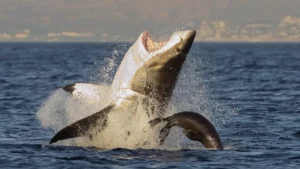 | 4–6 m (13–20 ft) | n/a | Not recorded in the Red Sea or the GulfListed only to answer the question. Both seas are too warm and enclosed for the species. |
The species missing from this list is the one people search for most. The great white shark has no record in the Red Sea or the Gulf; both are too warm and the Red Sea's narrow entrance at Bab-el-Mandeb has kept the cold-water lamnids out. Basking sharks and porbeagles are absent for the same reason. The Caribbean reef shark and the Atlantic nurse shark, both often named on older lists for the region, do not occur in the Indian Ocean; their Saudi equivalents are the grey reef shark and the tawny nurse shark.
Where to see sharks in Saudi Arabia
Diving tourism in Saudi Arabia is only a few years old, but the Red Sea coast was never empty: Jeddah and Yanbu have had dive clubs for decades, and the reefs are in better condition than many of their Egyptian counterparts because so few people have visited them. These are the places where sharks are a realistic expectation.
- Shib Habil, Al LithA shallow reef 150 km south of Jeddah where juvenile whale sharks, mostly 4–7 m, gather each spring to feed. Researchers from KAUST have tagged and photo-identified the animals here since 2010; snorkelling trips run from Al Lith from about March to May.
- Farasan Islands, JizanA marine protected area of more than 80 islands in the plankton-rich southern Red Sea. Reef sharks on the outer edges, scalloped hammerheads at depth, and whale sharks passing through the channels in the cooler months.
- Yanbu offshore reefs (Seven Sisters, Abu Galawa)Yanbu's reefs sit on the edge of deep water and are the most reliable Saudi sites for grey reef sharks and hammerheads. Long-established local dive clubs, few boats.
- Jeddah's outer reefs and wrecksReef platforms such as Abu Madafi and the wrecks off the city hold whitetip reef sharks under the ledges and silvertips on the deep corners. The best starting point for a first Saudi dive trip.
- Al Wajh lagoon (The Red Sea project)A 90-island lagoon on the northern coast, now the centre of the country's new resort development. Blacktip reef sharks and sicklefin lemon sharks patrol the sandy shallows, and tawny nurse sharks rest under the coral heads.
- Gulf of Aqaba coast, Tabuk (Haql, Sharma, NEOM)Steep drop-offs into very deep water within swimming distance of shore. Oceanic whitetips, silky sharks and hammerheads are possible in the blue, with reef sharks on the wall.
- Thuwal and Rabigh reefsThe reefs off the KAUST campus are the best-studied in the kingdom. Blacktip reef sharks and juvenile grey reef sharks use the reef flats; researchers have also recorded sandbar and tiger sharks on the deeper slopes.
- Jubail Marine Wildlife Sanctuary, Gulf coastA very different experience: seagrass and sandy shallows where the Arabian carpetshark, grey bamboo shark and milk shark live, and where whale sharks appear offshore in summer.
For most visitors the whale shark season at Al Lith is the reason to come, and it is one of the few places in the world where the animals are reliably found on shallow water close to shore. Divers wanting reef sharks should base themselves in Yanbu or Jeddah; the northern coast will become easier to reach as the Tabuk-region resorts open.
Best time of year to see sharks in Saudi Arabia
The two coasts have different calendars, and on the Red Sea the north and south differ again.
- Red Sea, October to May: the diving season. Surface water falls from about 30 °C in October to 22–24 °C in the north in January and February, and visibility is at its best. Hammerheads and other deep-water sharks come closer to the reefs in these cooler months.
- Whale sharks at Al Lith, March to May: the plankton bloom of spring draws the juvenile whale sharks onto Shib Habil, with sightings tailing off by June as the water warms past 30 °C.
- Red Sea, June to September: hot, with surface temperatures of 30–32 °C in the south and air temperatures well above 40 °C on shore. Reef sharks are still present but boats run early in the morning.
- Arabian Gulf, spring and autumn: the only comfortable windows. Summer water reaches 35 °C, when many larger sharks move to deeper, cooler water and whale sharks arrive to feed on spawning tuna; winter water of 15–18 °C pushes the small coastal species into the deeper channels.
Blacktip reef sharks on the reef flats are visible in every month on both coasts, most easily at high tide in the late afternoon.
Shark attacks in Saudi Arabia: what the record actually shows
For a country with roughly 2,300 km of coastline on two shark-rich seas, the Saudi record is remarkably short. SharkSider's database holds five entries, all listed below with the six-record display showing the complete set; our shark attacks in Saudi Arabia page tracks any new case as it appears.
- 2012 · Off Duba, Tabuk ProvinceAttempting to Kite surf from Egypt to Saudi Arabia — Harassed by sharks but not injured by themSpecies not identified · not fatal
- 1950 · East of the Ras Tanura-Jubail area, Eastern ProvinceDiving — Tissue stripped knee to footSpecies not identified · not fatal
- 1950 · East of the Ras Tanura-Jubail area, Eastern ProvinceDiving — Fatal, died of sepsisSpecies: "a black-tipped shark" · fatal
- 1950 · East of the Ras Tanura-Jubail area, Eastern ProvinceDiving — Buttocks bittenSpecies: 6' shark · not fatal
- 1950 · East of the Ras Tanura-Jubail area, Eastern ProvinceDiving — Foot lacerated, surgically amputatedSpecies not identified · not fatal
Four of the five entries come from one place and one era: the Gulf coast east of Ras Tanura and Jubail during the 1940s and 1950, when oil-company diving crews worked around the new terminals and pipelines. Three of those divers survived bites to the foot, knee and buttocks; one died, not of the bite itself but of sepsis that set in afterwards, and the shark was described only as “a black-tipped shark”, which in the Gulf could mean a blacktip, a spot-tail or a bull shark. Working divers in murky, warm water full of fish waste were the classic target then, and no similar incident has been recorded on that coast since. The fifth record, from March 2012, involved a kite-surfer attempting to cross the Red Sea from Egypt to Duba who was harassed by sharks in open water but not injured.
That leaves no confirmed bite on a swimmer, snorkeller or diver anywhere along the Saudi Red Sea coast in the database, despite a fauna that includes tiger sharks, oceanic whitetips and silky sharks. Part of the explanation is simply low use: until 2019 there was almost no recreational tourism and Saudi beaches were quiet. As the Red Sea resorts fill up, the sensible assumption is that the coast will behave like Egypt's, where incidents are rare but real and nearly always involve oceanic whitetips near offshore reefs or people swimming where fish are cleaned. The rules on our surviving a shark attack page apply: stay close to the reef rather than drifting in open water, avoid dusk, and never swim near fishing boats or jetties where scraps go in.
Is it safe to swim and snorkel with sharks in Saudi Arabia?
On the reef flats and in the lagoons, yes. The blacktip reef sharks that hunt along the Al Wajh and Farasan shallows bolt from a splash, whitetip reef sharks spend the day asleep under coral, and tawny nurse sharks will let a snorkeller float above them for minutes without moving. Sicklefin lemon sharks look alarming but are sluggish and unbothered by people. Grey reef sharks keep to the reef edge and deep passes, and their well-known threat posture, back arched, pectoral fins dropped, is aimed at divers who crowd them in a channel rather than at anyone at the surface.
The whale shark encounters at Al Lith are among the gentlest anywhere, partly because the animals are young and partly because the boats are few. Whale sharks are harmless plankton feeders; the only injuries ever recorded around them come from tails and propellers. Keep a few metres off the body, well clear of the tail, and slide in quietly rather than jumping. The animals here are photo-identified by researchers, so touching or riding them is both bad manners and a way to get an operator's permit revoked.
Offshore is where a little care is needed. The Red Sea's deep walls and offshore reefs are oceanic whitetip and silky shark territory, and both are curious, persistent animals that will circle a swimmer in blue water. Stay with the reef, stay with your group, and get out calmly if one keeps returning. On the Gulf coast the only species worth respecting is the bull shark near river outlets and harbour mouths, and even that has produced no recorded incident in seventy years.
Shark conservation in Saudi Arabia
On paper Saudi Arabia has protected sharks for longer than most countries in the region. A 2008 ministerial decree banned shark fishing and the sale of shark products throughout the kingdom's waters, the Farasan Islands have been a marine protected area since 1996, and the Jubail sanctuary on the Gulf coast dates from the clean-up after the 1991 oil spill. In practice the ban was weakly enforced for years: fish-market surveys in Jeddah between 2011 and 2013 recorded thousands of sharks landed openly, many of them hammerheads and juvenile silky sharks caught before they had ever bred. That evidence, gathered by researchers at KAUST near Thuwal, is a large part of why sharks are now written into the country's new marine planning.
Things have moved quickly since 2019. The National Center for Wildlife took over marine protected areas, the Red Sea and Amaala developments were built around no-take zones covering most of the Al Wajh lagoon, and Saudi Arabia has committed to protecting 30 percent of its seas by 2030. The whale sharks of Al Lith are the flagship: satellite tags have shown the same juveniles returning to Shib Habil across seasons and travelling the length of the Red Sea between visits, which has turned a local fishing reef into a research site with an encounter code. The pressures that remain are the ones found everywhere in the Indian Ocean: gill nets in the southern Red Sea that catch hammerheads, longlines beyond the reefs, coastal construction in the lagoons where lemon and blacktip reef sharks pup, and the Gulf's extreme summers, which climate change is making harder for the smaller species to survive. Our guide to why sharks are endangered explains why a slow-breeding animal cannot absorb that pressure for long.
Sharks in neighbouring waters
The same Red Sea sharks swim off Egypt, where the oceanic whitetips of the Brothers and Elphinstone reefs are world-famous, and the northern tip of the Gulf of Aqaba is shared with Israel, whose Eilat reefs see the occasional whale shark. On the Gulf side, Bahrain and Qatar share the shallow-water species and Qatar's Al Shaheen field hosts the largest whale shark gathering in the region; Iran holds the opposite shore. Round the corner, Oman opens onto the Arabian Sea with cooler, upwelling-fed water and a different, richer fauna. Our index of sharks around the world covers every country.
Frequently asked questions
Are there sharks in Saudi Arabia?
Yes, around 29 species with confirmed records. The Red Sea coast has blacktip reef, grey reef, whitetip reef and tawny nurse sharks on the reefs, silky sharks and hammerheads offshore, and whale sharks off Al Lith each spring. The Gulf coast holds smaller species such as milk, spot-tail and bamboo sharks.
Do shark attacks happen in Saudi Arabia?
Almost never. SharkSider's database lists five records: four bites on oil-company divers near Ras Tanura in the 1940s and 1950, one of which ended in a fatal infection, and a 2012 kite-surfer who was circled but not injured off Duba. No bite on a swimmer, snorkeller or diver on the Red Sea coast is on record.
Are there great white sharks in Saudi Arabia?
No. The great white has never been recorded in the Red Sea or the Arabian Gulf. Both seas are too warm and too enclosed for a cold-water species, and the narrow strait at Bab-el-Mandeb has kept great whites, basking sharks and porbeagles out of the Red Sea entirely.
Can you swim with whale sharks in Saudi Arabia?
Yes. Shib Habil, a shallow reef off Al Lith about 150 km south of Jeddah, draws juvenile whale sharks every spring, roughly March to May. Snorkelling trips run from Al Lith, and the site is a long-term research station where the animals are photo-identified, so touching or chasing them is not allowed.
Is it safe to swim in the Red Sea in Saudi Arabia?
Yes. Reef sharks on the Saudi coast are shy, and there is no recorded shark bite on the Red Sea side. The only species that call for caution are oceanic whitetips and silky sharks in deep open water, so stay close to the reef, avoid dusk, and keep away from fishing boats and fish-cleaning areas.
Are there sharks in the Arabian Gulf off Saudi Arabia?
Yes, but mostly small ones. The shallow, hot Gulf suits milk sharks, spot-tail, whitecheek and graceful sharks, the Arabian carpetshark and grey bamboo shark. Bull sharks, hammerheads and occasional tiger sharks are the large species, and whale sharks arrive offshore in summer to feed on tuna spawn.
What is the most common shark in Saudi Arabia?
On the Red Sea reefs, the blacktip reef shark, which patrols the lagoon flats and is the species most people see from shore. Among divers, the grey reef shark is the everyday sighting on the outer reefs. On the Gulf coast, the milk shark is the most numerous species by a wide margin.
When is the best time to see sharks in Saudi Arabia?
October to May on the Red Sea coast, when the water cools to 22–28 °C, visibility peaks and hammerheads come closer to the reefs. Whale sharks gather at Al Lith from March to May. On the Gulf coast, spring and autumn are the workable seasons; summer water can reach 35 °C.
Is shark fishing legal in Saudi Arabia?
No. A 2008 ministerial decree banned shark fishing and the sale of shark products in Saudi waters. Enforcement was weak for years, and Jeddah's fish market still landed sharks openly in the early 2010s, but the National Center for Wildlife and the new Red Sea no-take zones have tightened protection since 2019.
Where is the best diving with sharks in Saudi Arabia?
Yanbu's offshore reefs and the outer reefs of Jeddah are the most reliable for grey reef sharks, silvertips and hammerheads, and the Farasan Islands in the south add whale sharks and hammerhead schools. The steep walls of the Gulf of Aqaba coast near Haql and NEOM offer the best chance of oceanic sharks in the blue.
References

A small team focused on researching sharks and making marine biology easy to understand. Every page is reviewed against current species records and the SharkSider attack database, and updated when new incidents or research appear.
Published January 9, 2023 · Last updated September 21, 2026 · Incident data from the SharkSider attack database (5 records for Saudi Arabia, 1 fatal).


