Yes, there are sharks in Qatar, and one of the biggest whale shark gatherings in the world. Twenty-three species are recorded in the country's slice of the Arabian Gulf. The everyday ones are the milk shark, the spot-tail shark, the blacktip shark, the whitecheek shark and the Arabian carpetshark; larger visitors include the bull shark, the great hammerhead and, from May to September, hundreds of whale sharks at Al Shaheen.
For swimmers the record is blank. SharkSider's database contains no shark incident for Qatar in any year. The only species here with a real bite history, the bull shark and the tiger shark, are scarce along the developed coast, and the Gulf's historic bull shark attacks all happened hundreds of kilometres away in the rivers of Iraq and Iran, not on Qatari beaches.
- Shark species recorded23 with solid records
- ProtectionWhale shark protected; CITES member; finning and targeted shark fishing restricted
- Most seen from the beachMilk shark and spot-tail shark
- Signature encounterAl Shaheen whale shark aggregation, May–September
- Incidents in the databaseNone recorded
- Water temperature16–20 °C in January, 33–35 °C in August

On this page
- Where sharks live in Qatari waters
- List of the different types of sharks in Qatar
- Where to see sharks in Qatar
- Best time of year to see sharks in Qatar
- Shark attacks in Qatar: what the record actually shows
- Is it safe to swim and snorkel in Qatar?
- Shark conservation in Qatar
- Sharks in neighbouring waters
- Frequently asked questions
- References
Where sharks live in Qatari waters
To understand Qatar's sharks you have to understand the Gulf. The Arabian Gulf (the Persian Gulf on most maps) is a semi-enclosed basin with an average depth of only 35 m, connected to the Indian Ocean by the narrow Strait of Hormuz. Evaporation under the desert sun outpaces the trickle of river water coming in, so salinity climbs above 40 parts per thousand, and the shallow water swings from 16 °C in a January cold snap to 35 °C in August, a range that would kill most reef fish elsewhere. The sharks that live here are the ones that can tolerate it: hardy, mostly small requiem sharks and carpetsharks that move offshore in winter, into the cooler, deeper water of the central Gulf, and back over the shallows in spring.
Qatar's coast is 560 km of shallow bays, sandbanks and mangrove creeks with a few patches of coral. The northern tip around Al Ruwais and Fuwairit has the country's best reefs and the clearest water; the east coast holds Doha, the industrial port at Mesaieed and the resort strip; the south-east drains into Khor Al Adaid, the tidal “Inland Sea” where dunes run straight into the water; and the west coast, facing Bahrain and Saudi Arabia, is a maze of banks and seagrass meadows that support the world's second-largest dugong population and a nursery for young sharks. Offshore, Qatar's waters extend north to the Al Shaheen field and the maritime border with Iran, where the water is deeper, cooler and far richer.
That offshore zone is what makes Qatar special. In 2010 helicopter pilots serving the Al Shaheen platforms reported dozens of whale sharks around the rigs, and a research programme run by Qatar's environment ministry with the field operator has since counted several hundred individuals in a single summer, feeding on the eggs of mackerel tuna that spawn there in dense slicks. It is one of the largest whale shark aggregations known anywhere, and it is one that almost nobody sees, because the field is an exclusion zone for ordinary boats.
List of the different types of sharks in Qatar
The table lists the sharks with solid records in Qatari waters, based on fisheries landings at the Doha and Al Wakrah markets, regional surveys of the Gulf's shark fauna and the whale shark research at Al Shaheen. Sizes are typical adults. The risk column concerns a swimmer or snorkeller along the coast, and for most of these species it is nominal: Gulf sharks are small, and the ones that are not keep to the deeper offshore water. Local fishermen group most of the small sharks together as jarjur; the whale shark is the arhoum. The old version of this page listed several “highly aggressive” species and gave the great hammerhead a length of six metres; both claims have been corrected below.
| Species | Adult size | Risk to swimmers | Where in Qatar & notes |
|---|---|---|---|
Whale SharkRhincodon typus | 6–12 m (20–40 ft) | Low | Al Shaheen field, May–September; offshore banksSeveral hundred adults gather each summer to feed on tuna eggs, one of the largest aggregations known. Filter feeder, harmless. |
Blacktip SharkCarcharhinus limbatus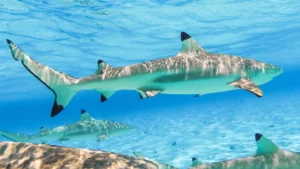 | 1.5–2.2 m (5–7 ft) | Moderate | Northern reefs, sandbanks and channel mouthsThe most common mid-sized shark in Qatari waters. Fast, jumping, fish-eating; nips waders elsewhere in the world but has no record here. |
| Spot-tail SharkCarcharhinus sorrah | 1.2–1.6 m (4–5 ft) | Low | Shallow banks and reefs all along the coastA slim Gulf regular with a black-tipped lower tail lobe. Landed in numbers at Al Wakrah. |
Spinner SharkCarcharhinus brevipinna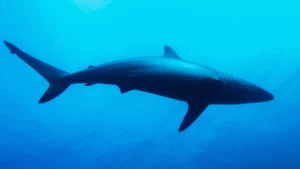 | 1.8–2.5 m (6–8 ft) | Moderate | Open water over the banks, following sardine schoolsLeaps and spins after fish. Confused with the blacktip shark in the markets. |
Bull SharkCarcharhinus leucas | 2.2–3.2 m (7–10 ft) | High | Occasional along the coast; Gulf stronghold is far north at the Shatt al-ArabGenuine but scarce in Qatar. The species behind the Gulf's historic river attacks in Iraq and Iran; none recorded in Qatar. |
Pigeye SharkCarcharhinus amboinensis | 2–2.5 m (7–8 ft) | Moderate | Turbid inshore water and bay mouthsThe bull shark's near-twin, told apart by fin proportions. Landed occasionally at Doha; the usual source of “bull shark” reports. |
Sandbar SharkCarcharhinus plumbeus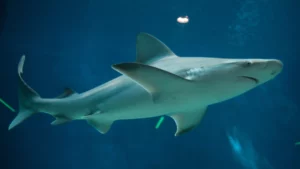 | 1.8–2.4 m (6–8 ft) | Low | Deeper offshore banks around Halul and the northern fieldsTall-finned and heavy-bodied. Heavily fished across the Gulf; adults now uncommon. |
Great Hammerhead SharkSphyrna mokarran | 3.5–4.5 m (11–15 ft) | Moderate | Offshore banks and channel edgesRealistic adult size corrected from the six metres in the old list. Hunts rays over the sand; critically endangered. |
Scalloped Hammerhead SharkSphyrna lewini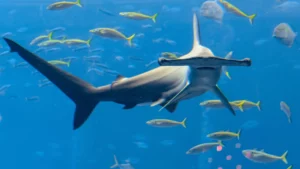 | 2.5–3.5 m (8–12 ft) | Low | Deeper central Gulf water; juveniles inshore in springLanded by the dhow fleet; adults are now rare in the Gulf. Shy of people. |
Tiger SharkGaleocerdo cuvier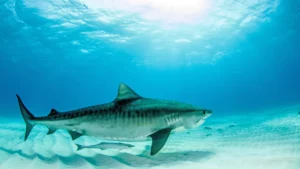 | 3–4.5 m (10–15 ft) | High | Rare visitor to the offshore banksRecorded in the Gulf but seldom near Qatar's coast. No incident on record. |
Milk SharkRhizoprionodon acutus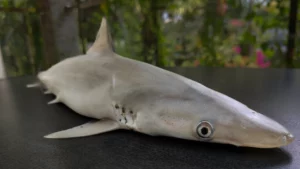 | 0.8–1.1 m (2.5–3.5 ft) | Low | Everywhere inshore: beaches, creeks, mangrovesThe most abundant shark in Qatar and the bulk of the market catch. Eats small fish and shrimp. |
Grey Sharpnose SharkRhizoprionodon oligolinx | 0.6–0.8 m (2–2.5 ft) | Low | Shallow sandy baysA smaller relative of the milk shark, common in the same nets. |
Whitecheek SharkCarcharhinus dussumieri | 0.8–1 m (2.5–3 ft) | Low | Coastal shallows and seagrassA small Gulf specialist with a black-tipped second dorsal fin. Regular in the Doha market. |
| Sliteye SharkLoxodon macrorhinus | 0.7–0.9 m (2.5–3 ft) | Low | Clear water over sand, 10–80 mBig-eyed, delicate and completely harmless. Caught by trawlers. |
| Arabian CarpetsharkChiloscyllium arabicum | 0.6–0.8 m (2–2.5 ft) | Low | Coral, wrecks and mangrove rootsA bamboo shark found only in the Gulf and neighbouring seas. Rests under ledges by day; divers see it on the Doha wrecks. |
| Arabian Smooth-houndMustelus mosis | 1–1.3 m (3–4 ft) | Low | Sand and mud bottoms offshoreA crab-eating houndshark of the Gulf and Arabian Sea. Trawl bycatch; harmless. |
| Slender Weasel SharkParagaleus randalli | 0.7–0.8 m (2.5 ft) | Low | Shallow banks of the western and northern GulfDescribed from the Gulf in 1996. A small, little-known species that turns up in gillnets. |
Hooktooth SharkChaenogaleus macrostoma | 0.8–1 m (2.5–3 ft) | Low | Inshore banks and trawl groundsLong-snouted weasel shark, common in the Gulf's fish-trap and trawl catch. |
Snaggletooth SharkHemipristis elongata | 1.8–2.3 m (6–7.5 ft) | Low | Reefs and sandbanks in 10–100 mThe largest weasel shark, with hooked upper teeth. Valued for its fins; now uncommon. |
Zebra SharkStegostoma tigrinum | 2–2.5 m (7–8 ft) | Low | Sandy patches beside reefs and wrecksCalled the leopard shark by Gulf divers. Sleeps on the sand by day, completely placid. Old list gave it 3.4 m; realistic adults are smaller. |
Tawny Nurse SharkNebrius ferrugineus | 2.5–3 m (8–10 ft) | Low | Caves and overhangs on the northern reefsDocile unless handled. Occasionally seen at Fuwairit and around Halul. |
Smoothtooth Blacktip SharkCarcharhinus leiodon | 1.2–1.5 m (4–5 ft) | Low | Shallow coastal water of the GulfOne of the rarest sharks in the world, known only from the Gulf and Gulf of Aden. Rediscovered in Kuwait fish markets in 2008. |
Sicklefin Lemon SharkNegaprion acutidens | 2.2–3 m (7–10 ft) | Low | Shallow banks, seagrass and mangrove edgesThe Indo-Pacific lemon shark. Sluggish and bottom-oriented; a rare sight along the Qatari coast today. |
Great White SharkCarcharodon carcharias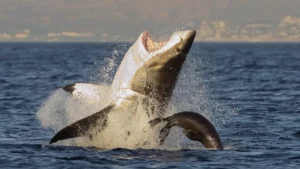 | 4–6 m (13–20 ft) | n/a | Not found in the GulfIncluded only to answer the question. A temperate species; it never enters the Arabian Gulf. |
Two species people ask about are not on the list. The great white does not enter the Gulf: it is a temperate-water shark and the nearest population is in the cooler waters of South Africa and southern Australia. The oceanic whitetip is an open-ocean animal of the Arabian Sea and the Red Sea that has no place in a 35-metre-deep basin. The bull shark is real here but scarce; its Gulf stronghold is the Shatt al-Arab estuary at the head of the Gulf, several hundred kilometres north of Qatar, where it historically swam far up the Tigris and Karun rivers and produced the region's only cluster of shark deaths in the 1940s to 1980s. Along the Qatari coast it is an occasional visitor rather than a resident, and the “bull shark” a beachgoer reports is more often a pigeye shark or a large sandbar shark.
Where to see sharks in Qatar
Qatar is not marketed as a shark destination and most of its sharks are seen on a fishmonger's slab rather than underwater. Still, there are a handful of places where a patient snorkeller, diver or boat passenger has a genuine chance, and one site that is world-class but almost inaccessible.
- Al Shaheen field, 90 km north-east of DohaThe whale shark aggregation, with several hundred individuals counted in peak summers. It lies inside an oil-field exclusion zone; a limited number of permitted trips run in some years through the environment ministry and licensed operators, and the sightings on those trips are extraordinary.
- Fuwairit and Al Ruwais reefs, northern coastThe best natural reefs in the country, in 5–15 m of clear water, with blacktip sharks, spot-tail sharks and the occasional tawny nurse shark. Fuwairit beach is also Qatar's hawksbill turtle nesting site and closes in the nesting season.
- Al Thakira and Al Khor mangrovesThe tidal creeks north of Doha are a nursery for juvenile sharks: newborn milk sharks, spot-tails and young blacktips hunt in the channels on a rising tide. Kayak tours pass through them.
- Khor Al Adaid (the Inland Sea)A UNESCO-recognised tidal lagoon in the far south-east, ringed by dunes. Shallow, warm and sandy, with small requiem sharks and rays feeding over the banks; seen from the shore at low water.
- Halul Island and the offshore banksAn oil terminal island 90 km east of Doha, surrounded by the deepest, cleanest water in Qatari territory. Sandbar sharks, great hammerheads and whale sharks pass here; access is restricted, but the surrounding banks are fished by permit.
- Doha wrecks and artificial reefsThe dive sites off Doha and Mesaieed are mostly scuttled vessels and concrete reef modules in 10–25 m. Zebra sharks and Arabian carpetsharks rest under the structures, and blacktips patrol the edges in the cooler months.
- Al Wakrah and Doha fish marketsThe honest place to see the Gulf's shark diversity: milk sharks, spot-tails, whitecheek sharks, snaggletooths and Arabian smooth-hounds land here from the dhow fleet. A morning visit shows more species than a month of diving.
If seeing a whale shark is the goal, the honest advice is to ask about Al Shaheen permits well in advance and have a plan B: the same aggregation spills into the waters of neighbouring states, and the Arabian Sea coast of Oman offers whale sharks without the exclusion zone. For reef sharks, Fuwairit in the cooler months is the best bet inside Qatar.
Best time of year to see sharks in Qatar
Qatar's shark year is dictated by heat. The sea is too hot to be comfortable in high summer and too cold for many of the sharks in midwinter, so the coast has two short good seasons and one offshore spectacle in between.
- May to September, the whale shark season: mackerel tuna spawn in the offshore waters of the northern Gulf and whale sharks converge on Al Shaheen to eat the eggs, with the peak in June, July and August. Coastal water reaches 33–35 °C, the air 45 °C, and inshore diving stops; the action is 90 km offshore.
- October to December: the sea cools from 32 °C to about 24 °C and the reefs at Fuwairit and the Doha wrecks come back to life. Blacktips, spot-tails and zebra sharks return to the shallows. The most comfortable months for diving and snorkelling.
- January and February: the coldest water, 16–20 °C in the shallows, cooler than most visitors expect. Many sharks move offshore into deeper, more stable water and inshore sightings fall to their lowest.
- March and April: water warming through the low twenties, the spring pupping season for the small requiem sharks in the mangroves and the second good window for diving before the heat returns.
Visibility is the other constraint. The Gulf is shallow and sandy, and the shamal, the north-westerly wind that blows hardest from December to February and again in early summer, stirs the bottom and can cut visibility to a metre or two for days.
Shark attacks in Qatar: what the record actually shows
Qatar has no shark attack on record. SharkSider's database, which collects every documented incident worldwide, holds no entry for Qatar in any year, not a bite, not a provoked injury to a fisherman, not a scratched boat. The summary below is generated directly from the database and reflects that.
No incidents are recorded in the SharkSider database for this country.
Context helps here, because the Gulf as a whole is not incident-free. The region's shark deaths are concentrated far to the north, in the Shatt al-Arab, the Tigris and the Karun, where bull sharks swam hundreds of kilometres upriver and attacked bathers and washerwomen in Iraq and Iran through the middle of the twentieth century. Saudi Arabia's Eastern Province also has a small cluster from the 1950s. None of that ever reached Qatar: the peninsula has no rivers, its beaches are shallow and enclosed, and its shark fauna is dominated by species too small to do serious harm. Qatar's reporting is also thin, and a minor nip to a fisherman handling a milk shark on a dhow would probably never be recorded, so the blank record should be read as “no known incident” rather than a guarantee. The standard precautions, avoid swimming at dusk, near fishing boats or where fish are being cleaned, and leave the water if a large shark shows interest, are as far as anyone in Qatar needs to go.
Is it safe to swim and snorkel in Qatar?
Where sharks are concerned, the answer is a plain yes. The species a swimmer at Sealine, Fuwairit or the Doha beaches could conceivably meet, milk sharks, spot-tails, small blacktips, are fish-eaters under 1.5 m that flee from people. Zebra sharks and Arabian carpetsharks on the wrecks are placid bottom-dwellers that can be watched from a metre away. Tawny nurse sharks are docile unless grabbed. The larger species, sandbar sharks, great hammerheads, the occasional bull shark, use the deeper offshore banks and are rarely encountered by anyone but fishermen. The real hazards for swimmers in Qatar are heat, sunburn, strong tidal currents in the channels around Al Khor and Khor Al Adaid, jellyfish in summer and, on the reefs, stonefish and sea urchins.
Whale sharks are harmless, but the Al Shaheen animals are large adults, up to 12 m, feeding in dense groups at the surface. If you are lucky enough to be on a permitted trip, the rules are the same as anywhere: no touching, no flash, three metres from the body and further from the tail, and slip in quietly rather than jumping. In practice Qatar's programme treats the site as a research area first and a tourist site a distant second, which is probably why the sharks keep coming back.
Shark conservation in Qatar
Qatar is a party to CITES, which lists the whale shark, the hammerheads, the oceanic whitetip and the makos, and it protects the whale shark under its environmental law. The Ministry of Environment and Climate Change runs the Al Shaheen research programme, which has tagged and photo-identified hundreds of individuals since 2011 and shown that the same sharks return summer after summer, some of them tracked afterwards across the Gulf and out through the Strait of Hormuz. Shark finning is prohibited, targeted shark fishing is restricted, and the traditional dhow fleet lands sharks mainly as bycatch of the fish-trap and gillnet fisheries.
The threats are the ones the whole Gulf shares. Regional surveys have found that most of the Gulf's larger sharks, the hammerheads, bull sharks, sandbar and pigeye sharks, have declined sharply under decades of unregulated fishing, and several small species endemic to the region, such as the smoothtooth blacktip, are among the most threatened sharks in the world. Qatar's coast has also been transformed by land reclamation, dredging and the construction of ports and artificial islands, which have buried seagrass and mangrove nurseries. The Gulf is warming faster than the global ocean and already sits near the thermal limit of many species. Our guide to why sharks are endangered explains why shallow, heavily fished seas like this one are where the losses come first.
Sharks in neighbouring waters
Qatar's sharks belong to the whole Gulf. Bahrain, just across the shallow banks to the west, has the same small requiem sharks and shares the dugong and seagrass habitat. Saudi Arabia wraps around Qatar's land border and holds both a Gulf coast and a Red Sea coast with entirely different sharks. Iran lies across the Gulf to the north and carries the region's grim bull shark history in its rivers. Beyond the Strait of Hormuz, Oman offers whale sharks and reef sharks in open Arabian Sea water, and Pakistan and India continue the same coast east. Our sharks around the world hub links to every country page on the site.
Frequently asked questions
Are there sharks in Qatar?
Yes. Twenty-three species have solid records in Qatari waters, most of them small Gulf sharks such as the milk shark, spot-tail shark, whitecheek shark and Arabian carpetshark. Larger species include the blacktip, sandbar, great hammerhead and occasional bull shark, and every summer hundreds of whale sharks gather offshore at the Al Shaheen field.
Have there been shark attacks in Qatar?
No. The SharkSider database has no recorded shark incident for Qatar in any year. The Gulf's historic shark attacks all happened far to the north, in the rivers of Iraq and Iran where bull sharks swam upstream, and in one 1950s cluster off Saudi Arabia's Eastern Province. Qatar's beaches have never produced a documented case.
Can you swim with whale sharks in Qatar?
Only with a permit, and only in some years. The aggregation sits inside the Al Shaheen oil field, 90 km north-east of Doha, which is closed to ordinary boats. The environment ministry and a small number of licensed operators have run limited trips during the May to September season; otherwise the site is reserved for research.
When is whale shark season in Qatar?
May to September, peaking in June, July and August, when mackerel tuna spawn in the northern Gulf and the whale sharks feed on the eggs at the surface. Counts in strong years have reached several hundred individual sharks, many of them adults returning year after year.
Are there great white sharks in Qatar?
No. Great whites are cool-water sharks and do not enter the Arabian Gulf, which is too shallow, too hot and too salty for them. The nearest populations are in South Africa and southern Australia. No confirmed great white record exists anywhere in the Gulf.
Are there bull sharks in Qatar?
Occasionally. Bull sharks are recorded in Qatari waters but are scarce along the coast; their Gulf stronghold is the Shatt al-Arab estuary hundreds of kilometres to the north. Many reported bull sharks in Qatar are actually pigeye sharks, a near-identical species that is landed more often at the Doha market.
Is it safe to swim in the sea in Qatar?
Where sharks are the question, yes. The sharks that reach Qatar's beaches are small fish-eaters that avoid people, and no incident has ever been documented. The real risks for swimmers are extreme heat, strong tidal currents in the channels around Al Khor and Khor Al Adaid, summer jellyfish and stonefish on the reefs.
What is the most common shark in Qatar?
The milk shark, a fish-eating species under 1.1 m long that lives in the beaches, creeks and mangroves all along the coast and makes up most of the shark catch at the Doha and Al Wakrah markets. Among larger sharks the blacktip is the most frequently seen on the northern reefs.
Is shark fishing legal in Qatar?
Targeted shark fishing is restricted and finning is prohibited, but sharks are still landed as bycatch of the dhow fleet's fish traps and gillnets and sold openly at the fish markets. The whale shark is protected under Qatari environmental law and Qatar is a party to CITES, which regulates trade in hammerheads, makos and whale sharks.
References

A small team focused on researching sharks and making marine biology easy to understand. Every page is reviewed against current species records and the SharkSider attack database, and updated when new incidents or research appear.
Published January 25, 2023 · Last updated September 21, 2026 · Incident data from the SharkSider attack database (0 records for Qatar, 0 fatal).


