
Yes, Panama has sharks on both coasts, 29 species with reliable records, and the ones you will meet depend on which ocean you are in. On the Pacific side, Coiba National Park has whitetip reef sharks on every dive, schooling scalloped hammerheads on its seamounts and whale sharks in the dry season; the Gulf of Panama and the Pearl Islands add bull, blacktip, silky and Pacific nurse sharks. On the Caribbean side, Bocas del Toro, Portobelo and Guna Yala have nurse sharks, Caribbean reef sharks, lemon sharks and the odd tiger.
The safety record needs reading in two halves. The SharkSider database holds 32 records for Panama from 1748 to 2009, 18 of them fatal; 28 date from 1900 onward, with 14 deaths. Nearly all the deaths come from 1910 to 1964, the era of the canal, the US bases and the Guna spearfishing coast. Since 1965 there are only five entries: a 1965 air crash after which life preservers were found bitten, three injuries between 2003 and 2009, and one undated death at Red Frog Beach in Bocas del Toro. No diver at Coiba or swimmer at a resort beach has ever been recorded as killed.
- Shark species recorded29 with solid records, on two oceans
- ProtectionFinning banned 2006; Coiba National Park (1991, UNESCO 2005); 54% of Panama's ocean protected since 2023
- Most seen from the beachJuvenile blacktips and nurse sharks in the bays; whitetip reef sharks at Coiba
- Signature encounterHammerhead schools and whale sharks at Coiba and Hannibal Bank
- Incidents in the database32 (1748–2009), 18 fatal; 28 since 1900, 14 fatal; 1 fatal since 1965
- Water temperatureCaribbean 27–29 °C all year; Gulf of Panama 20–24 °C in the Jan–Apr upwelling

On this page
- Where sharks live in Panamanian waters
- List of the different types of sharks in Panama
- Where to see sharks in Panama
- Best time of year to see sharks in Panama
- Shark attacks in Panama: what the record actually shows
- Is it safe to swim and snorkel in Panama?
- Shark conservation in Panama
- Sharks in neighbouring waters
- Frequently asked questions
- References
Where sharks live in Panamanian waters
The isthmus closed about three million years ago, and since then the two oceans on either side of Panama have been evolving separate shark communities. The Caribbean coast, from Bocas del Toro in the west through Colón and Portobelo to the 365 islands of Guna Yala in the east, is warm, clear and coral-fringed, and its sharks are the familiar Atlantic set: nurse sharks under the ledges, Caribbean reef sharks on the outer reefs, lemon and blacktip sharks in the mangrove lagoons, and tigers and bulls patrolling the murky river mouths and the harbour approaches at Colón. The water here is 27–29 °C in every month and the reefs are shallow, so the sharks are the same ones you would see in Belize or Jamaica.
The Pacific coast is a bigger, wilder sea. The Gulf of Panama is shallow and muddy, fed by dozens of rivers, and every dry season the trade winds blow across the low saddle of the isthmus and push its surface water offshore, dragging up cold, nutrient-rich water from below. This Panama upwelling cools the gulf to 20–24 °C between January and April, fills it with anchovies and sardines, and draws in blacktips, bull sharks, hammerheads and the small sharpnose and smalltail sharks that feed on the bait. The Pearl Islands, 50 km out in the gulf, sit on the edge of this system and are a nursery for scalloped hammerheads and a stop for whale sharks. Beyond the shelf, the gulf drops into deep water that holds the Panama ghost catshark, a species known only from these depths.
To the west, the Gulf of Chiriquí is sheltered from the upwelling by the mountains and stays warm, and it contains the jewel of Panamanian shark habitat: Coiba, a 500 km² island that was a penal colony for 85 years and, because nobody could fish there, kept its reefs intact. Coiba National Park, a UNESCO World Heritage Site since 2005, and the seamounts beyond it, Hannibal Bank and Isla Montuosa, sit on the underwater ridge that links Panama to Costa Rica's Cocos Island and Colombia's Malpelo. That ridge is the migration corridor of the eastern Pacific's big sharks: scalloped hammerheads, silky and Galapagos sharks, whale sharks and, at depth, the occasional white shark on its way between Mexico and the open ocean.
List of the different types of sharks in Panama
The table lists every shark with a solid record in Panamanian waters, on either coast, from the reefs and estuaries to the deep gulf. Sizes are typical adults, not records. The risk column is for swimmers and snorkellers at a Panamanian beach and does not describe how a species behaves toward divers who seek it out. Note the pairs: Panama has a Caribbean nurse shark and a Pacific nurse shark, a Caribbean sharpnose and a Pacific sharpnose, and the black-tipped shark of the bays is the Atlantic-Pacific Carcharhinus limbatus, not the Indo-Pacific reef species. Panamanian fishermen call any shark tiburón; the whitetip reef shark of Coiba is the tiburón punta blanca, and the hammerhead the cornuda.
| Species | Adult size | Risk to swimmers | Where in Panama & notes |
|---|---|---|---|
Whitetip Reef SharkTriaenodon obesus | 1.2–1.6 m (4–5 ft) | Low | Coiba National Park and the Gulf of Chiriquí reefs, on almost every diveThe signature shark of Coiba, resting in groups on the sand by day. Docile with divers; the Pacific coast's most-seen shark. |
Scalloped Hammerhead SharkSphyrna lewini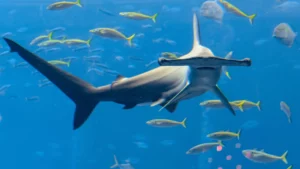 | 2.5–3.5 m (8–12 ft) | Low | Hannibal Bank, Montuosa and Coiba's deep pinnacles; nurseries in the Pearl Islands and Gulf of PanamaSchools in the dry-season current. Critically endangered; Panama's gulfs are among its most important nurseries. |
Whale SharkRhincodon typus | 6–10 m (20–33 ft) | Low | Coiba and the Gulf of Chiriquí, December–April; Pearl Islands in the upwellingA harmless filter feeder drawn by the dry-season plankton. Protected nationally. |
Bull SharkCarcharhinus leucas | 2.2–3.2 m (7–10 ft) | High | River mouths and muddy bays on both coasts; historically through the canal into Gatún LakeThe most likely species behind the harbour and river-mouth cases in the record. Avoid murky water at dusk. |
Tiger SharkGaleocerdo cuvier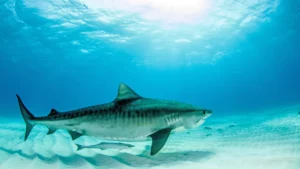 | 3–4.5 m (10–15 ft) | High | Deep reef edges and open water on both coasts; Darién PacificPresent but seldom seen by divers. Landed occasionally by longliners off Piñas and Colón. |
Blacktip SharkCarcharhinus limbatus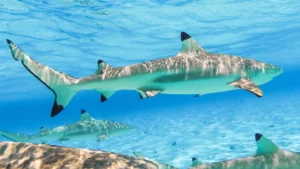 | 1.5–2 m (5–7 ft) | Moderate | Bays and estuaries on both coasts; juveniles in mangrove lagoonsThe black-tipped shark of Panamanian bays; a 1950 bite at the Chagres mouth was attributed to a large one. |
Silky SharkCarcharhinus falciformis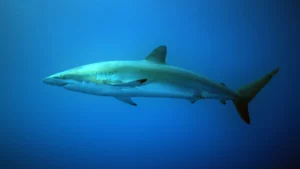 | 2–3 m (7–10 ft) | Moderate | Open water off Coiba, Hannibal Bank and the Darién; the main longline bycatchFollows tuna schools; curious around divers on the seamounts. CITES-listed. |
Galapagos SharkCarcharhinus galapagensis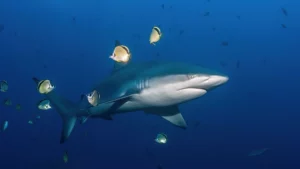 | 2.5–3 m (8–10 ft) | Moderate | Offshore islands and seamounts: Montuosa, Hannibal BankA bold island shark of the eastern Pacific ridge. Approaches divers closely; respect it. |
Pacific Nurse SharkGinglymostoma unami | 2–2.8 m (7–9 ft) | Low | Caves and ledges at Coiba and the Gulf of ChiriquíDescribed as a separate species only in 2015. Docile; the nurse shark divers see on the Pacific coast. |
Nurse SharkGinglymostoma cirratum | 2.2–3 m (7–10 ft) | Low | Caribbean reefs: Bocas del Toro, Portobelo, Guna YalaThe Caribbean nurse shark, on most Bocas dives. A provoked bite in the Pearl Islands in 2003 was the Pacific species. |
Caribbean Reef SharkCarcharhinus perezi | 2–2.5 m (7–8 ft) | Moderate | Outer reefs of Bocas del Toro and Guna YalaThe resident reef predator of the Caribbean coast. Confident but rarely troublesome. |
Lemon SharkNegaprion brevirostris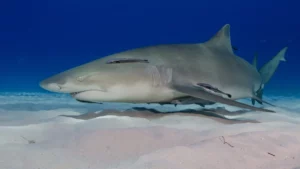 | 2.4–3 m (8–10 ft) | Low | Mangrove channels and sandy lagoons of the Caribbean coastJuveniles use Bocas and Guna Yala mangroves as nurseries. A lemon shark features in a no-injury 1964 record. |
Pacific Sharpnose SharkRhizoprionodon longurio | 0.9–1.1 m (3–3.6 ft) | Low | Gulf of Panama inshore waters; a staple of the artisanal catchA small, harmless schooling shark sold as cazón in Pacific markets. |
| Caribbean Sharpnose SharkRhizoprionodon porosus | 0.8–1.1 m (2.6–3.6 ft) | Low | Shallow Caribbean coast from Bocas to Guna YalaReplaces the Atlantic sharpnose of older lists; common in nets, timid in the water. |
Blacknose SharkCarcharhinus acronotus | 1.2–1.4 m (4–4.6 ft) | Low | Sand and seagrass on the Caribbean coastSmall, shy, and recognised by the dark tip of its snout. |
Bonnethead SharkSphyrna tiburo | 0.9–1.2 m (3–4 ft) | Low | Shallow bays and estuaries on both coastsA shovel-headed miniature hammerhead that eats crabs and seagrass. Completely harmless. |
Scalloped BonnetheadSphyrna corona | 70–90 cm (2.3–3 ft) | Low | Estuaries and mud flats of the Gulf of PanamaThe smallest hammerhead, found only in the eastern Pacific. Endangered and poorly known. |
Great Hammerhead SharkSphyrna mokarran | 3.5–4.5 m (11–15 ft) | Moderate | Deep reef edges and open water on both coasts; uncommonA solitary ray-hunter seen occasionally off Coiba and the Darién. Critically endangered. |
Smooth Hammerhead SharkSphyrna zygaena | 2.5–3.5 m (8–12 ft) | Low | Cooler upwelled water of the Gulf of Panama, dry seasonPrefers cooler water than the scalloped hammerhead; appears in the gulf with the upwelling. |
Shortfin Mako SharkIsurus oxyrinchus | 2–3 m (7–10 ft) | Moderate | Offshore Pacific, on the billfish grounds off Piñas Bay and CoibaHooked by sport-fishing boats; fast and dangerous only when boated. Endangered. |
Blue SharkPrionace glauca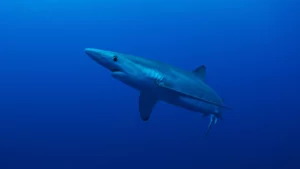 | 2–3 m (7–10 ft) | Low | Deep oceanic water beyond both shelvesA longline bycatch species, never near the beaches. |
Pelagic Thresher SharkAlopias pelagicus | 2.5–3.5 m (8–12 ft) incl. tail | Low | Open Pacific off Coiba and the seamountsThe eastern Pacific thresher, occasionally seen at depth on the Coiba ridge. |
Bigeye Thresher SharkAlopias superciliosus | 3–4 m (10–13 ft) incl. tail | Low | Deep water on both coasts; longline bycatchA deep-living thresher with enormous eyes. Harmless. |
Common Thresher SharkAlopias vulpinus | 3–4.5 m (10–15 ft) incl. tail | Low | Offshore Pacific in the cooler upwelling monthsRecorded occasionally on the Pacific side; stuns fish with its tail. |
| Oceanic Whitetip SharkCarcharhinus longimanus | 2–3 m (7–10 ft) | High | Deep ocean far off both coastsA bold open-water shark, a danger to castaways rather than swimmers. Rare today. |
Spinner SharkCarcharhinus brevipinna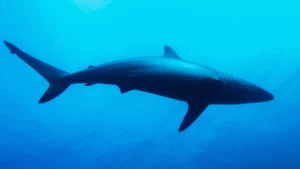 | 2–2.5 m (7–8 ft) | Moderate | Caribbean coast, chasing baitfish in the baysLeaps and spins through schools of sardines. Occasional minor bites to waders elsewhere in its range. |
Sandbar SharkCarcharhinus plumbeus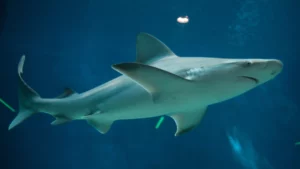 | 1.8–2.4 m (6–8 ft) | Low | Deeper Caribbean shelf water; uncommonA tall-finned bottom shark recorded on the Caribbean side. Placid. |
| Smalltail SharkCarcharhinus porosus | 1–1.3 m (3–4 ft) | Low | Muddy estuaries of the Gulf of PanamaA small, poorly known estuary shark of the eastern Pacific, heavily fished by artisanal nets. |
| Panama Ghost CatsharkApristurus stenseni | 20–25 cm (8–10 in) | Low | Deep slope of the Gulf of Panama, below 900 mA tiny deep-sea catshark known only from the Gulf of Panama. Never seen alive by divers. |
Great White SharkCarcharodon carcharias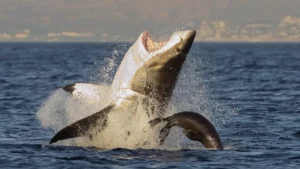 | 4–6 m (13–20 ft) | n/a | Two 1940s records in the database; no modern confirmationWhite sharks cross the eastern tropical Pacific at depth, but none has been confirmed near Panama's coast in modern times. |
The great white shark deserves a careful note. Two records in the database, from 1943 and 1944, were attributed to white sharks at the time, and the 1943 case at Rey Island in the Pearl Islands rested on a tooth fragment recovered from the victim and examined by the American Museum's ichthyologist J.T. Nichols. Satellite tags have since shown that white sharks from Mexico do cross the eastern tropical Pacific, usually deep and far offshore, so a 1940s visitor to the Gulf of Panama is not impossible. There has been no confirmed white shark on either Panamanian coast in modern times, and a large grey shark seen off Panama today is a bull, tiger, silky or Galapagos shark. The finetooth shark of older lists is a Gulf of Mexico and US Atlantic species with no confirmed Panamanian record, and the Atlantic sharpnose shark is replaced here by its Caribbean and Pacific cousins.
Where to see sharks in Panama
Panama has one world-class shark destination, Coiba, and a string of good ones on both coasts. There are no baited shark dives; the animals are resident and the encounters come from currents, cleaning stations and the right season. These are the sites with the most reliable records.
- Coiba National Park, Gulf of ChiriquíThe best shark diving in Central America outside Cocos and Malpelo. Whitetip reef sharks rest in dozens on the sand at sites like Frijoles and Hannibal's Wall, scalloped hammerheads school off the deeper pinnacles, Pacific nurse sharks fill the caves, and whale sharks pass through from December to April. Dive boats run from Santa Catalina.
- Hannibal Bank and Isla MontuosaA seamount rising to 40 m and a lonely island 30 km beyond Coiba, both bathed in current. Hammerhead schools, silky and Galapagos sharks, big tuna and, in season, whale sharks. For experienced divers and the liveaboards that work the ridge.
- The Pearl Islands (Archipiélago de las Perlas)Fifty kilometres into the Gulf of Panama from Panama City. Whale sharks feed around Contadora and the outer islands in the dry-season upwelling, juvenile hammerheads use the bays, and blacktip and bull sharks work the channels. The 1943 white shark record and a 2003 nurse shark bite both come from here.
- Bocas del Toro, Caribbean coastPanama's main Caribbean dive area, inside and around Bastimentos Island National Marine Park. Nurse sharks are on almost every dive at Hospital Point and the Zapatilla Cays, Caribbean reef sharks patrol Tiger Rock, and juvenile lemon sharks cruise the mangrove channels. Bocas is also where both of the country's 2009 entries come from.
- Guna Yala (San Blas), Caribbean coastThree hundred and sixty-five islands on a reef belt run by the Guna people, with nurse sharks, Caribbean reef sharks and lemon sharks on the outer reef. Diving is restricted; snorkelling from the islands is the usual way in. Most of the 1960s incidents in the database happened on this coast, to spearfishers.
- Portobelo National Park and Isla Grande, ColónColonial fort ruins, wrecks and reefs an hour from Panama City. Nurse sharks under the ledges, reef sharks on the outer walls, and the mouth of the Chagres River nearby where a 2.7 m black-tipped shark severed a bather's foot and hand in 1950.
- Bahía Piñas and the Darién PacificThe far south-east, reachable only by boat or small plane. Famous for sport fishing, and the deep water off Piñas and Jaqué produces hammerheads, silkies, makos and tigers for the boats. Two deaths in the database, 1961 and 1962, come from this bay.
- Gatún Lake and the Panama CanalNot a dive site, but a famous one: bull sharks are documented passing through the locks into the freshwater lake, and the database records bites in the canal itself in 1916 and the Canal Zone in 1950 and 1958. Today the locks are a barrier rather than a highway, and sightings in the lake are rare.
If you have one trip, go to Coiba between January and April: the whitetips are guaranteed, the hammerheads are likely on the deeper sites, and the whale sharks are in. For Caribbean sharks, Bocas del Toro is the easy choice, with nurse sharks on most dives and reef sharks at the outer sites. The Pearl Islands are the whale shark option closest to Panama City.
Best time of year to see sharks in Panama
Panama has a dry season and a wet season, and the Pacific upwelling turns the dry season into shark season on that coast.
- December to April, the dry season: trade winds drive the upwelling in the Gulf of Panama, cooling the water to 20–24 °C and filling it with baitfish. This is the peak for hammerheads, whale sharks and blacktips in the gulf and the Pearl Islands, and the season for whale sharks at Coiba, where the Gulf of Chiriquí stays warmer (26–28 °C) and clearer. Visibility at Coiba is best from December to March.
- May to November, the wet season: the upwelling stops, the Pacific warms back to 27–29 °C, and river run-off clouds the inshore water. Coiba diving continues year-round but visibility drops; hammerhead sightings thin out. Humpback whales arrive from July to October, and the reef sharks at Coiba are present in every month.
- The Caribbean coast: water is 27–29 °C all year, and the sharks do not move. The best visibility at Bocas del Toro and Portobelo is in the drier windows of February to April and September to October; the wettest months, November to January, bring swell and murk to the Bocas beaches.
The upwelling is the reason Panama's Pacific gulf can feel cold to a tropical diver in February, and it is also why the gulf's shark fauna is richer than a glance at the map would suggest.
Shark attacks in Panama: what the record actually shows
Panama has one of the longest incident lists in Central America, and it needs context. SharkSider keeps every case on the shark attacks in Panama page. The database holds 32 records from 1748 to 2009, 18 of them fatal. Twenty-eight of those are dated from 1900 onward, with 14 deaths; the other four are older, all fatal, and include pearl divers at Taboga and Isla del Rey in 1748, a man coming ashore on a hawser at Aspinwall (now Colón) in 1864, an undated 1880s death in Panama Bay and a capsized sailboat at Bocas del Toro in 1895. These are the six most recent dated records (the full list, updated weekly, is on the attacks page):
- 2009 · Playa La Cabaña, BocasWading — Arm & torso bittenSpecies not identified · not fatal
- 2009 · Red Frog Beach, Bocas del Toro ProvinceSwimming/ — FatalSpecies not identified · fatal
- 2008 · Playa Teta, San CarlosSwimming or surfing — 5 lacerations to left footSpecies: 3' shark · not fatal
- 2003 · Pearl IslandsSpearfishing — Left forearm bitten provoked incidentSpecies: Nurse shark, 60 cm to 90 cm [2' to 3'] · not fatal
- 1965 · Golfo de los Mosquitos, Caribbean SeaArgentine Air Force C-54 — 2 life preservers had been bitten by sharksSpecies: Shark involvement not confirmed · not fatal
- 1964 · Caribbean CoastStanding — No injurySpecies: Lemon shark · not fatal
Three patterns explain almost the whole list. The first is the canal and the military. From 1910 to 1944 the record is full of sailors and servicemen: a man who fell overboard from the cruiser Tacoma at Cristóbal in 1910, a swimmer from the Medic at Colón in 1917, a bite inside the canal in 1916, a drunken sailor who fell off a deck at the Pacific anchorage in 1924, a US Navy man who dived overboard to check a torpedo boat's propeller at Rey Island in 1943 and a serviceman washed overboard in the Caribbean in 1944. Colón's Limón Bay and the Panama City beaches, Bella Vista and Taboga, were busy, murky harbour waters at the time, and the 1928 Taboga case, a swimmer named Moreno whose leg and swimsuit were found in a 2.7 m carcharhinid shark caught two hours later, is one of the best-documented shark deaths in the region.
The second pattern is the Guna coast and the Darién in the early 1960s: a spearfisher lacerated off Diablo Island in 1960, a man pulled from his canoe by a hooked shark at Jaqué in 1961, a person sitting in the shallows at Piñas Bay in 1962, a bait fisherman standing in chest-deep water near Mulatupu in 1963, and two spearfishers at Achutupu in 1964, one killed. These are subsistence fishermen in fish-rich water with speared or netted fish around them, the highest-risk activity there is. The third pattern is the modern one, and it is thin: a provoked nurse shark bite to a spearfisher in the Pearl Islands in 2003, a surfer with lacerations to the foot from a small shark at Playa Teta in 2008, a wader bitten on the arm and torso at Playa La Cabaña in Bocas in 2009, and one undated death at Red Frog Beach in Bocas del Toro recorded as before October 2009. Set against millions of visitor-days at Coiba, Bocas and the Pearl Islands since the 1990s, that is a very small number. The usual rules would have prevented most of the historical cases: stay out of murky harbour water, do not swim at dusk near fish landings or with speared fish, and never grab a shark.
Is it safe to swim and snorkel in Panama?
At the beaches and reefs people actually use, yes. Coiba's whitetip reef sharks are among the most placid sharks in the world: they lie on the sand in groups, let divers approach to arm's length and swim off slowly when bothered. Pacific nurse sharks in the caves and Caribbean nurse sharks at Bocas are the same, provided nobody pulls a tail. Scalloped hammerheads at Hannibal Bank are shy of bubbles and hard to get close to; freedivers get the best views. Whale sharks at Coiba and the Pearl Islands are harmless, and the Panamanian rules ask for a 3 m distance from the body, no touching and no flash, which is worth following because the animals leave if harassed.
The places to be careful are the ones the record points at. The Gulf of Panama's inshore water is muddy, warm in the wet season and full of baitfish and bull sharks, and the beaches near Panama City and the river mouths of the Chagres, the Bayano and the Darién rivers are not places to swim at dusk or after rain. On the Caribbean side, the harbour at Colón and the murkier bays of Bocas del Toro during the wet season deserve the same respect; the two 2009 entries and the 2008 surfer case all come from beaches rather than reefs. Spearfishing on any Panamanian reef means keeping the catch on a float line, not on your belt, and getting out when a shark begins circling.
Bigger dangers than sharks are everywhere here: rip currents on the Pacific surf beaches from Santa Catalina to Playa Venao, strong currents on the Coiba seamounts, saltwater crocodiles in the estuaries and mangroves of both coasts, and the box jellyfish that appear on the Pacific side in the wet season. Panamanian lifeguards flag rips and jellyfish; no beach in the country has ever needed a shark closure.
Shark conservation in Panama
Panama has moved from being a shark-fishing and fin-exporting country to one of the region's leaders in shark protection, and the change has been fast. Law 9 of 2006 banned finning and required sharks to be landed with fins attached. Coiba became a national park in 1991 and a UNESCO World Heritage Site in 2005, and in 2021 the government created the Cordillera de Coiba marine protected area over the seamounts beyond it, expanding it again in 2023 so that more than half of Panama's exclusive economic zone, about 54%, is now under some form of protection, one of the highest proportions of any country. Panama is also part of the Eastern Tropical Pacific Marine Corridor with Costa Rica, Colombia and Ecuador, which aims to protect the hammerhead and whale shark migration route between Coiba, Cocos, Malpelo and the Galápagos.
The country's biggest contribution came in November 2022, when Panama City hosted the CITES conference at which the Panamanian proposal to list the entire requiem shark family, more than 50 species including the silky, blacktip, bull, tiger and reef sharks, on Appendix II was adopted, alongside the remaining hammerheads. That decision brought the majority of the world's traded shark fins under international export controls for the first time. Whale sharks and hammerheads have national protection in Panamanian waters, and scalloped hammerheads are listed as critically endangered by the IUCN, with the Pearl Islands and the Gulf of Chiriquí identified as nursery grounds.
The gaps are on the water. Artisanal and industrial longliners in the Gulf of Panama and the Gulf of Chiriquí still land silky sharks, hammerheads and threshers, juvenile hammerheads are caught in gillnets in the Gulf of Panama nurseries, and the scalloped bonnethead, a small Pacific hammerhead found in the gulf's estuaries, is endangered and barely studied. Coiba's protection depends on patrols against illegal fishing that have been underfunded for years. Mangrove loss around Panama City and in Chiriquí removes the nurseries that lemon, blacktip and hammerhead pups depend on. If you dive here, choose operators inside the park system, report hammerhead and whale shark sightings to the local monitoring projects, and do not buy shark meat, sold as cazón, in the markets. For the biology behind those declines, see why sharks are endangered.
Sharks in neighbouring waters
Panama's sharks belong to two regional systems. On the Pacific side, Costa Rica's Cocos Island and Colombia's Malpelo are the other two points of the hammerhead triangle that Coiba completes, and Ecuador's Galápagos closes the corridor to the south. On the Caribbean side, Nicaragua and Honduras share the same reef sharks, nurse sharks and whale shark passages along the Central American coast, and Jamaica across the sea shows what the same fauna looks like on an island. Our sharks around the world page lists every coast we have covered.
Frequently asked questions
Are there sharks in Panama?
Yes, on both coasts. Twenty-nine species have reliable records. On the Pacific side, Coiba National Park has whitetip reef sharks on every dive, plus hammerheads, Pacific nurse sharks and seasonal whale sharks, while the Gulf of Panama holds bull, blacktip and silky sharks. The Caribbean coast at Bocas del Toro, Portobelo and Guna Yala has nurse, Caribbean reef and lemon sharks.
Have there been shark attacks in Panama?
Yes. The SharkSider database holds 32 records from 1748 to 2009, 18 fatal, with 28 of them since 1900 and 14 deaths in that period. Almost all the deaths date from the canal and wartime decades, 1910 to 1964. Since 1965 there are only a 1965 air crash with bitten life preservers, three injuries between 2003 and 2009, the last at Bocas del Toro, and one undated death at Red Frog Beach.
Are there whale sharks in Panama?
Yes. Whale sharks visit Coiba National Park and the Gulf of Chiriquí from about December to April, and the Pearl Islands and Gulf of Panama during the dry-season upwelling. Dive and snorkel boats from Santa Catalina and Contadora run encounters under national rules: keep 3 m from the animal, no touching, no flash photography.
Is it safe to swim in Panama?
At the resort beaches and dive sites, yes. The places the record warns about are murky harbour and river-mouth water, especially around Colón and the Gulf of Panama near Panama City, at dusk or after rain, where bull sharks feed. Rip currents on the Pacific surf beaches and crocodiles in the mangroves are bigger everyday risks than sharks.
Are there great white sharks in Panama?
Not in modern times. Two database records from 1943 and 1944 were attributed to white sharks, one on a tooth fragment examined by an American Museum ichthyologist, and tagged white sharks from Mexico are known to cross the eastern tropical Pacific at depth. No white shark has been confirmed off either Panamanian coast in recent decades.
Are there bull sharks in the Panama Canal?
Historically, yes. Bull sharks tolerate fresh water and were documented passing through the locks into Gatún Lake, and the database records bites in the canal in 1916 and in the Canal Zone in 1950 and 1958. Today the locks act as a barrier and sightings in the lake are rare, but bull sharks remain common in the muddy bays at both ends of the canal.
Where is the best shark diving in Panama?
Coiba National Park in the Gulf of Chiriquí, reached from Santa Catalina. Whitetip reef sharks are guaranteed, scalloped hammerheads school on the deeper pinnacles and at Hannibal Bank, and whale sharks pass through in the dry season. On the Caribbean coast, Bocas del Toro is the easy option, with nurse sharks on most dives and reef sharks at Tiger Rock.
When is the best time to see sharks in Panama?
December to April on the Pacific side, when the dry-season upwelling cools the Gulf of Panama, brings in hammerheads and whale sharks, and gives Coiba its clearest water. The Caribbean coast is warm all year; the best visibility at Bocas del Toro and Portobelo is in February to April and September to October.
Are there hammerhead sharks in Panama?
Yes, four kinds. Scalloped hammerheads school at Hannibal Bank, Montuosa and Coiba's deep sites and use the Pearl Islands and Gulf of Panama as nurseries; smooth hammerheads appear in the cooler upwelling; great hammerheads are rare visitors on both coasts; and the tiny scalloped bonnethead lives in the gulf's estuaries. Scalloped and great hammerheads are critically endangered.
Is shark fishing legal in Panama?
Fishing is allowed but finning has been banned since 2006 and sharks must be landed with fins attached. Coiba and the Cordillera de Coiba reserve are no-take zones, and by 2023 more than half of Panama's ocean was under protection. Panama hosted the 2022 CITES meeting that placed all requiem sharks and hammerheads under trade controls. Whale sharks and hammerheads have national protection.
References
- International Shark Attack File: Yearly Worldwide Shark Attack Summary (Florida Museum of Natural History, University of Florida)
- Coiba National Park and its Special Zone of Marine Protection, UNESCO World Heritage List
- Scalloped hammerhead shark, NOAA Fisheries species directory
- Rhincodon typus (whale shark), Convention on the Conservation of Migratory Species of Wild Animals

A small team focused on researching sharks and making marine biology easy to understand. Every page is reviewed against current species records and the SharkSider attack database, and updated when new incidents or research appear.
Published December 30, 2022 · Last updated September 21, 2026 · Incident data from the SharkSider attack database (28 records for Panama, 14 fatal).


