
Yes, Pakistan has sharks, and a surprising variety of them. Twenty-seven species have a dependable record in its waters. The ones landed most often at Karachi are the milk shark, the spot-tail shark, the grey sharpnose shark, the blacktip shark and the scalloped hammerhead, while divers at Charna Island meet blacktip reef sharks and the tuna fleet regularly encounters whale sharks offshore.
The safety picture is as simple as it gets: the SharkSider database has no recorded shark attack in Pakistan, fatal or otherwise. Bull and tiger sharks live here, but very few people swim beyond the surf, the inshore water is too turbid for sharks to mistake a person for prey, and the species that fishermen handle daily are small. The realistic risk to a swimmer at Clifton or Hawke's Bay is the rip current, not the shark.
- Shark species recorded27 confirmed
- Protection statusWhale shark protected; June–July fishing ban
- Most common inshoreMilk shark (Karachi landings)
- Signature encounterBlacktip reef sharks at Charna Island
- Incidents in the databaseNone recorded
- Water temperature22–30 °C (coolest January–February)

On this page
- Where sharks live along the Pakistani coast
- List of the different types of sharks in Pakistan
- Where to see sharks in Pakistan
- Best time of year to see sharks in Pakistan
- Shark attacks in Pakistan: what the record actually shows
- Is it safe to swim and snorkel in Pakistan?
- Shark conservation in Pakistan
- Sharks in neighbouring waters
- Frequently asked questions
- References
Where sharks live along the Pakistani coast
Pakistan's coast is really two coasts. The Sindh shore in the east is soft and brown: the Indus, before barrages took most of its water, built a delta of mangrove creeks and mudflats that stretches from Karachi to the Indian border, and the sea off it is shallow, warm and cloudy with silt. This is nursery country. Milk sharks, spot-tail sharks, winghead sharks and young bull sharks grow up in the creeks around Keti Bandar and Kharo Chan, and the Indus itself was once known for bull sharks far upstream, before the river's flow was cut. The Balochistan shore in the west is the opposite: the Makran coast is a desert of cliffs, headlands and bays with clearer water, rocky reefs at Ormara, Pasni and Gwadar, and Astola Island, the country's only offshore island, sitting 25 kilometres out in the Arabian Sea.
Offshore, the continental shelf drops into the deep Arabian Sea, one of the most productive stretches of ocean in the world. The south-west monsoon from June to September stirs up nutrients that fuel dense blooms of plankton and the sardine, anchovy and tuna shoals that feed on them. Pakistan's big tuna gillnet fleet works this water from Karachi and Gwadar, and it is on those nets that most of the country's pelagic sharks are seen: silky sharks, oceanic whitetips, threshers, makos and, several times a year, a whale shark that the crew now cut free rather than land.
Protection is a patchwork. Fishing is a provincial matter in Pakistan, and both Sindh and Balochistan now list the whale shark as protected and close their waters to fishing during the June and July breeding season. Astola Island became the country's first marine protected area in 2017. There is no national shark sanctuary and no species-by-species protection for the hammerheads and other sharks that still arrive at Karachi Fish Harbour every morning.
List of the different types of sharks in Pakistan
Pakistani fisheries scientists have logged well over fifty shark species from landings, but many are single deep-water specimens or animals caught far offshore. The table below sticks to the species with repeated, reliable records along the coast and on the shelf, with realistic adult sizes and a risk rating that applies to swimmers, not to the fishermen who handle these animals by the thousand. Several of the smallest sharks, the milk shark and grey sharpnose shark in particular, are the ones you will actually see if you visit a fish market, because they make up the bulk of the catch.
| Species | Adult size | Risk to swimmers | Where in Pakistan & notes |
|---|---|---|---|
Milk SharkRhizoprionodon acutus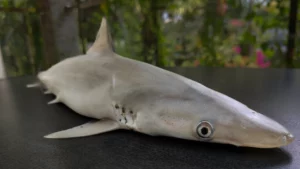 | 0.9–1.1 m (3–3.5 ft) | Low | Inshore along the entire coast; the most landed shark at KarachiSmall, fast and harmless. Its dried meat is a staple of the Sindh fish trade. |
Grey Sharpnose SharkRhizoprionodon oligolinx | 0.6–0.8 m (2–2.5 ft) | Low | Shallow muddy water off Sindh and the delta creeksEven smaller than the milk shark and often mixed with it in the catch. |
| Spot-tail SharkCarcharhinus sorrah | 1.2–1.6 m (4–5 ft) | Low | Shelf waters off both provincesBlack-tipped tail lobe; one of the main commercial sharks of the Arabian Sea. |
Blacktip SharkCarcharhinus limbatus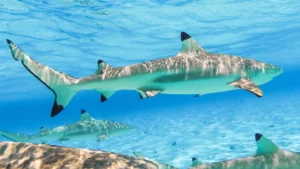 | 1.5–2.5 m (5–8 ft) | Moderate | Surf zone and shelf, Cape Monze to OrmaraSchooling hunter of sardines. Not the same animal as the blacktip reef shark below. |
Spinner SharkCarcharhinus brevipinna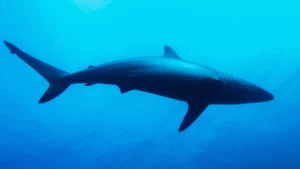 | 2–2.5 m (7–8 ft) | Moderate | Inshore during baitfish runs before and after the monsoonSpins clear of the water when feeding. A common Karachi landing. |
Blacktip Reef SharkCarcharhinus melanopterus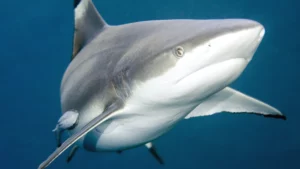 | 1.2–1.6 m (4–5 ft) | Low | Charna Island and Astola Island shallowsThe shark Pakistani divers actually see. Shy; a snorkeller who keeps still will watch it pass. |
Whitetip Reef SharkTriaenodon obesus | 1.2–1.6 m (4–5 ft) | Low | Ledges at Charna and Astola; uncommonRests under rocks by day. Records here are occasional rather than routine. |
Bull SharkCarcharhinus leucas | 2.2–3.2 m (7–11 ft) | High | Indus Delta creeks, river mouths, Karachi harbour channelsTolerates fresh water and once ranged up the Indus. Juveniles grow up in the mangroves. |
Tiger SharkGaleocerdo cuvier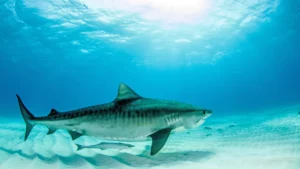 | 3–4.5 m (10–15 ft) | High | Shelf edge and around Astola; landed occasionally at KarachiThe largest predatory shark in Pakistani waters. Rarely near beaches. |
Sicklefin Lemon SharkNegaprion acutidens | 2.5–3 m (8–10 ft) | Low | Mangrove creeks and sandy shallows of the deltaThe Indo-Pacific lemon shark, much reduced by creek fishing. Docile. |
Scalloped Hammerhead SharkSphyrna lewini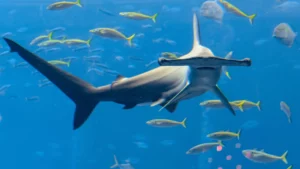 | 2.5–3.5 m (8–12 ft) | Low | Shelf edge in winter; juveniles inshore off SindhStill the most landed large shark at Karachi despite being critically endangered worldwide. |
Great Hammerhead SharkSphyrna mokarran | 3.5–4.5 m (11–15 ft) | Moderate | Deeper reefs off the Makran coastSolitary and now rare. Almost no record of biting people anywhere. |
Smooth Hammerhead SharkSphyrna zygaena | 2.5–4 m (8–13 ft) | Low | Cooler offshore water in winterThe hammerhead of temperate seas, at the warm edge of its range here. |
Winghead SharkEusphyra blochii | 1.2–1.6 m (4–5 ft) | Low | Muddy shallows and creeks of the Indus DeltaA small hammerhead with a head almost half its body length. Endangered; harmless. |
Sandbar SharkCarcharhinus plumbeus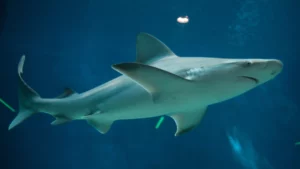 | 1.8–2.4 m (6–8 ft) | Low | Sandy bottoms on the shelf off both provincesHigh-finned and heavily fished; slow to mature. |
Dusky SharkCarcharhinus obscurus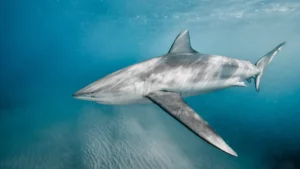 | 3–3.6 m (10–12 ft) | Moderate | Shelf edge, following sardine shoalsLong-lived and endangered; caught on longlines offshore. |
Silky SharkCarcharhinus falciformis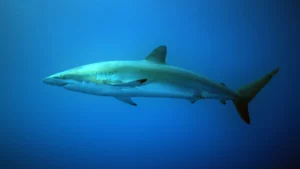 | 2–3 m (7–10 ft) | Moderate | Open water with the tuna shoalsThe most common shark in the tuna gillnet bycatch. |
| Oceanic Whitetip SharkCarcharhinus longimanus | 2–3 m (7–10 ft) | High | Deep Arabian Sea beyond the shelfBold around boats and anything floating. A danger to people adrift, never met from a beach. |
Shortfin Mako SharkIsurus oxyrinchus | 2.5–3.5 m (8–11 ft) | Moderate | Offshore, mainly in the cooler winter monthsFast pelagic hunter caught on tuna gear. Endangered. |
Longfin Mako SharkIsurus paucus | 2.5–3.5 m (8–11 ft) | Low | Deep offshore water; rare in the catchSlower, deeper-living cousin of the shortfin. No record of bites on people. |
Blue SharkPrionace glauca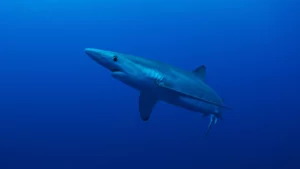 | 2–3 m (7–10 ft) | Low | Open ocean far beyond the shelfSlender oceanic wanderer; a longline bycatch, never seen inshore. |
Pelagic Thresher SharkAlopias pelagicus | 2.5–3.5 m (8–12 ft) incl. tail | Low | Shelf edge and open waterWhip-tailed and harmless; landed regularly at Karachi. |
Bigeye Thresher SharkAlopias superciliosus | 3–4 m (10–13 ft) incl. tail | Low | Deep water offshore, near the surface at nightEnormous eyes for hunting in the dark. Vulnerable to longlines. |
Whale SharkRhincodon typus | 5–10 m (16–33 ft) | Low | Shelf edge off Karachi and Gwadar, seen from tuna boatsProtected in both provinces. Crews now release them from gillnets alive. |
Bigeye HoundsharkIago omanensis | 0.4–0.6 m (1.5–2 ft) | Low | Deep, low-oxygen water on the outer shelfA tiny deep-water shark that turns up in trawl bycatch in large numbers. |
| Arabian CarpetsharkChiloscyllium arabicum | 0.6–0.8 m (2–2.5 ft) | Low | Rocky and coral bottoms off the Makran coastA small bottom-dwelling bamboo shark of the Gulf and Arabian Sea. Completely harmless. |
Snaggletooth SharkHemipristis elongata | 1.8–2.3 m (6–7.5 ft) | Low | Inshore shelf waters off SindhPrized for its fins; now uncommon. Not known to bite people. |
Great White SharkCarcharodon carcharias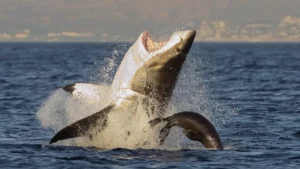 | 4–6 m (13–20 ft) | n/a | Not confirmed in PakistanIncluded because it is asked about. No verified specimen or sighting; the Arabian Sea is too warm for most of the year. |
The great white shark is the species people most often ask about, and it is not here. Older pages, including our own, suggested it might wander in as a migrant, but there is no verified specimen, photograph or landing from Pakistan, and the Arabian Sea's summer temperatures of 28–30 °C are well outside the animal's comfort zone. We list it as unconfirmed. The bigeye houndshark, which appeared in older lists at a nonsensical “1.2 feet”, is a real and common Pakistani species that reaches around 60 centimetres in the deep water off the shelf. The three species that were rated “highly aggressive” on the old page, the longfin mako, the silky shark and the great hammerhead, have almost no history of biting people anywhere and are rated here on what they actually do.
Where to see sharks in Pakistan
Diving in Pakistan barely exists as an industry, which makes the handful of real sites all the more worth knowing. Most operate out of Karachi between October and April, and most shark sightings are of small reef species. For the big pelagics, the honest answer is the fish harbour at dawn.
- Charna Island (Churna), off Mubarak VillagePakistan's one established dive site, a rocky islet 40 kilometres west of Karachi with coral-covered boulders down to 25 metres. Blacktip reef sharks patrol the shallows on the calm days of winter, and divers occasionally record small whitetip reef sharks under the ledges. Also the country's best snorkelling.
- Astola Island, BalochistanA seven-kilometre desert island 25 kilometres off Pasni, declared the country's first marine protected area in 2017. Its reefs hold blacktip reef sharks, and the drop-offs around it attract hammerheads and the odd tiger shark. Access is by fishing boat from Pasni in calm weather only.
- Karachi Fish HarbourNot a dive site, but the single best place in Pakistan to see the range of sharks the sea holds: milk sharks, hammerheads, blacktips, threshers and makos are landed daily in the winter season. Go at first light, when the boats come in.
- Indus Delta creeks (Keti Bandar and Kharo Chan)The mangrove nursery of Sindh. Juvenile bull sharks, milk sharks and winghead sharks are caught here by creek fishermen, and boat trips through the channels are the way to see the habitat if not the animals.
- Cape Monze (Ras Muari)A rocky headland west of Karachi where the water clears and the shelf drops away. Fishermen working the point report blacktips, spinner sharks and, in the cooler months, scalloped hammerheads.
- Gwadar and Jiwani, Makran coastThe far west, near the Iranian border, where the deep water comes closest to shore. Whale sharks are sighted from tuna boats off Gwadar's hammerhead-shaped peninsula, and the coast towards Jiwani has rocky reefs with reef sharks.
- Ormara and Kund MalirQuiet beaches and headlands on the central Makran coast with clearer water than Sindh. Small blacktips work the surf line, and the deeper reefs off Ormara head are fished for hammerheads.
If a shark encounter is the whole point of the trip, the neighbouring Sultanate of Oman offers the same Arabian Sea species with a functioning dive industry, and the Maldives and Sri Lanka are a short flight away. Within Pakistan, Charna in the winter months is the only place you can plan a shark sighting with any confidence.
Best time of year to see sharks in Pakistan
The Arabian Sea has a hard on-off switch: the south-west monsoon.
- October to April: the season for everything. Calm seas, visibility at Charna of 10–15 metres on the best days, water between 22 °C in January and 27 °C by April. The tuna fleet is out, the fish harbour is busy, and this is when hammerheads are landed in numbers and when the reef sharks are most reliable at Charna and Astola. December to February is the coolest and clearest window.
- June to September: the monsoon. Onshore winds, big swell and a sea that turns brown along the whole Sindh coast. Both provinces ban fishing in June and July, diving stops, and the beaches at Karachi are officially closed to swimming most years because of the currents. The sharks are still there and offshore the upwelling is at its richest, but nobody is out to see them.
- May and late September: transition months with hot water of 29–30 °C. Fishermen report whale sharks and spinner sharks close to shore as the baitfish move.
For whale sharks specifically there is no set season; sightings from the gillnet fleet are scattered through the year, with a slight peak in the months before and after the monsoon when the boats are working the shelf edge.
Shark attacks in Pakistan: what the record actually shows
Here the record is blank, and that is the story. The SharkSider database, compiled from the International Shark Attack File and from press reports around the world, contains no shark attack of any kind in Pakistani waters, fatal or non-fatal, provoked or unprovoked. For a country with bull sharks in its delta, tiger sharks on its shelf and thirty million people living within reach of the coast, that deserves an explanation rather than a shrug.
No incidents are recorded in the SharkSider database for this country.
Part of the answer is exposure. Pakistan has almost no swimming culture beyond the surf line: Karachi's beaches at Clifton, Hawke's Bay and Sandspit are places for wading and camel rides, not for long swims, and the sea off them is so silty that a shark would struggle to see a person at arm's length. Recreational diving amounts to a few hundred dives a year at one island. Surfing and spearfishing, which account for many bites in other countries, barely exist. The bull sharks of the Indus Delta live among fishermen who work from boats, not among bathers.
The other part is that the species people actually meet are small. The milk shark, the grey sharpnose and the spot-tail shark, which between them make up most of the inshore catch, are a metre long or less and physically incapable of causing a serious wound. The big, potentially dangerous species, tiger sharks, oceanic whitetips and hammerheads, are caught on the shelf edge by the tuna and gillnet fleet, and the handful of injuries that do happen in Pakistan are to fishermen bitten while unhooking a live shark, the kind of provoked wound that rarely reaches an international database. If you are one of the few who swim or dive here, the standard precautions are more than enough: stay out of the creeks and river mouths at dawn and dusk, keep away from fishing activity and never swim where the fleet cleans its catch.
Is it safe to swim and snorkel in Pakistan?
From the sharks, yes. The animals a snorkeller at Charna or Astola will see, blacktip reef sharks and the occasional whitetip reef shark, are timid and will keep their distance. Nothing larger patrols the shallows of either island by day. The one species to keep in mind is the bull shark, which lives in exactly the kind of water swimmers should avoid anyway: the turbid creeks of the delta, the mouths of the Hub and Indus rivers, and the harbour channels of Karachi, where fish waste goes into the sea. Bull sharks hunt by smell and pressure in water they cannot see through, and they are most active at dawn and dusk. Stay out of those places at those times and the risk falls close to zero.
Whale sharks are met almost entirely by fishermen, but if a boat trip from Gwadar or Karachi finds one at the surface, the rules are the ones that apply everywhere: the animal is harmless, keep three metres from its body and further from the tail, never touch, and let it set the pace. Pakistani crews have released dozens of whale sharks from their nets since a national observer programme began, and the animals are increasingly seen alive rather than hauled onto the quay.
The real hazards on this coast are physical. Rip currents at Karachi's beaches kill swimmers every summer, and the monsoon swell is dangerous even for strong swimmers; the beaches are closed for good reason. Jellyfish and stingrays in the shallows cause far more injuries here than any shark ever has.
Shark conservation in Pakistan
Pakistan's shark catch peaked in the 1980s and 1990s, when tens of thousands of tonnes a year were landed for dried meat and for fins exported through Karachi to East Asia. It has since collapsed. Landings are a fraction of what they were, the average shark on the quay is smaller and younger, and the largest hammerheads and sawfish that were once routine have all but vanished from the delta. Fisheries scientists put the decline in shark abundance at well over three quarters, and the old page on this site quoted the same figure. The cause is not mysterious: unregulated gillnetting, no size limits, no catch limits, and a fin market that paid more for a hammerhead's fins than for the rest of the animal.
The response has come slowly and mostly from the provinces. Sindh and Balochistan both protect the whale shark and observe a two-month fishing closure in June and July that covers the peak breeding season for many coastal sharks. Pakistan is a party to CITES, so exporting hammerheads, threshers, makos, silky and oceanic whitetip sharks now requires a permit showing the trade is sustainable, and the country has drafted a national plan of action for sharks under FAO guidelines. Astola Island's protected area, declared in 2017, gives the Balochistan reefs a refuge on paper, though enforcement out there is thin. The most effective single measure has been the crew-based observer programme on the tuna gillnet fleet, run with WWF-Pakistan, which trains fishermen to record and release whale sharks, mobula rays, turtles and dolphins alive; it has freed well over a hundred whale sharks since 2012.
What is still missing is a size limit for the species that dominate the catch, protection for the critically endangered scalloped and great hammerheads, and any monitoring at all of the creek nurseries in the delta, where the next generation of bull sharks, winghead sharks and lemon sharks is caught before it can breed. Our guide on why sharks are endangered explains why animals that mature at seven or ten years cannot recover under that kind of pressure.
Sharks in neighbouring waters
The Arabian Sea does not respect borders, and the same monsoon-driven system runs from Pakistan west along the Makran into Iran and across the Gulf of Oman to Oman, where the same species can be dived with proper infrastructure. To the east, India's Gujarat coast shares the Indus Delta's nursery species and its whale sharks, and Sri Lanka and the Maldives hold the clear-water reef sharks that Pakistan's silty shore lacks. Inside the Persian Gulf, Qatar has the whale shark gathering at the Al Shaheen oil field. Every country on the site is listed on our sharks around the world page.
Frequently asked questions
Are there sharks in Pakistan?
Yes. Twenty-seven species have a reliable record in Pakistani waters, from small inshore milk sharks and grey sharpnose sharks to hammerheads, tiger sharks and whale sharks on the shelf. Bull sharks live in the Indus Delta creeks, and blacktip reef sharks are seen by divers at Charna and Astola islands.
Have there been shark attacks in Pakistan?
None are recorded. The SharkSider database, built from the International Shark Attack File and press reports, has no Pakistani incident of any kind. Few people swim beyond the surf, the inshore water is too silty for sharks to target a person, and the species fishermen handle daily are mostly under a metre long.
Do great white sharks live in the waters around Pakistan?
No verified record exists. An older version of this page suggested the great white might pass through as a migrant, but there is no specimen, photograph or landing from Pakistan, and the Arabian Sea at 28–30 °C in summer is too warm for the species. We list it as unconfirmed.
Can you go diving with sharks in Pakistan?
Yes, on a small scale. Charna Island, 40 kilometres west of Karachi, is the country's established dive site and blacktip reef sharks are seen there in the calm winter months. Astola Island off the Balochistan coast has reef sharks too but needs a fishing boat from Pasni. Operators run from Karachi between October and April.
Are there whale sharks in Pakistan?
Yes. Whale sharks are met on the shelf edge off Karachi and Gwadar, mostly by the tuna gillnet fleet, throughout the year. They are protected in Sindh and Balochistan, and an observer programme run with WWF-Pakistan has trained crews to cut them free alive, releasing well over a hundred since 2012.
Is it safe to swim at Karachi's beaches?
Sharks are not the issue. The real hazards at Clifton, Hawke's Bay and Sandspit are rip currents and monsoon swell, which kill swimmers every summer and lead to official beach closures. Avoid the creeks, river mouths and harbour channels at dawn and dusk where bull sharks hunt, and stay away from fishing boats cleaning their catch.
What is the most common shark in Pakistan?
The milk shark, a harmless species about a metre long that dominates the inshore catch landed at Karachi Fish Harbour, followed by the grey sharpnose shark and the spot-tail shark. Among large sharks the scalloped hammerhead is still the most frequently landed, despite being critically endangered worldwide.
Are there bull sharks in the Indus River?
Bull sharks live in the Indus Delta creeks and river mouths, where the young grow up in the mangroves. Historically they were reported well upstream, but barrages have cut the river's flow to the sea so drastically that adult bull sharks are now mostly confined to the brackish delta and the coast.
Is shark fishing legal in Pakistan?
Yes, with limits. Sindh and Balochistan protect the whale shark and close their waters to fishing every June and July. Pakistan is a CITES party, so exporting hammerhead, thresher, mako, silky and oceanic whitetip products requires permits. There is no national shark sanctuary and no size or catch limit for the species that dominate landings.
When is the best time to see sharks in Pakistan?
October to April, when the monsoon is over, the sea is calm and Charna Island is diveable; December to February is clearest. Fish landings peak in the same window, so the harbour shows the widest range of species. From June to September the monsoon closes beaches and fishing, and diving stops entirely.
References

A small team focused on researching sharks and making marine biology easy to understand. Every page is reviewed against current species records and the SharkSider attack database, and updated when new incidents or research appear.
Published January 16, 2023 · Last updated September 21, 2026 · Incident data from the SharkSider attack database (0 records for Pakistan, 0 fatal).


