
Yes, Jamaica has sharks: 16 species with solid records, though few of them near the resort beaches. The nurse shark is the one snorkellers and divers see at Negril, Montego Bay and Ocho Rios. Caribbean reef sharks, blacktips and lemon sharks survive on the offshore banks and in the mangrove bays of the south, and tiger sharks and bull sharks patrol Kingston Harbour, the Pedro Bank and the deep water off the south coast.
The safety picture depends entirely on what you are doing. The SharkSider database holds 32 records for Jamaica going back to 1753, 24 of them since 1900 with 10 deaths; since 1990 there have been 8 cases and 3 deaths, all of the deaths spearfishers. No tourist swimmer has been seriously hurt in living memory, and the one beach case, at Rose Hall in 2025, was a paddler nipped on the fingers by a metre-long shark.
- Shark species recorded16 confirmed
- Protection statusNo shark-specific law; marine parks and fish sanctuaries since 1992
- Most seen by snorkellersNurse shark
- Signature encounterNurse sharks on the Negril and Montego Bay reefs
- Incidents in the database32 (1753–2025), 14 fatal; 24 since 1900, 10 fatal
- Water temperature26–27 °C in winter, 28–29 °C in late summer

On this page
- Where Jamaica's sharks live, and why the reefs have so few
- List of the different types of sharks in Jamaica
- Where to see sharks in Jamaica
- Best time of year to see sharks in Jamaica
- Shark attacks in Jamaica: what the record actually shows
- Is it safe to swim and snorkel in Jamaica?
- Shark conservation in Jamaica
- Sharks in neighbouring waters
- Frequently asked questions
- References
Where Jamaica's sharks live, and why the reefs have so few
Jamaica has two very different coasts. The north shore, where Negril, Montego Bay, Ocho Rios and Port Antonio sit, has a narrow shelf: fringing reef, a short sandy terrace, then a wall dropping into the deep Cayman Trench. The south coast is the opposite, a broad, shallow shelf of seagrass, mangrove and mud that runs out through Portland Bight and the Port Royal cays to the Pedro Bank, a submerged limestone plateau 80 km offshore that covers some 8,000 square kilometres, roughly three-quarters the size of the island itself. Pedro Bank is where Jamaica's fishing fleet works from the tiny Pedro Cays, and it is where most of the country's sharks live.
The reason the north-coast reefs hold so few sharks is not natural. Jamaica has one of the most heavily fished coastlines in the Caribbean, with thousands of small canoes setting fish traps and spearfishing on every reef within reach of shore for the best part of a century. The reef sharks, which are slow to mature and easy to spear or hook, went first, followed by the big groupers and snappers. Marine biologists who worked at Discovery Bay in the 1970s and 1980s documented the collapse, and the reefs are still recovering under the protection of the marine parks and fish sanctuaries set up since. That is why a snorkeller at Negril sees nurse sharks, which live in holes and are hard to catch, but almost never a Caribbean reef shark.
The big predators survive where the fishing pressure is different. Tiger sharks range across the Pedro Bank and the south-coast shelf and follow the fishing canoes for discarded catch; bull sharks have lived in Kingston Harbour, the seventh-largest natural harbour in the world, since the earliest harbour records, and they enter the Black River and the mangrove creeks of Portland Bight. The pelagic species, silky sharks, oceanic whitetips, makos, blue sharks and threshers, live in the deep water on both sides of the island, and whale sharks pass the west end in spring. The nurse shark, the lemon shark and the small blacknose and sharpnose sharks fill in the shallows.
List of the different types of sharks in Jamaica
Every species with a reliable Jamaican record is in the table, whether from the reefs, the Pedro Bank or the offshore fishery. Lengths are typical adults; the risk rating concerns swimmers and snorkellers; the species Jamaica's spearfishers meet on the banks are a different matter, and the shark attacks section deals with them. Two rows at the end are species from the older version of this page that cannot be confirmed here.
| Species | Adult size | Risk to swimmers | Where in Jamaica & notes |
|---|---|---|---|
Nurse SharkGinglymostoma cirratum | 2–2.6 m (7–8.5 ft) | Low | Caves and ledges on the Negril, Montego Bay and Ocho Rios walls; Pedro CaysThe only shark most visitors see. Sleeps by day in reef holes; bites only when handled. |
Caribbean Reef SharkCarcharhinus perezi | 1.5–2.5 m (5–8 ft) | Moderate | Pedro Bank, offshore cays and, increasingly, the fish sanctuariesFished out of the inshore reefs decades ago; returning slowly where no-take zones hold. Not named in any Jamaican incident. |
Tiger SharkGaleocerdo cuvier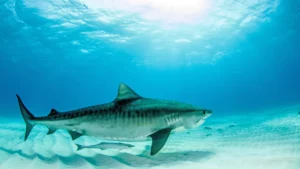 | 3–4.5 m (10–15 ft) | High | Pedro Bank, the south-coast shelf and around the fishing canoesNamed in the 2013, 2022 and 2024 records and the likely species in the other recent spearfishing cases. Follows canoes for discarded catch. |
Bull SharkCarcharhinus leucas | 2.2–3.2 m (7–10.5 ft) | High | Kingston Harbour, Port Royal, the Black River and Portland Bight mangrovesThe harbour shark of the historic record. Enters rivers and turbid bays; never confirmed in a modern beach incident. |
Lemon SharkNegaprion brevirostris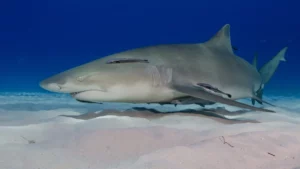 | 2.4–3 m (8–10 ft) | Low | Mangrove and seagrass bays of the south coast: Portland Bight, Black RiverPups grow up in the mangrove creeks. Slow and tolerant of people; no Jamaican incident. |
Blacktip SharkCarcharhinus limbatus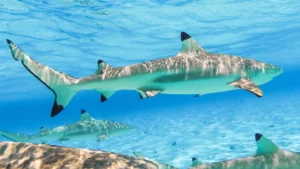 | 1.5–2.2 m (5–7 ft) | Moderate | Sandy bays and reef edges, especially the east end and the banksA fast schooling hunter seen at Alligator Head and over the south-coast shelf. Minor bites elsewhere, none here. |
Blacknose SharkCarcharhinus acronotus | 1–1.3 m (3–4 ft) | Low | Shallow sand and seagrass on the south coastA small requiem shark with a dusky snout tip; common in the trap and net fishery. Harmless. |
| Caribbean Sharpnose SharkRhizoprionodon porosus | 0.8–1.1 m (2.5–3.5 ft) | Low | Inshore shallows and estuaries all round the islandOne of the commonest sharks in Jamaican fish landings. Completely harmless, whatever the old table said. |
Great Hammerhead SharkSphyrna mokarran | 3.5–4.5 m (11–15 ft) | Moderate | Pedro Bank edges and the south-coast shelf; rareA solitary ray-hunter taken occasionally on longlines. Critically endangered; not involved in any Jamaican case. |
Scalloped Hammerhead SharkSphyrna lewini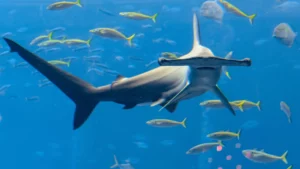 | 2.5–3.5 m (8–12 ft) | Low | Deep bank edges and the Cayman Trench slopeSchools at depth off the banks; young ones use the south-coast shallows. Heavily fished across the Caribbean. |
Silky SharkCarcharhinus falciformis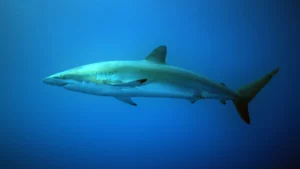 | 2–3 m (7–10 ft) | Moderate | Blue water off both coasts, with tuna and dolphinfishThe pelagic shark most often hooked by sport-fishing charters off Negril and Port Antonio. |
| Oceanic Whitetip SharkCarcharhinus longimanus | 2–3 m (7–10 ft) | High | Deep open water of the Cayman Trench and south of the Pedro BankBold around boats; the shark that mattered in the days of shipwrecks. Now rare and critically endangered. |
Shortfin Mako SharkIsurus oxyrinchus | 2.5–3.5 m (8–11 ft) | Moderate | Offshore, on longlines and sport-fishing gearThe fishermen's 'white shark' on the Pedro Bank. A hazard to anglers landing one, not to swimmers. |
Blue SharkPrionace glauca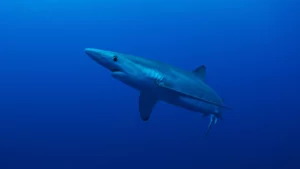 | 2–3 m (7–10 ft) | Low | Deep oceanic water, mostly in winterRecorded by the offshore longline fishery; never inshore. |
Common Thresher SharkAlopias vulpinus | 3–4.5 m (10–15 ft) incl. tail | Low | Offshore deep water on both coastsTaken occasionally on longlines with its bigeye cousin. Stuns fish with its tail; harmless to people. |
Whale SharkRhincodon typus | 6–10 m (20–33 ft) | Low | Passing the west end and the south-coast deep water, mainly March–JuneSeen a few times a year by fishing charters. No predictable aggregation; harmless. |
Basking SharkCetorhinus maximus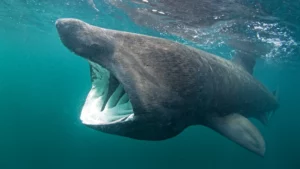 | 6–9 m (20–30 ft) | n/a | Unconfirmed in JamaicaA cold-water plankton feeder listed on the old page. Tagged animals cross the Caribbean at depth in winter, but no Jamaican sighting or capture has been verified. |
Great White SharkCarcharodon carcharias | 4–6 m (13–20 ft) | n/a | Not recorded in JamaicaWinter strays reach the Bahamas and the Gulf of Mexico, but there is no confirmed Jamaican record. |
The old table had the basking shark as a Jamaican species. It is a cold-water plankton feeder of the North Atlantic; satellite tags have shown that some basking sharks cross the Caribbean in winter at depths of several hundred metres, but no Jamaican sighting or capture has ever been verified, so it is listed as unconfirmed. The same goes for the great white shark: white sharks occasionally reach the Bahamas and the northern Gulf of Mexico from the US Atlantic coast in winter, but there is no confirmed Jamaican record, and the large sharks that fishermen call “white sharks” on the Pedro Bank are makos and big tigers. And the Caribbean sharpnose shark, given the rating “highly aggressive”, is a metre-long fish-eater that has never bitten anyone anywhere.
Where to see sharks in Jamaica
Jamaica is not a shark-diving destination and no operator runs dedicated shark dives. What it offers is reliable nurse sharks on the protected reefs, a chance of something bigger on the offshore banks, and a lot of history in Kingston Harbour. These are the places worth knowing about.
- Negril: The Throne Room, The Arches and the West End cliffsJamaica's best-known dive area, inside the Negril Marine Park. Nurse sharks rest in the caves and under the ledges of the wall, and the sanctuary status has brought back enough fish that a passing blacktip or reef shark is no longer a surprise.
- Montego Bay Marine ParkThe country's first marine park, protecting the reefs off Doctor's Cave, Rose Hall and the airport wall. Nurse sharks are regular on the deeper sites; the 2025 Rose Hall incident, a paddler nipped by a metre-long shark, happened on the shallow inshore side.
- Ocho Rios and Runaway BayWall and wreck dives on the mid-north coast with nurse sharks under the ledges. Dolphin Cove at Ocho Rios keeps captive nurse sharks for supervised encounters; it is an aquarium experience, not a wild one, and should be judged as such.
- Port Antonio and Alligator HeadThe quiet east end, where a community fish sanctuary at East Portland has let reef fish and the occasional reef shark return to the walls. Blacktips are seen over the sand at Alligator Head and around Monkey Island.
- Kingston Harbour, Port Royal and Lime CayThe historic heart of the record: bull sharks in the harbour, tiger sharks around the cays. Not a place to swim, but the boat trip to Lime Cay passes water where sharks were once so familiar that a 6 m animal called Old Tom was known by name in 1914.
- Portland Bight and the Black RiverMangroves, seagrass and turbid water on the south coast: nursery habitat for lemon sharks and, in the Black River, bull sharks that push up into the Lower Morass. Seen from a boat, never by swimming.
- Pedro Bank and the Pedro CaysThe offshore plateau where most of Jamaica's sharks live: Caribbean reef sharks, nurse sharks, tiger sharks, silkies and hammerheads around the cays and the bank edge. Reachable only by fishing boat or a serious charter, and the setting of the 2013 knee-bite record.
- The west-end deep water off NegrilSport-fishing charters working the drop-off for marlin and tuna hook silky sharks and makos, and this is where whale sharks are reported most often, usually between March and June.
For a wild encounter with the least effort, dive or snorkel the Negril wall inside the marine park. For a realistic chance of a reef shark or a tiger, you need a boat to the Pedro Bank and a captain who knows it.
Best time of year to see sharks in Jamaica
Jamaican water is warm all year, 26–27 °C from January to March and 28–29 °C from August to October, so the sharks do not migrate away. The calendar is about weather, sea state and a few seasonal visitors.
- December to April: the dry season and the peak of tourism. Calm seas on the north coast, the clearest water on the Negril and Montego Bay walls, and the best months for nurse sharks in the caves. Northerly swells occasionally close the north-coast sites for a day or two.
- March to June: whale sharks are reported off the west end and along the deep water south of Negril in these months, usually by fishing charters. There is no predictable aggregation and no tour, so a sighting is luck.
- May to November: the wet season, with a rainfall peak in May–June and again in October. River plumes cloud the water at the south-coast river mouths, which is exactly when bull sharks are most active there. Hurricane season runs from June to November with the highest risk from August to October.
- Tiger sharks on the Pedro Bank: present all year and most visible around the fishing canoes when catches are being cleaned. The three recent spearfishing deaths in the record fall in March, May and September, which says more about when people fish than about when sharks are around.
Shark attacks in Jamaica: what the record actually shows
Jamaica's record is longer than its reputation suggests, and older. SharkSider keeps every case on the shark attacks in Jamaica page, updated weekly. The database holds 32 records in all, going back to a sailor who fell overboard in Kingston Harbour in 1753; 24 of them are dated 1900 or later, with 10 deaths, and the eight earlier entries, from 1753 to 1898, include four more fatalities, most of them in and around Kingston Harbour and Port Royal. The old version of this page put the figure at “18 or so” and named a 2021 victim as having lost an arm; the database records that Little Bay case as fatal, and three further incidents have been added since. Below are the six latest dated entries; the whole list is on the attacks page:
- 2025 · Rose Hall beach, Montego BayPaddling — Minor injuries to fingers of left handSpecies: Small shark 1m (3ft) long · not fatal
- 2024 · Falmouth, Montego BaySpearfishing — Head right arm and leg severedSpecies: Reportedly Tiger Shark · not fatal
- 2022Fishing — Right arm severedSpecies: Tiger shark, 15' · not fatal
- 2021 · Little Bay, Little London, Westmoreland ParishSpearfishing — FatalSpecies not identified · fatal
- 2018 · James Bond Beach, St. Marys ParishSpearfishing — FatalSpecies not identified · fatal
- 2013 · Port Royal, Kingston Parish — Probable drowning with post-mortem bitesSpecies: Shark involvement prior to death not confirmed · not fatal
Read chronologically, the record splits into two eras. The first is Kingston Harbour. From the 18th century to the 1950s the harbour and Port Royal were full of sharks, drawn by the ships, the slaughterhouse waste and the fish market, and a third of all Jamaican records come from there: sailors who fell or jumped overboard, boys diving from the wharves for coins, fishermen standing in the shallows. The 1914 death was blamed on a 6 m shark the harbour knew as Old Tom; the 1922 killing of a man standing in the water was followed by the capture of a 2.7 m shark by the adventurer Mitchell-Hedges. That era ended as the harbour was industrialised and the shark population fished down, and there has been no harbour fatality since 1931.
The second era is spearfishing. Of the eight cases since 1990, five involve spearfishers or fishermen, and all three deaths do: at Pillikin off St Catherine in March 2013, where a 4.8 m tiger shark was identified; at James Bond Beach in St Mary in September 2018; and at Little Bay in Westmoreland in May 2021. A 15-foot tiger shark took a fisherman's arm in 2022, and the record lists catastrophic injuries to a spearfisher at Falmouth in August 2024, again attributed to a tiger shark. The pattern is consistent: a diver with a bleeding catch, often on the south coast or the banks where tiger sharks follow the canoes, and an animal that is big enough to make a single bite fatal. The 2013 Port Royal entry, a probable drowning with bites inflicted after death, and the 2025 Rose Hall case, a paddler with cut fingers from a metre-long shark, are the only two modern records that do not fit it. Jamaica's safety advice therefore reads differently from most islands: if you spearfish, tow your catch on a float line far behind you, get out as soon as a tiger shark appears, and never clean fish in the water. If you swim at a resort beach, the record contains nothing to worry about.
Is it safe to swim and snorkel in Jamaica?
At the beaches, yes. Seven Mile Beach at Negril, Doctor's Cave in Montego Bay, the Ocho Rios bays, Frenchman's Cove and the south-coast beaches at Treasure Beach have no serious shark incident on record, and the sharks that do live near them, nurse sharks and the small blacknose and sharpnose sharks, have no interest in people. The hazards that actually send tourists to hospital in Jamaica are rip currents on the exposed beaches, sea urchins on the reef flats, and jet-ski collisions. The single beach case in the database, a paddler at Rose Hall in 2025 with minor cuts to the fingers, was almost certainly a small shark reacting to a hand in cloudy water.
Nurse sharks deserve the same rule everywhere: look, do not touch. A snorkeller who grabs a tail or pokes a sleeping shark under a ledge at Negril is asking for a bite that clamps and holds, and that scenario accounts for most nurse shark injuries in the Caribbean. If you meet a Caribbean reef shark or a blacktip on a wall dive, keep close to the reef, stay with your group and let it pass; a shark that circles tighter or arches its back is telling you to leave, so ascend calmly along the wall.
Two places are off the list for swimming altogether. Kingston Harbour and the Port Royal cays have bull and tiger sharks and a long record to prove it, and the south-coast river mouths after heavy rain, the Black River above all, are bull shark water with zero visibility. Locals do not swim there, and visitors should follow their lead. If you spearfish anywhere in Jamaica, treat every tiger shark on the banks as a reason to end the dive.
Shark conservation in Jamaica
Jamaica has no shark-specific legislation and no ban on catching sharks. They are landed, mainly from the Pedro Bank and the south-coast shelf, and sold as “shark” in the fish markets, and there is no size limit or quota. What Jamaica does have is a growing network of protected areas that help sharks indirectly. The Montego Bay Marine Park was declared in 1992 and the Negril Marine Park in 1998; the Portland Bight Protected Area, covering the largest mangrove and seagrass system on the island, followed in 1999; and since 2009 the government has established more than a dozen Special Fishery Conservation Areas, no-take fish sanctuaries run with local fishing co-operatives, including one on the Pedro Bank in 2012. The Fisheries Act of 2018 replaced a 1975 law and gave the authorities stronger enforcement powers.
The results are visible in the sanctuaries, where fish biomass has climbed and the first reef sharks have reappeared on walls that had none for a generation. The pressures remain: Jamaica's reef fishery is still one of the most intensive in the region, tiger sharks and hammerheads are taken on longlines from the Pedro Cays, and the 2024 hurricane season damaged south-coast reefs and fishing communities alike. Internationally, Jamaica is a party to CITES, so the export and import of hammerhead, silky, thresher, mako and whale shark products require permits, and the oceanic whitetip and silky sharks caught in Jamaican waters are among the species the wider Caribbean has lost fastest.
Visitors can help by choosing the marine-park operators at Negril and Montego Bay, by not eating shark from the markets, and by treating captive nurse shark encounters as the aquarium shows they are. Our guide on why sharks are endangered explains why a fishery that removes a few hundred tiger and hammerhead sharks a year can undo decades of recovery.
Sharks in neighbouring waters
Jamaica's sharks are the sharks of the Greater Antilles, and its neighbours show what the same fauna looks like with less fishing. Cuba, 150 km to the north across the Cayman Trench, has the Gardens of the Queen, where Caribbean reef sharks and silkies crowd the reefs Jamaica once had. The Cayman Islands, just to the west, protect every shark by law. To the east, Haiti and the Dominican Republic share Jamaica's mix of heavy fishing and deep offshore water, while Puerto Rico adds the Mona Passage and its tiger sharks. The Bahamas, a day's sail north, is the region's shark sanctuary and the best place to see what the Pedro Bank could become. The sharks around the world page lists every country we have covered.
Frequently asked questions
Are there sharks in Jamaica?
Yes, 16 species with reliable records, but few of them near the beaches. Nurse sharks are the only species snorkellers and divers see regularly at Negril, Montego Bay and Ocho Rios. Caribbean reef sharks, tiger sharks, bull sharks, lemon sharks and hammerheads live on the offshore Pedro Bank, in Kingston Harbour and along the south coast.
Have there been shark attacks in Jamaica?
Yes. The SharkSider database holds 32 records for Jamaica going back to 1753, 24 of them since 1900 with 10 deaths. The older cases are mostly Kingston Harbour; the eight cases since 1990 are almost all spearfishers and fishermen, including three deaths in 2013, 2018 and 2021. The full list is on the shark attacks in Jamaica page.
Is it safe to swim in Jamaica?
Yes, at the beaches. No tourist swimmer has been seriously hurt by a shark in living memory, and the only beach record, at Rose Hall in 2025, was a paddler with cut fingers from a metre-long shark. The risk is concentrated on spearfishers with bleeding catch, and in Kingston Harbour and murky river mouths, which nobody should swim in.
Are there great white sharks in Jamaica?
There is no confirmed Jamaican record. Great whites are cool-water animals that stray into the Bahamas and the Gulf of Mexico from the US Atlantic coast in winter but are not known to reach Jamaica. The large sharks that fishermen on the Pedro Bank call white sharks are shortfin makos and big tiger sharks.
Are there tiger sharks in Jamaica?
Yes, and they are the species behind the modern record. Tiger sharks range across the Pedro Bank and the south-coast shelf and follow fishing canoes for discarded catch; a 4.8 m tiger was identified in the 2013 Pillikin death, a 15-foot tiger took a fisherman's arm in 2022, and a tiger was again reported in the 2024 Falmouth case. They are rarely seen near the north-coast resort beaches.
Can you swim with sharks in Jamaica?
Not on an organised wild shark dive; no Jamaican operator runs one. Nurse sharks are seen on ordinary dives and snorkels at Negril and Montego Bay, and Dolphin Cove at Ocho Rios offers supervised encounters with captive nurse sharks, which is an aquarium experience rather than a wild one.
What is the most common shark in Jamaica?
The nurse shark on the reefs, and the Caribbean sharpnose and blacknose sharks in the fishermen's nets. Decades of intensive fishing removed most reef sharks from the north-coast reefs, so the nurse shark, which lives in holes and is hard to catch, is the one species visitors reliably see.
When is the best time to see sharks in Jamaica?
December to April for calm seas and clear water on the Negril and Montego Bay walls, where nurse sharks are resident all year. Whale sharks are reported off the west end mainly from March to June. Tiger sharks are on the Pedro Bank in every month, but that is fishing water, not diving water.
Is shark fishing legal in Jamaica?
Yes. Jamaica has no shark-specific law, no quota and no size limit, and sharks from the Pedro Bank and south coast are sold in local markets. Protection is indirect, through the Montego Bay and Negril marine parks, the Portland Bight Protected Area, the no-take fish sanctuaries created since 2009, and CITES trade controls.
Are there bull sharks in Kingston Harbour?
Yes, and there always have been. Bull sharks were responsible for most of the historic harbour cases, from the 18th century to the last harbour fatality in 1931, and they still enter Kingston Harbour, the Port Royal cays, the Black River and the mangrove creeks of Portland Bight. None of those places is safe for swimming.
References

A small team focused on researching sharks and making marine biology easy to understand. Every page is reviewed against current species records and the SharkSider attack database, and updated when new incidents or research appear.
Published December 8, 2022 · Last updated September 21, 2026 · Incident data from the SharkSider attack database (24 records for Jamaica, 10 fatal).


